

SUBSCRIBE TO OUR FREE NEWSLETTER
Daily news & progressive opinion—funded by the people, not the corporations—delivered straight to your inbox.
5
#000000
#FFFFFF
To donate by check, phone, or other method, see our More Ways to Give page.
Daily news & progressive opinion—funded by the people, not the corporations—delivered straight to your inbox.
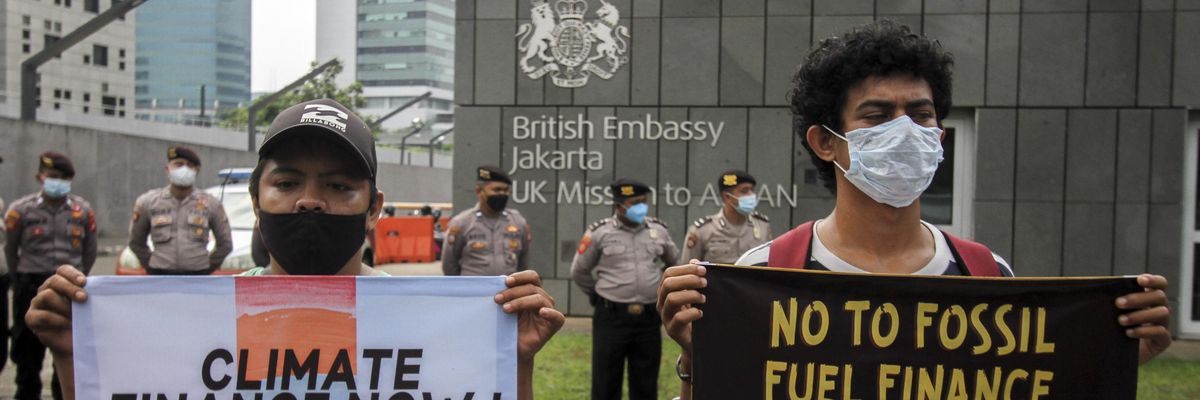
Environment activists hold a demonstration outside the British Embassy in Jakarta, Indonesia on November 3, 2021.
Group of 20 nations and major multilateral development banks spent nearly twice as much financing international fossil fuel projects as they did on clean energy alternatives during a recent two-year period, a report published Tuesday by a pair of green groups revealed.
"Right now, G20 countries and MDBs are overwhelmingly using their international public finance to prop up fossil fuel companies and prolong the fossil fuel era."
Oil Change International and Friends of the Earth U.S., along with dozens of collaborating climate and environmental justice groups, found that from 2019 to 2021, members of the G20 and multilateral development banks (MDBs) including the World Bank and International Monetary Fund (IMF) "provided at least $55 billion per year in international public finance for oil, gas, and coal," an amount "almost two times more than their support for clean energy, which averaged only $29 billion per year."
"This support directly counters G20 countries' commitment to align financial flows to 1.5degC under the Paris agreement, as well as their 2009 commitment to phase out fossil fuel subsidies," the publication continues. "This international public finance has an outsized impact on global energy systems, because it can offer government-backed credit ratings, is often provided at below-market rates, comes with large research and technical capacity, and signals broader government priorities."
"Right now," the report notes, "G20 countries and MDBs are overwhelmingly using their international public finance to prop up fossil fuel companies and prolong the fossil fuel era."
The new report comes just days ahead of the United Nations Climate Change Conference, or COP27, in Sharm El-Sheikh, Egypt. Last year, at COP26 in Glasgow, Scotland, dozens of countries and institutions including the United States pledged to end public financing of fossil fuel projects by 2022 and fully prioritize a shift to clean energy investment.
However, according to the new report, the United States has spent an average of $2.6 billion on fossil fuel investments, compared with just $358 million on renewables, from 2019 to 2021.
"The U.S. is breaking its promise rather than ending this deleterious financing."
"As the world's largest historical contributor to climate change, the United States has a duty to show true leadership by upholding President [Joe] Biden's commitment to shift international public finance away from fossil fuels toward clean energy," Kate DeAngelis, international finance program manager at Friends of the Earth U.S., said in a statement.
"Instead the U.S. Export-Import Bank and U.S. International Development Finance Corporation have bankrolled tens of billions of dollars to overseas fossil fuel projects that harm communities, kill workers and community members, and cause environmental destruction," she added. "Biden's failure to publish a comprehensive policy for international energy finance means the U.S. is breaking its promise rather than ending this deleterious financing."
According to the report, export credit agencies "were the worst public finance actors, providing seven times more support for fossil fuels than clean energy."
On Monday, The Guardian published a report that used Oil Change International's Public Finance for Energy Database to detail how the U.S. government is pouring billions of dollars into fossil fuel projects in Africa while making relatively limited investments in renewable energy.
"International public finance is urgently needed to build a globally just energy transition. But it cannot play this critical role if G20 countries and MDBs continue to funnel $55 billion annually into climate-wrecking fossil fuel projects," Claire O'Manique, one of the new report's lead authors and Oil Change International's public finance analyst, said in a statement.
"The climate movement will continue to hold wealthy countries accountable for their role in funding the climate crisis, and demand they move first and fastest to phase out their fossil fuel production, stop funding fossils, and pay their fair share of a globally just energy transition," she added. "It is well past time that public finance dollars are spent to remedy fossil fuel colonialism by funding real solutions."
Dear Common Dreams reader, It’s been nearly 30 years since I co-founded Common Dreams with my late wife, Lina Newhouser. We had the radical notion that journalism should serve the public good, not corporate profits. It was clear to us from the outset what it would take to build such a project. No paid advertisements. No corporate sponsors. No millionaire publisher telling us what to think or do. Many people said we wouldn't last a year, but we proved those doubters wrong. Together with a tremendous team of journalists and dedicated staff, we built an independent media outlet free from the constraints of profits and corporate control. Our mission has always been simple: To inform. To inspire. To ignite change for the common good. Building Common Dreams was not easy. Our survival was never guaranteed. When you take on the most powerful forces—Wall Street greed, fossil fuel industry destruction, Big Tech lobbyists, and uber-rich oligarchs who have spent billions upon billions rigging the economy and democracy in their favor—the only bulwark you have is supporters who believe in your work. But here’s the urgent message from me today. It's never been this bad out there. And it's never been this hard to keep us going. At the very moment Common Dreams is most needed, the threats we face are intensifying. We need your support now more than ever. We don't accept corporate advertising and never will. We don't have a paywall because we don't think people should be blocked from critical news based on their ability to pay. Everything we do is funded by the donations of readers like you. When everyone does the little they can afford, we are strong. But if that support retreats or dries up, so do we. Will you donate now to make sure Common Dreams not only survives but thrives? —Craig Brown, Co-founder |
Group of 20 nations and major multilateral development banks spent nearly twice as much financing international fossil fuel projects as they did on clean energy alternatives during a recent two-year period, a report published Tuesday by a pair of green groups revealed.
"Right now, G20 countries and MDBs are overwhelmingly using their international public finance to prop up fossil fuel companies and prolong the fossil fuel era."
Oil Change International and Friends of the Earth U.S., along with dozens of collaborating climate and environmental justice groups, found that from 2019 to 2021, members of the G20 and multilateral development banks (MDBs) including the World Bank and International Monetary Fund (IMF) "provided at least $55 billion per year in international public finance for oil, gas, and coal," an amount "almost two times more than their support for clean energy, which averaged only $29 billion per year."
"This support directly counters G20 countries' commitment to align financial flows to 1.5degC under the Paris agreement, as well as their 2009 commitment to phase out fossil fuel subsidies," the publication continues. "This international public finance has an outsized impact on global energy systems, because it can offer government-backed credit ratings, is often provided at below-market rates, comes with large research and technical capacity, and signals broader government priorities."
"Right now," the report notes, "G20 countries and MDBs are overwhelmingly using their international public finance to prop up fossil fuel companies and prolong the fossil fuel era."
The new report comes just days ahead of the United Nations Climate Change Conference, or COP27, in Sharm El-Sheikh, Egypt. Last year, at COP26 in Glasgow, Scotland, dozens of countries and institutions including the United States pledged to end public financing of fossil fuel projects by 2022 and fully prioritize a shift to clean energy investment.
However, according to the new report, the United States has spent an average of $2.6 billion on fossil fuel investments, compared with just $358 million on renewables, from 2019 to 2021.
"The U.S. is breaking its promise rather than ending this deleterious financing."
"As the world's largest historical contributor to climate change, the United States has a duty to show true leadership by upholding President [Joe] Biden's commitment to shift international public finance away from fossil fuels toward clean energy," Kate DeAngelis, international finance program manager at Friends of the Earth U.S., said in a statement.
"Instead the U.S. Export-Import Bank and U.S. International Development Finance Corporation have bankrolled tens of billions of dollars to overseas fossil fuel projects that harm communities, kill workers and community members, and cause environmental destruction," she added. "Biden's failure to publish a comprehensive policy for international energy finance means the U.S. is breaking its promise rather than ending this deleterious financing."
According to the report, export credit agencies "were the worst public finance actors, providing seven times more support for fossil fuels than clean energy."
On Monday, The Guardian published a report that used Oil Change International's Public Finance for Energy Database to detail how the U.S. government is pouring billions of dollars into fossil fuel projects in Africa while making relatively limited investments in renewable energy.
"International public finance is urgently needed to build a globally just energy transition. But it cannot play this critical role if G20 countries and MDBs continue to funnel $55 billion annually into climate-wrecking fossil fuel projects," Claire O'Manique, one of the new report's lead authors and Oil Change International's public finance analyst, said in a statement.
"The climate movement will continue to hold wealthy countries accountable for their role in funding the climate crisis, and demand they move first and fastest to phase out their fossil fuel production, stop funding fossils, and pay their fair share of a globally just energy transition," she added. "It is well past time that public finance dollars are spent to remedy fossil fuel colonialism by funding real solutions."
Group of 20 nations and major multilateral development banks spent nearly twice as much financing international fossil fuel projects as they did on clean energy alternatives during a recent two-year period, a report published Tuesday by a pair of green groups revealed.
"Right now, G20 countries and MDBs are overwhelmingly using their international public finance to prop up fossil fuel companies and prolong the fossil fuel era."
Oil Change International and Friends of the Earth U.S., along with dozens of collaborating climate and environmental justice groups, found that from 2019 to 2021, members of the G20 and multilateral development banks (MDBs) including the World Bank and International Monetary Fund (IMF) "provided at least $55 billion per year in international public finance for oil, gas, and coal," an amount "almost two times more than their support for clean energy, which averaged only $29 billion per year."
"This support directly counters G20 countries' commitment to align financial flows to 1.5degC under the Paris agreement, as well as their 2009 commitment to phase out fossil fuel subsidies," the publication continues. "This international public finance has an outsized impact on global energy systems, because it can offer government-backed credit ratings, is often provided at below-market rates, comes with large research and technical capacity, and signals broader government priorities."
"Right now," the report notes, "G20 countries and MDBs are overwhelmingly using their international public finance to prop up fossil fuel companies and prolong the fossil fuel era."
The new report comes just days ahead of the United Nations Climate Change Conference, or COP27, in Sharm El-Sheikh, Egypt. Last year, at COP26 in Glasgow, Scotland, dozens of countries and institutions including the United States pledged to end public financing of fossil fuel projects by 2022 and fully prioritize a shift to clean energy investment.
However, according to the new report, the United States has spent an average of $2.6 billion on fossil fuel investments, compared with just $358 million on renewables, from 2019 to 2021.
"The U.S. is breaking its promise rather than ending this deleterious financing."
"As the world's largest historical contributor to climate change, the United States has a duty to show true leadership by upholding President [Joe] Biden's commitment to shift international public finance away from fossil fuels toward clean energy," Kate DeAngelis, international finance program manager at Friends of the Earth U.S., said in a statement.
"Instead the U.S. Export-Import Bank and U.S. International Development Finance Corporation have bankrolled tens of billions of dollars to overseas fossil fuel projects that harm communities, kill workers and community members, and cause environmental destruction," she added. "Biden's failure to publish a comprehensive policy for international energy finance means the U.S. is breaking its promise rather than ending this deleterious financing."
According to the report, export credit agencies "were the worst public finance actors, providing seven times more support for fossil fuels than clean energy."
On Monday, The Guardian published a report that used Oil Change International's Public Finance for Energy Database to detail how the U.S. government is pouring billions of dollars into fossil fuel projects in Africa while making relatively limited investments in renewable energy.
"International public finance is urgently needed to build a globally just energy transition. But it cannot play this critical role if G20 countries and MDBs continue to funnel $55 billion annually into climate-wrecking fossil fuel projects," Claire O'Manique, one of the new report's lead authors and Oil Change International's public finance analyst, said in a statement.
"The climate movement will continue to hold wealthy countries accountable for their role in funding the climate crisis, and demand they move first and fastest to phase out their fossil fuel production, stop funding fossils, and pay their fair share of a globally just energy transition," she added. "It is well past time that public finance dollars are spent to remedy fossil fuel colonialism by funding real solutions."

