

SUBSCRIBE TO OUR FREE NEWSLETTER
Daily news & progressive opinion—funded by the people, not the corporations—delivered straight to your inbox.
5
#000000
#FFFFFF
To donate by check, phone, or other method, see our More Ways to Give page.
Daily news & progressive opinion—funded by the people, not the corporations—delivered straight to your inbox.
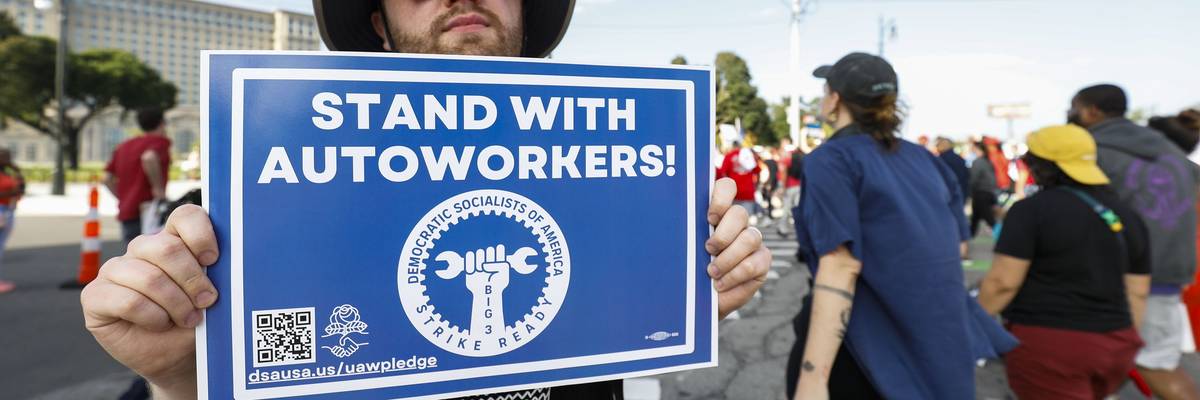
United Auto Workers members and others gather for a rally after marching in the Detroit Labor Day Parade on September 4, 2023 in Detroit, Michigan.
"This transition must center workers and communities," said advocates, "especially those who have powered our economy through the fossil fuel era, and be a vehicle for economic and racial justice."
On the eve of the expiration of the United Auto Workers union's contract and a potential strike Wednesday, climate action groups were among more than 100 civil society organizations on Wednesday calling on the "Big Three" automakers to ensure that a new contract protects workers as the U.S. transitions toward making electric vehicles.
Groups including the Center for Biological Diversity, Public Citizen, Sierra Club, and Earthjustice were among those expressing solidarity with nearly 150,000 union autoworkers who are demanding that employees of electric vehicle battery plants being developed by Stellantis, Ford, and General Motors are paid fairly—reflecting the record profits the automakers have reported in recent years.
"Within the next few years—the span of this next contract—lies humanity's last chance to navigate a transition away from fossil fuels, including away from combustion engines," wrote the groups in an open letter. "With that shift comes an opportunity for workers in the United States to benefit from a revival of new manufacturing, including electric vehicles (EVs) and collective transportation like buses and trains, as a part of the renewable energy revolution."
"This transition must center workers and communities, especially those who have powered our economy through the fossil fuel era, and be a vehicle for economic and racial justice," they added. "We are putting you on notice: Corporate greed and shareholder profits must never again be put before safe, good-paying union jobs, clean air and water, and a livable future."
"Corporate titans will try to split our movement by presenting us with a false choice. They'll try to argue that building more clean cars is more important than supporting workers. But we know better."
With the Biden administration—under the Inflation Reduction Act—poised to invest billions of taxpayer dollars "to boost your companies' transition to electric vehicle manufacturing and component production," the letter reads, the companies must "do right by the workers who have sacrificed to keep your companies profitable."
Without meeting the demands of the UAW, the organizations said, the Big Three will be embarking on a "race to the bottom" that continues to exploit workers.
"We do not have to choose between good jobs and green jobs," Trevor Dolan, industry and workforce policy lead at Evergreen Action, said Wednesday. "Corporate titans will try to split our movement by presenting us with a false choice. They'll try to argue that building more clean cars is more important than supporting workers. But we know better. Our collective movement can only succeed if workers directly benefit from climate action."
The groups highlighted the demands of the union, including:
Fain has led the union in demanding a 40% wage increase over four years—noting that compensation for General Motors CEO Mary Barra grew by more than 32% from 2018-22 while the median worker got only a 2.8% raise—cost-of-living increases, and a workweek shortened to 32 hours.
"The revival of domestic manufacturing of electric vehicles must also deliver on the promise of safe, dependable, good-paying UNION jobs across the entire supply chain," said Ben Smith, senior campaigner with Greenpeace USA. "In addition, we call on the Biden administration and all those in government at the federal, state, and local level to use every tool at their disposal to ensure strong labor standards are deployed alongside any support that taxpayers provide for EV automakers."
"It's time for the Big Three CEOs to deliver what these workers have demanded," Smith added, "a fair contract and a just transition now!"
Dear Common Dreams reader, It’s been nearly 30 years since I co-founded Common Dreams with my late wife, Lina Newhouser. We had the radical notion that journalism should serve the public good, not corporate profits. It was clear to us from the outset what it would take to build such a project. No paid advertisements. No corporate sponsors. No millionaire publisher telling us what to think or do. Many people said we wouldn't last a year, but we proved those doubters wrong. Together with a tremendous team of journalists and dedicated staff, we built an independent media outlet free from the constraints of profits and corporate control. Our mission has always been simple: To inform. To inspire. To ignite change for the common good. Building Common Dreams was not easy. Our survival was never guaranteed. When you take on the most powerful forces—Wall Street greed, fossil fuel industry destruction, Big Tech lobbyists, and uber-rich oligarchs who have spent billions upon billions rigging the economy and democracy in their favor—the only bulwark you have is supporters who believe in your work. But here’s the urgent message from me today. It's never been this bad out there. And it's never been this hard to keep us going. At the very moment Common Dreams is most needed, the threats we face are intensifying. We need your support now more than ever. We don't accept corporate advertising and never will. We don't have a paywall because we don't think people should be blocked from critical news based on their ability to pay. Everything we do is funded by the donations of readers like you. When everyone does the little they can afford, we are strong. But if that support retreats or dries up, so do we. Will you donate now to make sure Common Dreams not only survives but thrives? —Craig Brown, Co-founder |
On the eve of the expiration of the United Auto Workers union's contract and a potential strike Wednesday, climate action groups were among more than 100 civil society organizations on Wednesday calling on the "Big Three" automakers to ensure that a new contract protects workers as the U.S. transitions toward making electric vehicles.
Groups including the Center for Biological Diversity, Public Citizen, Sierra Club, and Earthjustice were among those expressing solidarity with nearly 150,000 union autoworkers who are demanding that employees of electric vehicle battery plants being developed by Stellantis, Ford, and General Motors are paid fairly—reflecting the record profits the automakers have reported in recent years.
"Within the next few years—the span of this next contract—lies humanity's last chance to navigate a transition away from fossil fuels, including away from combustion engines," wrote the groups in an open letter. "With that shift comes an opportunity for workers in the United States to benefit from a revival of new manufacturing, including electric vehicles (EVs) and collective transportation like buses and trains, as a part of the renewable energy revolution."
"This transition must center workers and communities, especially those who have powered our economy through the fossil fuel era, and be a vehicle for economic and racial justice," they added. "We are putting you on notice: Corporate greed and shareholder profits must never again be put before safe, good-paying union jobs, clean air and water, and a livable future."
"Corporate titans will try to split our movement by presenting us with a false choice. They'll try to argue that building more clean cars is more important than supporting workers. But we know better."
With the Biden administration—under the Inflation Reduction Act—poised to invest billions of taxpayer dollars "to boost your companies' transition to electric vehicle manufacturing and component production," the letter reads, the companies must "do right by the workers who have sacrificed to keep your companies profitable."
Without meeting the demands of the UAW, the organizations said, the Big Three will be embarking on a "race to the bottom" that continues to exploit workers.
"We do not have to choose between good jobs and green jobs," Trevor Dolan, industry and workforce policy lead at Evergreen Action, said Wednesday. "Corporate titans will try to split our movement by presenting us with a false choice. They'll try to argue that building more clean cars is more important than supporting workers. But we know better. Our collective movement can only succeed if workers directly benefit from climate action."
The groups highlighted the demands of the union, including:
Fain has led the union in demanding a 40% wage increase over four years—noting that compensation for General Motors CEO Mary Barra grew by more than 32% from 2018-22 while the median worker got only a 2.8% raise—cost-of-living increases, and a workweek shortened to 32 hours.
"The revival of domestic manufacturing of electric vehicles must also deliver on the promise of safe, dependable, good-paying UNION jobs across the entire supply chain," said Ben Smith, senior campaigner with Greenpeace USA. "In addition, we call on the Biden administration and all those in government at the federal, state, and local level to use every tool at their disposal to ensure strong labor standards are deployed alongside any support that taxpayers provide for EV automakers."
"It's time for the Big Three CEOs to deliver what these workers have demanded," Smith added, "a fair contract and a just transition now!"
On the eve of the expiration of the United Auto Workers union's contract and a potential strike Wednesday, climate action groups were among more than 100 civil society organizations on Wednesday calling on the "Big Three" automakers to ensure that a new contract protects workers as the U.S. transitions toward making electric vehicles.
Groups including the Center for Biological Diversity, Public Citizen, Sierra Club, and Earthjustice were among those expressing solidarity with nearly 150,000 union autoworkers who are demanding that employees of electric vehicle battery plants being developed by Stellantis, Ford, and General Motors are paid fairly—reflecting the record profits the automakers have reported in recent years.
"Within the next few years—the span of this next contract—lies humanity's last chance to navigate a transition away from fossil fuels, including away from combustion engines," wrote the groups in an open letter. "With that shift comes an opportunity for workers in the United States to benefit from a revival of new manufacturing, including electric vehicles (EVs) and collective transportation like buses and trains, as a part of the renewable energy revolution."
"This transition must center workers and communities, especially those who have powered our economy through the fossil fuel era, and be a vehicle for economic and racial justice," they added. "We are putting you on notice: Corporate greed and shareholder profits must never again be put before safe, good-paying union jobs, clean air and water, and a livable future."
"Corporate titans will try to split our movement by presenting us with a false choice. They'll try to argue that building more clean cars is more important than supporting workers. But we know better."
With the Biden administration—under the Inflation Reduction Act—poised to invest billions of taxpayer dollars "to boost your companies' transition to electric vehicle manufacturing and component production," the letter reads, the companies must "do right by the workers who have sacrificed to keep your companies profitable."
Without meeting the demands of the UAW, the organizations said, the Big Three will be embarking on a "race to the bottom" that continues to exploit workers.
"We do not have to choose between good jobs and green jobs," Trevor Dolan, industry and workforce policy lead at Evergreen Action, said Wednesday. "Corporate titans will try to split our movement by presenting us with a false choice. They'll try to argue that building more clean cars is more important than supporting workers. But we know better. Our collective movement can only succeed if workers directly benefit from climate action."
The groups highlighted the demands of the union, including:
Fain has led the union in demanding a 40% wage increase over four years—noting that compensation for General Motors CEO Mary Barra grew by more than 32% from 2018-22 while the median worker got only a 2.8% raise—cost-of-living increases, and a workweek shortened to 32 hours.
"The revival of domestic manufacturing of electric vehicles must also deliver on the promise of safe, dependable, good-paying UNION jobs across the entire supply chain," said Ben Smith, senior campaigner with Greenpeace USA. "In addition, we call on the Biden administration and all those in government at the federal, state, and local level to use every tool at their disposal to ensure strong labor standards are deployed alongside any support that taxpayers provide for EV automakers."
"It's time for the Big Three CEOs to deliver what these workers have demanded," Smith added, "a fair contract and a just transition now!"

