SUBSCRIBE TO OUR FREE NEWSLETTER
Daily news & progressive opinion—funded by the people, not the corporations—delivered straight to your inbox.
5
#000000
#FFFFFF
To donate by check, phone, or other method, see our More Ways to Give page.
Daily news & progressive opinion—funded by the people, not the corporations—delivered straight to your inbox.
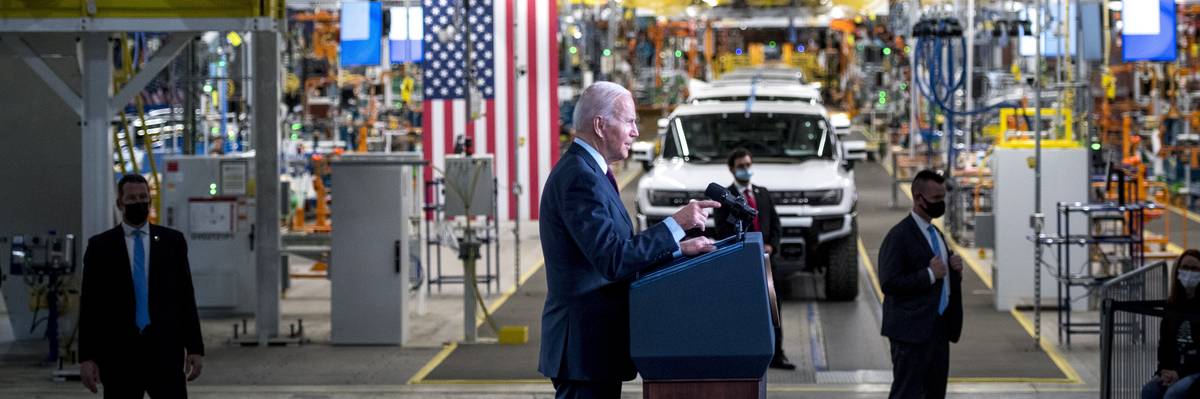
President Joe Biden speaks at the General Motors Factory ZERO electric vehicle assembly plant in Detroit on November 17, 2021.
"House GOP leaders should be ashamed for trying to thwart the EPA, and its authority under the Clean Air Act, to limit dangerous and deadly pollution," said one campaigner.
Climate and environmental campaigners on Wednesday bristled as the Republican-controlled U.S. House of Representatives voted to block a proposed Biden administration rule meant to accelerate the transition from gasoline-powered to electric automobiles.
House lawmakers voted 221-197, almost entirely along party lines, in favor of H.R. 4468, the so-called Choice in Automobile Retail Sales Act of 2023. The office of House Energy and Commerce Committee Chair Cathy McMorris Rodgers (R-Wash.) claimed the bill "stops President [Joe] Biden's agenda to force Americans to drive electric vehicles, which will cede our auto future to China."
However, Democratic Congressman Paul Tonko of New York condemned the measure during a House floor speech Wednesday, asserting that "we should be putting our clean energy standards in overdrive to protect consumers and our planet, not reversing course on vital electric vehicle policies."
"We should be putting our clean energy standards in overdrive to protect consumers and our planet, not reversing course on vital electric vehicle policies."
When the Biden administration unveiled its proposed clean transportation standard in April, progressive critics argued that it did not go far enough. The Environmental Protection Agency (EPA) projects that under the most robust version of its
proposal—which, if implemented, would take effect in 2027—electric vehicles could account for two-thirds of all new U.S. light-duty automobile sales by the 2032 model year. Last year, just 6% of new vehicles sold in the U.S. were electric.
A coalition of green groups slammed H.R. 4468 this week, writing to congressional leaders that "rather than recognize the twin crises of unmitigated climate change and public health impacts from transportation pollution and the transition to zero-emission vehicles underway, this bill aims to stem the tide of progress towards clean air and a healthy future."
"We need to move forward," the groups added, "not backward."
Margie Alt, director of the Washington, D.C.-based Climate Action Campaign, said in a statement that "today's vote on H.R. 4468 is a cynical and tremendously harmful attempt by some in Congress to placate their deep-pocketed fossil fuel executive and lobbyist allies."
"House GOP leaders should be ashamed for trying to thwart the EPA, and its authority under the Clean Air Act, to limit dangerous and deadly pollution from light duty and medium duty vehicles and trucks," she continued. "Cleaner cars standards protect all Americans from the significant respiratory and other health impacts of tailpipe pollution, not to mention limit the impacts of the climate crisis from a key source of climate pollution."
"Vehicle pollution endangers millions of Americans," Alt added, "particularly vulnerable Americans living near highways and high-traffic corridors."
H.R. 4468 has little chance of passing the Senate and even if it did, the White House has signaled that Biden will veto the measure. The White House Office of Management and Budgetsaid Monday that the GOP proposal "would catastrophically impair EPA's ability to issue automotive regulations that protect public health, save consumers money, strengthen American energy security, and protect American investments in the vehicle technologies of the future."
Republican lawmakers on Wednesday also advanced a raft of what GOP leaders called "American energy solutions" that critics slammed as damaging to the climate, environment, Indigenous rights, and frontline communities. These bills include H.R. 6009, a measure introduced by Rep. Lauren Boebert (R-Colo.) that would force taxpayers to foot the bill for cleaning up oil and gas wells on federal lands.
Dear Common Dreams reader, It’s been nearly 30 years since I co-founded Common Dreams with my late wife, Lina Newhouser. We had the radical notion that journalism should serve the public good, not corporate profits. It was clear to us from the outset what it would take to build such a project. No paid advertisements. No corporate sponsors. No millionaire publisher telling us what to think or do. Many people said we wouldn't last a year, but we proved those doubters wrong. Together with a tremendous team of journalists and dedicated staff, we built an independent media outlet free from the constraints of profits and corporate control. Our mission has always been simple: To inform. To inspire. To ignite change for the common good. Building Common Dreams was not easy. Our survival was never guaranteed. When you take on the most powerful forces—Wall Street greed, fossil fuel industry destruction, Big Tech lobbyists, and uber-rich oligarchs who have spent billions upon billions rigging the economy and democracy in their favor—the only bulwark you have is supporters who believe in your work. But here’s the urgent message from me today. It's never been this bad out there. And it's never been this hard to keep us going. At the very moment Common Dreams is most needed, the threats we face are intensifying. We need your support now more than ever. We don't accept corporate advertising and never will. We don't have a paywall because we don't think people should be blocked from critical news based on their ability to pay. Everything we do is funded by the donations of readers like you. When everyone does the little they can afford, we are strong. But if that support retreats or dries up, so do we. Will you donate now to make sure Common Dreams not only survives but thrives? —Craig Brown, Co-founder |
Climate and environmental campaigners on Wednesday bristled as the Republican-controlled U.S. House of Representatives voted to block a proposed Biden administration rule meant to accelerate the transition from gasoline-powered to electric automobiles.
House lawmakers voted 221-197, almost entirely along party lines, in favor of H.R. 4468, the so-called Choice in Automobile Retail Sales Act of 2023. The office of House Energy and Commerce Committee Chair Cathy McMorris Rodgers (R-Wash.) claimed the bill "stops President [Joe] Biden's agenda to force Americans to drive electric vehicles, which will cede our auto future to China."
However, Democratic Congressman Paul Tonko of New York condemned the measure during a House floor speech Wednesday, asserting that "we should be putting our clean energy standards in overdrive to protect consumers and our planet, not reversing course on vital electric vehicle policies."
"We should be putting our clean energy standards in overdrive to protect consumers and our planet, not reversing course on vital electric vehicle policies."
When the Biden administration unveiled its proposed clean transportation standard in April, progressive critics argued that it did not go far enough. The Environmental Protection Agency (EPA) projects that under the most robust version of its
proposal—which, if implemented, would take effect in 2027—electric vehicles could account for two-thirds of all new U.S. light-duty automobile sales by the 2032 model year. Last year, just 6% of new vehicles sold in the U.S. were electric.
A coalition of green groups slammed H.R. 4468 this week, writing to congressional leaders that "rather than recognize the twin crises of unmitigated climate change and public health impacts from transportation pollution and the transition to zero-emission vehicles underway, this bill aims to stem the tide of progress towards clean air and a healthy future."
"We need to move forward," the groups added, "not backward."
Margie Alt, director of the Washington, D.C.-based Climate Action Campaign, said in a statement that "today's vote on H.R. 4468 is a cynical and tremendously harmful attempt by some in Congress to placate their deep-pocketed fossil fuel executive and lobbyist allies."
"House GOP leaders should be ashamed for trying to thwart the EPA, and its authority under the Clean Air Act, to limit dangerous and deadly pollution from light duty and medium duty vehicles and trucks," she continued. "Cleaner cars standards protect all Americans from the significant respiratory and other health impacts of tailpipe pollution, not to mention limit the impacts of the climate crisis from a key source of climate pollution."
"Vehicle pollution endangers millions of Americans," Alt added, "particularly vulnerable Americans living near highways and high-traffic corridors."
H.R. 4468 has little chance of passing the Senate and even if it did, the White House has signaled that Biden will veto the measure. The White House Office of Management and Budgetsaid Monday that the GOP proposal "would catastrophically impair EPA's ability to issue automotive regulations that protect public health, save consumers money, strengthen American energy security, and protect American investments in the vehicle technologies of the future."
Republican lawmakers on Wednesday also advanced a raft of what GOP leaders called "American energy solutions" that critics slammed as damaging to the climate, environment, Indigenous rights, and frontline communities. These bills include H.R. 6009, a measure introduced by Rep. Lauren Boebert (R-Colo.) that would force taxpayers to foot the bill for cleaning up oil and gas wells on federal lands.
Climate and environmental campaigners on Wednesday bristled as the Republican-controlled U.S. House of Representatives voted to block a proposed Biden administration rule meant to accelerate the transition from gasoline-powered to electric automobiles.
House lawmakers voted 221-197, almost entirely along party lines, in favor of H.R. 4468, the so-called Choice in Automobile Retail Sales Act of 2023. The office of House Energy and Commerce Committee Chair Cathy McMorris Rodgers (R-Wash.) claimed the bill "stops President [Joe] Biden's agenda to force Americans to drive electric vehicles, which will cede our auto future to China."
However, Democratic Congressman Paul Tonko of New York condemned the measure during a House floor speech Wednesday, asserting that "we should be putting our clean energy standards in overdrive to protect consumers and our planet, not reversing course on vital electric vehicle policies."
"We should be putting our clean energy standards in overdrive to protect consumers and our planet, not reversing course on vital electric vehicle policies."
When the Biden administration unveiled its proposed clean transportation standard in April, progressive critics argued that it did not go far enough. The Environmental Protection Agency (EPA) projects that under the most robust version of its
proposal—which, if implemented, would take effect in 2027—electric vehicles could account for two-thirds of all new U.S. light-duty automobile sales by the 2032 model year. Last year, just 6% of new vehicles sold in the U.S. were electric.
A coalition of green groups slammed H.R. 4468 this week, writing to congressional leaders that "rather than recognize the twin crises of unmitigated climate change and public health impacts from transportation pollution and the transition to zero-emission vehicles underway, this bill aims to stem the tide of progress towards clean air and a healthy future."
"We need to move forward," the groups added, "not backward."
Margie Alt, director of the Washington, D.C.-based Climate Action Campaign, said in a statement that "today's vote on H.R. 4468 is a cynical and tremendously harmful attempt by some in Congress to placate their deep-pocketed fossil fuel executive and lobbyist allies."
"House GOP leaders should be ashamed for trying to thwart the EPA, and its authority under the Clean Air Act, to limit dangerous and deadly pollution from light duty and medium duty vehicles and trucks," she continued. "Cleaner cars standards protect all Americans from the significant respiratory and other health impacts of tailpipe pollution, not to mention limit the impacts of the climate crisis from a key source of climate pollution."
"Vehicle pollution endangers millions of Americans," Alt added, "particularly vulnerable Americans living near highways and high-traffic corridors."
H.R. 4468 has little chance of passing the Senate and even if it did, the White House has signaled that Biden will veto the measure. The White House Office of Management and Budgetsaid Monday that the GOP proposal "would catastrophically impair EPA's ability to issue automotive regulations that protect public health, save consumers money, strengthen American energy security, and protect American investments in the vehicle technologies of the future."
Republican lawmakers on Wednesday also advanced a raft of what GOP leaders called "American energy solutions" that critics slammed as damaging to the climate, environment, Indigenous rights, and frontline communities. These bills include H.R. 6009, a measure introduced by Rep. Lauren Boebert (R-Colo.) that would force taxpayers to foot the bill for cleaning up oil and gas wells on federal lands.