SUBSCRIBE TO OUR FREE NEWSLETTER
Daily news & progressive opinion—funded by the people, not the corporations—delivered straight to your inbox.
5
#000000
#FFFFFF
To donate by check, phone, or other method, see our More Ways to Give page.
Daily news & progressive opinion—funded by the people, not the corporations—delivered straight to your inbox.
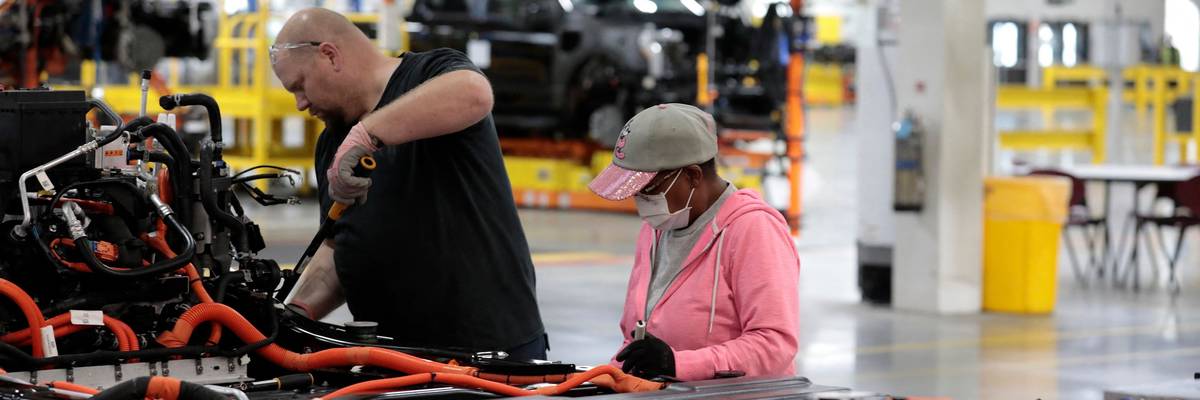
Ford workers build an electric F-150 Lightning at a factory in Dearborn, Michigan on September 8, 2022.
"We need to get our members organized behind a pro-worker, pro-climate, and pro-democracy political program that can deliver for the working class," says a memo from the union's new president.
The United Auto Workers is withholding its endorsement of U.S. President Joe Biden in the early stages of the 2024 race in an attempt to extract concessions that would ensure the nascent transition to all-electric vehicles benefits labor as well as the environment.
"We need to get our members organized behind a pro-worker, pro-climate, and pro-democracy political program that can deliver for the working class," says a memo written by UAW president Shawn Fain and shared internally on Tuesday.
Fain, an electrician from Indiana, won a March runoff election to lead the Detroit-based union, defeating incumbent Ray Curry of the powerful Administration Caucus in a major upset. Fain's victory, one of several in which challengers from the insurgent Members United slate prevailed, gave reformers control of UAW's direction. The new president quickly promised a more confrontational approach, decrying "give-back unionism" and vowing to "put the members back in the driver's seat, regain the trust of the rank and file, and put the companies on notice."
A reinvigorated UAW is also putting Biden on notice by holding onto its coveted endorsement. With 400,000 active members and a heavy presence in the battleground state of Michigan, the union remains a significant political force. Its goal is to pressure Biden into improving federal policies related to electric vehicle (EV) manufacturing.
"The federal government is pouring billions into the electric vehicle transition, with no strings attached and no commitment to workers," Fain wrote in his new memo. "The EV transition is at serious risk of becoming a race to the bottom. We want to see national leadership have our back on this before we make any commitments."
As The New York Times reported Wednesday:
In April, the Biden administration proposed the nation's most ambitious climate regulations yet, which would ensure that two-thirds of new passenger cars are all-electric by 2032—up from just 5.8% today. The rules, if enacted, could sharply lower planet-warming pollution from vehicle tailpipes, the nation's largest source of greenhouse emissions. But they come with costs for autoworkers, because it takes fewer than half the laborers to assemble an all-electric vehicle as it does to build a gasoline-powered car.
But it's not just potential job losses that are of concern to UAW leaders. They also want to see higher wages and better benefits for workers at EV facilities.
A 2021 report from the Economic Policy Institute made clear that the consequences of the EV transition for U.S. workers depend on how policymakers manage the shift. With "smart policy," lawmakers can turn the coming auto industry "upheaval" into an opportunity to create up to 150,000 "good jobs" by 2030, the analysis found. But if the move to EVs is not accompanied by policies to onshore manufacturing and improve job quality, then more than 75,000 jobs could be lost, it warned.
UAW made a similar point in a 2021 update to its EV white paper:
The growth of EVs must be an opportunity to re-invest in American manufacturing, with union workers making the vehicles of the future. But, to make sure this disruption does not leave American autoworkers behind, government subsidies and tax breaks for the transition to new technology must be paired with a commitment to locate these jobs in the United States at comparable wages and benefits to the jobs they replace. And we must ensure our laws level the playing field and give workers a voice on the job, which is why we are calling on Congress [to] strengthen our labor laws and pass the PRO Act. Protecting jobs and wages during this transition will only happen if workers have a seat at the table.
The Inflation Reduction Act passed by congressional Democrats and signed into law by Biden last August contains North American EV manufacturing incentives. Such provisions have been met with threats of trade challenges from Europe, however, leading progressive advocacy groups to urge governments on both sides of the Atlantic to start prioritizing decarbonization over corporate-friendly trade rules.
As CNBC reported Wednesday, Fain's memo lamented "the pay rate at a recently opened Ultium Cells LLC battery plant near Lordstown, Ohio—a joint venture between General Motors and LG Energy Solution—compared with that of traditional automotive assembly plants."
According to the outlet:
Ultium has said hourly workers currently make between $16 and $22 an hour with full benefits, incentives, and tuition assistance. That compares to traditional hourly UAW members that can make upward of $32 an hour at GM plants.
Joint venture battery facilities are viewed as crucial for the UAW to grow and add members, as automakers such as GM transition to EVs.
"The situation at Lordstown, and the current state of the EV transition, is unacceptable," Fain wrote. "We expect action from the people in power to make it right."
Fain and other UAW leaders met with White House officials last week to lay out the union's case for a just EV transition that simultaneously slashes life-threatening carbon dioxide pollution and enhances the well-being of workers involved in the process.
"We were very adamant that if the government is going to funnel billions in taxpayer money to these companies, the workers must be compensated with top wages and benefits," wrote Fain. "A 'just transition' has to include standards for our members and future workers."
UAW endorsed Biden in the 2020 race, citing his support for labor. But the union is in no rush to renew its blessing before it wins concessions for the workers behind the shift to EVs.
Noting that 150,000 autoworkers are organizing for a new contract with the "Big Three"—Ford, GM, and Stellantis (formerly Chrysler)—in September, Fain wrote that "we'll stand with whoever stands with our members in that fight."
"Right now, we're focused on making sure the EV transition does right by our members, our families, and our communities," Fain continued. "We'll be ready to talk politics once we secure a future for this industry and the workers who make it run."
Nevertheless, the union has no intention of backing former President Donald Trump—the leading candidate to win the Republican Party's 2024 nomination—given the GOP's long track record of greater hostility to organized labor.
A second Trump term "would be a disaster," Fain added. "But our members need to see an alternative that delivers real results."
Dear Common Dreams reader, It’s been nearly 30 years since I co-founded Common Dreams with my late wife, Lina Newhouser. We had the radical notion that journalism should serve the public good, not corporate profits. It was clear to us from the outset what it would take to build such a project. No paid advertisements. No corporate sponsors. No millionaire publisher telling us what to think or do. Many people said we wouldn't last a year, but we proved those doubters wrong. Together with a tremendous team of journalists and dedicated staff, we built an independent media outlet free from the constraints of profits and corporate control. Our mission has always been simple: To inform. To inspire. To ignite change for the common good. Building Common Dreams was not easy. Our survival was never guaranteed. When you take on the most powerful forces—Wall Street greed, fossil fuel industry destruction, Big Tech lobbyists, and uber-rich oligarchs who have spent billions upon billions rigging the economy and democracy in their favor—the only bulwark you have is supporters who believe in your work. But here’s the urgent message from me today. It's never been this bad out there. And it's never been this hard to keep us going. At the very moment Common Dreams is most needed, the threats we face are intensifying. We need your support now more than ever. We don't accept corporate advertising and never will. We don't have a paywall because we don't think people should be blocked from critical news based on their ability to pay. Everything we do is funded by the donations of readers like you. When everyone does the little they can afford, we are strong. But if that support retreats or dries up, so do we. Will you donate now to make sure Common Dreams not only survives but thrives? —Craig Brown, Co-founder |
The United Auto Workers is withholding its endorsement of U.S. President Joe Biden in the early stages of the 2024 race in an attempt to extract concessions that would ensure the nascent transition to all-electric vehicles benefits labor as well as the environment.
"We need to get our members organized behind a pro-worker, pro-climate, and pro-democracy political program that can deliver for the working class," says a memo written by UAW president Shawn Fain and shared internally on Tuesday.
Fain, an electrician from Indiana, won a March runoff election to lead the Detroit-based union, defeating incumbent Ray Curry of the powerful Administration Caucus in a major upset. Fain's victory, one of several in which challengers from the insurgent Members United slate prevailed, gave reformers control of UAW's direction. The new president quickly promised a more confrontational approach, decrying "give-back unionism" and vowing to "put the members back in the driver's seat, regain the trust of the rank and file, and put the companies on notice."
A reinvigorated UAW is also putting Biden on notice by holding onto its coveted endorsement. With 400,000 active members and a heavy presence in the battleground state of Michigan, the union remains a significant political force. Its goal is to pressure Biden into improving federal policies related to electric vehicle (EV) manufacturing.
"The federal government is pouring billions into the electric vehicle transition, with no strings attached and no commitment to workers," Fain wrote in his new memo. "The EV transition is at serious risk of becoming a race to the bottom. We want to see national leadership have our back on this before we make any commitments."
As The New York Times reported Wednesday:
In April, the Biden administration proposed the nation's most ambitious climate regulations yet, which would ensure that two-thirds of new passenger cars are all-electric by 2032—up from just 5.8% today. The rules, if enacted, could sharply lower planet-warming pollution from vehicle tailpipes, the nation's largest source of greenhouse emissions. But they come with costs for autoworkers, because it takes fewer than half the laborers to assemble an all-electric vehicle as it does to build a gasoline-powered car.
But it's not just potential job losses that are of concern to UAW leaders. They also want to see higher wages and better benefits for workers at EV facilities.
A 2021 report from the Economic Policy Institute made clear that the consequences of the EV transition for U.S. workers depend on how policymakers manage the shift. With "smart policy," lawmakers can turn the coming auto industry "upheaval" into an opportunity to create up to 150,000 "good jobs" by 2030, the analysis found. But if the move to EVs is not accompanied by policies to onshore manufacturing and improve job quality, then more than 75,000 jobs could be lost, it warned.
UAW made a similar point in a 2021 update to its EV white paper:
The growth of EVs must be an opportunity to re-invest in American manufacturing, with union workers making the vehicles of the future. But, to make sure this disruption does not leave American autoworkers behind, government subsidies and tax breaks for the transition to new technology must be paired with a commitment to locate these jobs in the United States at comparable wages and benefits to the jobs they replace. And we must ensure our laws level the playing field and give workers a voice on the job, which is why we are calling on Congress [to] strengthen our labor laws and pass the PRO Act. Protecting jobs and wages during this transition will only happen if workers have a seat at the table.
The Inflation Reduction Act passed by congressional Democrats and signed into law by Biden last August contains North American EV manufacturing incentives. Such provisions have been met with threats of trade challenges from Europe, however, leading progressive advocacy groups to urge governments on both sides of the Atlantic to start prioritizing decarbonization over corporate-friendly trade rules.
As CNBC reported Wednesday, Fain's memo lamented "the pay rate at a recently opened Ultium Cells LLC battery plant near Lordstown, Ohio—a joint venture between General Motors and LG Energy Solution—compared with that of traditional automotive assembly plants."
According to the outlet:
Ultium has said hourly workers currently make between $16 and $22 an hour with full benefits, incentives, and tuition assistance. That compares to traditional hourly UAW members that can make upward of $32 an hour at GM plants.
Joint venture battery facilities are viewed as crucial for the UAW to grow and add members, as automakers such as GM transition to EVs.
"The situation at Lordstown, and the current state of the EV transition, is unacceptable," Fain wrote. "We expect action from the people in power to make it right."
Fain and other UAW leaders met with White House officials last week to lay out the union's case for a just EV transition that simultaneously slashes life-threatening carbon dioxide pollution and enhances the well-being of workers involved in the process.
"We were very adamant that if the government is going to funnel billions in taxpayer money to these companies, the workers must be compensated with top wages and benefits," wrote Fain. "A 'just transition' has to include standards for our members and future workers."
UAW endorsed Biden in the 2020 race, citing his support for labor. But the union is in no rush to renew its blessing before it wins concessions for the workers behind the shift to EVs.
Noting that 150,000 autoworkers are organizing for a new contract with the "Big Three"—Ford, GM, and Stellantis (formerly Chrysler)—in September, Fain wrote that "we'll stand with whoever stands with our members in that fight."
"Right now, we're focused on making sure the EV transition does right by our members, our families, and our communities," Fain continued. "We'll be ready to talk politics once we secure a future for this industry and the workers who make it run."
Nevertheless, the union has no intention of backing former President Donald Trump—the leading candidate to win the Republican Party's 2024 nomination—given the GOP's long track record of greater hostility to organized labor.
A second Trump term "would be a disaster," Fain added. "But our members need to see an alternative that delivers real results."
The United Auto Workers is withholding its endorsement of U.S. President Joe Biden in the early stages of the 2024 race in an attempt to extract concessions that would ensure the nascent transition to all-electric vehicles benefits labor as well as the environment.
"We need to get our members organized behind a pro-worker, pro-climate, and pro-democracy political program that can deliver for the working class," says a memo written by UAW president Shawn Fain and shared internally on Tuesday.
Fain, an electrician from Indiana, won a March runoff election to lead the Detroit-based union, defeating incumbent Ray Curry of the powerful Administration Caucus in a major upset. Fain's victory, one of several in which challengers from the insurgent Members United slate prevailed, gave reformers control of UAW's direction. The new president quickly promised a more confrontational approach, decrying "give-back unionism" and vowing to "put the members back in the driver's seat, regain the trust of the rank and file, and put the companies on notice."
A reinvigorated UAW is also putting Biden on notice by holding onto its coveted endorsement. With 400,000 active members and a heavy presence in the battleground state of Michigan, the union remains a significant political force. Its goal is to pressure Biden into improving federal policies related to electric vehicle (EV) manufacturing.
"The federal government is pouring billions into the electric vehicle transition, with no strings attached and no commitment to workers," Fain wrote in his new memo. "The EV transition is at serious risk of becoming a race to the bottom. We want to see national leadership have our back on this before we make any commitments."
As The New York Times reported Wednesday:
In April, the Biden administration proposed the nation's most ambitious climate regulations yet, which would ensure that two-thirds of new passenger cars are all-electric by 2032—up from just 5.8% today. The rules, if enacted, could sharply lower planet-warming pollution from vehicle tailpipes, the nation's largest source of greenhouse emissions. But they come with costs for autoworkers, because it takes fewer than half the laborers to assemble an all-electric vehicle as it does to build a gasoline-powered car.
But it's not just potential job losses that are of concern to UAW leaders. They also want to see higher wages and better benefits for workers at EV facilities.
A 2021 report from the Economic Policy Institute made clear that the consequences of the EV transition for U.S. workers depend on how policymakers manage the shift. With "smart policy," lawmakers can turn the coming auto industry "upheaval" into an opportunity to create up to 150,000 "good jobs" by 2030, the analysis found. But if the move to EVs is not accompanied by policies to onshore manufacturing and improve job quality, then more than 75,000 jobs could be lost, it warned.
UAW made a similar point in a 2021 update to its EV white paper:
The growth of EVs must be an opportunity to re-invest in American manufacturing, with union workers making the vehicles of the future. But, to make sure this disruption does not leave American autoworkers behind, government subsidies and tax breaks for the transition to new technology must be paired with a commitment to locate these jobs in the United States at comparable wages and benefits to the jobs they replace. And we must ensure our laws level the playing field and give workers a voice on the job, which is why we are calling on Congress [to] strengthen our labor laws and pass the PRO Act. Protecting jobs and wages during this transition will only happen if workers have a seat at the table.
The Inflation Reduction Act passed by congressional Democrats and signed into law by Biden last August contains North American EV manufacturing incentives. Such provisions have been met with threats of trade challenges from Europe, however, leading progressive advocacy groups to urge governments on both sides of the Atlantic to start prioritizing decarbonization over corporate-friendly trade rules.
As CNBC reported Wednesday, Fain's memo lamented "the pay rate at a recently opened Ultium Cells LLC battery plant near Lordstown, Ohio—a joint venture between General Motors and LG Energy Solution—compared with that of traditional automotive assembly plants."
According to the outlet:
Ultium has said hourly workers currently make between $16 and $22 an hour with full benefits, incentives, and tuition assistance. That compares to traditional hourly UAW members that can make upward of $32 an hour at GM plants.
Joint venture battery facilities are viewed as crucial for the UAW to grow and add members, as automakers such as GM transition to EVs.
"The situation at Lordstown, and the current state of the EV transition, is unacceptable," Fain wrote. "We expect action from the people in power to make it right."
Fain and other UAW leaders met with White House officials last week to lay out the union's case for a just EV transition that simultaneously slashes life-threatening carbon dioxide pollution and enhances the well-being of workers involved in the process.
"We were very adamant that if the government is going to funnel billions in taxpayer money to these companies, the workers must be compensated with top wages and benefits," wrote Fain. "A 'just transition' has to include standards for our members and future workers."
UAW endorsed Biden in the 2020 race, citing his support for labor. But the union is in no rush to renew its blessing before it wins concessions for the workers behind the shift to EVs.
Noting that 150,000 autoworkers are organizing for a new contract with the "Big Three"—Ford, GM, and Stellantis (formerly Chrysler)—in September, Fain wrote that "we'll stand with whoever stands with our members in that fight."
"Right now, we're focused on making sure the EV transition does right by our members, our families, and our communities," Fain continued. "We'll be ready to talk politics once we secure a future for this industry and the workers who make it run."
Nevertheless, the union has no intention of backing former President Donald Trump—the leading candidate to win the Republican Party's 2024 nomination—given the GOP's long track record of greater hostility to organized labor.
A second Trump term "would be a disaster," Fain added. "But our members need to see an alternative that delivers real results."