SUBSCRIBE TO OUR FREE NEWSLETTER
Daily news & progressive opinion—funded by the people, not the corporations—delivered straight to your inbox.
5
#000000
#FFFFFF
To donate by check, phone, or other method, see our More Ways to Give page.
Daily news & progressive opinion—funded by the people, not the corporations—delivered straight to your inbox.
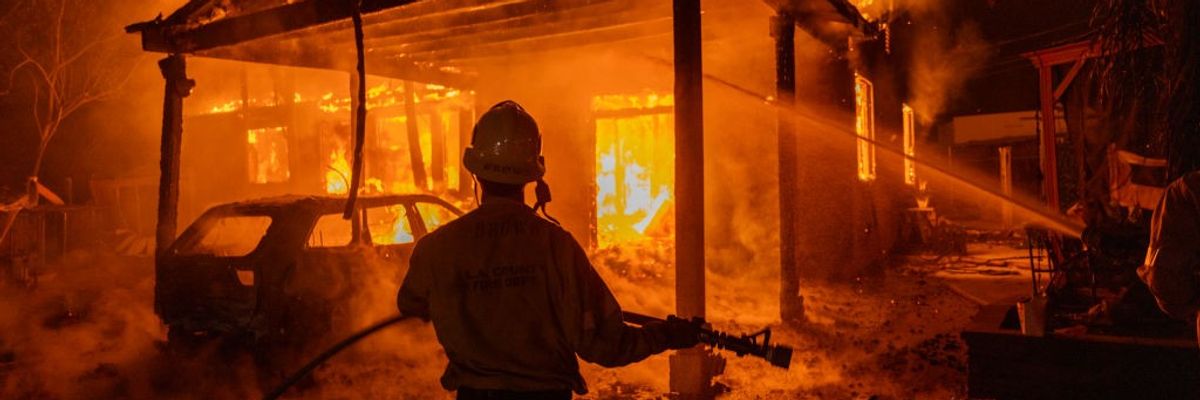
Firefighters battle the Eaton Fire on January 8, 2025 in Altadena, California.
If humanity stays on current course, warns top insurer, the "financial sector as we know it ceases to function. And with it, capitalism as we know it ceases to be viable."
A veteran financial consultant and insurance executive is warning his fellow capitalists that their commitment to profits and market supremacy is endangering the economic system to which they adhere and that if corrective actions are not taken capitalism itself will soon be consumed by the financial and social costs of a planet being cooked by the burning of fossil fuels.
According to Günther Thallinger, a former top executive at Germany's branch of the consulting giant McKinsey & Company and currently a board member of Allianz SE, one of the largest insurance companies in the world, the climate crisis is on a path to destroy capitalism as we know it.
"We are fast approaching temperature levels—1.5C, 2C, 3C—where insurers will no longer be able to offer coverage for many" of the risks associated with the climate crisis, Thallinger writes in a recent post highlighted Thursday by The Guardian.
"Meanwhile in the real world—a capitalist declares that capitalism is no longer sustainable..."
With "entire regions becoming uninsurable," he continues, the soaring costs of rebuilding and the insecurity of investments "threaten the very foundation of the financial sector," which he describes as " a climate-induced credit crunch" that will reverberate across national economies and globally.
"This applies not only to housing, but to infrastructure, transportation, agriculture, and industry," he warns. "The economic value of entire regions—coastal, arid, wildfire-prone—will begin to vanish from financial ledgers. Markets will reprice rapidly and brutally. This is what a climate-driven market failure looks like."
Commenting on the Guardian's coverage of Thallinger's declaration, Dan Taylor, a senior lecturer in social and political thought at the Open University, said, "Meanwhile in the real world—a capitalist declares that capitalism is no longer sustainable..."
While climate scientists, experts, and activists for decades have issued warning after warning of the threats posed by the burning of coal, oil, and gas and humanity's consumption of products derived from fossil fuels, the insurance industry has been the arm of capitalism most attuned to the lurking dangers.
"Here go the radical leftist insurance companies again," said David Abernathy, professor of global studies at Warren Wilson College, in a caustic response to Thallinger's latest warnings.
Despite their understanding of the threat, however, the world's insurers have primarily aimed to have it both ways, participating in the carnage by continuing to insure fossil fuel projects and underwriting expansion of the industry while increasingly attempting to offset their exposure to financial losses by changing policy agreements and lobbying governments for ever-increasing protections and preferable regulatory conditions.
In the post, self-published to LinkedIn last week, Thallinger—who has over many years lobbied for a more sustainable form of capitalism and led calls for a net-zero framework for corporations and industries—warned of the growing stress put on the insurance market worldwide by extreme weather events—including storms, floods, and fires—that ultimately will undermine the ability of markets to function or governments to keep pace with the costs:
There is no way to "adapt" to temperatures beyond human tolerance. There is limited adaptation to megafires, other than not building near forests. Whole cities built on flood plains cannot simply pick up and move uphill. And as temperatures continue to rise, adaptation itself becomes economically unviable.
Once we reach 3°C of warming, the situation locks in. Atmospheric energy at this level will persist for 100+ years due to carbon cycle inertia and the absence of scalable industrial carbon removal technologies. There is no known pathway to return to pre-2°C conditions. (See: IPCC AR6, 2023; NASA Earth Observatory: "The Long-Term Warming Commitment")
At that point, risk cannot be transferred (no insurance), risk cannot be absorbed (no public capacity), and risk cannot be adapted to (physical limits exceeded). That means no more mortgages, no new real estate development, no long-term investment, no financial stability. The financial sector as we know it ceases to function. And with it, capitalism as we know it ceases to be viable.
In an interview earlier this year, Thallinger explained that failure to act on the crisis of a rapidly warming planet is not just perilous for humanity and natural systems but doesn't make sense from an economic standpoint.
"The cost of inaction is higher than the cost of transformation and adaptation," Thallinger said in February. "Extreme heat, storms, wildfires, floods, and billions in economic damage occur each year. In 2024, insured natural catastrophe losses surpassed $140 billion, marking the fifth straight year above $100 billion."
"Transitioning to a net-zero economy is not just about sustainability," he continued, "it is a financial and operational necessity to avoid a future where climate shocks outpace our ability to recover, straining governments, businesses, and households. Without decisive action, we risk crossing a threshold where adaptation is no longer possible, and the costs—human and financial—become unimaginable."
Thallinger's solution to the crisis is not to subvert the capitalist system by transitioning the world to an economic system based on shared resources, communal ownership, or a more enlightened egalitarian response. Instead, he proposes that a "reformed" capitalism is the solution, writing, "Capitalism must now solve this existential threat."
Calling for a reduction of emissions and a rapid scale-up of green energy technologies is the path forward, he argues, asking readers to understand "this is not about saving the planet," but rather "saving the conditions under which markets, finance, and civilization itself can continue to operate."
This disconnect was not lost on astute observers, including Antía Casted, a senior researcher at the Sir Michael Marmot Institute of Health Equity, who suggested concern over Thallinger's prescription.
"It would be fine if [the climate crisis] destroyed civilization and maintained capitalism," Casted noted. "They just need to find a way for capitalism to work without people."
Dear Common Dreams reader, It’s been nearly 30 years since I co-founded Common Dreams with my late wife, Lina Newhouser. We had the radical notion that journalism should serve the public good, not corporate profits. It was clear to us from the outset what it would take to build such a project. No paid advertisements. No corporate sponsors. No millionaire publisher telling us what to think or do. Many people said we wouldn't last a year, but we proved those doubters wrong. Together with a tremendous team of journalists and dedicated staff, we built an independent media outlet free from the constraints of profits and corporate control. Our mission has always been simple: To inform. To inspire. To ignite change for the common good. Building Common Dreams was not easy. Our survival was never guaranteed. When you take on the most powerful forces—Wall Street greed, fossil fuel industry destruction, Big Tech lobbyists, and uber-rich oligarchs who have spent billions upon billions rigging the economy and democracy in their favor—the only bulwark you have is supporters who believe in your work. But here’s the urgent message from me today. It's never been this bad out there. And it's never been this hard to keep us going. At the very moment Common Dreams is most needed, the threats we face are intensifying. We need your support now more than ever. We don't accept corporate advertising and never will. We don't have a paywall because we don't think people should be blocked from critical news based on their ability to pay. Everything we do is funded by the donations of readers like you. When everyone does the little they can afford, we are strong. But if that support retreats or dries up, so do we. Will you donate now to make sure Common Dreams not only survives but thrives? —Craig Brown, Co-founder |
A veteran financial consultant and insurance executive is warning his fellow capitalists that their commitment to profits and market supremacy is endangering the economic system to which they adhere and that if corrective actions are not taken capitalism itself will soon be consumed by the financial and social costs of a planet being cooked by the burning of fossil fuels.
According to Günther Thallinger, a former top executive at Germany's branch of the consulting giant McKinsey & Company and currently a board member of Allianz SE, one of the largest insurance companies in the world, the climate crisis is on a path to destroy capitalism as we know it.
"We are fast approaching temperature levels—1.5C, 2C, 3C—where insurers will no longer be able to offer coverage for many" of the risks associated with the climate crisis, Thallinger writes in a recent post highlighted Thursday by The Guardian.
"Meanwhile in the real world—a capitalist declares that capitalism is no longer sustainable..."
With "entire regions becoming uninsurable," he continues, the soaring costs of rebuilding and the insecurity of investments "threaten the very foundation of the financial sector," which he describes as " a climate-induced credit crunch" that will reverberate across national economies and globally.
"This applies not only to housing, but to infrastructure, transportation, agriculture, and industry," he warns. "The economic value of entire regions—coastal, arid, wildfire-prone—will begin to vanish from financial ledgers. Markets will reprice rapidly and brutally. This is what a climate-driven market failure looks like."
Commenting on the Guardian's coverage of Thallinger's declaration, Dan Taylor, a senior lecturer in social and political thought at the Open University, said, "Meanwhile in the real world—a capitalist declares that capitalism is no longer sustainable..."
While climate scientists, experts, and activists for decades have issued warning after warning of the threats posed by the burning of coal, oil, and gas and humanity's consumption of products derived from fossil fuels, the insurance industry has been the arm of capitalism most attuned to the lurking dangers.
"Here go the radical leftist insurance companies again," said David Abernathy, professor of global studies at Warren Wilson College, in a caustic response to Thallinger's latest warnings.
Despite their understanding of the threat, however, the world's insurers have primarily aimed to have it both ways, participating in the carnage by continuing to insure fossil fuel projects and underwriting expansion of the industry while increasingly attempting to offset their exposure to financial losses by changing policy agreements and lobbying governments for ever-increasing protections and preferable regulatory conditions.
In the post, self-published to LinkedIn last week, Thallinger—who has over many years lobbied for a more sustainable form of capitalism and led calls for a net-zero framework for corporations and industries—warned of the growing stress put on the insurance market worldwide by extreme weather events—including storms, floods, and fires—that ultimately will undermine the ability of markets to function or governments to keep pace with the costs:
There is no way to "adapt" to temperatures beyond human tolerance. There is limited adaptation to megafires, other than not building near forests. Whole cities built on flood plains cannot simply pick up and move uphill. And as temperatures continue to rise, adaptation itself becomes economically unviable.
Once we reach 3°C of warming, the situation locks in. Atmospheric energy at this level will persist for 100+ years due to carbon cycle inertia and the absence of scalable industrial carbon removal technologies. There is no known pathway to return to pre-2°C conditions. (See: IPCC AR6, 2023; NASA Earth Observatory: "The Long-Term Warming Commitment")
At that point, risk cannot be transferred (no insurance), risk cannot be absorbed (no public capacity), and risk cannot be adapted to (physical limits exceeded). That means no more mortgages, no new real estate development, no long-term investment, no financial stability. The financial sector as we know it ceases to function. And with it, capitalism as we know it ceases to be viable.
In an interview earlier this year, Thallinger explained that failure to act on the crisis of a rapidly warming planet is not just perilous for humanity and natural systems but doesn't make sense from an economic standpoint.
"The cost of inaction is higher than the cost of transformation and adaptation," Thallinger said in February. "Extreme heat, storms, wildfires, floods, and billions in economic damage occur each year. In 2024, insured natural catastrophe losses surpassed $140 billion, marking the fifth straight year above $100 billion."
"Transitioning to a net-zero economy is not just about sustainability," he continued, "it is a financial and operational necessity to avoid a future where climate shocks outpace our ability to recover, straining governments, businesses, and households. Without decisive action, we risk crossing a threshold where adaptation is no longer possible, and the costs—human and financial—become unimaginable."
Thallinger's solution to the crisis is not to subvert the capitalist system by transitioning the world to an economic system based on shared resources, communal ownership, or a more enlightened egalitarian response. Instead, he proposes that a "reformed" capitalism is the solution, writing, "Capitalism must now solve this existential threat."
Calling for a reduction of emissions and a rapid scale-up of green energy technologies is the path forward, he argues, asking readers to understand "this is not about saving the planet," but rather "saving the conditions under which markets, finance, and civilization itself can continue to operate."
This disconnect was not lost on astute observers, including Antía Casted, a senior researcher at the Sir Michael Marmot Institute of Health Equity, who suggested concern over Thallinger's prescription.
"It would be fine if [the climate crisis] destroyed civilization and maintained capitalism," Casted noted. "They just need to find a way for capitalism to work without people."
A veteran financial consultant and insurance executive is warning his fellow capitalists that their commitment to profits and market supremacy is endangering the economic system to which they adhere and that if corrective actions are not taken capitalism itself will soon be consumed by the financial and social costs of a planet being cooked by the burning of fossil fuels.
According to Günther Thallinger, a former top executive at Germany's branch of the consulting giant McKinsey & Company and currently a board member of Allianz SE, one of the largest insurance companies in the world, the climate crisis is on a path to destroy capitalism as we know it.
"We are fast approaching temperature levels—1.5C, 2C, 3C—where insurers will no longer be able to offer coverage for many" of the risks associated with the climate crisis, Thallinger writes in a recent post highlighted Thursday by The Guardian.
"Meanwhile in the real world—a capitalist declares that capitalism is no longer sustainable..."
With "entire regions becoming uninsurable," he continues, the soaring costs of rebuilding and the insecurity of investments "threaten the very foundation of the financial sector," which he describes as " a climate-induced credit crunch" that will reverberate across national economies and globally.
"This applies not only to housing, but to infrastructure, transportation, agriculture, and industry," he warns. "The economic value of entire regions—coastal, arid, wildfire-prone—will begin to vanish from financial ledgers. Markets will reprice rapidly and brutally. This is what a climate-driven market failure looks like."
Commenting on the Guardian's coverage of Thallinger's declaration, Dan Taylor, a senior lecturer in social and political thought at the Open University, said, "Meanwhile in the real world—a capitalist declares that capitalism is no longer sustainable..."
While climate scientists, experts, and activists for decades have issued warning after warning of the threats posed by the burning of coal, oil, and gas and humanity's consumption of products derived from fossil fuels, the insurance industry has been the arm of capitalism most attuned to the lurking dangers.
"Here go the radical leftist insurance companies again," said David Abernathy, professor of global studies at Warren Wilson College, in a caustic response to Thallinger's latest warnings.
Despite their understanding of the threat, however, the world's insurers have primarily aimed to have it both ways, participating in the carnage by continuing to insure fossil fuel projects and underwriting expansion of the industry while increasingly attempting to offset their exposure to financial losses by changing policy agreements and lobbying governments for ever-increasing protections and preferable regulatory conditions.
In the post, self-published to LinkedIn last week, Thallinger—who has over many years lobbied for a more sustainable form of capitalism and led calls for a net-zero framework for corporations and industries—warned of the growing stress put on the insurance market worldwide by extreme weather events—including storms, floods, and fires—that ultimately will undermine the ability of markets to function or governments to keep pace with the costs:
There is no way to "adapt" to temperatures beyond human tolerance. There is limited adaptation to megafires, other than not building near forests. Whole cities built on flood plains cannot simply pick up and move uphill. And as temperatures continue to rise, adaptation itself becomes economically unviable.
Once we reach 3°C of warming, the situation locks in. Atmospheric energy at this level will persist for 100+ years due to carbon cycle inertia and the absence of scalable industrial carbon removal technologies. There is no known pathway to return to pre-2°C conditions. (See: IPCC AR6, 2023; NASA Earth Observatory: "The Long-Term Warming Commitment")
At that point, risk cannot be transferred (no insurance), risk cannot be absorbed (no public capacity), and risk cannot be adapted to (physical limits exceeded). That means no more mortgages, no new real estate development, no long-term investment, no financial stability. The financial sector as we know it ceases to function. And with it, capitalism as we know it ceases to be viable.
In an interview earlier this year, Thallinger explained that failure to act on the crisis of a rapidly warming planet is not just perilous for humanity and natural systems but doesn't make sense from an economic standpoint.
"The cost of inaction is higher than the cost of transformation and adaptation," Thallinger said in February. "Extreme heat, storms, wildfires, floods, and billions in economic damage occur each year. In 2024, insured natural catastrophe losses surpassed $140 billion, marking the fifth straight year above $100 billion."
"Transitioning to a net-zero economy is not just about sustainability," he continued, "it is a financial and operational necessity to avoid a future where climate shocks outpace our ability to recover, straining governments, businesses, and households. Without decisive action, we risk crossing a threshold where adaptation is no longer possible, and the costs—human and financial—become unimaginable."
Thallinger's solution to the crisis is not to subvert the capitalist system by transitioning the world to an economic system based on shared resources, communal ownership, or a more enlightened egalitarian response. Instead, he proposes that a "reformed" capitalism is the solution, writing, "Capitalism must now solve this existential threat."
Calling for a reduction of emissions and a rapid scale-up of green energy technologies is the path forward, he argues, asking readers to understand "this is not about saving the planet," but rather "saving the conditions under which markets, finance, and civilization itself can continue to operate."
This disconnect was not lost on astute observers, including Antía Casted, a senior researcher at the Sir Michael Marmot Institute of Health Equity, who suggested concern over Thallinger's prescription.
"It would be fine if [the climate crisis] destroyed civilization and maintained capitalism," Casted noted. "They just need to find a way for capitalism to work without people."