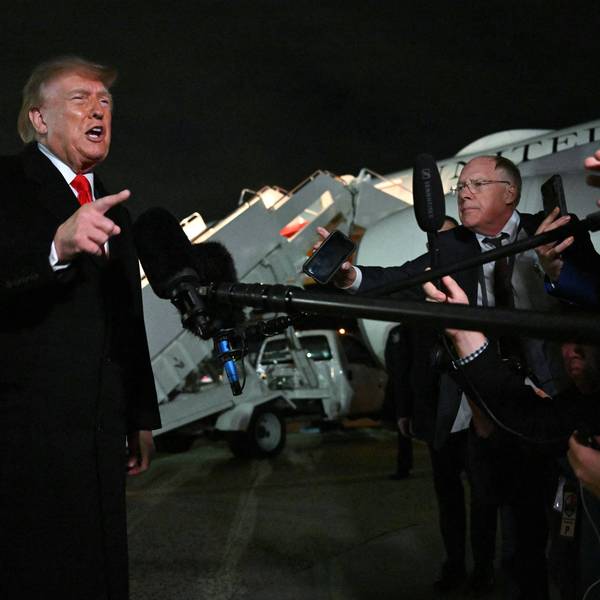
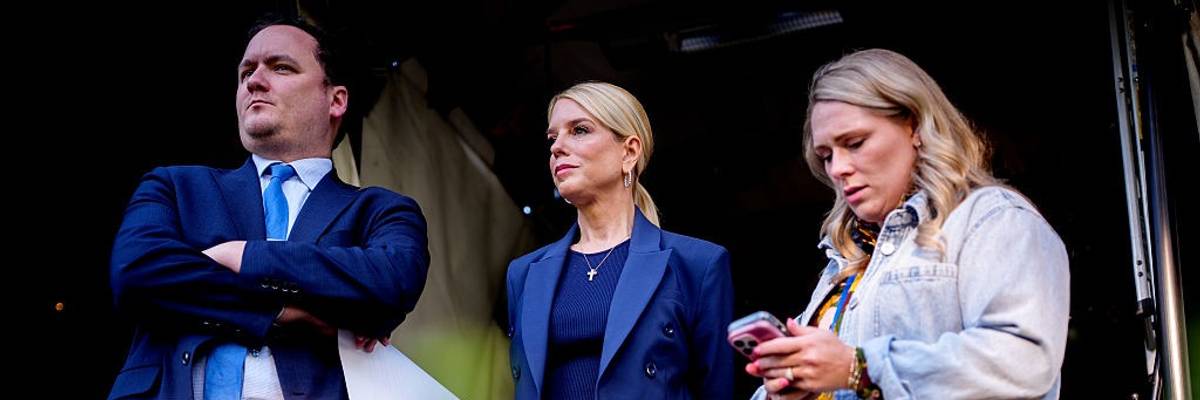
U.S. Attorney General Pam Bondi arrives for a television interview outside the West Wing of the White House on April 28, 2025 in Washington, D.C.
Bondi Shreds Biden-Era Protections for Journalists as Trump White House Hunts Leakers
One critic warned that President Donald Trump "almost certainly will abuse the legal system to investigate and prosecute his critics and the journalists they talk to."
U.S. Attorney General Pam Bondi has scrapped a Biden-era policy that sharply restricted the Justice Department's ability to seize journalists' records and force them to testify in leak investigations, an alarming move that press freedom advocates said carries dire implications for reporters and whistleblowers.
In an internal memo first reported Friday by CBS News, Bondi wrote that the Justice Department "will not tolerate unauthorized disclosures that undermine President [Donald] Trump's policies, victimize government agencies, and cause harm to the American people."
"The perpetrators of these leaks aid our foreign adversaries by spilling sensitive and sometimes classified information onto the Internet. The damage is significant and irreversible," Bondi continued. "Accountability, including criminal prosecutions, is necessary to set a new course."
As part of a renewed crackdown on leaks, Bondi said she is issuing revised Justice Department regulations stating that media outlets "must answer subpoenas" related to efforts to uncover sources of unauthorized disclosures within the federal government.
"The policy contemplates the use of subpoenas, court orders, and search warrants to compel production of information and testimony by and relating to members of the news media, subject to the Privacy Protection Act, 42 U.S.C. § 2000aa, and the approval of the department's leadership in some instances," the memo states. "The attorney general must also approve efforts to question or arrest members of the news media."
"Some of the most consequential reporting in U.S. history—from Watergate to warrantless wiretapping after 9/11—was and continues to be made possible because reporters have been able to protect the identities of confidential sources."
The Freedom of the Press Foundation (FPF)—a group co-founded by the late Daniel Ellsberg, who leaked classified documents that came to be known as the Pentagon Papers—noted in a statement that Bondi's memo followed "news that Director of National Intelligence Tulsi Gabbard asked the Department of Justice to investigate recent leaks to reporters."
Seth Stern, FPF's advocacy director, said Bondi's move was made possible by lawmakers' failure to pass the PRESS Act, bipartisan legislation would have codified into law rules prohibiting the federal government from forcing journalists or telecom companies from disclosing information about their sources.
"Every Democrat who put the PRESS Act on the back burner when they had the opportunity to pass a bipartisan bill codifying journalist-source confidentiality should be ashamed," said Stern. "Everyone predicted this would happen in a second Trump administration, yet politicians in a position to prevent it prioritized empty rhetoric over putting up a meaningful fight."
"Because of them," Stern added, "a president who threatens journalists with prison rape for protecting their sources and says reporting critically on his administration should be illegal can and almost certainly will abuse the legal system to investigate and prosecute his critics and the journalists they talk to."
After his victory in the 2024 presidential election, Trump instructed Republicans to block the PRESS Act, writing on his social media platform, "REPUBLICANS MUST KILL THIS BILL!"
Since the start of his second term, Trump has launched what Reporters Without Borders (RSF) characterized as "a monumental assault on press freedom," including by engaging in "legal intimidation" against media outlets.
"When you step back and look at the whole picture, the pattern of blows to press freedom is quite clear," Clayton Weimers, executive director of RSF North America, said late last week. "RSF refuses to accept this massive attack on press freedom as the new normal. We will continue to call out these assaults against the press and use every means at our disposal to fight back against them. We urge every American who values press freedom to do the same."
Earlier this month, the Committee to Protect Journalists issued a safety advisory to journalists planning to visit the United States, warning "journalists who are at high risk of being detained at the border" to "consider leaving their personal and/or work devices at home and instead carry separate devices and a new SIM card."
Bruce Brown, president of the Reporters Committee for Freedom of the Press, said in a statement following Bondi's memo that "strong protections for journalists serve the American public by safeguarding the free flow of information."
"Some of the most consequential reporting in U.S. history—from Watergate to warrantless wiretapping after 9/11—was and continues to be made possible because reporters have been able to protect the identities of confidential sources and uncover and report stories that matter to people across the political spectrum," Brown said.
We are at a crossroads
This country and this world are at a monumental crossroads. In a few short weeks, US voters will have an opportunity to beat back the forces of fascism and confront the billionaires who are rigging the economy, our media system, and our democracy, making it increasingly impossible for ordinary people to get by. We’re not just talking about the election. We’re talking about what must be done once these fascist elements are vanquished from power. We need a bolder set of solutions than what either major party has so far been willing to offer and a working-class movement ready to fight like hell for it. Trump didn't emerge from nowhere. The conditions that fueled MAGA authoritarianism were created by decades of radical neoliberal economic policies and a corrupt political system dominated by corporate interests. They slashed taxes on the super-rich, promising that the benefits would trickle down. They said giveaways to the corporate titans would make life more affordable for the rest of us. It was all bullshit. And when a bitter, betrayed populace searches for someone to blame, right-wing demagogues have little trouble finding scapegoats. People know when they're being lied to, but you won't hear any of this from the corporate media. Only independent journalism—powered and funded by people who believe in building a better world—can deliver truly trustworthy daily news. Our Fall Campaign is underway, and we need your help. To power our newsroom through the rest of the year, we need to raise $125,000 by midnight on October 31. So if you share our vision, please contribute whatever you can to sustain our work. |
U.S. Attorney General Pam Bondi has scrapped a Biden-era policy that sharply restricted the Justice Department's ability to seize journalists' records and force them to testify in leak investigations, an alarming move that press freedom advocates said carries dire implications for reporters and whistleblowers.
In an internal memo first reported Friday by CBS News, Bondi wrote that the Justice Department "will not tolerate unauthorized disclosures that undermine President [Donald] Trump's policies, victimize government agencies, and cause harm to the American people."
"The perpetrators of these leaks aid our foreign adversaries by spilling sensitive and sometimes classified information onto the Internet. The damage is significant and irreversible," Bondi continued. "Accountability, including criminal prosecutions, is necessary to set a new course."
As part of a renewed crackdown on leaks, Bondi said she is issuing revised Justice Department regulations stating that media outlets "must answer subpoenas" related to efforts to uncover sources of unauthorized disclosures within the federal government.
"The policy contemplates the use of subpoenas, court orders, and search warrants to compel production of information and testimony by and relating to members of the news media, subject to the Privacy Protection Act, 42 U.S.C. § 2000aa, and the approval of the department's leadership in some instances," the memo states. "The attorney general must also approve efforts to question or arrest members of the news media."
"Some of the most consequential reporting in U.S. history—from Watergate to warrantless wiretapping after 9/11—was and continues to be made possible because reporters have been able to protect the identities of confidential sources."
The Freedom of the Press Foundation (FPF)—a group co-founded by the late Daniel Ellsberg, who leaked classified documents that came to be known as the Pentagon Papers—noted in a statement that Bondi's memo followed "news that Director of National Intelligence Tulsi Gabbard asked the Department of Justice to investigate recent leaks to reporters."
Seth Stern, FPF's advocacy director, said Bondi's move was made possible by lawmakers' failure to pass the PRESS Act, bipartisan legislation would have codified into law rules prohibiting the federal government from forcing journalists or telecom companies from disclosing information about their sources.
"Every Democrat who put the PRESS Act on the back burner when they had the opportunity to pass a bipartisan bill codifying journalist-source confidentiality should be ashamed," said Stern. "Everyone predicted this would happen in a second Trump administration, yet politicians in a position to prevent it prioritized empty rhetoric over putting up a meaningful fight."
"Because of them," Stern added, "a president who threatens journalists with prison rape for protecting their sources and says reporting critically on his administration should be illegal can and almost certainly will abuse the legal system to investigate and prosecute his critics and the journalists they talk to."
After his victory in the 2024 presidential election, Trump instructed Republicans to block the PRESS Act, writing on his social media platform, "REPUBLICANS MUST KILL THIS BILL!"
Since the start of his second term, Trump has launched what Reporters Without Borders (RSF) characterized as "a monumental assault on press freedom," including by engaging in "legal intimidation" against media outlets.
"When you step back and look at the whole picture, the pattern of blows to press freedom is quite clear," Clayton Weimers, executive director of RSF North America, said late last week. "RSF refuses to accept this massive attack on press freedom as the new normal. We will continue to call out these assaults against the press and use every means at our disposal to fight back against them. We urge every American who values press freedom to do the same."
Earlier this month, the Committee to Protect Journalists issued a safety advisory to journalists planning to visit the United States, warning "journalists who are at high risk of being detained at the border" to "consider leaving their personal and/or work devices at home and instead carry separate devices and a new SIM card."
Bruce Brown, president of the Reporters Committee for Freedom of the Press, said in a statement following Bondi's memo that "strong protections for journalists serve the American public by safeguarding the free flow of information."
"Some of the most consequential reporting in U.S. history—from Watergate to warrantless wiretapping after 9/11—was and continues to be made possible because reporters have been able to protect the identities of confidential sources and uncover and report stories that matter to people across the political spectrum," Brown said.
U.S. Attorney General Pam Bondi has scrapped a Biden-era policy that sharply restricted the Justice Department's ability to seize journalists' records and force them to testify in leak investigations, an alarming move that press freedom advocates said carries dire implications for reporters and whistleblowers.
In an internal memo first reported Friday by CBS News, Bondi wrote that the Justice Department "will not tolerate unauthorized disclosures that undermine President [Donald] Trump's policies, victimize government agencies, and cause harm to the American people."
"The perpetrators of these leaks aid our foreign adversaries by spilling sensitive and sometimes classified information onto the Internet. The damage is significant and irreversible," Bondi continued. "Accountability, including criminal prosecutions, is necessary to set a new course."
As part of a renewed crackdown on leaks, Bondi said she is issuing revised Justice Department regulations stating that media outlets "must answer subpoenas" related to efforts to uncover sources of unauthorized disclosures within the federal government.
"The policy contemplates the use of subpoenas, court orders, and search warrants to compel production of information and testimony by and relating to members of the news media, subject to the Privacy Protection Act, 42 U.S.C. § 2000aa, and the approval of the department's leadership in some instances," the memo states. "The attorney general must also approve efforts to question or arrest members of the news media."
"Some of the most consequential reporting in U.S. history—from Watergate to warrantless wiretapping after 9/11—was and continues to be made possible because reporters have been able to protect the identities of confidential sources."
The Freedom of the Press Foundation (FPF)—a group co-founded by the late Daniel Ellsberg, who leaked classified documents that came to be known as the Pentagon Papers—noted in a statement that Bondi's memo followed "news that Director of National Intelligence Tulsi Gabbard asked the Department of Justice to investigate recent leaks to reporters."
Seth Stern, FPF's advocacy director, said Bondi's move was made possible by lawmakers' failure to pass the PRESS Act, bipartisan legislation would have codified into law rules prohibiting the federal government from forcing journalists or telecom companies from disclosing information about their sources.
"Every Democrat who put the PRESS Act on the back burner when they had the opportunity to pass a bipartisan bill codifying journalist-source confidentiality should be ashamed," said Stern. "Everyone predicted this would happen in a second Trump administration, yet politicians in a position to prevent it prioritized empty rhetoric over putting up a meaningful fight."
"Because of them," Stern added, "a president who threatens journalists with prison rape for protecting their sources and says reporting critically on his administration should be illegal can and almost certainly will abuse the legal system to investigate and prosecute his critics and the journalists they talk to."
After his victory in the 2024 presidential election, Trump instructed Republicans to block the PRESS Act, writing on his social media platform, "REPUBLICANS MUST KILL THIS BILL!"
Since the start of his second term, Trump has launched what Reporters Without Borders (RSF) characterized as "a monumental assault on press freedom," including by engaging in "legal intimidation" against media outlets.
"When you step back and look at the whole picture, the pattern of blows to press freedom is quite clear," Clayton Weimers, executive director of RSF North America, said late last week. "RSF refuses to accept this massive attack on press freedom as the new normal. We will continue to call out these assaults against the press and use every means at our disposal to fight back against them. We urge every American who values press freedom to do the same."
Earlier this month, the Committee to Protect Journalists issued a safety advisory to journalists planning to visit the United States, warning "journalists who are at high risk of being detained at the border" to "consider leaving their personal and/or work devices at home and instead carry separate devices and a new SIM card."
Bruce Brown, president of the Reporters Committee for Freedom of the Press, said in a statement following Bondi's memo that "strong protections for journalists serve the American public by safeguarding the free flow of information."
"Some of the most consequential reporting in U.S. history—from Watergate to warrantless wiretapping after 9/11—was and continues to be made possible because reporters have been able to protect the identities of confidential sources and uncover and report stories that matter to people across the political spectrum," Brown said.