SUBSCRIBE TO OUR FREE NEWSLETTER
Daily news & progressive opinion—funded by the people, not the corporations—delivered straight to your inbox.
5
#000000
#FFFFFF
To donate by check, phone, or other method, see our More Ways to Give page.
Daily news & progressive opinion—funded by the people, not the corporations—delivered straight to your inbox.
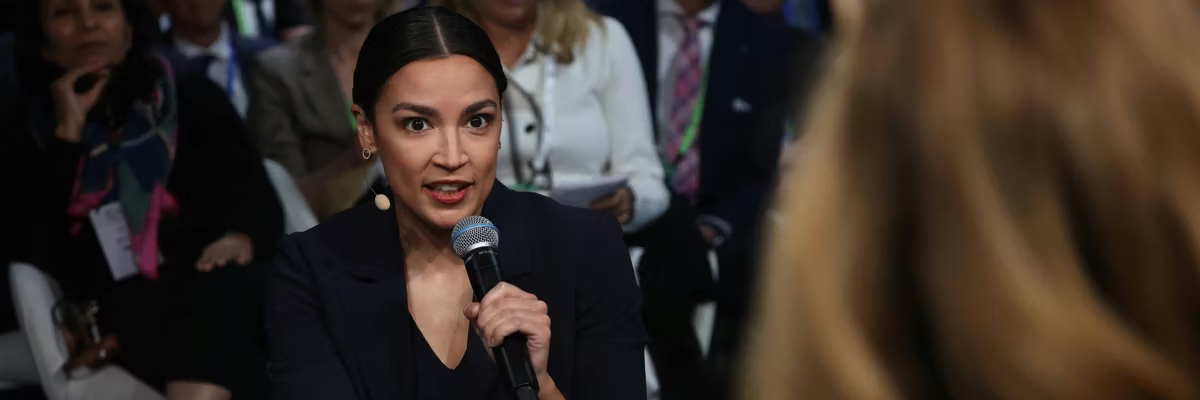
Alexandria Ocasio-Cortez, U.S. representative for New York's 14th congressional district, speaks at a Townhall panel on populism at the 62nd Munich Security Conference on February 13, 2,026 in Munich, Germany.
"An unmistakable majority wants a party that will fight harder against the corporations and rich people they see as responsible for keeping them down," wrote the New Republic's editorial director.
Democratic voters overwhelmingly want a leader who will fight the superrich and corporate America, and they believe Rep. Alexandria Ocasio-Cortez is the person to do it, according to a poll released this week.
While Democrats are often portrayed as squabbling and directionless, the poll conducted last month by the New Republic with Embold Research demonstrated a remarkable unity among the more than 2,400 Democratic voters it surveyed.
This was true with respect to policy: More than 9 in 10 want to raise taxes on corporations and on the wealthiest Americans, while more than three-quarters want to break up tech monopolies and believe the government should conduct stronger oversight of business.
But it was also reflected in sentiments that a more confrontational governing philosophy should prevail and general agreement that the party in its current form is not doing enough to take on its enemies.
Three-quarters said they wanted Democrats to "be more aggressive in calling out Republicans," while nearly 7 in 10 said it was appropriate to describe their party as "weak."
This appears to have translated to support for a more muscular view of government. Where the label once helped to sink Sen. Bernie Sanders' (I-Vt.) two runs for president, nearly three-quarters of Democrats now say they are either unconcerned with the label of "socialist" or view it as an asset.
Meanwhile, 46% said they want to see a "progressive" at the top of the Democratic ticket in 2028, higher than the number who said they wanted a "liberal" or a "moderate."
It's an environment that appears to be fertile ground for Ocasio-Cortez, who pitched her vision for a "working-class-centered politics" at this week's Munich summit in what many suspected was a soft-launch of her presidential candidacy in 2028.
With 85% favorability, Bronx congresswoman had the highest approval rating of any Democratic figure in the country among the voters surveyed.
It's a higher mark than either of the figures who head-to-head polls have shown to be presumptive favorites for the nomination: Former Vice President Kamala Harris and California Gov. Gavin Newsom.
Early polls show AOC lagging considerably behind these top two. However, there are signs in the New Republic's poll that may give her supporters cause for hope.
While Harris is also well-liked, 66% of Democrats surveyed said they believe she's "had her shot" at the presidency and should not run again after losing to President Donald Trump in 2024.
Newsom does not have a similar electoral history holding him back and is riding high from the passage of Proposition 50, which will allow Democrats to add potentially five more US House seats this November.
But his policy approach may prove an ill fit at a time when Democrats overwhelmingly say their party is "too timid" about taxing the rich and corporations and taking on tech oligarchs.
As labor unions in California have pushed for a popular proposal to introduce a billionaire's tax, Newsom has made himself the chiseled face of the resistance to this idea, joining with right-wing Silicon Valley barons in an aggressive campaign to kill it.
While polls can tell us little two years out about what voters will do in 2028, New Republic editorial director Emily Cooke said her magazine's survey shows an unmistakable pattern.
"It’s impossible to come away from these results without concluding that economic populism is a winning message for loyal Democrats," she wrote. "This was true across those who identify as liberals, moderates, or progressives: An unmistakable majority wants a party that will fight harder against the corporations and rich people they see as responsible for keeping them down."
Dear Common Dreams reader, It’s been nearly 30 years since I co-founded Common Dreams with my late wife, Lina Newhouser. We had the radical notion that journalism should serve the public good, not corporate profits. It was clear to us from the outset what it would take to build such a project. No paid advertisements. No corporate sponsors. No millionaire publisher telling us what to think or do. Many people said we wouldn't last a year, but we proved those doubters wrong. Together with a tremendous team of journalists and dedicated staff, we built an independent media outlet free from the constraints of profits and corporate control. Our mission has always been simple: To inform. To inspire. To ignite change for the common good. Building Common Dreams was not easy. Our survival was never guaranteed. When you take on the most powerful forces—Wall Street greed, fossil fuel industry destruction, Big Tech lobbyists, and uber-rich oligarchs who have spent billions upon billions rigging the economy and democracy in their favor—the only bulwark you have is supporters who believe in your work. But here’s the urgent message from me today. It's never been this bad out there. And it's never been this hard to keep us going. At the very moment Common Dreams is most needed, the threats we face are intensifying. We need your support now more than ever. We don't accept corporate advertising and never will. We don't have a paywall because we don't think people should be blocked from critical news based on their ability to pay. Everything we do is funded by the donations of readers like you. When everyone does the little they can afford, we are strong. But if that support retreats or dries up, so do we. Will you donate now to make sure Common Dreams not only survives but thrives? —Craig Brown, Co-founder |
Democratic voters overwhelmingly want a leader who will fight the superrich and corporate America, and they believe Rep. Alexandria Ocasio-Cortez is the person to do it, according to a poll released this week.
While Democrats are often portrayed as squabbling and directionless, the poll conducted last month by the New Republic with Embold Research demonstrated a remarkable unity among the more than 2,400 Democratic voters it surveyed.
This was true with respect to policy: More than 9 in 10 want to raise taxes on corporations and on the wealthiest Americans, while more than three-quarters want to break up tech monopolies and believe the government should conduct stronger oversight of business.
But it was also reflected in sentiments that a more confrontational governing philosophy should prevail and general agreement that the party in its current form is not doing enough to take on its enemies.
Three-quarters said they wanted Democrats to "be more aggressive in calling out Republicans," while nearly 7 in 10 said it was appropriate to describe their party as "weak."
This appears to have translated to support for a more muscular view of government. Where the label once helped to sink Sen. Bernie Sanders' (I-Vt.) two runs for president, nearly three-quarters of Democrats now say they are either unconcerned with the label of "socialist" or view it as an asset.
Meanwhile, 46% said they want to see a "progressive" at the top of the Democratic ticket in 2028, higher than the number who said they wanted a "liberal" or a "moderate."
It's an environment that appears to be fertile ground for Ocasio-Cortez, who pitched her vision for a "working-class-centered politics" at this week's Munich summit in what many suspected was a soft-launch of her presidential candidacy in 2028.
With 85% favorability, Bronx congresswoman had the highest approval rating of any Democratic figure in the country among the voters surveyed.
It's a higher mark than either of the figures who head-to-head polls have shown to be presumptive favorites for the nomination: Former Vice President Kamala Harris and California Gov. Gavin Newsom.
Early polls show AOC lagging considerably behind these top two. However, there are signs in the New Republic's poll that may give her supporters cause for hope.
While Harris is also well-liked, 66% of Democrats surveyed said they believe she's "had her shot" at the presidency and should not run again after losing to President Donald Trump in 2024.
Newsom does not have a similar electoral history holding him back and is riding high from the passage of Proposition 50, which will allow Democrats to add potentially five more US House seats this November.
But his policy approach may prove an ill fit at a time when Democrats overwhelmingly say their party is "too timid" about taxing the rich and corporations and taking on tech oligarchs.
As labor unions in California have pushed for a popular proposal to introduce a billionaire's tax, Newsom has made himself the chiseled face of the resistance to this idea, joining with right-wing Silicon Valley barons in an aggressive campaign to kill it.
While polls can tell us little two years out about what voters will do in 2028, New Republic editorial director Emily Cooke said her magazine's survey shows an unmistakable pattern.
"It’s impossible to come away from these results without concluding that economic populism is a winning message for loyal Democrats," she wrote. "This was true across those who identify as liberals, moderates, or progressives: An unmistakable majority wants a party that will fight harder against the corporations and rich people they see as responsible for keeping them down."
Democratic voters overwhelmingly want a leader who will fight the superrich and corporate America, and they believe Rep. Alexandria Ocasio-Cortez is the person to do it, according to a poll released this week.
While Democrats are often portrayed as squabbling and directionless, the poll conducted last month by the New Republic with Embold Research demonstrated a remarkable unity among the more than 2,400 Democratic voters it surveyed.
This was true with respect to policy: More than 9 in 10 want to raise taxes on corporations and on the wealthiest Americans, while more than three-quarters want to break up tech monopolies and believe the government should conduct stronger oversight of business.
But it was also reflected in sentiments that a more confrontational governing philosophy should prevail and general agreement that the party in its current form is not doing enough to take on its enemies.
Three-quarters said they wanted Democrats to "be more aggressive in calling out Republicans," while nearly 7 in 10 said it was appropriate to describe their party as "weak."
This appears to have translated to support for a more muscular view of government. Where the label once helped to sink Sen. Bernie Sanders' (I-Vt.) two runs for president, nearly three-quarters of Democrats now say they are either unconcerned with the label of "socialist" or view it as an asset.
Meanwhile, 46% said they want to see a "progressive" at the top of the Democratic ticket in 2028, higher than the number who said they wanted a "liberal" or a "moderate."
It's an environment that appears to be fertile ground for Ocasio-Cortez, who pitched her vision for a "working-class-centered politics" at this week's Munich summit in what many suspected was a soft-launch of her presidential candidacy in 2028.
With 85% favorability, Bronx congresswoman had the highest approval rating of any Democratic figure in the country among the voters surveyed.
It's a higher mark than either of the figures who head-to-head polls have shown to be presumptive favorites for the nomination: Former Vice President Kamala Harris and California Gov. Gavin Newsom.
Early polls show AOC lagging considerably behind these top two. However, there are signs in the New Republic's poll that may give her supporters cause for hope.
While Harris is also well-liked, 66% of Democrats surveyed said they believe she's "had her shot" at the presidency and should not run again after losing to President Donald Trump in 2024.
Newsom does not have a similar electoral history holding him back and is riding high from the passage of Proposition 50, which will allow Democrats to add potentially five more US House seats this November.
But his policy approach may prove an ill fit at a time when Democrats overwhelmingly say their party is "too timid" about taxing the rich and corporations and taking on tech oligarchs.
As labor unions in California have pushed for a popular proposal to introduce a billionaire's tax, Newsom has made himself the chiseled face of the resistance to this idea, joining with right-wing Silicon Valley barons in an aggressive campaign to kill it.
While polls can tell us little two years out about what voters will do in 2028, New Republic editorial director Emily Cooke said her magazine's survey shows an unmistakable pattern.
"It’s impossible to come away from these results without concluding that economic populism is a winning message for loyal Democrats," she wrote. "This was true across those who identify as liberals, moderates, or progressives: An unmistakable majority wants a party that will fight harder against the corporations and rich people they see as responsible for keeping them down."