SUBSCRIBE TO OUR FREE NEWSLETTER
Daily news & progressive opinion—funded by the people, not the corporations—delivered straight to your inbox.
5
#000000
#FFFFFF
To donate by check, phone, or other method, see our More Ways to Give page.
Daily news & progressive opinion—funded by the people, not the corporations—delivered straight to your inbox.

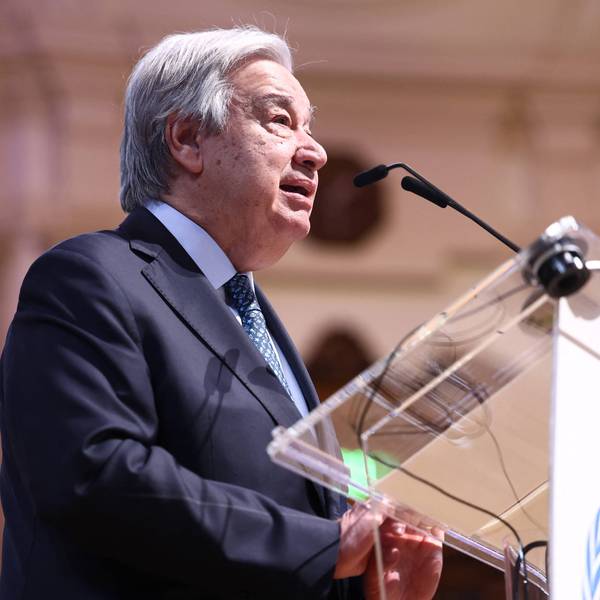
United Nations Secretary-General António Guterres speaks at the U.N. headquarters on February 22, 2023.
"Geopolitical divides are preventing us from coming together around global solutions for global challenges," said United Nations Secretary-General António Guterres.
At the World Economic Forum in Davos, Switzerland on Wednesday, United Nations Secretary-General António Guterres warned that multilateralism that includes often overlooked governments in the Global South is the only solution to the rapidly developing crises posed by the climate emergency and artificial intelligence—both of which are worsening "the global crisis in trust."
"In the face of the serious, even existential threats posed by runaway climate chaos," said Guterres, "and the runaway development of artificial intelligence without guardrails, we seem powerless to act together."
While "droughts, storms, fires, and floods are pummeling countries and communities," particularly in nations that have contributed the least planet-heating fossil fuel pollution, Guterres told the political and business elite assembled in Davos, "countries remain hellbent on raising emissions."
He reserved particular scorn for the United States fossil fuel industry, which—amid the Biden administration's approval of pollution-causing infrastructure including the Willow oil project and the Mountain Valley Pipeline—deceives the public with false climate solutions, misinformation, and greenwashing campaigns "to kneecap progress and keep the oil and gas flowing indefinitely."
As suffering intensifies in communities that are most vulnerable to drought, damage from extreme weather, and other climate catastrophes, Guterres said, fossil fuel giants and powerful governments are risking lives to only delay an "inevitable" shift to renewable energy.
"The phaseout of fossil fuels is essential," said the secretary-general. "No amount of spin or scare tactics will change that. Let's hope it doesn't come too late."
As trust between the Global South and wealthy governments is frayed by fossil fuel-producing countries' refusal to leave oil, gas, and coal behind, Guterres warned that the separate threat of "unintended consequences" of artificial intelligence evolution also looms—for people in rich economies as well as developing countries.
"This technology has enormous potential for sustainable development," said the U.N. chief, while noting that "some powerful tech companies are already pursuing profits with a clear disregard for human rights, personal privacy, and social impact."
Guterres' comments came days after the International Monetary Fund (IMF) released a new analysis of AI's expected impact on the global economy and workers, with nearly 40% of the labor market expected to be "exposed" to AI.
In wealthy countries, about 60% of jobs are projected to be impacted by AI, and about half of those workers are likely to see at least some of their primary tasks being completed by AI tools like ChatGPT or similar technology, "which could lower labor demand, leading to lower wages, and reduced hiring," according to the IMF. "In the most extreme cases, some of these jobs may disappear."
The analysis released Sunday noted that the rapidly changing field could worsen inequality within countries, as some higher earners may be able to "harness AI" and leverage its use for increases in their productivity and pay while those who can't fall behind.
"In most scenarios, AI will likely worsen overall inequality, a troubling trend that policymakers must proactively address to prevent the technology from further stoking social tensions," said the IMF. "It is crucial for countries to establish comprehensive social safety nets and offer retraining programs for vulnerable workers."
Guterres called on policymakers to work closely with the private sector—currently "in the lead on AI expertise and resources"—to "develop a governance model" for AI that is focused on "monitoring and mitigating future harms."
A systematic effort is also needed, said the secretary-general, "to increase access to AI so that developing economies can benefit from its enormous potential."
Along with the IMF and Guterres, global human rights group Amnesty International this week raised alarm about AI and the "urgent but difficult task" of regulating the technology, noting that in addition to changing how people and companies work, AI has the potential to be "used as a means of societal control, mass surveillance, and discrimination."
Police agencies in several countries have begun using AI for so-called "predictive policing," attempting to prevent crimes before they're committed, while officials have also deployed automated systems to detect fraud, determine who can and can't access healthcare and social assistance, as well as to monitor migrants' and refugees' movement.
Amnesty credited the European Union with making headway in regulating AI in 2023, closing out the year by reaching a landmark agreement on the AI Act, which would take steps to protect Europeans from the automation of jobs, the spread of misinformation, and national security threats.
The AI Act, however, has been criticized by rights groups over its failure to ban mass surveillance via live facial recognition tools.
"Others must learn from the E.U. process and ensure there are not loopholes for public and private sector players to circumvent regulatory obligations, and removing any exemptions for AI used within national security or law enforcement is critical to achieving this," said Amnesty.
In Davos on Wednesday, Guterres expressed hope that policymakers will agree on climate, AI, and other solutions that center human rights in the coming year, including at the U.N.'s Summit of the Future, planned for September.
"These two issues—climate and AI—are exhaustively discussed by governments, by the media, and by leaders here in Davos," said Guterres. "And yet, we have not yet an effective global strategy to deal with either. And the reason is simple. Geopolitical divides are preventing us from coming together around global solutions for global challenges."
"The only way to manage this complexity and avoid a slide into chaos," he said, "is through a reformed, inclusive, networked multilateralism."
Dear Common Dreams reader, It’s been nearly 30 years since I co-founded Common Dreams with my late wife, Lina Newhouser. We had the radical notion that journalism should serve the public good, not corporate profits. It was clear to us from the outset what it would take to build such a project. No paid advertisements. No corporate sponsors. No millionaire publisher telling us what to think or do. Many people said we wouldn't last a year, but we proved those doubters wrong. Together with a tremendous team of journalists and dedicated staff, we built an independent media outlet free from the constraints of profits and corporate control. Our mission has always been simple: To inform. To inspire. To ignite change for the common good. Building Common Dreams was not easy. Our survival was never guaranteed. When you take on the most powerful forces—Wall Street greed, fossil fuel industry destruction, Big Tech lobbyists, and uber-rich oligarchs who have spent billions upon billions rigging the economy and democracy in their favor—the only bulwark you have is supporters who believe in your work. But here’s the urgent message from me today. It's never been this bad out there. And it's never been this hard to keep us going. At the very moment Common Dreams is most needed, the threats we face are intensifying. We need your support now more than ever. We don't accept corporate advertising and never will. We don't have a paywall because we don't think people should be blocked from critical news based on their ability to pay. Everything we do is funded by the donations of readers like you. When everyone does the little they can afford, we are strong. But if that support retreats or dries up, so do we. Will you donate now to make sure Common Dreams not only survives but thrives? —Craig Brown, Co-founder |
At the World Economic Forum in Davos, Switzerland on Wednesday, United Nations Secretary-General António Guterres warned that multilateralism that includes often overlooked governments in the Global South is the only solution to the rapidly developing crises posed by the climate emergency and artificial intelligence—both of which are worsening "the global crisis in trust."
"In the face of the serious, even existential threats posed by runaway climate chaos," said Guterres, "and the runaway development of artificial intelligence without guardrails, we seem powerless to act together."
While "droughts, storms, fires, and floods are pummeling countries and communities," particularly in nations that have contributed the least planet-heating fossil fuel pollution, Guterres told the political and business elite assembled in Davos, "countries remain hellbent on raising emissions."
He reserved particular scorn for the United States fossil fuel industry, which—amid the Biden administration's approval of pollution-causing infrastructure including the Willow oil project and the Mountain Valley Pipeline—deceives the public with false climate solutions, misinformation, and greenwashing campaigns "to kneecap progress and keep the oil and gas flowing indefinitely."
As suffering intensifies in communities that are most vulnerable to drought, damage from extreme weather, and other climate catastrophes, Guterres said, fossil fuel giants and powerful governments are risking lives to only delay an "inevitable" shift to renewable energy.
"The phaseout of fossil fuels is essential," said the secretary-general. "No amount of spin or scare tactics will change that. Let's hope it doesn't come too late."
As trust between the Global South and wealthy governments is frayed by fossil fuel-producing countries' refusal to leave oil, gas, and coal behind, Guterres warned that the separate threat of "unintended consequences" of artificial intelligence evolution also looms—for people in rich economies as well as developing countries.
"This technology has enormous potential for sustainable development," said the U.N. chief, while noting that "some powerful tech companies are already pursuing profits with a clear disregard for human rights, personal privacy, and social impact."
Guterres' comments came days after the International Monetary Fund (IMF) released a new analysis of AI's expected impact on the global economy and workers, with nearly 40% of the labor market expected to be "exposed" to AI.
In wealthy countries, about 60% of jobs are projected to be impacted by AI, and about half of those workers are likely to see at least some of their primary tasks being completed by AI tools like ChatGPT or similar technology, "which could lower labor demand, leading to lower wages, and reduced hiring," according to the IMF. "In the most extreme cases, some of these jobs may disappear."
The analysis released Sunday noted that the rapidly changing field could worsen inequality within countries, as some higher earners may be able to "harness AI" and leverage its use for increases in their productivity and pay while those who can't fall behind.
"In most scenarios, AI will likely worsen overall inequality, a troubling trend that policymakers must proactively address to prevent the technology from further stoking social tensions," said the IMF. "It is crucial for countries to establish comprehensive social safety nets and offer retraining programs for vulnerable workers."
Guterres called on policymakers to work closely with the private sector—currently "in the lead on AI expertise and resources"—to "develop a governance model" for AI that is focused on "monitoring and mitigating future harms."
A systematic effort is also needed, said the secretary-general, "to increase access to AI so that developing economies can benefit from its enormous potential."
Along with the IMF and Guterres, global human rights group Amnesty International this week raised alarm about AI and the "urgent but difficult task" of regulating the technology, noting that in addition to changing how people and companies work, AI has the potential to be "used as a means of societal control, mass surveillance, and discrimination."
Police agencies in several countries have begun using AI for so-called "predictive policing," attempting to prevent crimes before they're committed, while officials have also deployed automated systems to detect fraud, determine who can and can't access healthcare and social assistance, as well as to monitor migrants' and refugees' movement.
Amnesty credited the European Union with making headway in regulating AI in 2023, closing out the year by reaching a landmark agreement on the AI Act, which would take steps to protect Europeans from the automation of jobs, the spread of misinformation, and national security threats.
The AI Act, however, has been criticized by rights groups over its failure to ban mass surveillance via live facial recognition tools.
"Others must learn from the E.U. process and ensure there are not loopholes for public and private sector players to circumvent regulatory obligations, and removing any exemptions for AI used within national security or law enforcement is critical to achieving this," said Amnesty.
In Davos on Wednesday, Guterres expressed hope that policymakers will agree on climate, AI, and other solutions that center human rights in the coming year, including at the U.N.'s Summit of the Future, planned for September.
"These two issues—climate and AI—are exhaustively discussed by governments, by the media, and by leaders here in Davos," said Guterres. "And yet, we have not yet an effective global strategy to deal with either. And the reason is simple. Geopolitical divides are preventing us from coming together around global solutions for global challenges."
"The only way to manage this complexity and avoid a slide into chaos," he said, "is through a reformed, inclusive, networked multilateralism."
At the World Economic Forum in Davos, Switzerland on Wednesday, United Nations Secretary-General António Guterres warned that multilateralism that includes often overlooked governments in the Global South is the only solution to the rapidly developing crises posed by the climate emergency and artificial intelligence—both of which are worsening "the global crisis in trust."
"In the face of the serious, even existential threats posed by runaway climate chaos," said Guterres, "and the runaway development of artificial intelligence without guardrails, we seem powerless to act together."
While "droughts, storms, fires, and floods are pummeling countries and communities," particularly in nations that have contributed the least planet-heating fossil fuel pollution, Guterres told the political and business elite assembled in Davos, "countries remain hellbent on raising emissions."
He reserved particular scorn for the United States fossil fuel industry, which—amid the Biden administration's approval of pollution-causing infrastructure including the Willow oil project and the Mountain Valley Pipeline—deceives the public with false climate solutions, misinformation, and greenwashing campaigns "to kneecap progress and keep the oil and gas flowing indefinitely."
As suffering intensifies in communities that are most vulnerable to drought, damage from extreme weather, and other climate catastrophes, Guterres said, fossil fuel giants and powerful governments are risking lives to only delay an "inevitable" shift to renewable energy.
"The phaseout of fossil fuels is essential," said the secretary-general. "No amount of spin or scare tactics will change that. Let's hope it doesn't come too late."
As trust between the Global South and wealthy governments is frayed by fossil fuel-producing countries' refusal to leave oil, gas, and coal behind, Guterres warned that the separate threat of "unintended consequences" of artificial intelligence evolution also looms—for people in rich economies as well as developing countries.
"This technology has enormous potential for sustainable development," said the U.N. chief, while noting that "some powerful tech companies are already pursuing profits with a clear disregard for human rights, personal privacy, and social impact."
Guterres' comments came days after the International Monetary Fund (IMF) released a new analysis of AI's expected impact on the global economy and workers, with nearly 40% of the labor market expected to be "exposed" to AI.
In wealthy countries, about 60% of jobs are projected to be impacted by AI, and about half of those workers are likely to see at least some of their primary tasks being completed by AI tools like ChatGPT or similar technology, "which could lower labor demand, leading to lower wages, and reduced hiring," according to the IMF. "In the most extreme cases, some of these jobs may disappear."
The analysis released Sunday noted that the rapidly changing field could worsen inequality within countries, as some higher earners may be able to "harness AI" and leverage its use for increases in their productivity and pay while those who can't fall behind.
"In most scenarios, AI will likely worsen overall inequality, a troubling trend that policymakers must proactively address to prevent the technology from further stoking social tensions," said the IMF. "It is crucial for countries to establish comprehensive social safety nets and offer retraining programs for vulnerable workers."
Guterres called on policymakers to work closely with the private sector—currently "in the lead on AI expertise and resources"—to "develop a governance model" for AI that is focused on "monitoring and mitigating future harms."
A systematic effort is also needed, said the secretary-general, "to increase access to AI so that developing economies can benefit from its enormous potential."
Along with the IMF and Guterres, global human rights group Amnesty International this week raised alarm about AI and the "urgent but difficult task" of regulating the technology, noting that in addition to changing how people and companies work, AI has the potential to be "used as a means of societal control, mass surveillance, and discrimination."
Police agencies in several countries have begun using AI for so-called "predictive policing," attempting to prevent crimes before they're committed, while officials have also deployed automated systems to detect fraud, determine who can and can't access healthcare and social assistance, as well as to monitor migrants' and refugees' movement.
Amnesty credited the European Union with making headway in regulating AI in 2023, closing out the year by reaching a landmark agreement on the AI Act, which would take steps to protect Europeans from the automation of jobs, the spread of misinformation, and national security threats.
The AI Act, however, has been criticized by rights groups over its failure to ban mass surveillance via live facial recognition tools.
"Others must learn from the E.U. process and ensure there are not loopholes for public and private sector players to circumvent regulatory obligations, and removing any exemptions for AI used within national security or law enforcement is critical to achieving this," said Amnesty.
In Davos on Wednesday, Guterres expressed hope that policymakers will agree on climate, AI, and other solutions that center human rights in the coming year, including at the U.N.'s Summit of the Future, planned for September.
"These two issues—climate and AI—are exhaustively discussed by governments, by the media, and by leaders here in Davos," said Guterres. "And yet, we have not yet an effective global strategy to deal with either. And the reason is simple. Geopolitical divides are preventing us from coming together around global solutions for global challenges."
"The only way to manage this complexity and avoid a slide into chaos," he said, "is through a reformed, inclusive, networked multilateralism."