SUBSCRIBE TO OUR FREE NEWSLETTER
Daily news & progressive opinion—funded by the people, not the corporations—delivered straight to your inbox.
5
#000000
#FFFFFF
To donate by check, phone, or other method, see our More Ways to Give page.
Daily news & progressive opinion—funded by the people, not the corporations—delivered straight to your inbox.
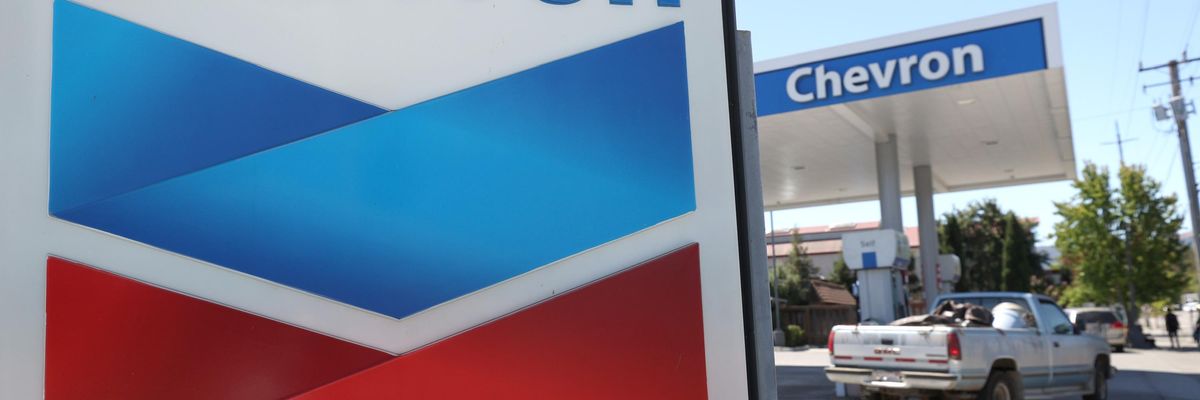
A sign is posted in front of a Chevron gas station on July 31, 2020 in Novato, California. (Photo: Justin Sullivan/Getty Images)
The new global media outlet Semafor came under fire by journalists and other critics Monday for allowing fossil fuel giant Chevron to sponsor its climate-focused newsletter.
"Welcome to Semafor Climate, where we take the temperature of the politics, technology, and energy markets influencing global warming," journalist Bill Spindle wrote for Monday's newsletter.
"Today I delve into Europe's efforts to get off Russian gas and the U.S. campaign to assure the E.U.'s ban on Russian oil doesn't send crude prices soaring," Spindle continued. "And feeling anxious about climate change? A study shows you are not alone. But an electric Rolls Royce could make you feel better, if you can afford it."
However, it was a message from sponsor Chevron that caught the attention of several readers.
"We're working toward a lower carbon future," Chevron's message--which links to a page on the company's website--says in large letters above an image of a cow's snout.
Below the cow image, the company adds: "We believe the fuels of the future can come from some very unexpected places. At Chevron, we're working with partners in California to convert the methane from cow waste into renewable natural gas."
Longtime science journalist Joe Brown--who runs the Substack project one5c--was among the critics, tweeting at Semafor that the fossil fuel company "wouldn't be my choice of sponsor for a climate newsletter."
Blasting Chevron's lack of climate action, Brown added that "the ag-capture project in this ad is as bad as greenwashing gets: It's a natural gas plant."
While Chevron claims to support the Paris agreement and last year adopted a "2050 net-zero aspiration for equity upstream scope 1 and 2 emissions," the company continues to face criticism for failing to cut planet-heating pollution.
Previewing Semafor in June, The New York Times reported that the co-founders--the newspaper's former media columnist, Ben Smith, and ex-Bloomberg Media CEO Justin Smith, who are not related--said that "it would tackle the lack of trust in media and compete for English-language readers against outlets like CNN, the Times, and The Washington Post."
Semafor, which aims to distinguish itself from such legacy media outlets with a unique article structure, launched last week "as a free, advertising-supported media site but will evolve into a paywalled subscription site in about 12 to 18 months, as it gains brand recognition," according to CNBC.
"What stage of media is it when Climate Newsletter Brought To You By The Industry Destroying The Climate is the ascendant business model?" The Lever's David Sirota asked Monday.
Both Sirota and The Lever's Andrew Perez pointed out similar sponsorship choices by major newsletters--which they reported on last year with fellow journalist Walker Bragman.
"It's great that more companies are adopting the Politico Playbook/Axios/Punchbowl model where they let horrible companies actively lie to their readers for money," Perez said Monday.
As The Lever's reporters detailed in October 2021:
This new foundation of political news was originally constructed by now-disgraced Washington gossip Mark Halperin and his ABC News email called The Note--a publication founded in January 2002 as an internal staff memo proudly boasting that it only cared about the so-called "Gang Of 500" people in Washington who allegedly matter.
Today's copycats like Politico, Punchbowl, and Axios have made this arrangement even more explicit: Their innovation was baking corporate ideology directly into their news via snarky voice and so-called "native advertising." In practice, their primary raison d'etre is not to publish accountability reporting, but to instead play tone policeman and frame the parameters of the policy discourse so that it best guarantees outcomes that corporate sponsors want.
The trio added that "in the rip-and-read world of news and politics, these newsletters are the talking points torn out by pundits, TV bookers, and lobbyists and then turned into newspaper columns, to-camera diatribes, and pitches to lawmakers. They are, in other words, the prefabricated scripts distributed throughout news industry superstructure, wrapped in the veneer of objectivity, and then blasted out to the general population under the banner of corporate media mastheads."
The Lever's reporting on "the Washington gossip rags that are quite literally 'presented by' a rogues gallery of corporate villains trying to buy politicians and kill the reconciliation bill" highlighted sponsorships by Chevron, ExxonMobil, HCA Healthcare, Facebook, Pharmaceutical Research and Manufacturers of America (PhRMA), and Uber.
The week after that reporting was published, HEATED's Emily Atkin and Earther's Molly Taft examined recent fossil fuel industry sponsorships of Punchbowl and climate-related newsletters from Axios and Politico.
After representatives for the media outlets told the journalists that newsletter content is independent from advertising, Atkin and Taft wrote that "the responses appear to misunderstand the issue being raised."
"No one has claimed Big Oil's ads influence the reporting at these news outlets," Atkin and Taft explained. "The issue is that news outlets are using their own quality reporting to sell advertisers on opportunities to spread misinformation on their platforms and making a lot of money from it."
This post has been updated with additional information about Chevron's climate claims.
Dear Common Dreams reader, It’s been nearly 30 years since I co-founded Common Dreams with my late wife, Lina Newhouser. We had the radical notion that journalism should serve the public good, not corporate profits. It was clear to us from the outset what it would take to build such a project. No paid advertisements. No corporate sponsors. No millionaire publisher telling us what to think or do. Many people said we wouldn't last a year, but we proved those doubters wrong. Together with a tremendous team of journalists and dedicated staff, we built an independent media outlet free from the constraints of profits and corporate control. Our mission has always been simple: To inform. To inspire. To ignite change for the common good. Building Common Dreams was not easy. Our survival was never guaranteed. When you take on the most powerful forces—Wall Street greed, fossil fuel industry destruction, Big Tech lobbyists, and uber-rich oligarchs who have spent billions upon billions rigging the economy and democracy in their favor—the only bulwark you have is supporters who believe in your work. But here’s the urgent message from me today. It's never been this bad out there. And it's never been this hard to keep us going. At the very moment Common Dreams is most needed, the threats we face are intensifying. We need your support now more than ever. We don't accept corporate advertising and never will. We don't have a paywall because we don't think people should be blocked from critical news based on their ability to pay. Everything we do is funded by the donations of readers like you. When everyone does the little they can afford, we are strong. But if that support retreats or dries up, so do we. Will you donate now to make sure Common Dreams not only survives but thrives? —Craig Brown, Co-founder |
The new global media outlet Semafor came under fire by journalists and other critics Monday for allowing fossil fuel giant Chevron to sponsor its climate-focused newsletter.
"Welcome to Semafor Climate, where we take the temperature of the politics, technology, and energy markets influencing global warming," journalist Bill Spindle wrote for Monday's newsletter.
"Today I delve into Europe's efforts to get off Russian gas and the U.S. campaign to assure the E.U.'s ban on Russian oil doesn't send crude prices soaring," Spindle continued. "And feeling anxious about climate change? A study shows you are not alone. But an electric Rolls Royce could make you feel better, if you can afford it."
However, it was a message from sponsor Chevron that caught the attention of several readers.
"We're working toward a lower carbon future," Chevron's message--which links to a page on the company's website--says in large letters above an image of a cow's snout.
Below the cow image, the company adds: "We believe the fuels of the future can come from some very unexpected places. At Chevron, we're working with partners in California to convert the methane from cow waste into renewable natural gas."
Longtime science journalist Joe Brown--who runs the Substack project one5c--was among the critics, tweeting at Semafor that the fossil fuel company "wouldn't be my choice of sponsor for a climate newsletter."
Blasting Chevron's lack of climate action, Brown added that "the ag-capture project in this ad is as bad as greenwashing gets: It's a natural gas plant."
While Chevron claims to support the Paris agreement and last year adopted a "2050 net-zero aspiration for equity upstream scope 1 and 2 emissions," the company continues to face criticism for failing to cut planet-heating pollution.
Previewing Semafor in June, The New York Times reported that the co-founders--the newspaper's former media columnist, Ben Smith, and ex-Bloomberg Media CEO Justin Smith, who are not related--said that "it would tackle the lack of trust in media and compete for English-language readers against outlets like CNN, the Times, and The Washington Post."
Semafor, which aims to distinguish itself from such legacy media outlets with a unique article structure, launched last week "as a free, advertising-supported media site but will evolve into a paywalled subscription site in about 12 to 18 months, as it gains brand recognition," according to CNBC.
"What stage of media is it when Climate Newsletter Brought To You By The Industry Destroying The Climate is the ascendant business model?" The Lever's David Sirota asked Monday.
Both Sirota and The Lever's Andrew Perez pointed out similar sponsorship choices by major newsletters--which they reported on last year with fellow journalist Walker Bragman.
"It's great that more companies are adopting the Politico Playbook/Axios/Punchbowl model where they let horrible companies actively lie to their readers for money," Perez said Monday.
As The Lever's reporters detailed in October 2021:
This new foundation of political news was originally constructed by now-disgraced Washington gossip Mark Halperin and his ABC News email called The Note--a publication founded in January 2002 as an internal staff memo proudly boasting that it only cared about the so-called "Gang Of 500" people in Washington who allegedly matter.
Today's copycats like Politico, Punchbowl, and Axios have made this arrangement even more explicit: Their innovation was baking corporate ideology directly into their news via snarky voice and so-called "native advertising." In practice, their primary raison d'etre is not to publish accountability reporting, but to instead play tone policeman and frame the parameters of the policy discourse so that it best guarantees outcomes that corporate sponsors want.
The trio added that "in the rip-and-read world of news and politics, these newsletters are the talking points torn out by pundits, TV bookers, and lobbyists and then turned into newspaper columns, to-camera diatribes, and pitches to lawmakers. They are, in other words, the prefabricated scripts distributed throughout news industry superstructure, wrapped in the veneer of objectivity, and then blasted out to the general population under the banner of corporate media mastheads."
The Lever's reporting on "the Washington gossip rags that are quite literally 'presented by' a rogues gallery of corporate villains trying to buy politicians and kill the reconciliation bill" highlighted sponsorships by Chevron, ExxonMobil, HCA Healthcare, Facebook, Pharmaceutical Research and Manufacturers of America (PhRMA), and Uber.
The week after that reporting was published, HEATED's Emily Atkin and Earther's Molly Taft examined recent fossil fuel industry sponsorships of Punchbowl and climate-related newsletters from Axios and Politico.
After representatives for the media outlets told the journalists that newsletter content is independent from advertising, Atkin and Taft wrote that "the responses appear to misunderstand the issue being raised."
"No one has claimed Big Oil's ads influence the reporting at these news outlets," Atkin and Taft explained. "The issue is that news outlets are using their own quality reporting to sell advertisers on opportunities to spread misinformation on their platforms and making a lot of money from it."
This post has been updated with additional information about Chevron's climate claims.
The new global media outlet Semafor came under fire by journalists and other critics Monday for allowing fossil fuel giant Chevron to sponsor its climate-focused newsletter.
"Welcome to Semafor Climate, where we take the temperature of the politics, technology, and energy markets influencing global warming," journalist Bill Spindle wrote for Monday's newsletter.
"Today I delve into Europe's efforts to get off Russian gas and the U.S. campaign to assure the E.U.'s ban on Russian oil doesn't send crude prices soaring," Spindle continued. "And feeling anxious about climate change? A study shows you are not alone. But an electric Rolls Royce could make you feel better, if you can afford it."
However, it was a message from sponsor Chevron that caught the attention of several readers.
"We're working toward a lower carbon future," Chevron's message--which links to a page on the company's website--says in large letters above an image of a cow's snout.
Below the cow image, the company adds: "We believe the fuels of the future can come from some very unexpected places. At Chevron, we're working with partners in California to convert the methane from cow waste into renewable natural gas."
Longtime science journalist Joe Brown--who runs the Substack project one5c--was among the critics, tweeting at Semafor that the fossil fuel company "wouldn't be my choice of sponsor for a climate newsletter."
Blasting Chevron's lack of climate action, Brown added that "the ag-capture project in this ad is as bad as greenwashing gets: It's a natural gas plant."
While Chevron claims to support the Paris agreement and last year adopted a "2050 net-zero aspiration for equity upstream scope 1 and 2 emissions," the company continues to face criticism for failing to cut planet-heating pollution.
Previewing Semafor in June, The New York Times reported that the co-founders--the newspaper's former media columnist, Ben Smith, and ex-Bloomberg Media CEO Justin Smith, who are not related--said that "it would tackle the lack of trust in media and compete for English-language readers against outlets like CNN, the Times, and The Washington Post."
Semafor, which aims to distinguish itself from such legacy media outlets with a unique article structure, launched last week "as a free, advertising-supported media site but will evolve into a paywalled subscription site in about 12 to 18 months, as it gains brand recognition," according to CNBC.
"What stage of media is it when Climate Newsletter Brought To You By The Industry Destroying The Climate is the ascendant business model?" The Lever's David Sirota asked Monday.
Both Sirota and The Lever's Andrew Perez pointed out similar sponsorship choices by major newsletters--which they reported on last year with fellow journalist Walker Bragman.
"It's great that more companies are adopting the Politico Playbook/Axios/Punchbowl model where they let horrible companies actively lie to their readers for money," Perez said Monday.
As The Lever's reporters detailed in October 2021:
This new foundation of political news was originally constructed by now-disgraced Washington gossip Mark Halperin and his ABC News email called The Note--a publication founded in January 2002 as an internal staff memo proudly boasting that it only cared about the so-called "Gang Of 500" people in Washington who allegedly matter.
Today's copycats like Politico, Punchbowl, and Axios have made this arrangement even more explicit: Their innovation was baking corporate ideology directly into their news via snarky voice and so-called "native advertising." In practice, their primary raison d'etre is not to publish accountability reporting, but to instead play tone policeman and frame the parameters of the policy discourse so that it best guarantees outcomes that corporate sponsors want.
The trio added that "in the rip-and-read world of news and politics, these newsletters are the talking points torn out by pundits, TV bookers, and lobbyists and then turned into newspaper columns, to-camera diatribes, and pitches to lawmakers. They are, in other words, the prefabricated scripts distributed throughout news industry superstructure, wrapped in the veneer of objectivity, and then blasted out to the general population under the banner of corporate media mastheads."
The Lever's reporting on "the Washington gossip rags that are quite literally 'presented by' a rogues gallery of corporate villains trying to buy politicians and kill the reconciliation bill" highlighted sponsorships by Chevron, ExxonMobil, HCA Healthcare, Facebook, Pharmaceutical Research and Manufacturers of America (PhRMA), and Uber.
The week after that reporting was published, HEATED's Emily Atkin and Earther's Molly Taft examined recent fossil fuel industry sponsorships of Punchbowl and climate-related newsletters from Axios and Politico.
After representatives for the media outlets told the journalists that newsletter content is independent from advertising, Atkin and Taft wrote that "the responses appear to misunderstand the issue being raised."
"No one has claimed Big Oil's ads influence the reporting at these news outlets," Atkin and Taft explained. "The issue is that news outlets are using their own quality reporting to sell advertisers on opportunities to spread misinformation on their platforms and making a lot of money from it."
This post has been updated with additional information about Chevron's climate claims.