

SUBSCRIBE TO OUR FREE NEWSLETTER
Daily news & progressive opinion—funded by the people, not the corporations—delivered straight to your inbox.
5
#000000
#FFFFFF
To donate by check, phone, or other method, see our More Ways to Give page.
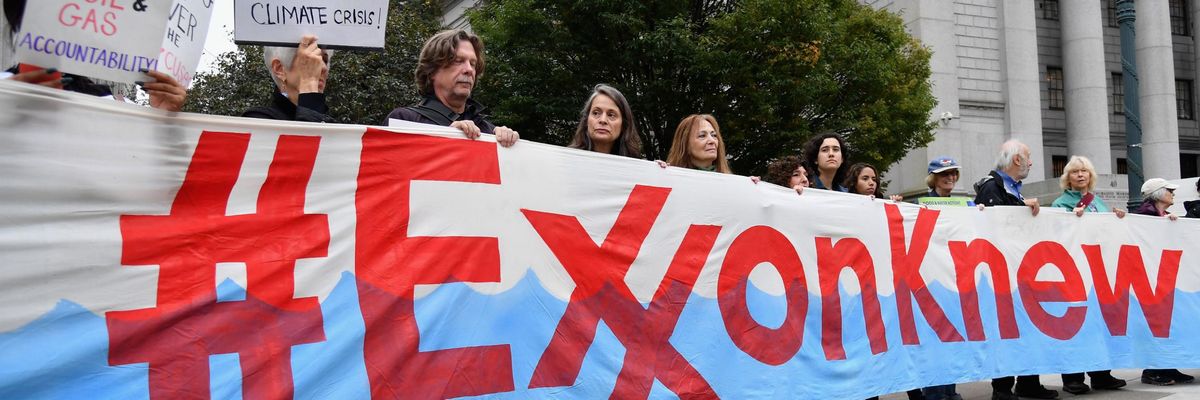
An investigation by HEATED and Earther revealed Wednesday that fossil fuel industry advertising in some of the most popular U.S. political newsletters "has exploded" as Democrats in Congress prepare to grill leaders of oil majors and trade groups about their contributions to climate disinformation.
"News outlets are using their own quality reporting to sell advertisers on opportunities to spread misinformation."
Journalists Emily Atkin and Molly Taft examined ads in Punchbowl News' daily political email newsletter as well as two climate-related newsletters, "Axios Generate" and Politico's "Morning Energy," leading up the U.S. House of Representatives hearing scheduled for Thursday.
The HEATED and Earther reporters found that from October 1 to October 22, 62% of Axios newsletters (10 of 16), 63% of Punchbowl newsletters (30 of 48), and 100% of Politico newsletters (15 of 15) "were sponsored by fossil fuel interests."
The pair noted the contrast with the past six months: From May 1 to October 22, those figures were 46% for Axios (51 of 112), 14% for Punchbowl (45 of 315), and 68% for Politico (78 of 115).
Though Chevron was the most frequent advertiser for the full period and content examined--57% or 99 of the 174 fossil fuel-sponsored newsletters since May--the report also highlights ads from the American Petroleum Institute (API) and ExxonMobil.
While the ad buyers didn't respond to requests for comment, representatives for Axios and Politico reportedly emphasized that newsletter content is independent from advertising.
However, "the responses appear to misunderstand the issue being raised," Atkin and Taft wrote. "No one has claimed Big Oil's ads influence the reporting at these news outlets. The issue is that news outlets are using their own quality reporting to sell advertisers on opportunities to spread misinformation on their platforms and making a lot of money from it."
The analysis of polluters' efforts to boost their Beltway influence and spread climate misinformation via email was published just a day before executives at BP America, Chevron, ExxonMobil, and Shell Oil, along with API and the U.S. Chamber of Commerce, are set to testify before the House Committee on Oversight and Reform in what is expected to be a "historic showdown."
Reps. Carolyn Maloney (D-N.Y.) and Ro Khanna (D-Calif.), who respectively chair the House panel and its Subcommittee on the Environment, had threatened to subpoena the industry leaders if they refused to show up for the hearing, entitled, "Fueling the Climate Crisis: Exposing Big Oil's Disinformation Campaign to Prevent Climate Action."
"This hearing is an important first step to stand up to polluters... but it cannot end here."
Khanna has vowed that the committee's event "will be like" the historic congressional inquiry that targeted Big Tobacco in the 1990s. Leading up to the hearing, climate campaigners reiterated their praise for the House Democrats' efforts and offered suggestions.
The watchdog group Accountable.US detailed five questions that Big Oil CEOs "must answer," focusing on everything from industry claims about pandemic-era bailouts to the ineffectiveness of voluntary climate mitigation methods to polluters' decades of denying and sowing doubt about science while knowing about the existential threat posed by fossil fuel use.
"For too long, oil companies have skirted responsibility for their harmful campaign of disinformation aimed at swaying Americans against commonsense policies to protect public lands and fight the climate crisis," said Accountable.US president Kyle Herrig.
"It shouldn't have taken several dodged hearings and a subpoena threat for these executives to come before Congress," he added. "With the American people watching, will these executives own up to their misinformation, or keep trying to hide behind lies and spin?"
Others emphasized their ongoing mistrust of the fossil fuel giants and trade groups.
"The U.S. Chamber of Commerce has spent decades denying the climate crisis and it is now sabotaging our nation's best shot at stopping climate catastrophe," Extinction Rebellion (XR) spokesperson Reilly Polka said in a statement Wednesday.
As Common Dreams reported earlier this month, during a climate-focused week of action in Washington, D.C., XR demonstrators targeted the trade group's office, dropping a banner that said, "Welcome to the Chamber of Climate Chaos."
Calling on the Chamber's members to "immediately abandon an organization that puts corporate wealth over people's health," Polka declared that "it's past time these companies stood on the right side of history--and with the people whose lives are being destroyed by the climate crisis."
Related Content

Josh Eisenfeld is a corporate accountability campaigner at Earthworks, which in March joined with Greenpeace USA and Global Witness to file a complaint with the Federal Trade Commission calling for an investigation into Chevron's "misleading" claims about its efforts to cut emissions.
"The world's largest polluters should not be able to claim they are climate-friendly, yet that is exactly what they are doing," Eisenfeld said Wednesday. "It is far past time for the companies behind the climate crisis to be held accountable for the harm they have done."
"This hearing is an important first step to stand up to polluters who profit off of the exploitation of ordinary people, especially Black, Indigenous, and people of color who suffer disproportionate impacts from extractive industries," he said, "but it cannot end here."
An investigation by HEATED and Earther revealed Wednesday that fossil fuel industry advertising in some of the most popular U.S. political newsletters "has exploded" as Democrats in Congress prepare to grill leaders of oil majors and trade groups about their contributions to climate disinformation.
"News outlets are using their own quality reporting to sell advertisers on opportunities to spread misinformation."
Journalists Emily Atkin and Molly Taft examined ads in Punchbowl News' daily political email newsletter as well as two climate-related newsletters, "Axios Generate" and Politico's "Morning Energy," leading up the U.S. House of Representatives hearing scheduled for Thursday.
The HEATED and Earther reporters found that from October 1 to October 22, 62% of Axios newsletters (10 of 16), 63% of Punchbowl newsletters (30 of 48), and 100% of Politico newsletters (15 of 15) "were sponsored by fossil fuel interests."
The pair noted the contrast with the past six months: From May 1 to October 22, those figures were 46% for Axios (51 of 112), 14% for Punchbowl (45 of 315), and 68% for Politico (78 of 115).
Though Chevron was the most frequent advertiser for the full period and content examined--57% or 99 of the 174 fossil fuel-sponsored newsletters since May--the report also highlights ads from the American Petroleum Institute (API) and ExxonMobil.
While the ad buyers didn't respond to requests for comment, representatives for Axios and Politico reportedly emphasized that newsletter content is independent from advertising.
However, "the responses appear to misunderstand the issue being raised," Atkin and Taft wrote. "No one has claimed Big Oil's ads influence the reporting at these news outlets. The issue is that news outlets are using their own quality reporting to sell advertisers on opportunities to spread misinformation on their platforms and making a lot of money from it."
The analysis of polluters' efforts to boost their Beltway influence and spread climate misinformation via email was published just a day before executives at BP America, Chevron, ExxonMobil, and Shell Oil, along with API and the U.S. Chamber of Commerce, are set to testify before the House Committee on Oversight and Reform in what is expected to be a "historic showdown."
Reps. Carolyn Maloney (D-N.Y.) and Ro Khanna (D-Calif.), who respectively chair the House panel and its Subcommittee on the Environment, had threatened to subpoena the industry leaders if they refused to show up for the hearing, entitled, "Fueling the Climate Crisis: Exposing Big Oil's Disinformation Campaign to Prevent Climate Action."
"This hearing is an important first step to stand up to polluters... but it cannot end here."
Khanna has vowed that the committee's event "will be like" the historic congressional inquiry that targeted Big Tobacco in the 1990s. Leading up to the hearing, climate campaigners reiterated their praise for the House Democrats' efforts and offered suggestions.
The watchdog group Accountable.US detailed five questions that Big Oil CEOs "must answer," focusing on everything from industry claims about pandemic-era bailouts to the ineffectiveness of voluntary climate mitigation methods to polluters' decades of denying and sowing doubt about science while knowing about the existential threat posed by fossil fuel use.
"For too long, oil companies have skirted responsibility for their harmful campaign of disinformation aimed at swaying Americans against commonsense policies to protect public lands and fight the climate crisis," said Accountable.US president Kyle Herrig.
"It shouldn't have taken several dodged hearings and a subpoena threat for these executives to come before Congress," he added. "With the American people watching, will these executives own up to their misinformation, or keep trying to hide behind lies and spin?"
Others emphasized their ongoing mistrust of the fossil fuel giants and trade groups.
"The U.S. Chamber of Commerce has spent decades denying the climate crisis and it is now sabotaging our nation's best shot at stopping climate catastrophe," Extinction Rebellion (XR) spokesperson Reilly Polka said in a statement Wednesday.
As Common Dreams reported earlier this month, during a climate-focused week of action in Washington, D.C., XR demonstrators targeted the trade group's office, dropping a banner that said, "Welcome to the Chamber of Climate Chaos."
Calling on the Chamber's members to "immediately abandon an organization that puts corporate wealth over people's health," Polka declared that "it's past time these companies stood on the right side of history--and with the people whose lives are being destroyed by the climate crisis."
Related Content
Josh Eisenfeld is a corporate accountability campaigner at Earthworks, which in March joined with Greenpeace USA and Global Witness to file a complaint with the Federal Trade Commission calling for an investigation into Chevron's "misleading" claims about its efforts to cut emissions.
"The world's largest polluters should not be able to claim they are climate-friendly, yet that is exactly what they are doing," Eisenfeld said Wednesday. "It is far past time for the companies behind the climate crisis to be held accountable for the harm they have done."
"This hearing is an important first step to stand up to polluters who profit off of the exploitation of ordinary people, especially Black, Indigenous, and people of color who suffer disproportionate impacts from extractive industries," he said, "but it cannot end here."

