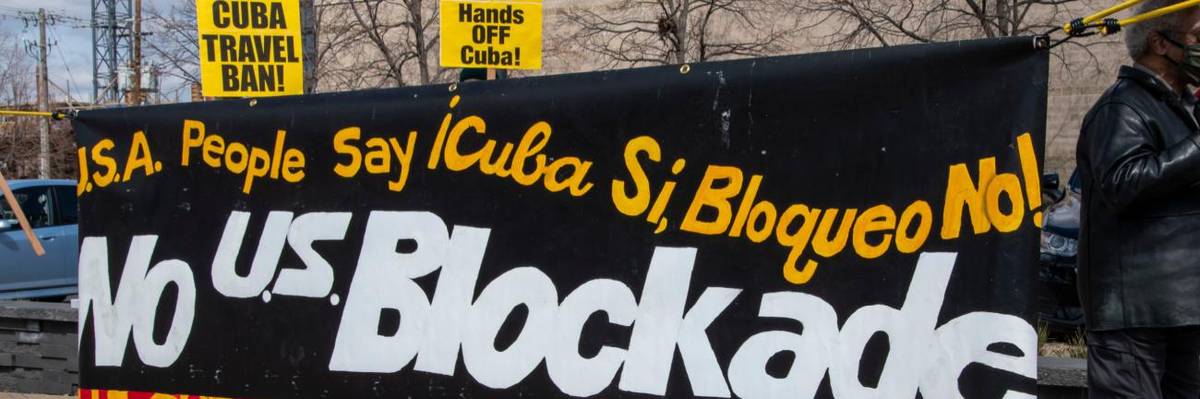
In Minneapolis, Minnesota in March 2021, protesters demand that the Biden administration take immediate action to reverse the economic sanctions imposed by former President Donald Trump on Cuba. (Photo by: Michael Siluk/Education Images/Universal Images Group via Getty Images)
Progressives Call on Biden to Lift U.S. Embargo on Cuba as Thousands Protest Critical Shortages
"The truth is that if one wanted to help Cuba, the first thing that should be done is to suspend the blockade of Cuba as the majority of countries in the world are asking," said Mexican President Andres Manuel Lopez Obrador.
Jul 12, 2021
Progressives in the U.S. and around the world on Monday demanded the Biden administration lift the U.S. trade embargo on Cuba and hundreds of sanctions on the country after thousands of Cubans protested the country's economic crisis, which has been worsened by the Covid-19 pandemic.
The protests in Havana and several smaller cities and towns made headlines Sunday, with major international outlets reporting on Cubans taking to the streets to express outrage over food and medicine shortages.
"Biden's Cuba policies, just like Trump's, are causing misery and could lead to chaos, violence, mass migration. This must stop!" --Medea Benjamin, CODEPINK
Demonstrators chanted, "Enough!" and "Freedom!" while one person told the Associated Press, "We are fed up with the queues, the shortages."
As The Economist reported earlier this month, food exports from the U.S. to Cuba, which imports about 70% of its food and relies heavily goods exported from the U.S., recently reached their lowest level since 2002.
Last month, The Intercept reported that the decades-long U.S. trade embargo against Cuba as well as sanctions imposed by the Trump administration and kept in place by President Joe Biden has kept Cuba from accessing "critical foreign-made medical supplies to treat its own population" during the pandemic, even as Cuba sent more than 2,000 medical professionals to help fight the global crisis in other countries.
According to The Intercept, large shipments of ventilators, masks, and syringes have been unable to reach Cuba since the pandemic began due to companies' financial ties to the United States.
Days before leaving office, former President Donald Trump designated Cuba as one of four state sponsors of international terrorism, along with North Korea, Iran, and Syria. The Biden administration has not lifted the designation, which "restricts Cuba's access to international financing as its economy emerges from a massive recession, having slid 11 percent in 2020," The Intercept reported.
While much of the international reporting on Cuba's protests over the weekend focused on anti-government sentiment on the island, activists including Medea Benjamin of CODEPINK said the clear solution to Cubans' economic woes lies in U.S. government policy changes.
"Biden's Cuba policies, just like Trump's, are causing misery and could lead to chaos, violence, mass migration," said Benjamin. "This must stop!"
The Trump administration barred most travel from the U.S. to Cuba and banned people in the U.S. from sending remittances to their relatives in the island nation, cutting off a major source of income for many--a policy that has yet to be lifted by Biden.
Last month, the U.S. delegation to the United Nations General Assembly was joined only by Israel in voting against a resolution to condemn the six-decade trade embargo imposed by the U.S. on Cuba; 184 countries voted for the resolution, which has passed every year for nearly three decades.
"Biden hasn't shown himself to be any different from Trump," Cuban journalist Laura Prado told CBS News after the U.N. vote. "What's needed is action and deeds."
Biden's State Department released a statement Sunday expressing support for the Cubans who were protesting, framing the issue as promoting the "right to peaceful assembly to express concern about rising Covid cases/deaths and medicine shortages."
"The U.S. has had no problem starving Cuba with a decades-long embargo that the entire world (minus Israel) condemns," said Assal Rad, a senior research fellow at NIAC Action. "If we care about Cubans, lift the embargo."
Others, including Miami's Democratic Socialists of America chapter and Progressive International, echoed the calls made by Rad and Benjamin, with Rep. Jim McGovern (D-Mass.) tweeting about the issue on Monday.
"The truth is that if one wanted to help Cuba, the first thing that should be done is to suspend the blockade of Cuba as the majority of countries in the world are asking," Mexico's leftist president, Andres Manuel Lopez Obrador, said Monday. "That would be a truly humanitarian gesture. No country in the world should be fenced in, blockaded."
David Adler, general coordinator for Progressive International, noted that the corporate U.S. media reported on Sunday's protests as though the embargo has little connection to Cubans' suffering. The blockade has barred U.S. trade with Cuba since 1962 and has cost the island an estimated $130 billion according to Cuban officials and the United Nations.
"So do reporters just not know that there's been a decades-long U.S.-led embargo targeting Cuba," asked Evan Greer, director of digital rights group Fight for the Future, "or they just don't think it's relevant to reporting on protests about food and medicine shortages?"
An Urgent Message From Our Co-Founder
Dear Common Dreams reader, It’s been nearly 30 years since I co-founded Common Dreams with my late wife, Lina Newhouser. We had the radical notion that journalism should serve the public good, not corporate profits. It was clear to us from the outset what it would take to build such a project. No paid advertisements. No corporate sponsors. No millionaire publisher telling us what to think or do. Many people said we wouldn't last a year, but we proved those doubters wrong. Together with a tremendous team of journalists and dedicated staff, we built an independent media outlet free from the constraints of profits and corporate control. Our mission has always been simple: To inform. To inspire. To ignite change for the common good. Building Common Dreams was not easy. Our survival was never guaranteed. When you take on the most powerful forces—Wall Street greed, fossil fuel industry destruction, Big Tech lobbyists, and uber-rich oligarchs who have spent billions upon billions rigging the economy and democracy in their favor—the only bulwark you have is supporters who believe in your work. But here’s the urgent message from me today. It's never been this bad out there. And it's never been this hard to keep us going. At the very moment Common Dreams is most needed, the threats we face are intensifying. We need your support now more than ever. We don't accept corporate advertising and never will. We don't have a paywall because we don't think people should be blocked from critical news based on their ability to pay. Everything we do is funded by the donations of readers like you. When everyone does the little they can afford, we are strong. But if that support retreats or dries up, so do we. Will you donate now to make sure Common Dreams not only survives but thrives? —Craig Brown, Co-founder |
Our work is licensed under Creative Commons (CC BY-NC-ND 3.0). Feel free to republish and share widely.
Progressives in the U.S. and around the world on Monday demanded the Biden administration lift the U.S. trade embargo on Cuba and hundreds of sanctions on the country after thousands of Cubans protested the country's economic crisis, which has been worsened by the Covid-19 pandemic.
The protests in Havana and several smaller cities and towns made headlines Sunday, with major international outlets reporting on Cubans taking to the streets to express outrage over food and medicine shortages.
"Biden's Cuba policies, just like Trump's, are causing misery and could lead to chaos, violence, mass migration. This must stop!" --Medea Benjamin, CODEPINK
Demonstrators chanted, "Enough!" and "Freedom!" while one person told the Associated Press, "We are fed up with the queues, the shortages."
As The Economist reported earlier this month, food exports from the U.S. to Cuba, which imports about 70% of its food and relies heavily goods exported from the U.S., recently reached their lowest level since 2002.
Last month, The Intercept reported that the decades-long U.S. trade embargo against Cuba as well as sanctions imposed by the Trump administration and kept in place by President Joe Biden has kept Cuba from accessing "critical foreign-made medical supplies to treat its own population" during the pandemic, even as Cuba sent more than 2,000 medical professionals to help fight the global crisis in other countries.
According to The Intercept, large shipments of ventilators, masks, and syringes have been unable to reach Cuba since the pandemic began due to companies' financial ties to the United States.
Days before leaving office, former President Donald Trump designated Cuba as one of four state sponsors of international terrorism, along with North Korea, Iran, and Syria. The Biden administration has not lifted the designation, which "restricts Cuba's access to international financing as its economy emerges from a massive recession, having slid 11 percent in 2020," The Intercept reported.
While much of the international reporting on Cuba's protests over the weekend focused on anti-government sentiment on the island, activists including Medea Benjamin of CODEPINK said the clear solution to Cubans' economic woes lies in U.S. government policy changes.
"Biden's Cuba policies, just like Trump's, are causing misery and could lead to chaos, violence, mass migration," said Benjamin. "This must stop!"
The Trump administration barred most travel from the U.S. to Cuba and banned people in the U.S. from sending remittances to their relatives in the island nation, cutting off a major source of income for many--a policy that has yet to be lifted by Biden.
Last month, the U.S. delegation to the United Nations General Assembly was joined only by Israel in voting against a resolution to condemn the six-decade trade embargo imposed by the U.S. on Cuba; 184 countries voted for the resolution, which has passed every year for nearly three decades.
"Biden hasn't shown himself to be any different from Trump," Cuban journalist Laura Prado told CBS News after the U.N. vote. "What's needed is action and deeds."
Biden's State Department released a statement Sunday expressing support for the Cubans who were protesting, framing the issue as promoting the "right to peaceful assembly to express concern about rising Covid cases/deaths and medicine shortages."
"The U.S. has had no problem starving Cuba with a decades-long embargo that the entire world (minus Israel) condemns," said Assal Rad, a senior research fellow at NIAC Action. "If we care about Cubans, lift the embargo."
Others, including Miami's Democratic Socialists of America chapter and Progressive International, echoed the calls made by Rad and Benjamin, with Rep. Jim McGovern (D-Mass.) tweeting about the issue on Monday.
"The truth is that if one wanted to help Cuba, the first thing that should be done is to suspend the blockade of Cuba as the majority of countries in the world are asking," Mexico's leftist president, Andres Manuel Lopez Obrador, said Monday. "That would be a truly humanitarian gesture. No country in the world should be fenced in, blockaded."
David Adler, general coordinator for Progressive International, noted that the corporate U.S. media reported on Sunday's protests as though the embargo has little connection to Cubans' suffering. The blockade has barred U.S. trade with Cuba since 1962 and has cost the island an estimated $130 billion according to Cuban officials and the United Nations.
"So do reporters just not know that there's been a decades-long U.S.-led embargo targeting Cuba," asked Evan Greer, director of digital rights group Fight for the Future, "or they just don't think it's relevant to reporting on protests about food and medicine shortages?"
From Your Site Articles
- Mexican President Urges US to Stop Fueling Migration With Sanctions on Cuba, Venezuela ›
- US and Israel Only 'No' Votes as UN Members Demand End to 61-Year Cuba Embargo ›
- 'Two Genocidaires v. the World': US, Israel Oppose Lifting Cuba Blockade | Common Dreams ›
- Opinion | Lift the Cuban Trade Embargo Now | Common Dreams ›
Progressives in the U.S. and around the world on Monday demanded the Biden administration lift the U.S. trade embargo on Cuba and hundreds of sanctions on the country after thousands of Cubans protested the country's economic crisis, which has been worsened by the Covid-19 pandemic.
The protests in Havana and several smaller cities and towns made headlines Sunday, with major international outlets reporting on Cubans taking to the streets to express outrage over food and medicine shortages.
"Biden's Cuba policies, just like Trump's, are causing misery and could lead to chaos, violence, mass migration. This must stop!" --Medea Benjamin, CODEPINK
Demonstrators chanted, "Enough!" and "Freedom!" while one person told the Associated Press, "We are fed up with the queues, the shortages."
As The Economist reported earlier this month, food exports from the U.S. to Cuba, which imports about 70% of its food and relies heavily goods exported from the U.S., recently reached their lowest level since 2002.
Last month, The Intercept reported that the decades-long U.S. trade embargo against Cuba as well as sanctions imposed by the Trump administration and kept in place by President Joe Biden has kept Cuba from accessing "critical foreign-made medical supplies to treat its own population" during the pandemic, even as Cuba sent more than 2,000 medical professionals to help fight the global crisis in other countries.
According to The Intercept, large shipments of ventilators, masks, and syringes have been unable to reach Cuba since the pandemic began due to companies' financial ties to the United States.
Days before leaving office, former President Donald Trump designated Cuba as one of four state sponsors of international terrorism, along with North Korea, Iran, and Syria. The Biden administration has not lifted the designation, which "restricts Cuba's access to international financing as its economy emerges from a massive recession, having slid 11 percent in 2020," The Intercept reported.
While much of the international reporting on Cuba's protests over the weekend focused on anti-government sentiment on the island, activists including Medea Benjamin of CODEPINK said the clear solution to Cubans' economic woes lies in U.S. government policy changes.
"Biden's Cuba policies, just like Trump's, are causing misery and could lead to chaos, violence, mass migration," said Benjamin. "This must stop!"
The Trump administration barred most travel from the U.S. to Cuba and banned people in the U.S. from sending remittances to their relatives in the island nation, cutting off a major source of income for many--a policy that has yet to be lifted by Biden.
Last month, the U.S. delegation to the United Nations General Assembly was joined only by Israel in voting against a resolution to condemn the six-decade trade embargo imposed by the U.S. on Cuba; 184 countries voted for the resolution, which has passed every year for nearly three decades.
"Biden hasn't shown himself to be any different from Trump," Cuban journalist Laura Prado told CBS News after the U.N. vote. "What's needed is action and deeds."
Biden's State Department released a statement Sunday expressing support for the Cubans who were protesting, framing the issue as promoting the "right to peaceful assembly to express concern about rising Covid cases/deaths and medicine shortages."
"The U.S. has had no problem starving Cuba with a decades-long embargo that the entire world (minus Israel) condemns," said Assal Rad, a senior research fellow at NIAC Action. "If we care about Cubans, lift the embargo."
Others, including Miami's Democratic Socialists of America chapter and Progressive International, echoed the calls made by Rad and Benjamin, with Rep. Jim McGovern (D-Mass.) tweeting about the issue on Monday.
"The truth is that if one wanted to help Cuba, the first thing that should be done is to suspend the blockade of Cuba as the majority of countries in the world are asking," Mexico's leftist president, Andres Manuel Lopez Obrador, said Monday. "That would be a truly humanitarian gesture. No country in the world should be fenced in, blockaded."
David Adler, general coordinator for Progressive International, noted that the corporate U.S. media reported on Sunday's protests as though the embargo has little connection to Cubans' suffering. The blockade has barred U.S. trade with Cuba since 1962 and has cost the island an estimated $130 billion according to Cuban officials and the United Nations.
"So do reporters just not know that there's been a decades-long U.S.-led embargo targeting Cuba," asked Evan Greer, director of digital rights group Fight for the Future, "or they just don't think it's relevant to reporting on protests about food and medicine shortages?"
From Your Site Articles
- Mexican President Urges US to Stop Fueling Migration With Sanctions on Cuba, Venezuela ›
- US and Israel Only 'No' Votes as UN Members Demand End to 61-Year Cuba Embargo ›
- 'Two Genocidaires v. the World': US, Israel Oppose Lifting Cuba Blockade | Common Dreams ›
- Opinion | Lift the Cuban Trade Embargo Now | Common Dreams ›
We've had enough. The 1% own and operate the corporate media. They are doing everything they can to defend the status quo, squash dissent and protect the wealthy and the powerful. The Common Dreams media model is different. We cover the news that matters to the 99%. Our mission? To inform. To inspire. To ignite change for the common good. How? Nonprofit. Independent. Reader-supported. Free to read. Free to republish. Free to share. With no advertising. No paywalls. No selling of your data. Thousands of small donations fund our newsroom and allow us to continue publishing. Can you chip in? We can't do it without you. Thank you.