SUBSCRIBE TO OUR FREE NEWSLETTER
Daily news & progressive opinion—funded by the people, not the corporations—delivered straight to your inbox.
5
#000000
#FFFFFF
To donate by check, phone, or other method, see our More Ways to Give page.
Daily news & progressive opinion—funded by the people, not the corporations—delivered straight to your inbox.
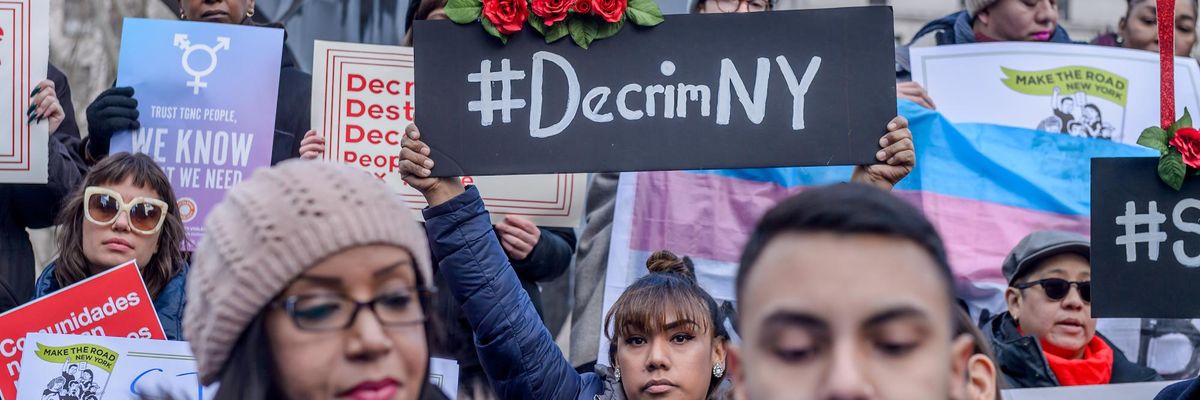
LGBTQ+, immigrant rights, harm reduction, and criminal justice reform groups, led by people who trade sex, launched a 20+ organization coalition, Decrim NY, to decriminalize and decarcerate the sex trades in New York City and state. (Photo: Erik McGregor/LightRocket via Getty Images)
The Manhattan district attorney's office in New York announced Wednesday what it called a "paradigm shift" by saying it will no longer prosecute prostitution and unlicensed massage.
"Over the last decade we've learned from those with lived experience, and from our own experience on the ground: criminally prosecuting prostitution does not make us safer, and too often, achieves the opposite result by further marginalizing vulnerable New Yorkers," District Attorney Cy Vance said in a statement. "For years, rather than seeking criminal convictions, my office has reformed its practice to offer services to individuals arrested for prostitution. Now, we will decline to prosecute these arrests outright, providing services and supports solely on a voluntary basis."
At a virtual court appearance, Vance said his office was dismissing 914 prostitution and "unlicensed massage" cases to reflect the new policy.
His office is also dismissing over 5,000 "loitering for the purpose of prostitution" cases. State lawmakers in February repealed the law that criminalized such loitering. Dubbed the "walking while trans" law, its critics say (pdf) the law was used to targt BIPOC and transgender communities.
"By vacating warrants, dismissing cases, and erasing convictions for these charges, we are completing a paradigm shift in our approach," Vance said, pointing the fact that many cases go back to the 1970s and 1980s.
Vance added that reforms would not have been possible "without the tireless work of dedicated individuals who changed not only our laws, but law enforcement's understanding of their lived experiences."
The move in New York follows similar steps already taken by other cities, as the New York Times noted:
Manhattan will join Baltimore, Philadelphia, and other jurisdictions that have declined to prosecute sex workers. Brooklyn also does not prosecute people arrested for prostitution, but instead refers them to social services before they are compelled to appear in court--unless the district attorney's office there is unable to reach them.
Abigail Swenstein, staff attorney with The Legal Aid Society's Exploitation Intervention Project, welcomed the development. "Countless sex workers, those profiled as sex workers, and trafficking victims have suffered under the weight of convictions and warrants," she said. "These perpetual punishments extend into family and immigration court, and impact our clients' ability to find stability through housing and employment."
"However," Swenstein added, "today's announcement should not supplant the need to pass legislation that would fully decriminalize sex work and provide for criminal record relief for people convicted of prostitution offense." She called on lawmakers to pass the Stop Violence in the Sex Trades Act, S6419, which would decriminalize sex work.
An analysis released in October by the ACLU provides evidence for that legislation, finding that full decriminalization of sex work better supported such workers' safety, health, and economic well-being compared to more restrictive and punitive approaches.
"Right now, millions of people are asking what we can do to reduce abuse by law enforcement, racial disparities in our criminal justice system, and our overall jail and prison populations," LaLa Zannell, the ACLU's Trans Justice campaign manager, said at the time.
"One policy that can achieve all of these goals--particularly for Black trans women and immigrants--is to recognize that sex work is work and treat it like any other industry," said Zannell. "Sex workers have been saying they face significant violence from police and clients for decades and it is time that we all listen to these voices when determining how to improve safety for sex workers."
This country and this world are at a monumental crossroads. US voters have an opportunity to beat back the forces of fascism and confront the billionaires who are rigging the economy, our media system, and our democracy, making it increasingly impossible for ordinary people to get by. We’re not just talking about the election. We’re talking about what must be done once these fascist elements are vanquished from power. We need a bolder set of solutions than what either major party has so far been willing to offer and a working-class movement ready to fight like hell for it. Trump didn't emerge from nowhere. The conditions that fueled MAGA authoritarianism were created by decades of radical neoliberal economic policies and a corrupt political system dominated by corporate interests. They slashed taxes on the super-rich, promising that the benefits would trickle down. They said giveaways to the corporate titans would make life more affordable for the rest of us. It was all bullshit. And when a bitter, betrayed populace searches for someone to blame, right-wing demagogues have little trouble finding scapegoats. People know when they're being lied to, but you won't hear any of this from the corporate media. Only independent journalism—powered and funded by people who believe in building a better world—can deliver truly trustworthy daily news. If you share our vision, please contribute whatever you can to sustain our work. |
The Manhattan district attorney's office in New York announced Wednesday what it called a "paradigm shift" by saying it will no longer prosecute prostitution and unlicensed massage.
"Over the last decade we've learned from those with lived experience, and from our own experience on the ground: criminally prosecuting prostitution does not make us safer, and too often, achieves the opposite result by further marginalizing vulnerable New Yorkers," District Attorney Cy Vance said in a statement. "For years, rather than seeking criminal convictions, my office has reformed its practice to offer services to individuals arrested for prostitution. Now, we will decline to prosecute these arrests outright, providing services and supports solely on a voluntary basis."
At a virtual court appearance, Vance said his office was dismissing 914 prostitution and "unlicensed massage" cases to reflect the new policy.
His office is also dismissing over 5,000 "loitering for the purpose of prostitution" cases. State lawmakers in February repealed the law that criminalized such loitering. Dubbed the "walking while trans" law, its critics say (pdf) the law was used to targt BIPOC and transgender communities.
"By vacating warrants, dismissing cases, and erasing convictions for these charges, we are completing a paradigm shift in our approach," Vance said, pointing the fact that many cases go back to the 1970s and 1980s.
Vance added that reforms would not have been possible "without the tireless work of dedicated individuals who changed not only our laws, but law enforcement's understanding of their lived experiences."
The move in New York follows similar steps already taken by other cities, as the New York Times noted:
Manhattan will join Baltimore, Philadelphia, and other jurisdictions that have declined to prosecute sex workers. Brooklyn also does not prosecute people arrested for prostitution, but instead refers them to social services before they are compelled to appear in court--unless the district attorney's office there is unable to reach them.
Abigail Swenstein, staff attorney with The Legal Aid Society's Exploitation Intervention Project, welcomed the development. "Countless sex workers, those profiled as sex workers, and trafficking victims have suffered under the weight of convictions and warrants," she said. "These perpetual punishments extend into family and immigration court, and impact our clients' ability to find stability through housing and employment."
"However," Swenstein added, "today's announcement should not supplant the need to pass legislation that would fully decriminalize sex work and provide for criminal record relief for people convicted of prostitution offense." She called on lawmakers to pass the Stop Violence in the Sex Trades Act, S6419, which would decriminalize sex work.
An analysis released in October by the ACLU provides evidence for that legislation, finding that full decriminalization of sex work better supported such workers' safety, health, and economic well-being compared to more restrictive and punitive approaches.
"Right now, millions of people are asking what we can do to reduce abuse by law enforcement, racial disparities in our criminal justice system, and our overall jail and prison populations," LaLa Zannell, the ACLU's Trans Justice campaign manager, said at the time.
"One policy that can achieve all of these goals--particularly for Black trans women and immigrants--is to recognize that sex work is work and treat it like any other industry," said Zannell. "Sex workers have been saying they face significant violence from police and clients for decades and it is time that we all listen to these voices when determining how to improve safety for sex workers."