

SUBSCRIBE TO OUR FREE NEWSLETTER
Daily news & progressive opinion—funded by the people, not the corporations—delivered straight to your inbox.
5
#000000
#FFFFFF
To donate by check, phone, or other method, see our More Ways to Give page.
Daily news & progressive opinion—funded by the people, not the corporations—delivered straight to your inbox.
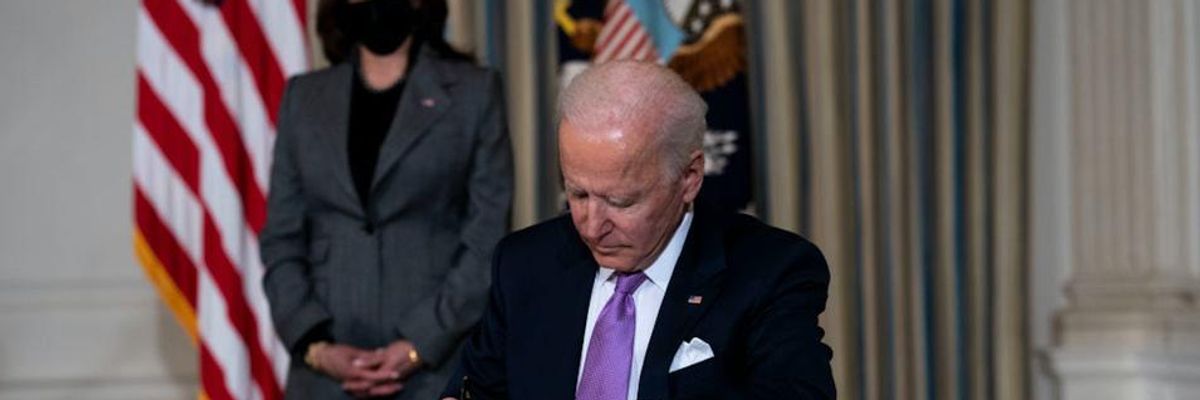
Vice President Kamala Harris looks on as President Joe Biden signs executives orders related to his racial equity agenda in the State Dining Room of the White House on January 26, 2021 in Washington, D.C. (Photo: Doug Mills/Getty Images)
Criminal justice reform advocates on Tuesday welcomed an executive order from President Joe Biden phasing out Department of Justice contracts with private prisons as a meaningful first step, even as the president faced criticism over the order's limited scope and impact.
"We've never fully lived up to the founding principles of this nation... that all people are created equal and have a right to be treated equally throughout their lives."
--President Joe Biden
In announcing Tuesday's orders, Biden acknowledged the wave of racial justice protests that swept the nation in the wake of last year's killing of George Floyd, an unarmed Black man, by Minneapolis police, which the president said "opened the eyes of millions."
"We've never fully lived up to the founding principles of this nation... that all people are created equal and have a right to be treated equally throughout their lives," Biden admitted, declaring that "now's the time to act."
"More than two million people are currently incarcerated in the United States, including a disproportionate number of people of color," the executive order states. "There is broad consensus that our current system of mass incarceration imposes significant costs and hardships on our society and communities and does not make us safer."
"To decrease incarceration levels, we must reduce profit-based incentives to incarcerate by phasing out the federal government's reliance on privately operated criminal detention facilities," it adds.
To that end, Biden's order directs the office of the attorney general--currently headed by Monty Wilkinson in an acting capacity pending the Senate confirmation of Merrick Garland--to "not renew Department of Justice contracts with privately operated criminal detention facilities."
The order will affect around 14,000 federal inmates currently incarcerated in private prisons, or about 9% of the federal prison population--and just 0.6% of the approximately 2.3 million people incarcerated in US prisons and jails. It does not apply to other federal agencies that contract with private prisons, including Immigration and Customs Enforcement (ICE) and the U.S. Marshals Service.
Progressive lawmakers, organizations, and advocates welcomed the order, even while many noted its considerable limitations.
The order on prisons was one of a set of racial equity measures enacted by Biden on Tuesday. The president also issued a memorandum ordering the Department of Housing and Urban Development to "redress historical racism in federal housing policies" and fully implement the requirements of the Fair Housing Act.
Additionally, he signed an executive order re-affirming the federal government's commitment to Indigenous sovereignty, and another memorandum condemning "racism, xenophobia, and intolerance" against Asian and Pacific Islander Americans, which has spiked during the coronavirus pandemic, in part due to racist rhetoric from former President Donald Trump.
Dorian Spence, director of special litigation and advocacy at the Lawyers' Committee for Civil Rights Under Law, issued a statement praising Biden's actions on Tuesday as a "welcome change."
"Following four years of the Trump administration turning a blind eye to racial inequity and injustice at every turn, we are pleased that this new administration is centering its focus around issues impacting the lives and reality faced by people of color in this country," he said.
"The forerunners of these executive orders and other future actions for racial equity were embodied in last summer's protests in the streets, and through a commitment from the millions of registered voters who turned out during a pandemic to vote in numbers not seen in our nation's history," Spence added.
Dear Common Dreams reader, It’s been nearly 30 years since I co-founded Common Dreams with my late wife, Lina Newhouser. We had the radical notion that journalism should serve the public good, not corporate profits. It was clear to us from the outset what it would take to build such a project. No paid advertisements. No corporate sponsors. No millionaire publisher telling us what to think or do. Many people said we wouldn't last a year, but we proved those doubters wrong. Together with a tremendous team of journalists and dedicated staff, we built an independent media outlet free from the constraints of profits and corporate control. Our mission has always been simple: To inform. To inspire. To ignite change for the common good. Building Common Dreams was not easy. Our survival was never guaranteed. When you take on the most powerful forces—Wall Street greed, fossil fuel industry destruction, Big Tech lobbyists, and uber-rich oligarchs who have spent billions upon billions rigging the economy and democracy in their favor—the only bulwark you have is supporters who believe in your work. But here’s the urgent message from me today. It's never been this bad out there. And it's never been this hard to keep us going. At the very moment Common Dreams is most needed, the threats we face are intensifying. We need your support now more than ever. We don't accept corporate advertising and never will. We don't have a paywall because we don't think people should be blocked from critical news based on their ability to pay. Everything we do is funded by the donations of readers like you. When everyone does the little they can afford, we are strong. But if that support retreats or dries up, so do we. Will you donate now to make sure Common Dreams not only survives but thrives? —Craig Brown, Co-founder |
Criminal justice reform advocates on Tuesday welcomed an executive order from President Joe Biden phasing out Department of Justice contracts with private prisons as a meaningful first step, even as the president faced criticism over the order's limited scope and impact.
"We've never fully lived up to the founding principles of this nation... that all people are created equal and have a right to be treated equally throughout their lives."
--President Joe Biden
In announcing Tuesday's orders, Biden acknowledged the wave of racial justice protests that swept the nation in the wake of last year's killing of George Floyd, an unarmed Black man, by Minneapolis police, which the president said "opened the eyes of millions."
"We've never fully lived up to the founding principles of this nation... that all people are created equal and have a right to be treated equally throughout their lives," Biden admitted, declaring that "now's the time to act."
"More than two million people are currently incarcerated in the United States, including a disproportionate number of people of color," the executive order states. "There is broad consensus that our current system of mass incarceration imposes significant costs and hardships on our society and communities and does not make us safer."
"To decrease incarceration levels, we must reduce profit-based incentives to incarcerate by phasing out the federal government's reliance on privately operated criminal detention facilities," it adds.
To that end, Biden's order directs the office of the attorney general--currently headed by Monty Wilkinson in an acting capacity pending the Senate confirmation of Merrick Garland--to "not renew Department of Justice contracts with privately operated criminal detention facilities."
The order will affect around 14,000 federal inmates currently incarcerated in private prisons, or about 9% of the federal prison population--and just 0.6% of the approximately 2.3 million people incarcerated in US prisons and jails. It does not apply to other federal agencies that contract with private prisons, including Immigration and Customs Enforcement (ICE) and the U.S. Marshals Service.
Progressive lawmakers, organizations, and advocates welcomed the order, even while many noted its considerable limitations.
The order on prisons was one of a set of racial equity measures enacted by Biden on Tuesday. The president also issued a memorandum ordering the Department of Housing and Urban Development to "redress historical racism in federal housing policies" and fully implement the requirements of the Fair Housing Act.
Additionally, he signed an executive order re-affirming the federal government's commitment to Indigenous sovereignty, and another memorandum condemning "racism, xenophobia, and intolerance" against Asian and Pacific Islander Americans, which has spiked during the coronavirus pandemic, in part due to racist rhetoric from former President Donald Trump.
Dorian Spence, director of special litigation and advocacy at the Lawyers' Committee for Civil Rights Under Law, issued a statement praising Biden's actions on Tuesday as a "welcome change."
"Following four years of the Trump administration turning a blind eye to racial inequity and injustice at every turn, we are pleased that this new administration is centering its focus around issues impacting the lives and reality faced by people of color in this country," he said.
"The forerunners of these executive orders and other future actions for racial equity were embodied in last summer's protests in the streets, and through a commitment from the millions of registered voters who turned out during a pandemic to vote in numbers not seen in our nation's history," Spence added.
Criminal justice reform advocates on Tuesday welcomed an executive order from President Joe Biden phasing out Department of Justice contracts with private prisons as a meaningful first step, even as the president faced criticism over the order's limited scope and impact.
"We've never fully lived up to the founding principles of this nation... that all people are created equal and have a right to be treated equally throughout their lives."
--President Joe Biden
In announcing Tuesday's orders, Biden acknowledged the wave of racial justice protests that swept the nation in the wake of last year's killing of George Floyd, an unarmed Black man, by Minneapolis police, which the president said "opened the eyes of millions."
"We've never fully lived up to the founding principles of this nation... that all people are created equal and have a right to be treated equally throughout their lives," Biden admitted, declaring that "now's the time to act."
"More than two million people are currently incarcerated in the United States, including a disproportionate number of people of color," the executive order states. "There is broad consensus that our current system of mass incarceration imposes significant costs and hardships on our society and communities and does not make us safer."
"To decrease incarceration levels, we must reduce profit-based incentives to incarcerate by phasing out the federal government's reliance on privately operated criminal detention facilities," it adds.
To that end, Biden's order directs the office of the attorney general--currently headed by Monty Wilkinson in an acting capacity pending the Senate confirmation of Merrick Garland--to "not renew Department of Justice contracts with privately operated criminal detention facilities."
The order will affect around 14,000 federal inmates currently incarcerated in private prisons, or about 9% of the federal prison population--and just 0.6% of the approximately 2.3 million people incarcerated in US prisons and jails. It does not apply to other federal agencies that contract with private prisons, including Immigration and Customs Enforcement (ICE) and the U.S. Marshals Service.
Progressive lawmakers, organizations, and advocates welcomed the order, even while many noted its considerable limitations.
The order on prisons was one of a set of racial equity measures enacted by Biden on Tuesday. The president also issued a memorandum ordering the Department of Housing and Urban Development to "redress historical racism in federal housing policies" and fully implement the requirements of the Fair Housing Act.
Additionally, he signed an executive order re-affirming the federal government's commitment to Indigenous sovereignty, and another memorandum condemning "racism, xenophobia, and intolerance" against Asian and Pacific Islander Americans, which has spiked during the coronavirus pandemic, in part due to racist rhetoric from former President Donald Trump.
Dorian Spence, director of special litigation and advocacy at the Lawyers' Committee for Civil Rights Under Law, issued a statement praising Biden's actions on Tuesday as a "welcome change."
"Following four years of the Trump administration turning a blind eye to racial inequity and injustice at every turn, we are pleased that this new administration is centering its focus around issues impacting the lives and reality faced by people of color in this country," he said.
"The forerunners of these executive orders and other future actions for racial equity were embodied in last summer's protests in the streets, and through a commitment from the millions of registered voters who turned out during a pandemic to vote in numbers not seen in our nation's history," Spence added.

