

SUBSCRIBE TO OUR FREE NEWSLETTER
Daily news & progressive opinion—funded by the people, not the corporations—delivered straight to your inbox.
5
#000000
#FFFFFF
To donate by check, phone, or other method, see our More Ways to Give page.
Daily news & progressive opinion—funded by the people, not the corporations—delivered straight to your inbox.
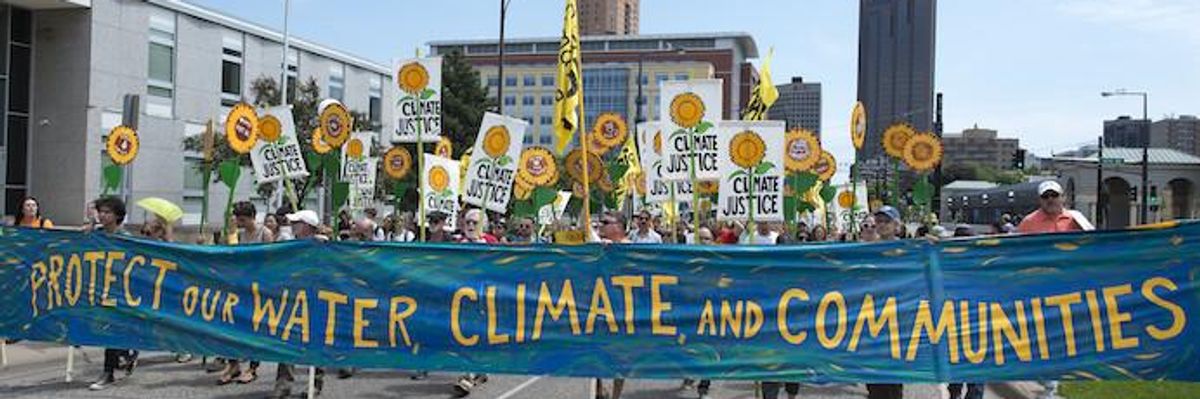
Demonstrators hold signs at an anti-tar sands march in St. Paul, Minnesota in 2015. (Photo: Fibonacci Blue/CC BY 2.0)
A group of Indigenous women and their allies on Monday urged the heads of major global financial institutions to stop propping up the tar sands industry and sever all ties with the sector's "climate-wrecking pipelines, as well as the massively destructive extraction projects that feed them."
The demand to the CEOs comes in an open letter (pdf) signed by over 40 Indigenous leaders including Rebecca Adamson, Cherokee and founder ofFirst Nations and First Peoples Worldwide; Tara Houska, Couchiching First Nation and founder of the Giniw Collective; and Winona LaDuke, White Earth Nation and executive director of Honor the Earth.
Supporting the call is a diverse group of over 150 organizations such as Another Gulf Is Possible Collaborative, Global Exchange, and Indigenous Environmental Network.
"It's time to move on. The most destructive and expensive oil in the world needs to stay in the ground," LaDuke said in a statement.
Beyond the tar sands sector's "grave threats to Indigenous rights, cultural survival, local waterways and environments, the global climate, and public health," the open letter says continued financing and insuring of tar sands projects just makes bad economic sense, noting that "no subsector has had a worse financial prognosis than tar sands oil."
"The current economic crisis has sent oil and gas prices, and particularly tar sands oil, plunging," the letter notes.
"Tar sands is one of the most carbon-intensive, expensive extraction processes in the industry, and these pipelines are likely to be stranded assets soon after they are built," the women wrote, referring to a scenario in which fossil fuels will have to stay in the ground.
The letter zeroes in on three specific pipelines as pivotal to future tar sands extraction--TC Energy's Keystone XL pipeline, Enbridge's Line 3 pipeline, and the Canadian government-owned Trans Mountain pipeline--each of which has faced sustained opposition. The economic impact of such opposition can't be denied, with the letter pointing to the "$25 billion in mining assets lost due to operations being tied up or shut down by community protests" in 2018.
What's more, the Indigenous leaders wrote, the "risk portfolio for extractive and land-based companies show[s] that 73% of company risk and delays are non-technical. Non-technical means community protests and boycotts that result in operational delays or shutdowns."
Should the CEOs fail to heed the demands laid out in the letter, further delays ought to be expected. "We will continue to resist the remaining proposed projects and hold the financial backers of these companies accountable," the letter states.
While the ecological harm of tar sands extraction and infrastructure has been repeatedly noted by fossil fuel critics, the letter points to new threats brought by the coronavirus crisis. The signatories point to the mulitple work sites in Alberta that have seen outbreaks of Covid-19 as extremely bad news for Indigenous communities who "are uniquely vulnerable to the virus's spread due to historically underfunded healthcare programs and significant health disparities."
In addition, an influx of project workers and so-called "man camps" bring particularly acute harm to Indigenous women:
Indigenous women in these rural areas are in peril. There is growing evidence that the epidemic of missing and murdered Indigenous women (MMIW) is directly linked to fossil fuel production. Workers relocate to construction sites to build pipelines, creating temporary housing communities known as "man camps" near the pipeline route, which is oftentimes on or next to tribal nation lands. Studies, reports, and Congressional hearings have found that man camps lead to increased rates of sexual violence and sexual trafficking.
"We need a just transition to renewable, sustainable energy, not expansion of fossil fuel extraction," the signatories declare. "We demand respect for our rights and sovereignty as Indigenous Peoples so that we can control our own lands, futures, and job opportunities."
The letter lays out a way forward for the financial institutions.
"Rather than exploit the tar sands sector for its last drops of profit in the face of climate crisis and disregard the health and safety of communities along pipeline routes, your company can accelerate a just transition for Indigenous nations, communities, and workers that depend on the industry for their livelihoods by publicly ruling out involvement in these tar sands projects and redirecting your insurance underwriting to communities and renewable, clean energy," the women wrote.
According to Joye Braun, Cheyenne River Sioux, organizer with Indigenous Environmental Network, the tar sands industry has been "nothing more than evil incarnate."
"We must put a stop to them," said Braun. "We must stand and say enough is enough. Join us in saving our future. Join us putting the proverbial nail in the coffin of these dying, unneeded industries."
Dear Common Dreams reader, It’s been nearly 30 years since I co-founded Common Dreams with my late wife, Lina Newhouser. We had the radical notion that journalism should serve the public good, not corporate profits. It was clear to us from the outset what it would take to build such a project. No paid advertisements. No corporate sponsors. No millionaire publisher telling us what to think or do. Many people said we wouldn't last a year, but we proved those doubters wrong. Together with a tremendous team of journalists and dedicated staff, we built an independent media outlet free from the constraints of profits and corporate control. Our mission has always been simple: To inform. To inspire. To ignite change for the common good. Building Common Dreams was not easy. Our survival was never guaranteed. When you take on the most powerful forces—Wall Street greed, fossil fuel industry destruction, Big Tech lobbyists, and uber-rich oligarchs who have spent billions upon billions rigging the economy and democracy in their favor—the only bulwark you have is supporters who believe in your work. But here’s the urgent message from me today. It's never been this bad out there. And it's never been this hard to keep us going. At the very moment Common Dreams is most needed, the threats we face are intensifying. We need your support now more than ever. We don't accept corporate advertising and never will. We don't have a paywall because we don't think people should be blocked from critical news based on their ability to pay. Everything we do is funded by the donations of readers like you. When everyone does the little they can afford, we are strong. But if that support retreats or dries up, so do we. Will you donate now to make sure Common Dreams not only survives but thrives? —Craig Brown, Co-founder |
A group of Indigenous women and their allies on Monday urged the heads of major global financial institutions to stop propping up the tar sands industry and sever all ties with the sector's "climate-wrecking pipelines, as well as the massively destructive extraction projects that feed them."
The demand to the CEOs comes in an open letter (pdf) signed by over 40 Indigenous leaders including Rebecca Adamson, Cherokee and founder ofFirst Nations and First Peoples Worldwide; Tara Houska, Couchiching First Nation and founder of the Giniw Collective; and Winona LaDuke, White Earth Nation and executive director of Honor the Earth.
Supporting the call is a diverse group of over 150 organizations such as Another Gulf Is Possible Collaborative, Global Exchange, and Indigenous Environmental Network.
"It's time to move on. The most destructive and expensive oil in the world needs to stay in the ground," LaDuke said in a statement.
Beyond the tar sands sector's "grave threats to Indigenous rights, cultural survival, local waterways and environments, the global climate, and public health," the open letter says continued financing and insuring of tar sands projects just makes bad economic sense, noting that "no subsector has had a worse financial prognosis than tar sands oil."
"The current economic crisis has sent oil and gas prices, and particularly tar sands oil, plunging," the letter notes.
"Tar sands is one of the most carbon-intensive, expensive extraction processes in the industry, and these pipelines are likely to be stranded assets soon after they are built," the women wrote, referring to a scenario in which fossil fuels will have to stay in the ground.
The letter zeroes in on three specific pipelines as pivotal to future tar sands extraction--TC Energy's Keystone XL pipeline, Enbridge's Line 3 pipeline, and the Canadian government-owned Trans Mountain pipeline--each of which has faced sustained opposition. The economic impact of such opposition can't be denied, with the letter pointing to the "$25 billion in mining assets lost due to operations being tied up or shut down by community protests" in 2018.
What's more, the Indigenous leaders wrote, the "risk portfolio for extractive and land-based companies show[s] that 73% of company risk and delays are non-technical. Non-technical means community protests and boycotts that result in operational delays or shutdowns."
Should the CEOs fail to heed the demands laid out in the letter, further delays ought to be expected. "We will continue to resist the remaining proposed projects and hold the financial backers of these companies accountable," the letter states.
While the ecological harm of tar sands extraction and infrastructure has been repeatedly noted by fossil fuel critics, the letter points to new threats brought by the coronavirus crisis. The signatories point to the mulitple work sites in Alberta that have seen outbreaks of Covid-19 as extremely bad news for Indigenous communities who "are uniquely vulnerable to the virus's spread due to historically underfunded healthcare programs and significant health disparities."
In addition, an influx of project workers and so-called "man camps" bring particularly acute harm to Indigenous women:
Indigenous women in these rural areas are in peril. There is growing evidence that the epidemic of missing and murdered Indigenous women (MMIW) is directly linked to fossil fuel production. Workers relocate to construction sites to build pipelines, creating temporary housing communities known as "man camps" near the pipeline route, which is oftentimes on or next to tribal nation lands. Studies, reports, and Congressional hearings have found that man camps lead to increased rates of sexual violence and sexual trafficking.
"We need a just transition to renewable, sustainable energy, not expansion of fossil fuel extraction," the signatories declare. "We demand respect for our rights and sovereignty as Indigenous Peoples so that we can control our own lands, futures, and job opportunities."
The letter lays out a way forward for the financial institutions.
"Rather than exploit the tar sands sector for its last drops of profit in the face of climate crisis and disregard the health and safety of communities along pipeline routes, your company can accelerate a just transition for Indigenous nations, communities, and workers that depend on the industry for their livelihoods by publicly ruling out involvement in these tar sands projects and redirecting your insurance underwriting to communities and renewable, clean energy," the women wrote.
According to Joye Braun, Cheyenne River Sioux, organizer with Indigenous Environmental Network, the tar sands industry has been "nothing more than evil incarnate."
"We must put a stop to them," said Braun. "We must stand and say enough is enough. Join us in saving our future. Join us putting the proverbial nail in the coffin of these dying, unneeded industries."
A group of Indigenous women and their allies on Monday urged the heads of major global financial institutions to stop propping up the tar sands industry and sever all ties with the sector's "climate-wrecking pipelines, as well as the massively destructive extraction projects that feed them."
The demand to the CEOs comes in an open letter (pdf) signed by over 40 Indigenous leaders including Rebecca Adamson, Cherokee and founder ofFirst Nations and First Peoples Worldwide; Tara Houska, Couchiching First Nation and founder of the Giniw Collective; and Winona LaDuke, White Earth Nation and executive director of Honor the Earth.
Supporting the call is a diverse group of over 150 organizations such as Another Gulf Is Possible Collaborative, Global Exchange, and Indigenous Environmental Network.
"It's time to move on. The most destructive and expensive oil in the world needs to stay in the ground," LaDuke said in a statement.
Beyond the tar sands sector's "grave threats to Indigenous rights, cultural survival, local waterways and environments, the global climate, and public health," the open letter says continued financing and insuring of tar sands projects just makes bad economic sense, noting that "no subsector has had a worse financial prognosis than tar sands oil."
"The current economic crisis has sent oil and gas prices, and particularly tar sands oil, plunging," the letter notes.
"Tar sands is one of the most carbon-intensive, expensive extraction processes in the industry, and these pipelines are likely to be stranded assets soon after they are built," the women wrote, referring to a scenario in which fossil fuels will have to stay in the ground.
The letter zeroes in on three specific pipelines as pivotal to future tar sands extraction--TC Energy's Keystone XL pipeline, Enbridge's Line 3 pipeline, and the Canadian government-owned Trans Mountain pipeline--each of which has faced sustained opposition. The economic impact of such opposition can't be denied, with the letter pointing to the "$25 billion in mining assets lost due to operations being tied up or shut down by community protests" in 2018.
What's more, the Indigenous leaders wrote, the "risk portfolio for extractive and land-based companies show[s] that 73% of company risk and delays are non-technical. Non-technical means community protests and boycotts that result in operational delays or shutdowns."
Should the CEOs fail to heed the demands laid out in the letter, further delays ought to be expected. "We will continue to resist the remaining proposed projects and hold the financial backers of these companies accountable," the letter states.
While the ecological harm of tar sands extraction and infrastructure has been repeatedly noted by fossil fuel critics, the letter points to new threats brought by the coronavirus crisis. The signatories point to the mulitple work sites in Alberta that have seen outbreaks of Covid-19 as extremely bad news for Indigenous communities who "are uniquely vulnerable to the virus's spread due to historically underfunded healthcare programs and significant health disparities."
In addition, an influx of project workers and so-called "man camps" bring particularly acute harm to Indigenous women:
Indigenous women in these rural areas are in peril. There is growing evidence that the epidemic of missing and murdered Indigenous women (MMIW) is directly linked to fossil fuel production. Workers relocate to construction sites to build pipelines, creating temporary housing communities known as "man camps" near the pipeline route, which is oftentimes on or next to tribal nation lands. Studies, reports, and Congressional hearings have found that man camps lead to increased rates of sexual violence and sexual trafficking.
"We need a just transition to renewable, sustainable energy, not expansion of fossil fuel extraction," the signatories declare. "We demand respect for our rights and sovereignty as Indigenous Peoples so that we can control our own lands, futures, and job opportunities."
The letter lays out a way forward for the financial institutions.
"Rather than exploit the tar sands sector for its last drops of profit in the face of climate crisis and disregard the health and safety of communities along pipeline routes, your company can accelerate a just transition for Indigenous nations, communities, and workers that depend on the industry for their livelihoods by publicly ruling out involvement in these tar sands projects and redirecting your insurance underwriting to communities and renewable, clean energy," the women wrote.
According to Joye Braun, Cheyenne River Sioux, organizer with Indigenous Environmental Network, the tar sands industry has been "nothing more than evil incarnate."
"We must put a stop to them," said Braun. "We must stand and say enough is enough. Join us in saving our future. Join us putting the proverbial nail in the coffin of these dying, unneeded industries."

