

SUBSCRIBE TO OUR FREE NEWSLETTER
Daily news & progressive opinion—funded by the people, not the corporations—delivered straight to your inbox.
5
#000000
#FFFFFF
To donate by check, phone, or other method, see our More Ways to Give page.
Daily news & progressive opinion—funded by the people, not the corporations—delivered straight to your inbox.
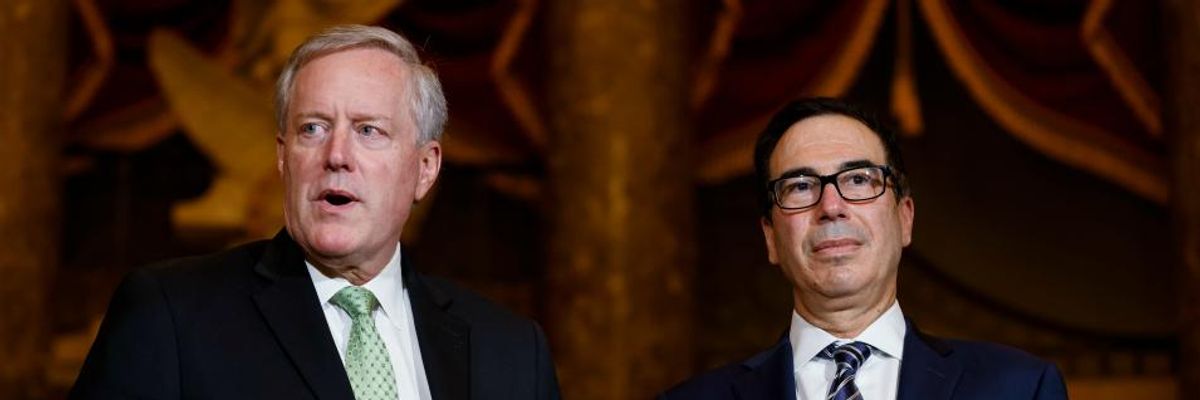
White House Chief of Staff Mark Meadows speaks to reporters alongside Treasury Secretary Steve Mnuchin following Covid-19 relief negotiations on Capitol Hill on August 6, 2020 in Washington, D.C. (Photo: Samuel Corum/Getty Images)
More than 20 million Americans don't have enough food to eat, 30 million have seen their incomes cut in half due to the expiration of boosted unemployment benefits, and 40 million could face eviction if Congress and the White House don't act.
But these coronavirus-induced human crises have not yet been enough to break the deadlock between the Trump administration and Democratic congressional leaders as the two sides remain far apart in relief talks that have dragged on for more than a week with little to no progress.
With their end-of-the-week deadline fast approaching, Treasury Secretary Steve Mnuchin and White House Chief of Staff Mark Meadows met Thursday with House Speaker Nancy Pelosi (D-Calif.) and Senate Minority Leader Chuck Schumer (D-N.Y.) and emerged after three hours seemingly no closer to a deal than they were before.
"Our country already has a public health crisis. We've already got an unemployment crisis. And with Republicans skipping town, now we've got a crisis of legislative malpractice."
--Sen. Ron Wyden
"We had what I would call a consequential meeting," Pelosi told reporters. "It was one where we could see the difference in values that we bring to the table. We have always said that the Republicans and the president do not understand the gravity of the situation and every time that we have met, it has been reinforced."
Though Schumer and Pelosi urged that negotiations continue until an agreement is reached on key issues like unemployment aid, money for state and local governments, and nutrition assistance, Mnuchin said Thursday that he is "not going to just keep on coming back every day if we can't get to a deal."
Politico reported this week that the White House offered Democratic leaders several "concessions," including $400-per-week in boosted unemployment benefits--an $800 monthly reduction from the previous level--and $150 billion in aid to state and local governments. Pelosi and Schumer rejected both as insufficient.
By the end of the day Thursday, many senators had already left Washington, D.C. for a long weekend with a green light from Senate Majority Leader Mitch McConnell (R-Ky.), who has largely remained on the sidelines throughout the bipartisan negotiations after unveiling a $1 trillion relief proposal that would have slashed boosted unemployment benefits by $1,600 per month.
"Is this just another Thursday?" Sen. Jeff Merkley (D-Ore.) asked in a speech on the Senate floor Thursday evening. "You wouldn't know we're in a terrible economic collapse based on the fact that the Majority Leader is treating this period of time like just another Thursday when everything's fine, everything's good in America."
On Twitter, Sen. Ron Wyden (D-Ore.) wrote that "Americans are dying and going hungry and Mitch McConnell just sent Republicans home for the weekend."
"Our country already has a public health crisis," Wyden added. "We've already got an unemployment crisis. And with Republicans skipping town, now we've got a crisis of legislative malpractice."
Failure by the White House and Congress to reach an agreement on additional relief spending could have catastrophic human consequences as Covid-19 infections continue to soar across the U.S. and the economic recovery sputters.
The Washington Post's Jeff Stein noted on Twitter that no deal means no additional aid to state and local governments, no new round of direct stimulus payments, no money for schools, no emergency funding for the U.S. Postal Service, no hazard pay for frontline workers, and no money for Covid-19 testing.
The Bureau of Labor Statistics announced Friday that the U.S. added 1.8 million jobs in July, a significant drop compared to 4.8 million in June and 2.7 million in May. Elise Gould, senior economist at the Economic Policy Institute, noted in a blog post that the U.S. is "still 12.9 million jobs below where we were in February, before the pandemic spread."
"Federal policymakers need to act now to reinstate the $600 unemployment insurance benefits to the 30+ million workers who are desperately trying to make ends meet," Gould wrote. "And, those benefits are supporting a huge amount of spending, which means, without it, the loss of about five million jobs."
"Federal policymakers also need to provide massive fiscal relief to state and local governments," added Gould, "so they can continue to provide necessary services and prevent unnecessary cuts to their budgets as their revenue falls."
In May, the Democrat-controlled House passed a bill proposing $1 trillion in aid to state and local governments and an extension of the $600-per-week unemployment insurance boost through January of next year. McConnell blocked the bill from even being considered on the Senate floor.
"They didn't act in the first week after the House acted," Merkley said of the Republican-controlled Senate. "Just treated it like another week. No concerns. Didn't act in the second week. Now we're 11 weeks since the House acted and still, the Majority Leader says, 'Don't worry, be happy.'"
"We will not go along with the meager legislative proposals that fail to address the gravity of the health and economic situation our country faces."
--House Speaker Nancy Pelosi and Senate Minority Leader Chuck Schumer
Mnuchin and Meadows are planning to meet once more with Pelosi and Schumer Friday afternoon. Speaking to reporters ahead of the meeting, Mnuchin said the two sides remain "very far apart" on aid to state and local governments facing massive budget shortfalls due to the Covid-19 crisis.
"The president is not going to do a deal that has a massive amount of money to bail out state and locals," said Mnuchin.
If the two sides don't reach a deal, Mnuchin said the president will move ahead with legally dubious executive orders to suspend collection of the payroll tax, extend enhanced unemployment benefits at an unspecified rate, and revive an expired eviction moratorium. Trump said he could sign the orders as early as Friday afternoon.
The Post reported that "any executive actions the president might take would likely provide much narrower relief than what a congressional deal could produce, even if they survived court challenges."
In a joint statement Friday morning, Pelosi and Schumer said they "remain committed to continue negotiating and reaching a fair agreement with the administration, but we will not go along with the meager legislative proposals that fail to address the gravity of the health and economic situation our country faces."
"Millions of Americans are still hurting," the Democratic leaders added. "And yet, despite this reality, President Trump and Republicans appear ready to walk away from the negotiating table to do unworkable, weak, and narrow executive orders that barely scratch the surface of what is needed to defeat the virus and help struggling Americans."
Dear Common Dreams reader, It’s been nearly 30 years since I co-founded Common Dreams with my late wife, Lina Newhouser. We had the radical notion that journalism should serve the public good, not corporate profits. It was clear to us from the outset what it would take to build such a project. No paid advertisements. No corporate sponsors. No millionaire publisher telling us what to think or do. Many people said we wouldn't last a year, but we proved those doubters wrong. Together with a tremendous team of journalists and dedicated staff, we built an independent media outlet free from the constraints of profits and corporate control. Our mission has always been simple: To inform. To inspire. To ignite change for the common good. Building Common Dreams was not easy. Our survival was never guaranteed. When you take on the most powerful forces—Wall Street greed, fossil fuel industry destruction, Big Tech lobbyists, and uber-rich oligarchs who have spent billions upon billions rigging the economy and democracy in their favor—the only bulwark you have is supporters who believe in your work. But here’s the urgent message from me today. It's never been this bad out there. And it's never been this hard to keep us going. At the very moment Common Dreams is most needed, the threats we face are intensifying. We need your support now more than ever. We don't accept corporate advertising and never will. We don't have a paywall because we don't think people should be blocked from critical news based on their ability to pay. Everything we do is funded by the donations of readers like you. When everyone does the little they can afford, we are strong. But if that support retreats or dries up, so do we. Will you donate now to make sure Common Dreams not only survives but thrives? —Craig Brown, Co-founder |
More than 20 million Americans don't have enough food to eat, 30 million have seen their incomes cut in half due to the expiration of boosted unemployment benefits, and 40 million could face eviction if Congress and the White House don't act.
But these coronavirus-induced human crises have not yet been enough to break the deadlock between the Trump administration and Democratic congressional leaders as the two sides remain far apart in relief talks that have dragged on for more than a week with little to no progress.
With their end-of-the-week deadline fast approaching, Treasury Secretary Steve Mnuchin and White House Chief of Staff Mark Meadows met Thursday with House Speaker Nancy Pelosi (D-Calif.) and Senate Minority Leader Chuck Schumer (D-N.Y.) and emerged after three hours seemingly no closer to a deal than they were before.
"Our country already has a public health crisis. We've already got an unemployment crisis. And with Republicans skipping town, now we've got a crisis of legislative malpractice."
--Sen. Ron Wyden
"We had what I would call a consequential meeting," Pelosi told reporters. "It was one where we could see the difference in values that we bring to the table. We have always said that the Republicans and the president do not understand the gravity of the situation and every time that we have met, it has been reinforced."
Though Schumer and Pelosi urged that negotiations continue until an agreement is reached on key issues like unemployment aid, money for state and local governments, and nutrition assistance, Mnuchin said Thursday that he is "not going to just keep on coming back every day if we can't get to a deal."
Politico reported this week that the White House offered Democratic leaders several "concessions," including $400-per-week in boosted unemployment benefits--an $800 monthly reduction from the previous level--and $150 billion in aid to state and local governments. Pelosi and Schumer rejected both as insufficient.
By the end of the day Thursday, many senators had already left Washington, D.C. for a long weekend with a green light from Senate Majority Leader Mitch McConnell (R-Ky.), who has largely remained on the sidelines throughout the bipartisan negotiations after unveiling a $1 trillion relief proposal that would have slashed boosted unemployment benefits by $1,600 per month.
"Is this just another Thursday?" Sen. Jeff Merkley (D-Ore.) asked in a speech on the Senate floor Thursday evening. "You wouldn't know we're in a terrible economic collapse based on the fact that the Majority Leader is treating this period of time like just another Thursday when everything's fine, everything's good in America."
On Twitter, Sen. Ron Wyden (D-Ore.) wrote that "Americans are dying and going hungry and Mitch McConnell just sent Republicans home for the weekend."
"Our country already has a public health crisis," Wyden added. "We've already got an unemployment crisis. And with Republicans skipping town, now we've got a crisis of legislative malpractice."
Failure by the White House and Congress to reach an agreement on additional relief spending could have catastrophic human consequences as Covid-19 infections continue to soar across the U.S. and the economic recovery sputters.
The Washington Post's Jeff Stein noted on Twitter that no deal means no additional aid to state and local governments, no new round of direct stimulus payments, no money for schools, no emergency funding for the U.S. Postal Service, no hazard pay for frontline workers, and no money for Covid-19 testing.
The Bureau of Labor Statistics announced Friday that the U.S. added 1.8 million jobs in July, a significant drop compared to 4.8 million in June and 2.7 million in May. Elise Gould, senior economist at the Economic Policy Institute, noted in a blog post that the U.S. is "still 12.9 million jobs below where we were in February, before the pandemic spread."
"Federal policymakers need to act now to reinstate the $600 unemployment insurance benefits to the 30+ million workers who are desperately trying to make ends meet," Gould wrote. "And, those benefits are supporting a huge amount of spending, which means, without it, the loss of about five million jobs."
"Federal policymakers also need to provide massive fiscal relief to state and local governments," added Gould, "so they can continue to provide necessary services and prevent unnecessary cuts to their budgets as their revenue falls."
In May, the Democrat-controlled House passed a bill proposing $1 trillion in aid to state and local governments and an extension of the $600-per-week unemployment insurance boost through January of next year. McConnell blocked the bill from even being considered on the Senate floor.
"They didn't act in the first week after the House acted," Merkley said of the Republican-controlled Senate. "Just treated it like another week. No concerns. Didn't act in the second week. Now we're 11 weeks since the House acted and still, the Majority Leader says, 'Don't worry, be happy.'"
"We will not go along with the meager legislative proposals that fail to address the gravity of the health and economic situation our country faces."
--House Speaker Nancy Pelosi and Senate Minority Leader Chuck Schumer
Mnuchin and Meadows are planning to meet once more with Pelosi and Schumer Friday afternoon. Speaking to reporters ahead of the meeting, Mnuchin said the two sides remain "very far apart" on aid to state and local governments facing massive budget shortfalls due to the Covid-19 crisis.
"The president is not going to do a deal that has a massive amount of money to bail out state and locals," said Mnuchin.
If the two sides don't reach a deal, Mnuchin said the president will move ahead with legally dubious executive orders to suspend collection of the payroll tax, extend enhanced unemployment benefits at an unspecified rate, and revive an expired eviction moratorium. Trump said he could sign the orders as early as Friday afternoon.
The Post reported that "any executive actions the president might take would likely provide much narrower relief than what a congressional deal could produce, even if they survived court challenges."
In a joint statement Friday morning, Pelosi and Schumer said they "remain committed to continue negotiating and reaching a fair agreement with the administration, but we will not go along with the meager legislative proposals that fail to address the gravity of the health and economic situation our country faces."
"Millions of Americans are still hurting," the Democratic leaders added. "And yet, despite this reality, President Trump and Republicans appear ready to walk away from the negotiating table to do unworkable, weak, and narrow executive orders that barely scratch the surface of what is needed to defeat the virus and help struggling Americans."
More than 20 million Americans don't have enough food to eat, 30 million have seen their incomes cut in half due to the expiration of boosted unemployment benefits, and 40 million could face eviction if Congress and the White House don't act.
But these coronavirus-induced human crises have not yet been enough to break the deadlock between the Trump administration and Democratic congressional leaders as the two sides remain far apart in relief talks that have dragged on for more than a week with little to no progress.
With their end-of-the-week deadline fast approaching, Treasury Secretary Steve Mnuchin and White House Chief of Staff Mark Meadows met Thursday with House Speaker Nancy Pelosi (D-Calif.) and Senate Minority Leader Chuck Schumer (D-N.Y.) and emerged after three hours seemingly no closer to a deal than they were before.
"Our country already has a public health crisis. We've already got an unemployment crisis. And with Republicans skipping town, now we've got a crisis of legislative malpractice."
--Sen. Ron Wyden
"We had what I would call a consequential meeting," Pelosi told reporters. "It was one where we could see the difference in values that we bring to the table. We have always said that the Republicans and the president do not understand the gravity of the situation and every time that we have met, it has been reinforced."
Though Schumer and Pelosi urged that negotiations continue until an agreement is reached on key issues like unemployment aid, money for state and local governments, and nutrition assistance, Mnuchin said Thursday that he is "not going to just keep on coming back every day if we can't get to a deal."
Politico reported this week that the White House offered Democratic leaders several "concessions," including $400-per-week in boosted unemployment benefits--an $800 monthly reduction from the previous level--and $150 billion in aid to state and local governments. Pelosi and Schumer rejected both as insufficient.
By the end of the day Thursday, many senators had already left Washington, D.C. for a long weekend with a green light from Senate Majority Leader Mitch McConnell (R-Ky.), who has largely remained on the sidelines throughout the bipartisan negotiations after unveiling a $1 trillion relief proposal that would have slashed boosted unemployment benefits by $1,600 per month.
"Is this just another Thursday?" Sen. Jeff Merkley (D-Ore.) asked in a speech on the Senate floor Thursday evening. "You wouldn't know we're in a terrible economic collapse based on the fact that the Majority Leader is treating this period of time like just another Thursday when everything's fine, everything's good in America."
On Twitter, Sen. Ron Wyden (D-Ore.) wrote that "Americans are dying and going hungry and Mitch McConnell just sent Republicans home for the weekend."
"Our country already has a public health crisis," Wyden added. "We've already got an unemployment crisis. And with Republicans skipping town, now we've got a crisis of legislative malpractice."
Failure by the White House and Congress to reach an agreement on additional relief spending could have catastrophic human consequences as Covid-19 infections continue to soar across the U.S. and the economic recovery sputters.
The Washington Post's Jeff Stein noted on Twitter that no deal means no additional aid to state and local governments, no new round of direct stimulus payments, no money for schools, no emergency funding for the U.S. Postal Service, no hazard pay for frontline workers, and no money for Covid-19 testing.
The Bureau of Labor Statistics announced Friday that the U.S. added 1.8 million jobs in July, a significant drop compared to 4.8 million in June and 2.7 million in May. Elise Gould, senior economist at the Economic Policy Institute, noted in a blog post that the U.S. is "still 12.9 million jobs below where we were in February, before the pandemic spread."
"Federal policymakers need to act now to reinstate the $600 unemployment insurance benefits to the 30+ million workers who are desperately trying to make ends meet," Gould wrote. "And, those benefits are supporting a huge amount of spending, which means, without it, the loss of about five million jobs."
"Federal policymakers also need to provide massive fiscal relief to state and local governments," added Gould, "so they can continue to provide necessary services and prevent unnecessary cuts to their budgets as their revenue falls."
In May, the Democrat-controlled House passed a bill proposing $1 trillion in aid to state and local governments and an extension of the $600-per-week unemployment insurance boost through January of next year. McConnell blocked the bill from even being considered on the Senate floor.
"They didn't act in the first week after the House acted," Merkley said of the Republican-controlled Senate. "Just treated it like another week. No concerns. Didn't act in the second week. Now we're 11 weeks since the House acted and still, the Majority Leader says, 'Don't worry, be happy.'"
"We will not go along with the meager legislative proposals that fail to address the gravity of the health and economic situation our country faces."
--House Speaker Nancy Pelosi and Senate Minority Leader Chuck Schumer
Mnuchin and Meadows are planning to meet once more with Pelosi and Schumer Friday afternoon. Speaking to reporters ahead of the meeting, Mnuchin said the two sides remain "very far apart" on aid to state and local governments facing massive budget shortfalls due to the Covid-19 crisis.
"The president is not going to do a deal that has a massive amount of money to bail out state and locals," said Mnuchin.
If the two sides don't reach a deal, Mnuchin said the president will move ahead with legally dubious executive orders to suspend collection of the payroll tax, extend enhanced unemployment benefits at an unspecified rate, and revive an expired eviction moratorium. Trump said he could sign the orders as early as Friday afternoon.
The Post reported that "any executive actions the president might take would likely provide much narrower relief than what a congressional deal could produce, even if they survived court challenges."
In a joint statement Friday morning, Pelosi and Schumer said they "remain committed to continue negotiating and reaching a fair agreement with the administration, but we will not go along with the meager legislative proposals that fail to address the gravity of the health and economic situation our country faces."
"Millions of Americans are still hurting," the Democratic leaders added. "And yet, despite this reality, President Trump and Republicans appear ready to walk away from the negotiating table to do unworkable, weak, and narrow executive orders that barely scratch the surface of what is needed to defeat the virus and help struggling Americans."

