SUBSCRIBE TO OUR FREE NEWSLETTER
Daily news & progressive opinion—funded by the people, not the corporations—delivered straight to your inbox.
5
#000000
#FFFFFF
To donate by check, phone, or other method, see our More Ways to Give page.
Daily news & progressive opinion—funded by the people, not the corporations—delivered straight to your inbox.
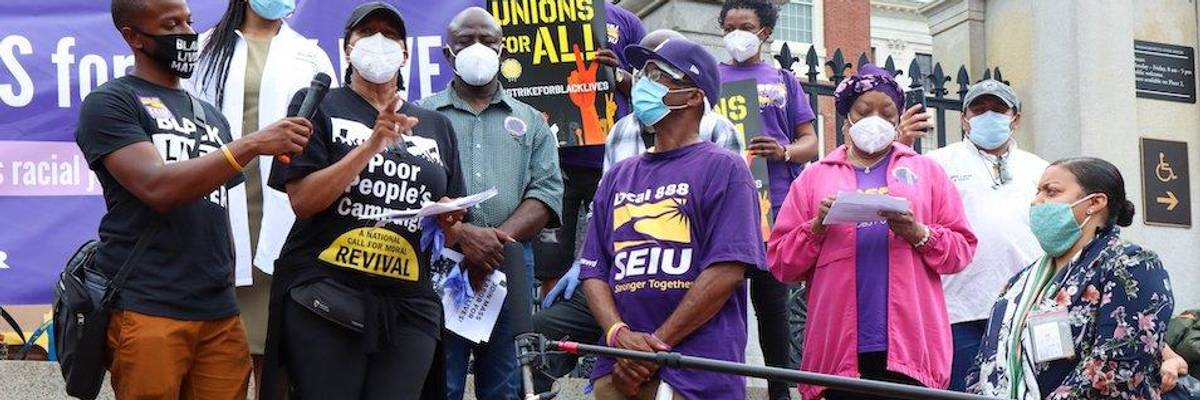
Striking workers from the SEIU for Monday's action. (Photo: Sen. Ed Markey)
Thousands of workers in over 100 U.S. cities on Monday are on strike for Black lives and racial justice as demonstrations against the American economic and political system and the abuses of law enforcement continue into their second month since the killing of George Floyd by Minneapolis police officers.
"The Strike for Black Lives is a moment of reckoning for corporations that have long ignored the concerns of their Black workforce and denied them better working conditions, living wages, and healthcare," Tennessee-based Movement for Black Lives organizer Ash-Lee Henderson told the Associated Press.
"We're risking our lives going to work and still getting the same poverty wages, and I don't think that's fair," said Adriana Alvarez, a striking McDonald's worker in Chicago. "I'm raising my eight-year-old son on my own, and I shouldn't have to choose between our health, or having food on the table for us."
The strike movement claims over 50 groups in support, including the Service Employees International Union (SEIU), which was the lead organizer of the action along with the Movement for Black Lives (M4BL). SEIU president Mary Kay Henry joined M4BL national field director Karissa Lewis in an opinion piece for Salon Monday explaining "Why We're Striking."
As Lewis and Henry wrote:
The current pandemic of Covid-19 and the generational pandemic of violence against Black lives have brought some truths into sharp relief. As tens of millions of people have worked without personal protective equipment or paid sick time, it has become clear to us all: Workers, those we have recently taken to calling "essential," are the cornerstone of our social and economic well-being. These are disproportionately Black and brown workers. As we enter further and further into an economic depression, it's become clear that for so many communities, it is time to take action that pushes elected officials and CEOs to dismantle racism and white supremacy in the workplace. Our fights for racial, economic, health care, gender, climate, and immigration justice are all connected. We are connected, as well.
"We're on strike for racial justice and economic justice in society and at work," striking Detroit nursing home worker Trece Andrews said. "We can't have one without the other. They go hand in hand."
The Labor Network for Sustainability said in a press release supporting the movement that it was important for Black workers to come together to withhold their labor as a check on corporate power.
"Until Black people can thrive, none of our communities can, which means we cannot succeed in our movement toward a society that is economically just and ecologically sustainable," the group said.
The strike calls for four major reforms:
"When we talk about racial justice it's not just a call for diversity and inclusion, or to send out a tweet that 'Black Lives Matter,'" Cherrell Brown, lead organizer for strike-supporting organization 350.org, said in a statement. "It's about disrupting and dismantling all the ways racialized violence harms our communities, whether at the hands of fossil fuel companies, greedy CEOs and corporations, or police and prisons."
Progressive politicians expressed support for the movement as well, with Sen. Ed Markey (D-Mass.) joining striking workers from the SEIU.
"Workers are rising up across the country to say that economic justice is racial justice," tweeted Markey.
Other progressive lawmakers, including Reps. Ayanna Pressley (D-Mass.) and Ro Khanna (D-Calif.), also weighed in on Twitter.
Guillermo Garcia, striking farmworker, said in a statement in Spanish that he joined the strike to show solidarity.
"Today we are joining the Strike for Black Lives to demand an end to racism," said Garcia. "We face racism as well; often while we work alongside the main road, passersby yell racial slurs as we harvest the vegetables. I feed the world. Black and Brown division is created and perpetuated to make profit. Our collective liberation is linked, and together we will win. Si Se Puede--yes we can."
Dear Common Dreams reader, It’s been nearly 30 years since I co-founded Common Dreams with my late wife, Lina Newhouser. We had the radical notion that journalism should serve the public good, not corporate profits. It was clear to us from the outset what it would take to build such a project. No paid advertisements. No corporate sponsors. No millionaire publisher telling us what to think or do. Many people said we wouldn't last a year, but we proved those doubters wrong. Together with a tremendous team of journalists and dedicated staff, we built an independent media outlet free from the constraints of profits and corporate control. Our mission has always been simple: To inform. To inspire. To ignite change for the common good. Building Common Dreams was not easy. Our survival was never guaranteed. When you take on the most powerful forces—Wall Street greed, fossil fuel industry destruction, Big Tech lobbyists, and uber-rich oligarchs who have spent billions upon billions rigging the economy and democracy in their favor—the only bulwark you have is supporters who believe in your work. But here’s the urgent message from me today. It's never been this bad out there. And it's never been this hard to keep us going. At the very moment Common Dreams is most needed, the threats we face are intensifying. We need your support now more than ever. We don't accept corporate advertising and never will. We don't have a paywall because we don't think people should be blocked from critical news based on their ability to pay. Everything we do is funded by the donations of readers like you. When everyone does the little they can afford, we are strong. But if that support retreats or dries up, so do we. Will you donate now to make sure Common Dreams not only survives but thrives? —Craig Brown, Co-founder |
Thousands of workers in over 100 U.S. cities on Monday are on strike for Black lives and racial justice as demonstrations against the American economic and political system and the abuses of law enforcement continue into their second month since the killing of George Floyd by Minneapolis police officers.
"The Strike for Black Lives is a moment of reckoning for corporations that have long ignored the concerns of their Black workforce and denied them better working conditions, living wages, and healthcare," Tennessee-based Movement for Black Lives organizer Ash-Lee Henderson told the Associated Press.
"We're risking our lives going to work and still getting the same poverty wages, and I don't think that's fair," said Adriana Alvarez, a striking McDonald's worker in Chicago. "I'm raising my eight-year-old son on my own, and I shouldn't have to choose between our health, or having food on the table for us."
The strike movement claims over 50 groups in support, including the Service Employees International Union (SEIU), which was the lead organizer of the action along with the Movement for Black Lives (M4BL). SEIU president Mary Kay Henry joined M4BL national field director Karissa Lewis in an opinion piece for Salon Monday explaining "Why We're Striking."
As Lewis and Henry wrote:
The current pandemic of Covid-19 and the generational pandemic of violence against Black lives have brought some truths into sharp relief. As tens of millions of people have worked without personal protective equipment or paid sick time, it has become clear to us all: Workers, those we have recently taken to calling "essential," are the cornerstone of our social and economic well-being. These are disproportionately Black and brown workers. As we enter further and further into an economic depression, it's become clear that for so many communities, it is time to take action that pushes elected officials and CEOs to dismantle racism and white supremacy in the workplace. Our fights for racial, economic, health care, gender, climate, and immigration justice are all connected. We are connected, as well.
"We're on strike for racial justice and economic justice in society and at work," striking Detroit nursing home worker Trece Andrews said. "We can't have one without the other. They go hand in hand."
The Labor Network for Sustainability said in a press release supporting the movement that it was important for Black workers to come together to withhold their labor as a check on corporate power.
"Until Black people can thrive, none of our communities can, which means we cannot succeed in our movement toward a society that is economically just and ecologically sustainable," the group said.
The strike calls for four major reforms:
"When we talk about racial justice it's not just a call for diversity and inclusion, or to send out a tweet that 'Black Lives Matter,'" Cherrell Brown, lead organizer for strike-supporting organization 350.org, said in a statement. "It's about disrupting and dismantling all the ways racialized violence harms our communities, whether at the hands of fossil fuel companies, greedy CEOs and corporations, or police and prisons."
Progressive politicians expressed support for the movement as well, with Sen. Ed Markey (D-Mass.) joining striking workers from the SEIU.
"Workers are rising up across the country to say that economic justice is racial justice," tweeted Markey.
Other progressive lawmakers, including Reps. Ayanna Pressley (D-Mass.) and Ro Khanna (D-Calif.), also weighed in on Twitter.
Guillermo Garcia, striking farmworker, said in a statement in Spanish that he joined the strike to show solidarity.
"Today we are joining the Strike for Black Lives to demand an end to racism," said Garcia. "We face racism as well; often while we work alongside the main road, passersby yell racial slurs as we harvest the vegetables. I feed the world. Black and Brown division is created and perpetuated to make profit. Our collective liberation is linked, and together we will win. Si Se Puede--yes we can."
Thousands of workers in over 100 U.S. cities on Monday are on strike for Black lives and racial justice as demonstrations against the American economic and political system and the abuses of law enforcement continue into their second month since the killing of George Floyd by Minneapolis police officers.
"The Strike for Black Lives is a moment of reckoning for corporations that have long ignored the concerns of their Black workforce and denied them better working conditions, living wages, and healthcare," Tennessee-based Movement for Black Lives organizer Ash-Lee Henderson told the Associated Press.
"We're risking our lives going to work and still getting the same poverty wages, and I don't think that's fair," said Adriana Alvarez, a striking McDonald's worker in Chicago. "I'm raising my eight-year-old son on my own, and I shouldn't have to choose between our health, or having food on the table for us."
The strike movement claims over 50 groups in support, including the Service Employees International Union (SEIU), which was the lead organizer of the action along with the Movement for Black Lives (M4BL). SEIU president Mary Kay Henry joined M4BL national field director Karissa Lewis in an opinion piece for Salon Monday explaining "Why We're Striking."
As Lewis and Henry wrote:
The current pandemic of Covid-19 and the generational pandemic of violence against Black lives have brought some truths into sharp relief. As tens of millions of people have worked without personal protective equipment or paid sick time, it has become clear to us all: Workers, those we have recently taken to calling "essential," are the cornerstone of our social and economic well-being. These are disproportionately Black and brown workers. As we enter further and further into an economic depression, it's become clear that for so many communities, it is time to take action that pushes elected officials and CEOs to dismantle racism and white supremacy in the workplace. Our fights for racial, economic, health care, gender, climate, and immigration justice are all connected. We are connected, as well.
"We're on strike for racial justice and economic justice in society and at work," striking Detroit nursing home worker Trece Andrews said. "We can't have one without the other. They go hand in hand."
The Labor Network for Sustainability said in a press release supporting the movement that it was important for Black workers to come together to withhold their labor as a check on corporate power.
"Until Black people can thrive, none of our communities can, which means we cannot succeed in our movement toward a society that is economically just and ecologically sustainable," the group said.
The strike calls for four major reforms:
"When we talk about racial justice it's not just a call for diversity and inclusion, or to send out a tweet that 'Black Lives Matter,'" Cherrell Brown, lead organizer for strike-supporting organization 350.org, said in a statement. "It's about disrupting and dismantling all the ways racialized violence harms our communities, whether at the hands of fossil fuel companies, greedy CEOs and corporations, or police and prisons."
Progressive politicians expressed support for the movement as well, with Sen. Ed Markey (D-Mass.) joining striking workers from the SEIU.
"Workers are rising up across the country to say that economic justice is racial justice," tweeted Markey.
Other progressive lawmakers, including Reps. Ayanna Pressley (D-Mass.) and Ro Khanna (D-Calif.), also weighed in on Twitter.
Guillermo Garcia, striking farmworker, said in a statement in Spanish that he joined the strike to show solidarity.
"Today we are joining the Strike for Black Lives to demand an end to racism," said Garcia. "We face racism as well; often while we work alongside the main road, passersby yell racial slurs as we harvest the vegetables. I feed the world. Black and Brown division is created and perpetuated to make profit. Our collective liberation is linked, and together we will win. Si Se Puede--yes we can."