
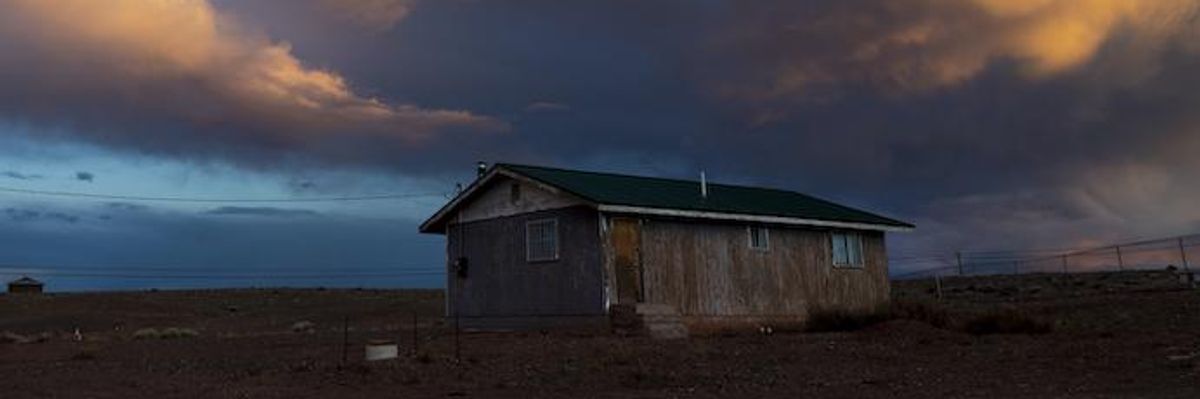
Storm clouds pass over one of many rural homes on the Navajo reservation which do not have electricity or running water during the coronavirus pandemic on March 27, 2020 in Cameron, Arizona. (Photo: Gina Ferazzi/Los Angeles Times via Getty Images)
As Covid-19 Devastates Navajo Nation, Doctors Without Borders Dispatches Team to Battle Outbreak
"You're telling people, 'Wash your hands for 20 seconds multiple times a day,' and they don't have running water."
As the virus continues to lay bare systemic inequities in the United States, Doctors Without Borders has sent a health team to the Navajo Nation, which has been hard-hit by the Covid-19 pandemic.
"The international group typically sends health professionals to conflict zones around the world during medical disasters and the coronavirus pandemic marks the first time it has dispatched teams within the U.S.," The Hill reported Tuesday.
A nine-person team was sent in April to help the tribe and will stay until at least June, the medical group, known by its French acronym MSF, told the outlet.
The head of MSF's U.S. Covid-19 response team, Jean Stowell, put the reason for the rare dispatch in stark terms. From CNN:
When asked why their teams were sent to the area to assist, Stowell said the organization has helped in epidemics around the globe and has been "providing support to people who have been excluded from healthcare and emergency response."
"Historically, the Navajo Nation has not received the same attention and resources as other communities in the U.S., and that has made it particularly difficult for them to respond to this unprecedented epidemic," Stowell said.
New data shows the virus continuing its devastating toll on the community.
The Navajo Nation said Monday that there have been 3,204 confirmed Covid-19 cases and 102 deaths as it continues its state of emergency.
Reporting Tuesday from the Associated Press highlights the crisis further:
If the Navajo Nation were its own state, it would have the highest per capita rate of confirmed positive coronavirus cases in the country, behind only New York. In the states it spans, the number of cases and deaths among people who are Native American, on and off the reservations, is disproportionately high.
[...]
The virus hit like a tsunami in mid-March, and smaller medical centers quickly were overwhelmed. Health problems that make Covid-19 more deadly, such as obesity, diabetes, and heart disease, are all much more common among Native Americans than the general U.S. population.
"I watched the trends very, very early, and quite frankly, I was very concerned," Loretta Christensen, chief medical officer for the Navajo Nation at the federal government's Indian Health Service, told NBC News last month. "We deal with a tremendous amount of health disparities out here, which leave us with a very vulnerable population."
"You're telling people, 'Wash your hands for 20 seconds multiple times a day,' and they don't have running water. Or you're saying, 'Go buy groceries for two or three weeks and shelter in place and don't come out,' but people can't afford groceries for two or three weeks," she continued. "So it's just a setup for frustration and concern by the population here."
Carolina Batista, the physician medical team lead, told local KOAT News that the group is "trying to visit as many facilities around the reservations as possible, speaking with the leaders, speaking with the medical teams that are working very hard on the ground to address the needs of the populations here."
Michelle Tom, a member of the Navajo Nation and a family physician treating Covid-19 patients at the Winslow Indian Health Care Center and Little Colorado Medical Center in northern Arizona near the Navajo reservation, spoke to Democracy Now! last week about the pandemic's toll in her community and stressed how the tribe is "struggling with just clean water in general."
We are at a crossroads
This country and this world are at a monumental crossroads. In a few short weeks, US voters will have an opportunity to beat back the forces of fascism and confront the billionaires who are rigging the economy, our media system, and our democracy, making it increasingly impossible for ordinary people to get by. We’re not just talking about the election. We’re talking about what must be done once these fascist elements are vanquished from power. We need a bolder set of solutions than what either major party has so far been willing to offer and a working-class movement ready to fight like hell for it. Trump didn't emerge from nowhere. The conditions that fueled MAGA authoritarianism were created by decades of radical neoliberal economic policies and a corrupt political system dominated by corporate interests. They slashed taxes on the super-rich, promising that the benefits would trickle down. They said giveaways to the corporate titans would make life more affordable for the rest of us. It was all bullshit. And when a bitter, betrayed populace searches for someone to blame, right-wing demagogues have little trouble finding scapegoats. People know when they're being lied to, but you won't hear any of this from the corporate media. Only independent journalism—powered and funded by people who believe in building a better world—can deliver truly trustworthy daily news. Our Fall Campaign is underway, and we need your help. To power our newsroom through the rest of the year, we need to raise $125,000 by midnight on October 31. So if you share our vision, please contribute whatever you can to sustain our work. |
As the virus continues to lay bare systemic inequities in the United States, Doctors Without Borders has sent a health team to the Navajo Nation, which has been hard-hit by the Covid-19 pandemic.
"The international group typically sends health professionals to conflict zones around the world during medical disasters and the coronavirus pandemic marks the first time it has dispatched teams within the U.S.," The Hill reported Tuesday.
A nine-person team was sent in April to help the tribe and will stay until at least June, the medical group, known by its French acronym MSF, told the outlet.
The head of MSF's U.S. Covid-19 response team, Jean Stowell, put the reason for the rare dispatch in stark terms. From CNN:
When asked why their teams were sent to the area to assist, Stowell said the organization has helped in epidemics around the globe and has been "providing support to people who have been excluded from healthcare and emergency response."
"Historically, the Navajo Nation has not received the same attention and resources as other communities in the U.S., and that has made it particularly difficult for them to respond to this unprecedented epidemic," Stowell said.
New data shows the virus continuing its devastating toll on the community.
The Navajo Nation said Monday that there have been 3,204 confirmed Covid-19 cases and 102 deaths as it continues its state of emergency.
Reporting Tuesday from the Associated Press highlights the crisis further:
If the Navajo Nation were its own state, it would have the highest per capita rate of confirmed positive coronavirus cases in the country, behind only New York. In the states it spans, the number of cases and deaths among people who are Native American, on and off the reservations, is disproportionately high.
[...]
The virus hit like a tsunami in mid-March, and smaller medical centers quickly were overwhelmed. Health problems that make Covid-19 more deadly, such as obesity, diabetes, and heart disease, are all much more common among Native Americans than the general U.S. population.
"I watched the trends very, very early, and quite frankly, I was very concerned," Loretta Christensen, chief medical officer for the Navajo Nation at the federal government's Indian Health Service, told NBC News last month. "We deal with a tremendous amount of health disparities out here, which leave us with a very vulnerable population."
"You're telling people, 'Wash your hands for 20 seconds multiple times a day,' and they don't have running water. Or you're saying, 'Go buy groceries for two or three weeks and shelter in place and don't come out,' but people can't afford groceries for two or three weeks," she continued. "So it's just a setup for frustration and concern by the population here."
Carolina Batista, the physician medical team lead, told local KOAT News that the group is "trying to visit as many facilities around the reservations as possible, speaking with the leaders, speaking with the medical teams that are working very hard on the ground to address the needs of the populations here."
Michelle Tom, a member of the Navajo Nation and a family physician treating Covid-19 patients at the Winslow Indian Health Care Center and Little Colorado Medical Center in northern Arizona near the Navajo reservation, spoke to Democracy Now! last week about the pandemic's toll in her community and stressed how the tribe is "struggling with just clean water in general."
As the virus continues to lay bare systemic inequities in the United States, Doctors Without Borders has sent a health team to the Navajo Nation, which has been hard-hit by the Covid-19 pandemic.
"The international group typically sends health professionals to conflict zones around the world during medical disasters and the coronavirus pandemic marks the first time it has dispatched teams within the U.S.," The Hill reported Tuesday.
A nine-person team was sent in April to help the tribe and will stay until at least June, the medical group, known by its French acronym MSF, told the outlet.
The head of MSF's U.S. Covid-19 response team, Jean Stowell, put the reason for the rare dispatch in stark terms. From CNN:
When asked why their teams were sent to the area to assist, Stowell said the organization has helped in epidemics around the globe and has been "providing support to people who have been excluded from healthcare and emergency response."
"Historically, the Navajo Nation has not received the same attention and resources as other communities in the U.S., and that has made it particularly difficult for them to respond to this unprecedented epidemic," Stowell said.
New data shows the virus continuing its devastating toll on the community.
The Navajo Nation said Monday that there have been 3,204 confirmed Covid-19 cases and 102 deaths as it continues its state of emergency.
Reporting Tuesday from the Associated Press highlights the crisis further:
If the Navajo Nation were its own state, it would have the highest per capita rate of confirmed positive coronavirus cases in the country, behind only New York. In the states it spans, the number of cases and deaths among people who are Native American, on and off the reservations, is disproportionately high.
[...]
The virus hit like a tsunami in mid-March, and smaller medical centers quickly were overwhelmed. Health problems that make Covid-19 more deadly, such as obesity, diabetes, and heart disease, are all much more common among Native Americans than the general U.S. population.
"I watched the trends very, very early, and quite frankly, I was very concerned," Loretta Christensen, chief medical officer for the Navajo Nation at the federal government's Indian Health Service, told NBC News last month. "We deal with a tremendous amount of health disparities out here, which leave us with a very vulnerable population."
"You're telling people, 'Wash your hands for 20 seconds multiple times a day,' and they don't have running water. Or you're saying, 'Go buy groceries for two or three weeks and shelter in place and don't come out,' but people can't afford groceries for two or three weeks," she continued. "So it's just a setup for frustration and concern by the population here."
Carolina Batista, the physician medical team lead, told local KOAT News that the group is "trying to visit as many facilities around the reservations as possible, speaking with the leaders, speaking with the medical teams that are working very hard on the ground to address the needs of the populations here."
Michelle Tom, a member of the Navajo Nation and a family physician treating Covid-19 patients at the Winslow Indian Health Care Center and Little Colorado Medical Center in northern Arizona near the Navajo reservation, spoke to Democracy Now! last week about the pandemic's toll in her community and stressed how the tribe is "struggling with just clean water in general."