SUBSCRIBE TO OUR FREE NEWSLETTER
Daily news & progressive opinion—funded by the people, not the corporations—delivered straight to your inbox.
5
#000000
#FFFFFF
To donate by check, phone, or other method, see our More Ways to Give page.
Daily news & progressive opinion—funded by the people, not the corporations—delivered straight to your inbox.
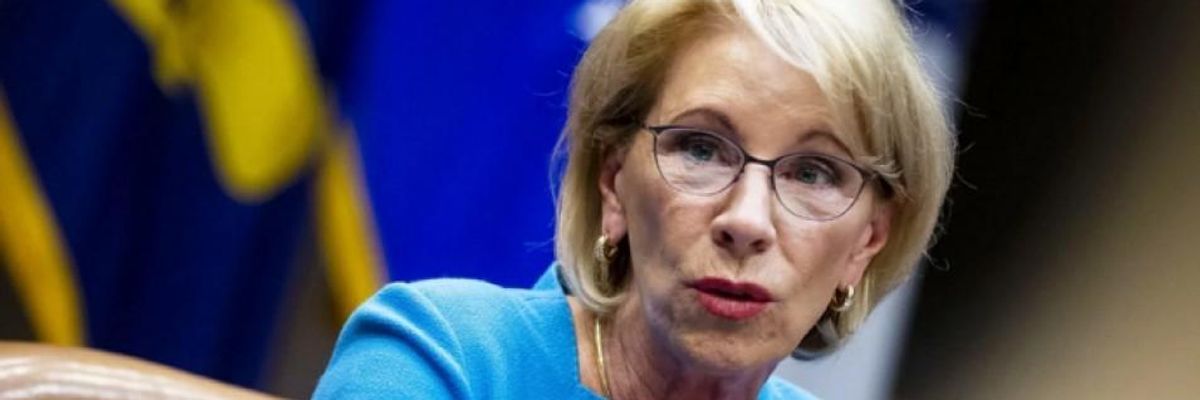
Education Secretary Betsy DeVos unveiled new guidance Tuesday which excludes undocumented students from receiving emergncy assistance through a new $6 billion program for college students amid the coronavirus pandemic. (Photo: Al Drago/Bloomberg via Getty Images)
Immigrant rights groups on Wednesday condemned the Trump administration's decision to block undocumented students from a $6 billion aid program that the Education Department unveiled earlier this month, calling the exclusion needlessly "cruel."
To supplement $14 billion included in the CARES Act last month for postsecondary institutions and students, Education Secretary Betsy DeVos released $6.2 billion for cash grants for students whose lives and educations have been disrupted by the coronavirus pandemic. The program, called the Higher Education Emergency Relief Fund (HEERF), is meant to be used for necessities like housing, food, and childcare.
On Tuesday, however, DeVos announced that students who are not eligible for federal financial aid for college will not be permitted to access the money.
"The criteria to participate," the Education Department wrote in a new guidance (pdf), "include but are not limited to the following: U.S. citizenship or eligible noncitizen; a valid Social Security number; registration with Selective Service (if the student is male); and a high school diploma, GED, or completion of high school in an approved homeschool setting."
Undocumented students who are recipients of the Deferred Action for Childhood Arrivals (DACA) program, also known as Dreamers, are not eligible for most federal financial aid.
Vanita Gupta, president of the Leadership Council on Civil and Human Rights, called the move "cruel and outrageous."
As Rep. Darren Soto (D-Fla.) wrote on Twitter, the CARES Act does not include restrictions on which students can access aid.
An estimated 14 million students were forced to leave their college campuses and shift to remote learning last month as governments imposed lockdowns and schools closed. Many returned home to stay with their families.
According to a 2019 survey by the Hope Center for College, Community and Justice at Temple University, nearly one-third of students at four-year colleges experience housing and food insecurity. The same is true for about half of students at two-year institutions.
The Education Department's new rule was issued two months before the U.S. Supreme Court is expected to hand down a ruling on whether the DACA program should continue.
As Cristina Jimenez, co-founder of youth-led immigrant rights group United We Dream, wrote on social media, DeVos's guidance is just one of several attacks on immigrants by the Trump administration since the coronavirus pandemic began.
"This is what [it's] like to be an immigrant under Trump," Jimenez said.
Dear Common Dreams reader, It’s been nearly 30 years since I co-founded Common Dreams with my late wife, Lina Newhouser. We had the radical notion that journalism should serve the public good, not corporate profits. It was clear to us from the outset what it would take to build such a project. No paid advertisements. No corporate sponsors. No millionaire publisher telling us what to think or do. Many people said we wouldn't last a year, but we proved those doubters wrong. Together with a tremendous team of journalists and dedicated staff, we built an independent media outlet free from the constraints of profits and corporate control. Our mission has always been simple: To inform. To inspire. To ignite change for the common good. Building Common Dreams was not easy. Our survival was never guaranteed. When you take on the most powerful forces—Wall Street greed, fossil fuel industry destruction, Big Tech lobbyists, and uber-rich oligarchs who have spent billions upon billions rigging the economy and democracy in their favor—the only bulwark you have is supporters who believe in your work. But here’s the urgent message from me today. It's never been this bad out there. And it's never been this hard to keep us going. At the very moment Common Dreams is most needed, the threats we face are intensifying. We need your support now more than ever. We don't accept corporate advertising and never will. We don't have a paywall because we don't think people should be blocked from critical news based on their ability to pay. Everything we do is funded by the donations of readers like you. When everyone does the little they can afford, we are strong. But if that support retreats or dries up, so do we. Will you donate now to make sure Common Dreams not only survives but thrives? —Craig Brown, Co-founder |
Immigrant rights groups on Wednesday condemned the Trump administration's decision to block undocumented students from a $6 billion aid program that the Education Department unveiled earlier this month, calling the exclusion needlessly "cruel."
To supplement $14 billion included in the CARES Act last month for postsecondary institutions and students, Education Secretary Betsy DeVos released $6.2 billion for cash grants for students whose lives and educations have been disrupted by the coronavirus pandemic. The program, called the Higher Education Emergency Relief Fund (HEERF), is meant to be used for necessities like housing, food, and childcare.
On Tuesday, however, DeVos announced that students who are not eligible for federal financial aid for college will not be permitted to access the money.
"The criteria to participate," the Education Department wrote in a new guidance (pdf), "include but are not limited to the following: U.S. citizenship or eligible noncitizen; a valid Social Security number; registration with Selective Service (if the student is male); and a high school diploma, GED, or completion of high school in an approved homeschool setting."
Undocumented students who are recipients of the Deferred Action for Childhood Arrivals (DACA) program, also known as Dreamers, are not eligible for most federal financial aid.
Vanita Gupta, president of the Leadership Council on Civil and Human Rights, called the move "cruel and outrageous."
As Rep. Darren Soto (D-Fla.) wrote on Twitter, the CARES Act does not include restrictions on which students can access aid.
An estimated 14 million students were forced to leave their college campuses and shift to remote learning last month as governments imposed lockdowns and schools closed. Many returned home to stay with their families.
According to a 2019 survey by the Hope Center for College, Community and Justice at Temple University, nearly one-third of students at four-year colleges experience housing and food insecurity. The same is true for about half of students at two-year institutions.
The Education Department's new rule was issued two months before the U.S. Supreme Court is expected to hand down a ruling on whether the DACA program should continue.
As Cristina Jimenez, co-founder of youth-led immigrant rights group United We Dream, wrote on social media, DeVos's guidance is just one of several attacks on immigrants by the Trump administration since the coronavirus pandemic began.
"This is what [it's] like to be an immigrant under Trump," Jimenez said.
Immigrant rights groups on Wednesday condemned the Trump administration's decision to block undocumented students from a $6 billion aid program that the Education Department unveiled earlier this month, calling the exclusion needlessly "cruel."
To supplement $14 billion included in the CARES Act last month for postsecondary institutions and students, Education Secretary Betsy DeVos released $6.2 billion for cash grants for students whose lives and educations have been disrupted by the coronavirus pandemic. The program, called the Higher Education Emergency Relief Fund (HEERF), is meant to be used for necessities like housing, food, and childcare.
On Tuesday, however, DeVos announced that students who are not eligible for federal financial aid for college will not be permitted to access the money.
"The criteria to participate," the Education Department wrote in a new guidance (pdf), "include but are not limited to the following: U.S. citizenship or eligible noncitizen; a valid Social Security number; registration with Selective Service (if the student is male); and a high school diploma, GED, or completion of high school in an approved homeschool setting."
Undocumented students who are recipients of the Deferred Action for Childhood Arrivals (DACA) program, also known as Dreamers, are not eligible for most federal financial aid.
Vanita Gupta, president of the Leadership Council on Civil and Human Rights, called the move "cruel and outrageous."
As Rep. Darren Soto (D-Fla.) wrote on Twitter, the CARES Act does not include restrictions on which students can access aid.
An estimated 14 million students were forced to leave their college campuses and shift to remote learning last month as governments imposed lockdowns and schools closed. Many returned home to stay with their families.
According to a 2019 survey by the Hope Center for College, Community and Justice at Temple University, nearly one-third of students at four-year colleges experience housing and food insecurity. The same is true for about half of students at two-year institutions.
The Education Department's new rule was issued two months before the U.S. Supreme Court is expected to hand down a ruling on whether the DACA program should continue.
As Cristina Jimenez, co-founder of youth-led immigrant rights group United We Dream, wrote on social media, DeVos's guidance is just one of several attacks on immigrants by the Trump administration since the coronavirus pandemic began.
"This is what [it's] like to be an immigrant under Trump," Jimenez said.