SUBSCRIBE TO OUR FREE NEWSLETTER
Daily news & progressive opinion—funded by the people, not the corporations—delivered straight to your inbox.
5
#000000
#FFFFFF
To donate by check, phone, or other method, see our More Ways to Give page.
Daily news & progressive opinion—funded by the people, not the corporations—delivered straight to your inbox.
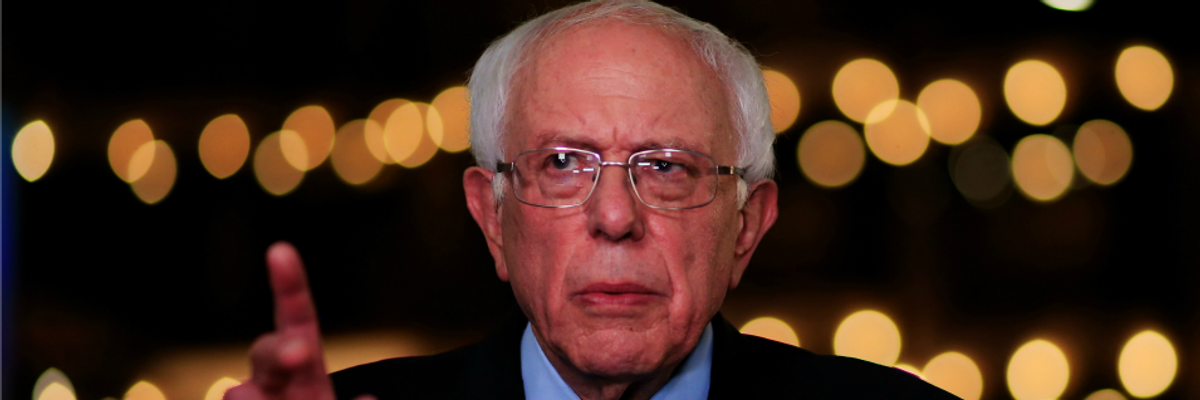
Democratic presidential candidate Sen. Bernie Sanders (I-Vt.) speaks to the media after the second night of the first Democratic presidential debate on June 27, 2019 in Miami. (Photo: Cliff Hawkins/Getty Images)
New York state election officials are poised to remove Sen. Bernie Sanders from the ballot in June's primary election, a move that would deny the Vermont lawmaker's supporters the chance to cast a vote for him as president and would harm his chances of using his delegate count to influence the party's direction and push for reforms.
"Hard to imagine a pettier decision more perfectly calibrated to infuriate and depress younger and progressive voters," tweeted Jewish Currents editor David Klion.
As HuffPost's Daniel Marans reported Tuesday, Board of Elections co-chair Douglas Kellner and commissioner Andrew Spano, both Democrats, will meet Wednesday to decide on whether or not to remove Sanders' name from the ballot. Kellner believes that a provision in the 2019-2020 budget saying the board "may" remove a candidate from the ballot if they make clear they are no longer seeking the office in question rquires Sanders' removal.
Under Kellner's interpretation of the statute, Sanders, who suspended his campaign on April 8, falls under that category.
"It's not very controversial that Bernie Sanders has suspended his campaign," Kellner told HuffPost. "I anticipate that we will be removing him."
Such a decision by Kellner and Spano, under the statute, would have to be unanimous--both men would have to agree.
Progressives in New York had been anticipating such a move after Gov. Andrew Cuomo postponed the state's election due to the coronavirus outbreak and pushed for the inclusion of the language in the bill.
"We think this is a power play on the part of the governor who wants to control the entire delegation," said New York activist George Albro.
A letter (pdf) from a number of advocacy groups in the state said that removing Sanders from the ballot would constitute a "suspension of democracy" and warned that disenfranchising the Vermont senator's New York supporters was not a path to unity.
"We urge you to prioritize saving lives and defeating Donald Trump over the possible implementation of this clause," the groups wrote. "Cancelling the presidential primary is not the right way to address our current challenges."
As HuffPost explained, removing Sanders from the ballot would cut off the ability of the senator and his supporters to influence the party platform due to New York's delegate count:
When Sanders withdrew from the primary earlier this month, he promised to remain on the ballot in states that had yet to cast votes to maximize his influence over the Democratic Party platform and nominating rules. (He endorsed former Vice President Joe Biden, the party's presumptive nominee, a few days after dropping out.)
Sanders partisans are hoping, for example, to make permanent a rule change in effect in the 2020 cycle that bars the party officials known as "superdelegates" from backing a presidential candidate on the first convention ballot that differs from the candidate their state's voters chose in a primary election or caucus.
In an April 15 letter (pdf) aimed at staving off the move by the board to take Sanders off the ballot, New York candidates for delegates to the convention backing Sanders urged the state not exercise the authority in the budget line.
"To cancel the presidential primary would be an affront to democracy, to the efforts and dedication of our delegate candidates, and to common decency and fairness," the group wrote.
Dear Common Dreams reader, It’s been nearly 30 years since I co-founded Common Dreams with my late wife, Lina Newhouser. We had the radical notion that journalism should serve the public good, not corporate profits. It was clear to us from the outset what it would take to build such a project. No paid advertisements. No corporate sponsors. No millionaire publisher telling us what to think or do. Many people said we wouldn't last a year, but we proved those doubters wrong. Together with a tremendous team of journalists and dedicated staff, we built an independent media outlet free from the constraints of profits and corporate control. Our mission has always been simple: To inform. To inspire. To ignite change for the common good. Building Common Dreams was not easy. Our survival was never guaranteed. When you take on the most powerful forces—Wall Street greed, fossil fuel industry destruction, Big Tech lobbyists, and uber-rich oligarchs who have spent billions upon billions rigging the economy and democracy in their favor—the only bulwark you have is supporters who believe in your work. But here’s the urgent message from me today. It's never been this bad out there. And it's never been this hard to keep us going. At the very moment Common Dreams is most needed, the threats we face are intensifying. We need your support now more than ever. We don't accept corporate advertising and never will. We don't have a paywall because we don't think people should be blocked from critical news based on their ability to pay. Everything we do is funded by the donations of readers like you. When everyone does the little they can afford, we are strong. But if that support retreats or dries up, so do we. Will you donate now to make sure Common Dreams not only survives but thrives? —Craig Brown, Co-founder |
New York state election officials are poised to remove Sen. Bernie Sanders from the ballot in June's primary election, a move that would deny the Vermont lawmaker's supporters the chance to cast a vote for him as president and would harm his chances of using his delegate count to influence the party's direction and push for reforms.
"Hard to imagine a pettier decision more perfectly calibrated to infuriate and depress younger and progressive voters," tweeted Jewish Currents editor David Klion.
As HuffPost's Daniel Marans reported Tuesday, Board of Elections co-chair Douglas Kellner and commissioner Andrew Spano, both Democrats, will meet Wednesday to decide on whether or not to remove Sanders' name from the ballot. Kellner believes that a provision in the 2019-2020 budget saying the board "may" remove a candidate from the ballot if they make clear they are no longer seeking the office in question rquires Sanders' removal.
Under Kellner's interpretation of the statute, Sanders, who suspended his campaign on April 8, falls under that category.
"It's not very controversial that Bernie Sanders has suspended his campaign," Kellner told HuffPost. "I anticipate that we will be removing him."
Such a decision by Kellner and Spano, under the statute, would have to be unanimous--both men would have to agree.
Progressives in New York had been anticipating such a move after Gov. Andrew Cuomo postponed the state's election due to the coronavirus outbreak and pushed for the inclusion of the language in the bill.
"We think this is a power play on the part of the governor who wants to control the entire delegation," said New York activist George Albro.
A letter (pdf) from a number of advocacy groups in the state said that removing Sanders from the ballot would constitute a "suspension of democracy" and warned that disenfranchising the Vermont senator's New York supporters was not a path to unity.
"We urge you to prioritize saving lives and defeating Donald Trump over the possible implementation of this clause," the groups wrote. "Cancelling the presidential primary is not the right way to address our current challenges."
As HuffPost explained, removing Sanders from the ballot would cut off the ability of the senator and his supporters to influence the party platform due to New York's delegate count:
When Sanders withdrew from the primary earlier this month, he promised to remain on the ballot in states that had yet to cast votes to maximize his influence over the Democratic Party platform and nominating rules. (He endorsed former Vice President Joe Biden, the party's presumptive nominee, a few days after dropping out.)
Sanders partisans are hoping, for example, to make permanent a rule change in effect in the 2020 cycle that bars the party officials known as "superdelegates" from backing a presidential candidate on the first convention ballot that differs from the candidate their state's voters chose in a primary election or caucus.
In an April 15 letter (pdf) aimed at staving off the move by the board to take Sanders off the ballot, New York candidates for delegates to the convention backing Sanders urged the state not exercise the authority in the budget line.
"To cancel the presidential primary would be an affront to democracy, to the efforts and dedication of our delegate candidates, and to common decency and fairness," the group wrote.
New York state election officials are poised to remove Sen. Bernie Sanders from the ballot in June's primary election, a move that would deny the Vermont lawmaker's supporters the chance to cast a vote for him as president and would harm his chances of using his delegate count to influence the party's direction and push for reforms.
"Hard to imagine a pettier decision more perfectly calibrated to infuriate and depress younger and progressive voters," tweeted Jewish Currents editor David Klion.
As HuffPost's Daniel Marans reported Tuesday, Board of Elections co-chair Douglas Kellner and commissioner Andrew Spano, both Democrats, will meet Wednesday to decide on whether or not to remove Sanders' name from the ballot. Kellner believes that a provision in the 2019-2020 budget saying the board "may" remove a candidate from the ballot if they make clear they are no longer seeking the office in question rquires Sanders' removal.
Under Kellner's interpretation of the statute, Sanders, who suspended his campaign on April 8, falls under that category.
"It's not very controversial that Bernie Sanders has suspended his campaign," Kellner told HuffPost. "I anticipate that we will be removing him."
Such a decision by Kellner and Spano, under the statute, would have to be unanimous--both men would have to agree.
Progressives in New York had been anticipating such a move after Gov. Andrew Cuomo postponed the state's election due to the coronavirus outbreak and pushed for the inclusion of the language in the bill.
"We think this is a power play on the part of the governor who wants to control the entire delegation," said New York activist George Albro.
A letter (pdf) from a number of advocacy groups in the state said that removing Sanders from the ballot would constitute a "suspension of democracy" and warned that disenfranchising the Vermont senator's New York supporters was not a path to unity.
"We urge you to prioritize saving lives and defeating Donald Trump over the possible implementation of this clause," the groups wrote. "Cancelling the presidential primary is not the right way to address our current challenges."
As HuffPost explained, removing Sanders from the ballot would cut off the ability of the senator and his supporters to influence the party platform due to New York's delegate count:
When Sanders withdrew from the primary earlier this month, he promised to remain on the ballot in states that had yet to cast votes to maximize his influence over the Democratic Party platform and nominating rules. (He endorsed former Vice President Joe Biden, the party's presumptive nominee, a few days after dropping out.)
Sanders partisans are hoping, for example, to make permanent a rule change in effect in the 2020 cycle that bars the party officials known as "superdelegates" from backing a presidential candidate on the first convention ballot that differs from the candidate their state's voters chose in a primary election or caucus.
In an April 15 letter (pdf) aimed at staving off the move by the board to take Sanders off the ballot, New York candidates for delegates to the convention backing Sanders urged the state not exercise the authority in the budget line.
"To cancel the presidential primary would be an affront to democracy, to the efforts and dedication of our delegate candidates, and to common decency and fairness," the group wrote.