
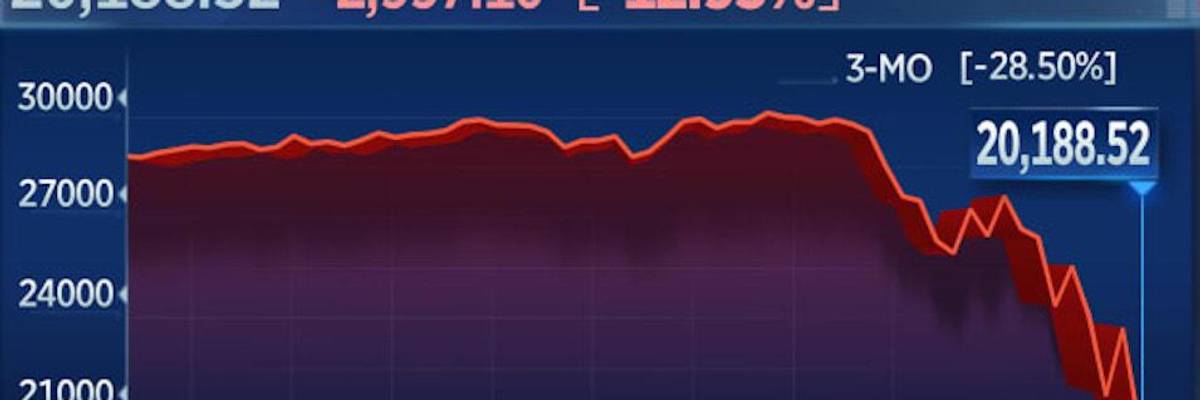
The Dow Jones Industrial Average plunged to a historic loss Monday. (image: CNBC/screenshot)
'Coronavirus Collapse': Dow Drops Record-Smashing 3,000 Points as Outbreak Panics Markets
"The market is at the mercy of the virus."
The Dow Jones Industrial Average fell nearly 3,000 points by the end of trading Monday as part of the stock market's 12.9% drop--its second worst one-day decline ever, after the "Black Monday" crash in 1987--on fears of continuing economic stoppage due to the coronavirus outbreak which has covered the planet.
"Who needs Disneyland when the stock market is currently the wildest ride on the planet," tweeted Media Matters researcher Nikki McCann Ramirez.
Monday's drop followed an attempt by the Federal Reserve to stabilize markets with an interest rate cut.
"The market will take care of itself," President Donald Trump said at a White House press conference Monday afternoon as the bell rang in New York.
At the beginning of trading Monday stocks fell so fast that they tripped the "circuit breaker," which suspends trading for 15 minutes to give markets a chance to recover from losses of 7%. The circuit breaker kicks on again at 13%.
"While the news continues to worsen and with the price action doing things we've only seen a handful of other times in the last century, it's nearly impossible to keep things in perspective," Instinet executive director Frank Cappelleri told CNBC.
The economic slowdown spurred by the coronavirus outbreak has already done major damage to the economies of China, South Korea, Japan, and the European Union. Investors fear the U.S. is next and told CNBC they were unlikely to jump back into the market until the disease had passed its peak.
"The market is at the mercy of the virus and at the mercy of whether the containment policies work," said Quincy Krosby, a Prudential Financial chief market strategist.
We are at a crossroads
This country and this world are at a monumental crossroads. In a few short weeks, US voters will have an opportunity to beat back the forces of fascism and confront the billionaires who are rigging the economy, our media system, and our democracy, making it increasingly impossible for ordinary people to get by. We’re not just talking about the election. We’re talking about what must be done once these fascist elements are vanquished from power. We need a bolder set of solutions than what either major party has so far been willing to offer and a working-class movement ready to fight like hell for it. Trump didn't emerge from nowhere. The conditions that fueled MAGA authoritarianism were created by decades of radical neoliberal economic policies and a corrupt political system dominated by corporate interests. They slashed taxes on the super-rich, promising that the benefits would trickle down. They said giveaways to the corporate titans would make life more affordable for the rest of us. It was all bullshit. And when a bitter, betrayed populace searches for someone to blame, right-wing demagogues have little trouble finding scapegoats. People know when they're being lied to, but you won't hear any of this from the corporate media. Only independent journalism—powered and funded by people who believe in building a better world—can deliver truly trustworthy daily news. Our Fall Campaign is underway, and we need your help. To power our newsroom through the rest of the year, we need to raise $125,000 by midnight on October 31. So if you share our vision, please contribute whatever you can to sustain our work. |
The Dow Jones Industrial Average fell nearly 3,000 points by the end of trading Monday as part of the stock market's 12.9% drop--its second worst one-day decline ever, after the "Black Monday" crash in 1987--on fears of continuing economic stoppage due to the coronavirus outbreak which has covered the planet.
"Who needs Disneyland when the stock market is currently the wildest ride on the planet," tweeted Media Matters researcher Nikki McCann Ramirez.
Monday's drop followed an attempt by the Federal Reserve to stabilize markets with an interest rate cut.
"The market will take care of itself," President Donald Trump said at a White House press conference Monday afternoon as the bell rang in New York.
At the beginning of trading Monday stocks fell so fast that they tripped the "circuit breaker," which suspends trading for 15 minutes to give markets a chance to recover from losses of 7%. The circuit breaker kicks on again at 13%.
"While the news continues to worsen and with the price action doing things we've only seen a handful of other times in the last century, it's nearly impossible to keep things in perspective," Instinet executive director Frank Cappelleri told CNBC.
The economic slowdown spurred by the coronavirus outbreak has already done major damage to the economies of China, South Korea, Japan, and the European Union. Investors fear the U.S. is next and told CNBC they were unlikely to jump back into the market until the disease had passed its peak.
"The market is at the mercy of the virus and at the mercy of whether the containment policies work," said Quincy Krosby, a Prudential Financial chief market strategist.