SUBSCRIBE TO OUR FREE NEWSLETTER
Daily news & progressive opinion—funded by the people, not the corporations—delivered straight to your inbox.
5
#000000
#FFFFFF
To donate by check, phone, or other method, see our More Ways to Give page.
Daily news & progressive opinion—funded by the people, not the corporations—delivered straight to your inbox.
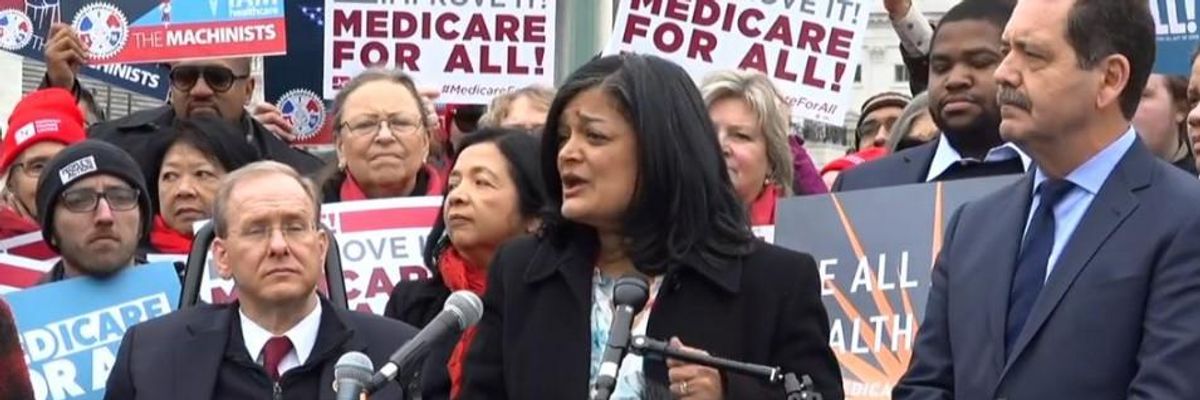
Rep. Pramila Jayapal (D-Wash.) introduced her Medicare for All legislation in the U.S. House on Feb. 27, 2019. (Photo: Public Citizen/Twitter)
At a Thursday event celebrating the one-year anniversary of House Democrats introducing landmark Medicare for All legislation in the U.S. House, the bill's sponsors and medical and policy experts made the case that establishing a national single-payer healthcare system is essential for racial equity.
Rep. Pramila Jayapal (D-Wash.), co-chair of the Congressional Progressive Caucus, is the lead sponsor of the Medicare for All Act of 2019 (H.R. 1384)--now backed by more than a hundred House Democrats.
"We have a burden of our healthcare system that does disproportionately affect black and brown folks... and poor communities," Jayapal said at the event Thursday. She highlighted the disparities in health insurance coverage for people of color and recent findings that black people are three times more likely than their white peers to die of pregnancy-related causes in the United States.
Sharing updates from the event on Twitter, the group Social Security Works repeatedly declared that "#MedicareForAll is a racial justice necessity," borrowing language from a July 2019 letter to Congress from 10 national groups "that represent people of color" in support of Jayapal's bill and S. 1129, similar legislation that Sen. Bernie Sanders (I-Vt.) introduced in April 2019.
Jayapal, who endorsed Sanders' second run for president last month and serves as his campaign's national health policy chair, was joined at Thursday's live-streamed event by Democratic Reps. Judy Chu (Calif.), Yvette Clark (N.Y.), Debbie Dingell (Mich.), Sheila Jackson Lee (Texas), and Rep. Ilhan Omar (Minn.).
Other speakers included Dr. Sanjeev Sriram, founder of the All Means All Campaign at Social Security Works; Liz Watson, executive director of the Congressional Progressive Caucus Center; Amirah Sequeira, lead legislative advocate of National Nurses United; and racial justice activist, Kymone Freeman, who discussed how his sister's death related to racial inequities in healthcare.
Ahead of the event, All Means All--a campaign to center racial equity and the elimination of minority health disparities in the creation of a single-payer system--released fact sheets for each congressional district nationwide that "use data of who makes up the uninsured to make the case for Medicare for All."
The fact sheet for Washington's 7th District (pdf), which Jayapal represents, noted that 31,710 of the state's 435,000 uninsured residents live in the district and just over half of uninsured Washingtonians are racial or ethnic minorities.
Republican House Minority Leader Kevin McCarthy, who represents California's 23rd District (pdf), has 40,780 uninsured constituents. Across his state, 2,723,000 people lack health insurance. According to the document, 80% of them are minorities.
The second page of all the fact sheets emphasize that:
"Even with the passage of Medicare For All, we will still need to dismantle racism, the biggest contributor to minority health disparities and poor health outcomes," the fact sheets say. "By guaranteeing every person in America the basic human right of healthcare under Medicare For ALL, we take an important step forward."
Dingell took to Twitter during the event to celebrate the progress made since the bill was introduced a year ago, noting that "the legislation has received support from half the Democrats in the House, had four historic hearings, and fostered a national conversation on how to improve healthcare in the United States."
Dear Common Dreams reader, It’s been nearly 30 years since I co-founded Common Dreams with my late wife, Lina Newhouser. We had the radical notion that journalism should serve the public good, not corporate profits. It was clear to us from the outset what it would take to build such a project. No paid advertisements. No corporate sponsors. No millionaire publisher telling us what to think or do. Many people said we wouldn't last a year, but we proved those doubters wrong. Together with a tremendous team of journalists and dedicated staff, we built an independent media outlet free from the constraints of profits and corporate control. Our mission has always been simple: To inform. To inspire. To ignite change for the common good. Building Common Dreams was not easy. Our survival was never guaranteed. When you take on the most powerful forces—Wall Street greed, fossil fuel industry destruction, Big Tech lobbyists, and uber-rich oligarchs who have spent billions upon billions rigging the economy and democracy in their favor—the only bulwark you have is supporters who believe in your work. But here’s the urgent message from me today. It's never been this bad out there. And it's never been this hard to keep us going. At the very moment Common Dreams is most needed, the threats we face are intensifying. We need your support now more than ever. We don't accept corporate advertising and never will. We don't have a paywall because we don't think people should be blocked from critical news based on their ability to pay. Everything we do is funded by the donations of readers like you. When everyone does the little they can afford, we are strong. But if that support retreats or dries up, so do we. Will you donate now to make sure Common Dreams not only survives but thrives? —Craig Brown, Co-founder |
At a Thursday event celebrating the one-year anniversary of House Democrats introducing landmark Medicare for All legislation in the U.S. House, the bill's sponsors and medical and policy experts made the case that establishing a national single-payer healthcare system is essential for racial equity.
Rep. Pramila Jayapal (D-Wash.), co-chair of the Congressional Progressive Caucus, is the lead sponsor of the Medicare for All Act of 2019 (H.R. 1384)--now backed by more than a hundred House Democrats.
"We have a burden of our healthcare system that does disproportionately affect black and brown folks... and poor communities," Jayapal said at the event Thursday. She highlighted the disparities in health insurance coverage for people of color and recent findings that black people are three times more likely than their white peers to die of pregnancy-related causes in the United States.
Sharing updates from the event on Twitter, the group Social Security Works repeatedly declared that "#MedicareForAll is a racial justice necessity," borrowing language from a July 2019 letter to Congress from 10 national groups "that represent people of color" in support of Jayapal's bill and S. 1129, similar legislation that Sen. Bernie Sanders (I-Vt.) introduced in April 2019.
Jayapal, who endorsed Sanders' second run for president last month and serves as his campaign's national health policy chair, was joined at Thursday's live-streamed event by Democratic Reps. Judy Chu (Calif.), Yvette Clark (N.Y.), Debbie Dingell (Mich.), Sheila Jackson Lee (Texas), and Rep. Ilhan Omar (Minn.).
Other speakers included Dr. Sanjeev Sriram, founder of the All Means All Campaign at Social Security Works; Liz Watson, executive director of the Congressional Progressive Caucus Center; Amirah Sequeira, lead legislative advocate of National Nurses United; and racial justice activist, Kymone Freeman, who discussed how his sister's death related to racial inequities in healthcare.
Ahead of the event, All Means All--a campaign to center racial equity and the elimination of minority health disparities in the creation of a single-payer system--released fact sheets for each congressional district nationwide that "use data of who makes up the uninsured to make the case for Medicare for All."
The fact sheet for Washington's 7th District (pdf), which Jayapal represents, noted that 31,710 of the state's 435,000 uninsured residents live in the district and just over half of uninsured Washingtonians are racial or ethnic minorities.
Republican House Minority Leader Kevin McCarthy, who represents California's 23rd District (pdf), has 40,780 uninsured constituents. Across his state, 2,723,000 people lack health insurance. According to the document, 80% of them are minorities.
The second page of all the fact sheets emphasize that:
"Even with the passage of Medicare For All, we will still need to dismantle racism, the biggest contributor to minority health disparities and poor health outcomes," the fact sheets say. "By guaranteeing every person in America the basic human right of healthcare under Medicare For ALL, we take an important step forward."
Dingell took to Twitter during the event to celebrate the progress made since the bill was introduced a year ago, noting that "the legislation has received support from half the Democrats in the House, had four historic hearings, and fostered a national conversation on how to improve healthcare in the United States."
At a Thursday event celebrating the one-year anniversary of House Democrats introducing landmark Medicare for All legislation in the U.S. House, the bill's sponsors and medical and policy experts made the case that establishing a national single-payer healthcare system is essential for racial equity.
Rep. Pramila Jayapal (D-Wash.), co-chair of the Congressional Progressive Caucus, is the lead sponsor of the Medicare for All Act of 2019 (H.R. 1384)--now backed by more than a hundred House Democrats.
"We have a burden of our healthcare system that does disproportionately affect black and brown folks... and poor communities," Jayapal said at the event Thursday. She highlighted the disparities in health insurance coverage for people of color and recent findings that black people are three times more likely than their white peers to die of pregnancy-related causes in the United States.
Sharing updates from the event on Twitter, the group Social Security Works repeatedly declared that "#MedicareForAll is a racial justice necessity," borrowing language from a July 2019 letter to Congress from 10 national groups "that represent people of color" in support of Jayapal's bill and S. 1129, similar legislation that Sen. Bernie Sanders (I-Vt.) introduced in April 2019.
Jayapal, who endorsed Sanders' second run for president last month and serves as his campaign's national health policy chair, was joined at Thursday's live-streamed event by Democratic Reps. Judy Chu (Calif.), Yvette Clark (N.Y.), Debbie Dingell (Mich.), Sheila Jackson Lee (Texas), and Rep. Ilhan Omar (Minn.).
Other speakers included Dr. Sanjeev Sriram, founder of the All Means All Campaign at Social Security Works; Liz Watson, executive director of the Congressional Progressive Caucus Center; Amirah Sequeira, lead legislative advocate of National Nurses United; and racial justice activist, Kymone Freeman, who discussed how his sister's death related to racial inequities in healthcare.
Ahead of the event, All Means All--a campaign to center racial equity and the elimination of minority health disparities in the creation of a single-payer system--released fact sheets for each congressional district nationwide that "use data of who makes up the uninsured to make the case for Medicare for All."
The fact sheet for Washington's 7th District (pdf), which Jayapal represents, noted that 31,710 of the state's 435,000 uninsured residents live in the district and just over half of uninsured Washingtonians are racial or ethnic minorities.
Republican House Minority Leader Kevin McCarthy, who represents California's 23rd District (pdf), has 40,780 uninsured constituents. Across his state, 2,723,000 people lack health insurance. According to the document, 80% of them are minorities.
The second page of all the fact sheets emphasize that:
"Even with the passage of Medicare For All, we will still need to dismantle racism, the biggest contributor to minority health disparities and poor health outcomes," the fact sheets say. "By guaranteeing every person in America the basic human right of healthcare under Medicare For ALL, we take an important step forward."
Dingell took to Twitter during the event to celebrate the progress made since the bill was introduced a year ago, noting that "the legislation has received support from half the Democrats in the House, had four historic hearings, and fostered a national conversation on how to improve healthcare in the United States."