SUBSCRIBE TO OUR FREE NEWSLETTER
Daily news & progressive opinion—funded by the people, not the corporations—delivered straight to your inbox.
5
#000000
#FFFFFF
To donate by check, phone, or other method, see our More Ways to Give page.
Daily news & progressive opinion—funded by the people, not the corporations—delivered straight to your inbox.
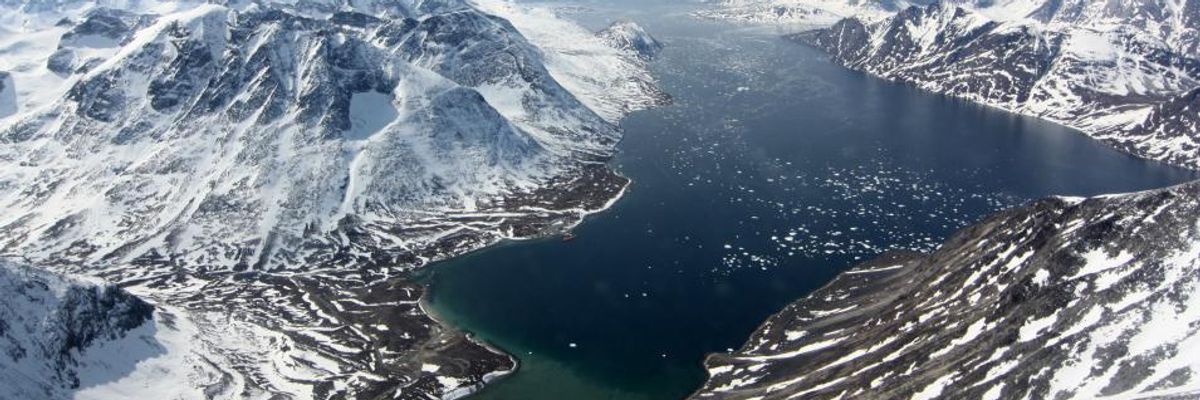
A fjord is seen from the air in southwest Greenland, where new research shows ice is melting even more rapidly that scientists previously feared.
While climate scientists have repeatedly raised alarm about the how human-caused global warming is driving "off the charts" ice loss in Greenland that will contribute to devastating sea level rise, a new analysis of a less studied region has ramped up those concerns, revealing that Greenland's ice sheet is melting even faster than previously thought.
"We're going to see faster and faster sea level rise for the foreseeable future."
--Michael Bevis, Ohio State University
"We are watching the ice sheet hit a tipping point," warned lead author Michael Bevis, a geodynamics professor at Ohio State University. "We're going to see faster and faster sea level rise for the foreseeable future."
Researchers often look at ice loss from large glaciers in Greenland's southeast and northwest regions. However, this study, published Monday in the Proceedings of the National Academy of Sciences (PNAS), found that the most sustained ice loss during the decade following 2003 was in the island's southwest region.
"Whatever this was, it couldn't be explained by glaciers, because there aren't many there," noted Bevis. "It had to be the surface mass--the ice was melting inland from the coastline."
Using data from satellites and GPS stations across Greenland, his team found that by 2012, Greenland was losing ice at four times the rate it was in 2003, and that acceleration was focused in the southwest region. The cause of this unprecedented ice loss, they concluded, was global atmospheric warming from human activities coupled with a natural phenomenon that brings warmer air to West Greenland.
"Global warming has brought summertime temperatures in a significant portion of Greenland close to the melting point," Bevis explained, "and the North Atlantic Oscillation has provided the extra push that caused large areas of ice to melt."
This new study follows several others published in the past few months that show across the globe, but especially near the poles, ice is melting and oceans are warming even more rapidly than experts once feared, which could lead to worldwide sea level rise of more than 10 feet within this century alone.
"Once you hit that tipping point, the only question is: How severe does it get?"
--Bevis
Given the ongoing ice loss in Greenland and elsewhere, what's clear, according to Bevis, is that "the only thing we can do is adapt and mitigate further global warming--it's too late for there to be no effect."
However, the degree of devastation is still variable. The more rapidly that world leaders comply with mounting public demands for bold climate action and implement the systemic changes that scientists say are necessary to avert climate catastrophe--most notably, immediately phasing out fossil fuels--the better off we will be.
As Bevis put it, "Once you hit that tipping point, the only question is: How severe does it get?"
Responding to the study, Icelandic Prime Minister Katrin Jakobsdottir declared, "We must fight climate change together, the threat is real and we are reaching the tipping point."
U.S. Sen. Amy Klobuchar (D-Minn.), who recently confirmed she's considering a run for president in 2020, tweeted: "I've seen this ice sheet and it is truly massive. We must take action now to reverse climate change."
This country and this world are at a monumental crossroads. US voters have an opportunity to beat back the forces of fascism and confront the billionaires who are rigging the economy, our media system, and our democracy, making it increasingly impossible for ordinary people to get by. We’re not just talking about the election. We’re talking about what must be done once these fascist elements are vanquished from power. We need a bolder set of solutions than what either major party has so far been willing to offer and a working-class movement ready to fight like hell for it. Trump didn't emerge from nowhere. The conditions that fueled MAGA authoritarianism were created by decades of radical neoliberal economic policies and a corrupt political system dominated by corporate interests. They slashed taxes on the super-rich, promising that the benefits would trickle down. They said giveaways to the corporate titans would make life more affordable for the rest of us. It was all bullshit. And when a bitter, betrayed populace searches for someone to blame, right-wing demagogues have little trouble finding scapegoats. People know when they're being lied to, but you won't hear any of this from the corporate media. Only independent journalism—powered and funded by people who believe in building a better world—can deliver truly trustworthy daily news. If you share our vision, please contribute whatever you can to sustain our work. |
While climate scientists have repeatedly raised alarm about the how human-caused global warming is driving "off the charts" ice loss in Greenland that will contribute to devastating sea level rise, a new analysis of a less studied region has ramped up those concerns, revealing that Greenland's ice sheet is melting even faster than previously thought.
"We're going to see faster and faster sea level rise for the foreseeable future."
--Michael Bevis, Ohio State University
"We are watching the ice sheet hit a tipping point," warned lead author Michael Bevis, a geodynamics professor at Ohio State University. "We're going to see faster and faster sea level rise for the foreseeable future."
Researchers often look at ice loss from large glaciers in Greenland's southeast and northwest regions. However, this study, published Monday in the Proceedings of the National Academy of Sciences (PNAS), found that the most sustained ice loss during the decade following 2003 was in the island's southwest region.
"Whatever this was, it couldn't be explained by glaciers, because there aren't many there," noted Bevis. "It had to be the surface mass--the ice was melting inland from the coastline."
Using data from satellites and GPS stations across Greenland, his team found that by 2012, Greenland was losing ice at four times the rate it was in 2003, and that acceleration was focused in the southwest region. The cause of this unprecedented ice loss, they concluded, was global atmospheric warming from human activities coupled with a natural phenomenon that brings warmer air to West Greenland.
"Global warming has brought summertime temperatures in a significant portion of Greenland close to the melting point," Bevis explained, "and the North Atlantic Oscillation has provided the extra push that caused large areas of ice to melt."
This new study follows several others published in the past few months that show across the globe, but especially near the poles, ice is melting and oceans are warming even more rapidly than experts once feared, which could lead to worldwide sea level rise of more than 10 feet within this century alone.
"Once you hit that tipping point, the only question is: How severe does it get?"
--Bevis
Given the ongoing ice loss in Greenland and elsewhere, what's clear, according to Bevis, is that "the only thing we can do is adapt and mitigate further global warming--it's too late for there to be no effect."
However, the degree of devastation is still variable. The more rapidly that world leaders comply with mounting public demands for bold climate action and implement the systemic changes that scientists say are necessary to avert climate catastrophe--most notably, immediately phasing out fossil fuels--the better off we will be.
As Bevis put it, "Once you hit that tipping point, the only question is: How severe does it get?"
Responding to the study, Icelandic Prime Minister Katrin Jakobsdottir declared, "We must fight climate change together, the threat is real and we are reaching the tipping point."
U.S. Sen. Amy Klobuchar (D-Minn.), who recently confirmed she's considering a run for president in 2020, tweeted: "I've seen this ice sheet and it is truly massive. We must take action now to reverse climate change."