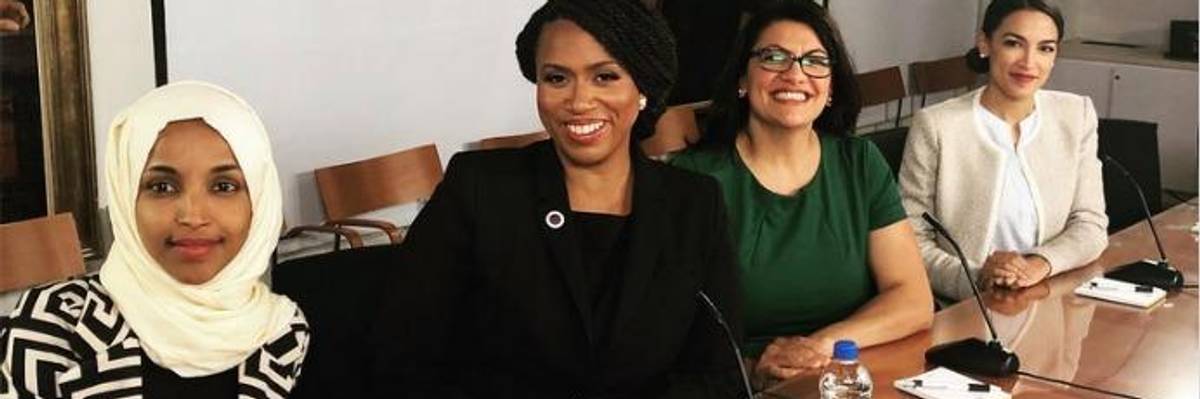
"If Democrats are smart, congresswomen like New York's Alexandria Ocasio-Cortez, Michigan's Rashida Tlaib, and Minnesota's Ilhan Omar will represent the future of party leadership," Demos Action president K. Sabeel Rahman argued in a piece for The New Republic on Monday. (Photo: Alexandria Ocasio-Cortez/Instagram)
At Freshman Orientation, Young and Growing Progressive Caucus Makes Clear It Will 'Fight Like Hell' for Bold Democratic Agenda
"We're the folks out there trying to advocate for big change... and that's what we're going to expect out of leadership, as well."
As some members of the House Democratic leadership quickly pivoted to centrist talk of bipartisanship and compromise with the Trumpian Republican Party in the aftermath of last week's midterm elections, the young, diverse, and rapidly growing Congressional Progressive Caucus (CPC) used its freshman member orientation on Monday to make clear that it has no intention of watering down its demands for a living wage, Medicare for All, bold climate action, and other ambitious solutions to pressing problems.
"We're going to fight like hell to get those things done, and that's what we're going to expect out of leadership, as well."
--Rep. Mark Pocan"A number of members [of Congress] prefer to spend their life in the fetal position, rocking in the corner of a room," declared CPC co-chair Rep. Mark Pocan (D-Wis.), who led Tuesday's meeting at the AFL-CIO's headquarters in Washington, D.C. "We don't do that. We're the folks out there trying to advocate for big change. We're going to fight like hell to get those things done, and that's what we're going to expect out of leadership, as well."
As the orientation unfolded, incoming progressives like Ayanna Pressley of Massachusetts, Alexandria Ocasio-Cortez of New York, and Ilhan Omar of Minnesota posted photos to Instagram using hashtags like #DreamTeam and #ChangeCantWait to signal their plans to start fighting for an ambitious progressive agenda as soon as the new Congress convenes in January.
The addition of around 20 newly elected members to the CPC brings total membership of the caucus to over 90 and moves its ideological center of gravity significantly leftward, given that many members were elected on unabashedly left-wing platforms that called for transformative climate action and robust economic measures to stem soaring inequality.
"We think there need to be strong progressive voices in a number of different spots in order to reflect the size of the Progressive Caucus and the energy that came from the base."
--Rep. Pramila Jayapal
Given that Democrats are likely to end up with 16-seat advantage in the House, at most, the CPC will have tremendous leverage to shape the party's leadership, policy agenda, and ideological trajectory in the months and years to come. As The Intercept reported last week, the CPC is withholding support for California Rep. Nancy Pelosi's bid for House Speaker in an effort to ensure that "progressives are well represented in leadership."
"We are concerned not only about the top spot," said Rep. Pramila Jayapal (D-Wash.), first vice chair of the CPC. "We think there need to be strong progressive voices in a number of different spots in order to reflect the size of the Progressive Caucus and the energy that came from the base."
Pointing to the young and disproportionately female group of incoming progressive members--which Sen. Bernie Sanders (I-Vt.) has deemed "the most progressive freshman class in modern U.S. history"--Jayapal noted that they "ran and won not just in progressive districts but in districts that have been seen as swing districts, districts that frankly we didn't know we had a shot at winning, except they ran on bold ideas."
"They ran on values of income equality, healthcare for everyone, of college without debt, of a country that respects and welcomes immigrants and diversity across the board," Jayapal concluded.
As Demos Action president K. Sabeel Rahman argued in a piece for The New Republic on Monday, Democrats must "pursue a legislative agenda that offers a clear moral vision"--and to do so, they must elevate bold progressives like Omar and Ocasio-Cortez."
"If Democrats are smart, congresswomen like New York's Alexandria Ocasio-Cortez, Michigan's Rashida Tlaib, and Minnesota's Ilhan Omar will represent the future of party leadership," Rahman wrote. "Democrats have traditionally relied on norms of seniority to decide leadership positions, and all indications are that Nancy Pelosi will return as speaker. But Democrats would do better to elevate someone new who can mobilize young communities of color and argue for political ideals free of the baggage of previous decades of political conflict."
Watch the press conference from the CPC's new member orientation:
We are at a crossroads
This country and this world are at a monumental crossroads. In a few short weeks, US voters will have an opportunity to beat back the forces of fascism and confront the billionaires who are rigging the economy, our media system, and our democracy, making it increasingly impossible for ordinary people to get by. We’re not just talking about the election. We’re talking about what must be done once these fascist elements are vanquished from power. We need a bolder set of solutions than what either major party has so far been willing to offer and a working-class movement ready to fight like hell for it. Trump didn't emerge from nowhere. The conditions that fueled MAGA authoritarianism were created by decades of radical neoliberal economic policies and a corrupt political system dominated by corporate interests. They slashed taxes on the super-rich, promising that the benefits would trickle down. They said giveaways to the corporate titans would make life more affordable for the rest of us. It was all bullshit. And when a bitter, betrayed populace searches for someone to blame, right-wing demagogues have little trouble finding scapegoats. People know when they're being lied to, but you won't hear any of this from the corporate media. Only independent journalism—powered and funded by people who believe in building a better world—can deliver truly trustworthy daily news. Our Fall Campaign is underway, and we need your help. To power our newsroom through the rest of the year, we need to raise $125,000 by midnight on October 31. So if you share our vision, please contribute whatever you can to sustain our work. |
As some members of the House Democratic leadership quickly pivoted to centrist talk of bipartisanship and compromise with the Trumpian Republican Party in the aftermath of last week's midterm elections, the young, diverse, and rapidly growing Congressional Progressive Caucus (CPC) used its freshman member orientation on Monday to make clear that it has no intention of watering down its demands for a living wage, Medicare for All, bold climate action, and other ambitious solutions to pressing problems.
"We're going to fight like hell to get those things done, and that's what we're going to expect out of leadership, as well."
--Rep. Mark Pocan"A number of members [of Congress] prefer to spend their life in the fetal position, rocking in the corner of a room," declared CPC co-chair Rep. Mark Pocan (D-Wis.), who led Tuesday's meeting at the AFL-CIO's headquarters in Washington, D.C. "We don't do that. We're the folks out there trying to advocate for big change. We're going to fight like hell to get those things done, and that's what we're going to expect out of leadership, as well."
As the orientation unfolded, incoming progressives like Ayanna Pressley of Massachusetts, Alexandria Ocasio-Cortez of New York, and Ilhan Omar of Minnesota posted photos to Instagram using hashtags like #DreamTeam and #ChangeCantWait to signal their plans to start fighting for an ambitious progressive agenda as soon as the new Congress convenes in January.
The addition of around 20 newly elected members to the CPC brings total membership of the caucus to over 90 and moves its ideological center of gravity significantly leftward, given that many members were elected on unabashedly left-wing platforms that called for transformative climate action and robust economic measures to stem soaring inequality.
"We think there need to be strong progressive voices in a number of different spots in order to reflect the size of the Progressive Caucus and the energy that came from the base."
--Rep. Pramila Jayapal
Given that Democrats are likely to end up with 16-seat advantage in the House, at most, the CPC will have tremendous leverage to shape the party's leadership, policy agenda, and ideological trajectory in the months and years to come. As The Intercept reported last week, the CPC is withholding support for California Rep. Nancy Pelosi's bid for House Speaker in an effort to ensure that "progressives are well represented in leadership."
"We are concerned not only about the top spot," said Rep. Pramila Jayapal (D-Wash.), first vice chair of the CPC. "We think there need to be strong progressive voices in a number of different spots in order to reflect the size of the Progressive Caucus and the energy that came from the base."
Pointing to the young and disproportionately female group of incoming progressive members--which Sen. Bernie Sanders (I-Vt.) has deemed "the most progressive freshman class in modern U.S. history"--Jayapal noted that they "ran and won not just in progressive districts but in districts that have been seen as swing districts, districts that frankly we didn't know we had a shot at winning, except they ran on bold ideas."
"They ran on values of income equality, healthcare for everyone, of college without debt, of a country that respects and welcomes immigrants and diversity across the board," Jayapal concluded.
As Demos Action president K. Sabeel Rahman argued in a piece for The New Republic on Monday, Democrats must "pursue a legislative agenda that offers a clear moral vision"--and to do so, they must elevate bold progressives like Omar and Ocasio-Cortez."
"If Democrats are smart, congresswomen like New York's Alexandria Ocasio-Cortez, Michigan's Rashida Tlaib, and Minnesota's Ilhan Omar will represent the future of party leadership," Rahman wrote. "Democrats have traditionally relied on norms of seniority to decide leadership positions, and all indications are that Nancy Pelosi will return as speaker. But Democrats would do better to elevate someone new who can mobilize young communities of color and argue for political ideals free of the baggage of previous decades of political conflict."
Watch the press conference from the CPC's new member orientation: