SUBSCRIBE TO OUR FREE NEWSLETTER
Daily news & progressive opinion—funded by the people, not the corporations—delivered straight to your inbox.
5
#000000
#FFFFFF
To donate by check, phone, or other method, see our More Ways to Give page.
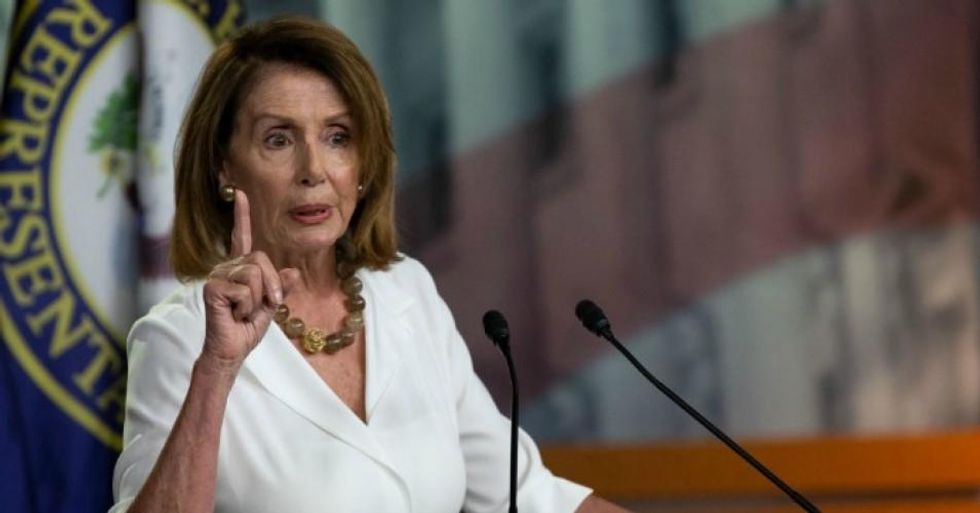
Even as recent surveys, major congressional primary results, and leftward shifts within the Democratic caucus continue to demonstrate a widespread desire for progressive change within the party, House Democrats' newly revealed 2019 legislative strategy--spearheaded by House Minority Leader Nancy Pelosi (D-Calif.)--shows that party leaders are planning to cripple any move toward bold policy goals like Medicare for All by reimposing the fiscally conservative pay-go rule.
"Pay-go is a self-imposed, economically illiterate approach to budgeting."
--Stephanie Kelton, economist Pay-go--which Pelosi first implemented in 2007 after becoming House Speaker--requires that all new spending be completely offset by budget cuts or tax hikes. According to Axios, which first reported on the outline of House Democrats' strategy on Monday, Pelosi is "committed" to reviving pay-go if Democrats take control of the House in November, despite strong progressive opposition to the rule.
Stephanie Kelton, an economist and former adviser to Sen. Bernie Sanders (I-Vt.), told The Intercept that "pay-go is a self-imposed, economically illiterate approach to budgeting," particularly as Republicans continue to disregard such restraints to deliver massive rewards to wealthy Americans and large corporations.
"Instead of vowing budget chastity, Democrats should be articulating an agenda that excites voters so that they can unleash the full power of the public purse on their behalf," Kelton argued.
Sen. Brian Schatz (D-Hawaii)--who introduced a plan in March to make public college debt-free for all--has echoed Kelton's critique of pay-go, arguing that Democrats shouldn't fall victim to deficit hysteria as Republicans freely ram through deficit-exploding tax cuts.
"Reviving 'pay-go' is one of the dumbest things Democrats could do."
--Pat Garofalo" I just reject the idea that only progressive ideas have to be paid for. If it's defense spending, nobody even considers paying for it," Schatz said in an interview with New York Magazine. "If it's a tax cut, nobody really talks very seriously about paying for it. But when it comes to a progressive priority, even liberals scurry around, wondering what the pay-for is--and I just reject the premise of a totally unfair debate."
But Pelosi--who has not joined the House Democrats' growing Medicare for All caucus or expressed support for tuition-free public college--appears firmly dedicated to placing arbitrary boundaries on the Democratic Party's agenda and ignoring grassroots demands for an ambitious policies like single-payer and a federal jobs guarantee.
As David Dayen noted in an analysis of House Democrats' strategy for The Intercept on Tuesday, Pelosi's commitment to reimposing pay-go "continues a trend of Democrats caring far more about deficits than Republicans."
"Deficit fears stop Democrats from moving forward on social programs, while Republicans plow ahead with tax cuts when they get to power," Dayen added.
With Pelosi already facing growing pressure from both the grassroots and inside the Democratic Party to step aside, the House Minority Leader's commitment to pay-go is likely to spark intense backlash from progressive incumbents as well as left-wing insurgent newcomers who are likely to defeat their Republican opponents in November.
The Washington Post's Jeff Stein offered a partial list of the "left coalition" that could pose a serious threat to Pelosi's efforts to stop the Democratic Party from moving in a more progressive direction and embracing bold policies like Medicare for All, which is supported by over 120 House Democrats.
Even as recent surveys, major congressional primary results, and leftward shifts within the Democratic caucus continue to demonstrate a widespread desire for progressive change within the party, House Democrats' newly revealed 2019 legislative strategy--spearheaded by House Minority Leader Nancy Pelosi (D-Calif.)--shows that party leaders are planning to cripple any move toward bold policy goals like Medicare for All by reimposing the fiscally conservative pay-go rule.
"Pay-go is a self-imposed, economically illiterate approach to budgeting."
--Stephanie Kelton, economist Pay-go--which Pelosi first implemented in 2007 after becoming House Speaker--requires that all new spending be completely offset by budget cuts or tax hikes. According to Axios, which first reported on the outline of House Democrats' strategy on Monday, Pelosi is "committed" to reviving pay-go if Democrats take control of the House in November, despite strong progressive opposition to the rule.
Stephanie Kelton, an economist and former adviser to Sen. Bernie Sanders (I-Vt.), told The Intercept that "pay-go is a self-imposed, economically illiterate approach to budgeting," particularly as Republicans continue to disregard such restraints to deliver massive rewards to wealthy Americans and large corporations.
"Instead of vowing budget chastity, Democrats should be articulating an agenda that excites voters so that they can unleash the full power of the public purse on their behalf," Kelton argued.
Sen. Brian Schatz (D-Hawaii)--who introduced a plan in March to make public college debt-free for all--has echoed Kelton's critique of pay-go, arguing that Democrats shouldn't fall victim to deficit hysteria as Republicans freely ram through deficit-exploding tax cuts.
"Reviving 'pay-go' is one of the dumbest things Democrats could do."
--Pat Garofalo" I just reject the idea that only progressive ideas have to be paid for. If it's defense spending, nobody even considers paying for it," Schatz said in an interview with New York Magazine. "If it's a tax cut, nobody really talks very seriously about paying for it. But when it comes to a progressive priority, even liberals scurry around, wondering what the pay-for is--and I just reject the premise of a totally unfair debate."
But Pelosi--who has not joined the House Democrats' growing Medicare for All caucus or expressed support for tuition-free public college--appears firmly dedicated to placing arbitrary boundaries on the Democratic Party's agenda and ignoring grassroots demands for an ambitious policies like single-payer and a federal jobs guarantee.
As David Dayen noted in an analysis of House Democrats' strategy for The Intercept on Tuesday, Pelosi's commitment to reimposing pay-go "continues a trend of Democrats caring far more about deficits than Republicans."
"Deficit fears stop Democrats from moving forward on social programs, while Republicans plow ahead with tax cuts when they get to power," Dayen added.
With Pelosi already facing growing pressure from both the grassroots and inside the Democratic Party to step aside, the House Minority Leader's commitment to pay-go is likely to spark intense backlash from progressive incumbents as well as left-wing insurgent newcomers who are likely to defeat their Republican opponents in November.
The Washington Post's Jeff Stein offered a partial list of the "left coalition" that could pose a serious threat to Pelosi's efforts to stop the Democratic Party from moving in a more progressive direction and embracing bold policies like Medicare for All, which is supported by over 120 House Democrats.
Even as recent surveys, major congressional primary results, and leftward shifts within the Democratic caucus continue to demonstrate a widespread desire for progressive change within the party, House Democrats' newly revealed 2019 legislative strategy--spearheaded by House Minority Leader Nancy Pelosi (D-Calif.)--shows that party leaders are planning to cripple any move toward bold policy goals like Medicare for All by reimposing the fiscally conservative pay-go rule.
"Pay-go is a self-imposed, economically illiterate approach to budgeting."
--Stephanie Kelton, economist Pay-go--which Pelosi first implemented in 2007 after becoming House Speaker--requires that all new spending be completely offset by budget cuts or tax hikes. According to Axios, which first reported on the outline of House Democrats' strategy on Monday, Pelosi is "committed" to reviving pay-go if Democrats take control of the House in November, despite strong progressive opposition to the rule.
Stephanie Kelton, an economist and former adviser to Sen. Bernie Sanders (I-Vt.), told The Intercept that "pay-go is a self-imposed, economically illiterate approach to budgeting," particularly as Republicans continue to disregard such restraints to deliver massive rewards to wealthy Americans and large corporations.
"Instead of vowing budget chastity, Democrats should be articulating an agenda that excites voters so that they can unleash the full power of the public purse on their behalf," Kelton argued.
Sen. Brian Schatz (D-Hawaii)--who introduced a plan in March to make public college debt-free for all--has echoed Kelton's critique of pay-go, arguing that Democrats shouldn't fall victim to deficit hysteria as Republicans freely ram through deficit-exploding tax cuts.
"Reviving 'pay-go' is one of the dumbest things Democrats could do."
--Pat Garofalo" I just reject the idea that only progressive ideas have to be paid for. If it's defense spending, nobody even considers paying for it," Schatz said in an interview with New York Magazine. "If it's a tax cut, nobody really talks very seriously about paying for it. But when it comes to a progressive priority, even liberals scurry around, wondering what the pay-for is--and I just reject the premise of a totally unfair debate."
But Pelosi--who has not joined the House Democrats' growing Medicare for All caucus or expressed support for tuition-free public college--appears firmly dedicated to placing arbitrary boundaries on the Democratic Party's agenda and ignoring grassroots demands for an ambitious policies like single-payer and a federal jobs guarantee.
As David Dayen noted in an analysis of House Democrats' strategy for The Intercept on Tuesday, Pelosi's commitment to reimposing pay-go "continues a trend of Democrats caring far more about deficits than Republicans."
"Deficit fears stop Democrats from moving forward on social programs, while Republicans plow ahead with tax cuts when they get to power," Dayen added.
With Pelosi already facing growing pressure from both the grassroots and inside the Democratic Party to step aside, the House Minority Leader's commitment to pay-go is likely to spark intense backlash from progressive incumbents as well as left-wing insurgent newcomers who are likely to defeat their Republican opponents in November.
The Washington Post's Jeff Stein offered a partial list of the "left coalition" that could pose a serious threat to Pelosi's efforts to stop the Democratic Party from moving in a more progressive direction and embracing bold policies like Medicare for All, which is supported by over 120 House Democrats.