

SUBSCRIBE TO OUR FREE NEWSLETTER
Daily news & progressive opinion—funded by the people, not the corporations—delivered straight to your inbox.
5
#000000
#FFFFFF
To donate by check, phone, or other method, see our More Ways to Give page.
Daily news & progressive opinion—funded by the people, not the corporations—delivered straight to your inbox.
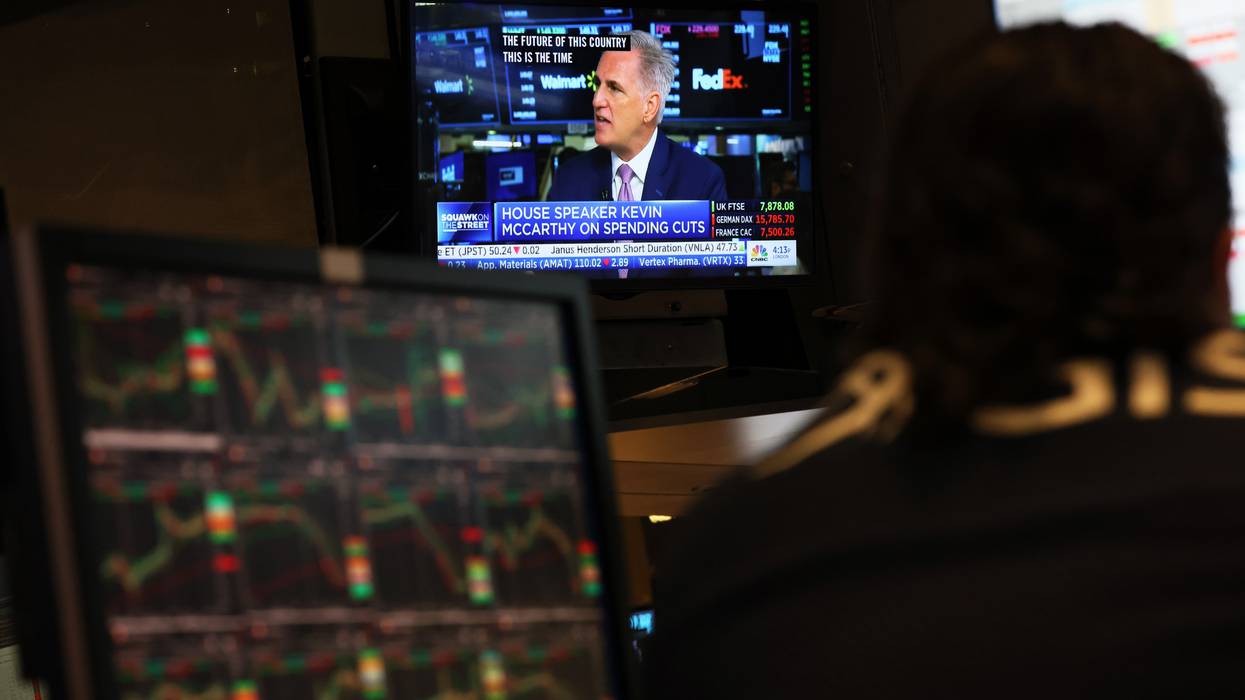
"We are an example to the world," wrote one American economist. "An example of what not to do."
Nations around the world are looking on with a mixture of alarm and bafflement as the United States hurtles toward an economy-wrecking default, with the Republican Party refusing to raise the country's globally unique debt limit without massive, harmful spending cuts.
The possibility of a U.S. default—a failure to pay the government's obligations—has already rattled global markets and prompted grave warnings from major institutions such as the International Monetary Fund, which said last week that a default would have "severe repercussions" for a world economy already facing the prospect of a central bank-induced recession.
The Washington Post reported Friday that the finance ministers of G7 nations have privately asked U.S. Treasury Secretary Janet Yellen for "updates on the status of negotiations between the White House and House Republicans" as officials from the rich countries gather in Hiroshima for their annual summit.
Finance ministers have also voiced their concerns publicly. German finance chief Christian Lindner said last week that he hopes "an adult decision will be made with regard to the development of American government finances and the associated effects on the global economy."
Kazuo Ueda, governor of the Bank of Japan, cautioned that a U.S. default could become a "big problem" that the Federal Reserve "may not be able to counteract."
"The United States is one among the few polities that have adopted and retained debt limits."
The U.S. debt limit, which currently sits at $31.4 trillion, is a "global outlier," the Atlantic Council's Mrugank Bhusari wrote in March, noting that "the United States is one among the few polities that have adopted and retained debt limits."
"Debt limits like the United States'... are not the norm—and they rarely cause major deadlocks in the few countries that have adopted this tool," Bhusari observed. "Like the United States, Denmark also sets its debt limit as a nominal value. But that’s where the similarity ends. The Danish Parliament intentionally sets the ceiling sufficiently high such that it will not be crossed, rendering it no more than a formality."
"Like the United States and Denmark, Kenya also has a nominal debt limit. However, it is under the process of replacing the nominal limit with a limit as a percentage of GDP at 55%," Bhusari continued. "Australia briefly experimented with a debt limit similar to that of the United States, experienced the political infighting that Washington is familiar with, and abolished it soon after."
Citing one Latin America expert, the Post noted Friday that "a debt ceiling like the one that exists in the U.S. stirred debate" in Brazil, where the Lula government is aiming to loosen existing restraints on government spending.
The idea of imposing a strict debt limit "was shot down vehemently, thanks to the U.S. example," the Post reported.
"We are an example to the world," Stephanie Kelton, an American economist, wrote on Twitter. "An example of what not to do."
The international community's reaction to the perilous U.S. debt ceiling standoff comes as President Joe Biden is facing growing pressure from lawmakers at home to end the crisis unilaterally if necessary by invoking the 14th Amendment, which states that "the public debt of the United States... shall not be questioned."
Progressives and legal scholars have long argued that the debt limit, first imposed by Congress in 1917, is unconstitutional and should be abolished—an argument that the National Association of Government Employees makes in a lawsuit filed in federal court 10 days ago.
But as The American Prospect's David Dayen wrote Friday, the plaintiffs "didn’t file a motion for immediate relief," so "the case has sat dormant."
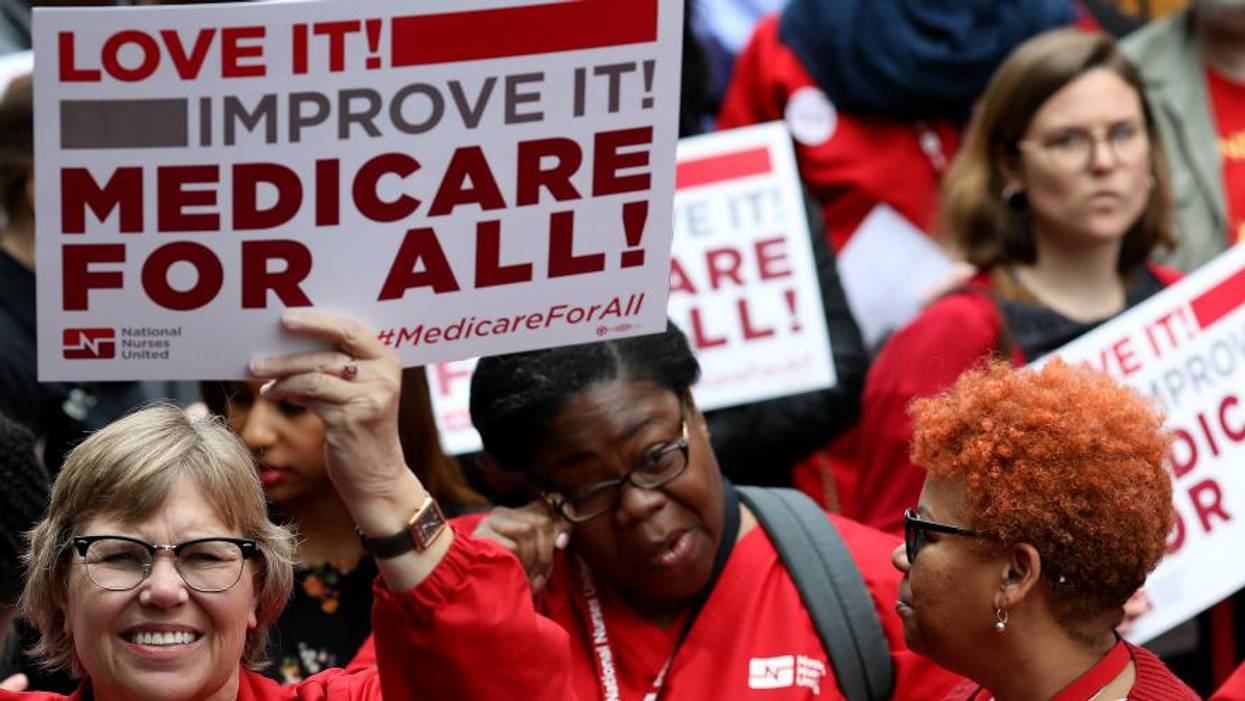
Ahead of a historic single-payer hearing at the House Budget Committee on Wednesday, more than 200 economists sent a letter to Congress blasting America's "exorbitant and wasteful" healthcare system and endorsing Medicare for All as the most humane and cost-effective solution.
"America's health system turns our survival over to greedy companies with the market power to set outrageously high prices," Jeffrey Sachs, professor of economics at Columbia University and one of the letter's 209 signatories, said in a statement on Tuesday.
" Medicare for All will give us a system already proven in other countries: much lower costs with less hassle and worry. It's a sure winner--except for the profiteers."
--Jeffrey Sachs, Columbia University
"Medicare for All will give us a system already proven in other countries: much lower costs with less hassle and worry," Sachs said. "It's a sure winner--except for the profiteers."
In their letter (pdf), the economists highlighted the fact that the United States spends far more on healthcare than other industrialized nations while achieving significantly worse results--a crisis they say can be remedied by transitioning to a single-payer system.
"Evidence from around the world demonstrates that publicly financed healthcare systems result in improved health outcomes, lower costs, and greater equity," the letter states. "For these reasons the time is now to create a universal, single-payer, Medicare for All healthcare system in the United States."
The economists' endorsement of Medicare for All comes just 24 hours before the House Budget Committee is scheduled to hold just the second-ever congressional hearing on single-payer. The panel will discuss Rep. Pramila Jayapal's (D-Wash.) Medicare for All Act of 2019, which currently has 108 co-sponsors.
National Nurses United (NNU), which has been leading efforts to build grassroots support for Medicare for All nationwide, urged Americans to call members of the Budget Committee and let them know "we're counting on their support."
"For patients, the effects would be life-changing," NNU president Jean Ross said in a statement Tuesday. "A Medicare for All system would guarantee the care we need throughout our lifetimes and patients would no longer have to deal with debilitating premiums, out-of-pocket costs, hospital bills, and drug costs again."
Read the economists' full letter:
As economists, we understand that a single-payer "Medicare for All" health insurance system for the U.S. can finance good-quality care for all U.S. residents as a basic right while still significantly reducing overall health care spending relative to the current exorbitant and wasteful system. Healthcare is not a service that follows standard market rules. It should therefore be provided as a public good.
Evidence from around the world demonstrates that publicly financed healthcare systems result in improved health outcomes, lower costs, and greater equity. As of 2017, the U.S. spent $3.3 trillion annually on healthcare. This equaled 17 percent of U.S. GDP, with average spending at about $10,000 per person. By contrast, Germany, France, Japan, Canada, the U.K., Australia, Spain and Italy spent between 9 - 11 percent of GDP on health care, averaging $3,400 to $5,700 per person. Yet average health outcomes in all of these countries are superior to those in the United States. In all of these countries, the public sector is predominant in financing heath care.
For these reasons the time is now to create a universal, single-payer, Medicare for All health care system in the United States.
Public financing for health is not a matter of raising new money for healthcare, but of reducing total healthcare outlays and distributing payments more equitably and efficiently. Implementing a unified single-payer system would reduce administrative costs and eliminate individuals' and employers' insurance premiums and out-of-pocket costs. If combined with public control of drug prices and a dramatically simplified global budgeting system, a sensible Medicare financing system would reduce healthcare costs while guaranteeing access to comprehensive care and financial security to all.
As such, we support publicly and equitably financed healthcare through a Medicare for All system at the Federal level, as described in H.R. 1384 and S. 1129. We encourage Congress to move forward with implementing a public financed Medicare for All plan to achieve the equitable and affordable universal healthcare system that the American people need.
Signed,
- Randy Albelda, Professor of Economics, University of Massachusetts Boston
- Carolyn B. Aldana, Professor Emeritus, California State University, San Bernardino
- Mona Ali, Associate Professor of Economics, SUNY New Paltz
- Larry Allen, Professor of Economics, Lamar University
- Jack Amariglio, Emeritus Professor of Economics, Merrimack College
- Eileen Appelbaum, Co-Director and Senior Economist, Center for Economic and Policy Research
- Peter Arno, Senior Fellow & Director Health Policy Research, Political Economy Research Institute, University of Massachusetts, Amherst
- Michael Ash, Professor of Economics & Public Policy, University of Massachusetts Amherst
- Glen Atkinson, Emeritus Professor of Economics, University of Nevada, Reno
- M V Lee Badgett, Professor of Economics, University of Massachusetts Amherst
- Ron Baiman, Assistant Professor of Economics, Benedictine University
- Dean Baker, Senior Economist, Center for Economic and Policy Research
- Radhika Balakrishnan, Professor, Rutgers University
- Nina Banks, Associate Professor of Economics, Bucknell University
- David Barkin, Distinguished Professor, Universidad Autonoma Metropolitana
- Charles Barone, Professor Emeritus, Dickinson College
- Deepankar Basu, Associate Professor, University of Massachusetts Amherst
- Lourdes Beneria, Professor Emerita, Cornell University
- Peter H. Bent, Assistant Professor, American University of Paris
- Suzanne Bergeron, Professor, University of Michigan Dearborn
- Cyrus Bina, Distinguished Research Professor of Economics, University of Minnesota (Morris Campus), and Fellow, Economists for Peace and Security
- Josh Bivens, Research Director, Economic Policy Institute
- Robert A. Blecker, Professor of Economics, American University
- Peter Bohmer, Faculty in Economics and Political Economy, The Evergreen State College
- Howard Botwinick, Associate Professor of Economics, SUNY Cortland
- Roger Even Bove, Ph.D. in Economics, West Chester University (retired)
- James K. Boyce, Professor Emeritus, University of Massachusetts Amherst
- Robert Brenner, Director, Center for Social Theory and Comparative History, UCLA
- Michael Brun, Instructor, Heartland Community College
- Antonio Callari, Professor, Franklin and Marshall College
- Al Campbell, Emeritus Professor of Economics, University of Utah
- Martha Campbell, Associate Professor of Economics, Emeritus, SUNY Potsdam
- Jim Campen, Professor of Economics, Emeritus, University of Massachusetts Boston
- Jose Caraballo, Professor, University of Puerto Rico
- Scott Carter, Professor of Economics, The University of Tulsa
- James F Casey, Associate Professor of Economics, Washington and Lee University
- John Dennis Chasse, Professor Emeritus, SUNY College at Brockport
- Robert Chernomas, Professor of Economics, University of Manitoba
- Kimberly Christensen, Economics Professor, Sarah Lawrence College
- Douglas Cliggott, Lecturer, Economics, University of Massachusetts
- Nathaniel Cline, Associate Professor, University of Redlands
- Richard Cornwall, Professor Emeritus, Middlebury College
- James Crotty, Emeritus Professor, University of Massachusetts
- Dr. James Cypher, Professor of Economics, Universidad Autonoma de Zacatecas, Mexico, and Emeritus Professor, California State University
- Omar Dahi, Hampshire College
- Anita Dancs, Associate Professor of Economics, Western New England University
- Paul Davidson, Emeritus Professor Chair of Honor, University of Tennessee
- Charles Davis, Professor of Labor Studies, Indiana University
- Carmen Diana Deere, Distinguished Professor Emerita, University of Florida
- George DeMartino, Professor, JKSIS, University of Denver
- Firat Demir, Professor, University of Oklahoma
- James G. Devine, Professor of Economics, Loyola Marymount University
- Geert Dhondt, Associate Professor, John Jay College, CUNY
- Peter Dorman, Professor of Political Economy, Evergreen State College
- Richard Du Boff, Professor Emeritus, Bryn Mawr College
- Marie C. Duggan, Professor of Economics, Keene State College
- Amitava Krishna Dutt, Professor of Economics and Political Science, University of Notre Dame
- Nina Eichacker, Assistant Professor, University of Rhode Island
- David P Ellerman, Visiting Scholar, University of California at Riverside
- Gerald Epstein, Professor of Economics, University of Massachusetts Amherst
- Thomas Ferguson, Professor Emeritus, University of Massachusetts Boston
- Ellen Fitzpatrick, Professor, Merrimack College
- Sean Flaherty, Professor of Economics, Franklin and Marshall College
- Nancy Folbre, Professor Emerita of Economics, University of Massachusetts Amherst
- Mariko Frame, Assistant Professor of Economics, Merrimack College
- Dania V. Francis, Assistant Professor, University of Massachusetts Amherst
- Gerald Friedman, Professor of Economics, University of Massachusetts Amherst
- James K. Galbraith, Professor, University of Texas at Austin
- Barbara Garson, Author, Money Makes the World Go Round
- Armagan Gezici, Associate Professor of Economics, Keene State College
- Helen Lachs Ginsburg, Professor Emerita of Economics, Brooklyn College/CUNY
- Mwangi Wa Githinji, Associate Professor, University of Massachusetts-Amherst
- Art Goldsmith, Professor of Economics, Washington and Lee University
- Neva Goodwin, Co-director, GDAE, Tufts University
- Ulla Grapard, Professor of Economics and Women's Studies, Emerita, Colgate University
- Robert Guttmann, Augustus B Weller Professor of Economics, Hofstra University
- Robin E Hahnel, Professor Emeritus, American University
- John Battaile Hall, Professor of Economics, Portland State University
- Jay Hamilton, Assistant Professor, John Jay College
- Greg P. Hannsgen, Founder and Blogger, Greg Hannsgen's Economics Blog, and Research Associate, Levy Economics Institute of Bard College
- John T. Harvey, Professor of Economics, Texas Christian University
- Baban Hasnat, Professor of International Business, SUNY Brockport
- F. Gregory Hayden, Professor, University of Nebraska-Lincoln
- Carol E. Heim, Professor of Economics, University of Massachusetts Amherst
- John Forrest Henry, Senior Scholar, Levy Economics Institute, and Adjunct Professor, University of Missouri-Kansas City
- P. Sai-wing Ho, Professor, University of Denver
- Joan Hoffman, Professor, John Jay College of Criminal Justice CUNY
- Barbara Hopkins, Professor, Wright State University
- Candace Howes, Professor of Economics, Connecticut College
- Eric Hoyt, Ph.D. in Economics, University of Massachusetts Amherst, and Research Director, Center for Employment Equity
- Joseph Michael Hunt, Instructor, Environmental and Health Policy, Harvard Uiversity
- Dorene Isenberg, Professor of Economics, University of Redlands
- Tae-Hee Jo, Associate Professor, SUNY Buffalo State
- Fadhel Kaboub, Associate Professor of Economics, Denison University, and President, Global Institute for Sustainable Prosperity
- Stephanie A Kelton, Professor of Economics and Public Policy, Stony Brook University, and Senior Economic Advisor, Bernie2020 Presidential Campaign
- Haider A Khan, John Evans Distinguished University Professor, University of Denver
- Mu-Jeong Kho, University College London, the University of London
- Marlene Kim, Professor, University of Massachusetts Boston
- Mary C. King, Professor of Economics Emerita, Portland State University
- Charalampos Konstantinidis, Associate Professor, University of Massachusetts Boston
- Kazim Konyar, Professor of Economics, California State University, San Bernardino
- Brent Kramer, Adjunct Assistant Professor, City University of New York
- Patrick L Mason, Professor of Economics, Florida State University, and Director, African American Studies Program
- David Laibman, Professor Emeritus, Economics, City University of New York, and Editor, Science & Society
- Thomas Lambert, Lecturer, University of Louisville
- Anthony Laramie, Professor of Economics, Merrimack College
- Margaret Levenstein, Research Professor, Institute for Social Research and School of Information, University of Michigan
- An Li, Assistant Professor, Sarah Lawrence College
- Victor D. Lippit, Professor Emeritus of Economics, University of California, Riverside
- James Luke, Professor of Economics, Lansing Community College
- Daniel MacDonald, Assistant Professor, California State University San Bernardino
- Arthur MacEwan, Professor Emeritus of Economics, University of Massachusetts Boston
- Allan MacNeill, Professor, Webster University
- Zagros Madjd-Sadjadi, Full Professor of Economics, Winston-Salem State University, and Former Chief Economist, City and County of San Francisco
- Yahya M. Madra, Associate Professor of Economics, Drew University
- Theresa Mannah-Blankson, Assistant Professor of Economics, Messiah College
- Thomas Masterson, Director of Applied Micromodeling, Levy Economics Institute of Bard College
- Gabriel Mathy, Assistant Professor, American University
- Peter H Matthews, Dana Professor of Economics, Middlebury College
- Scott McConnell, Associate Professor of Economics, Eastern Oregon University, and Owner/CEO, Side A Brewing
- Elaine McCrate, Economics Professor Emerita, University of Vermont
- Terrence McDonough, Professor Emeritus, National University Ireland Galway
- Martin Melkonian, Adjunct Associate Professor, Economics, Hofstra University
- Peter B. Meyer, Professor Emeritus of Urban Policy and Economics, University of Louisville
- Thomas Michl, Professor of Economics, Colgate University
- John Miller, Professor of Economics, Wheaton College
- Katherine A. Moos, Assistant Professor of Economics, University of Massachusetts Amherst
- Tracy Mott, Professor, University of Denver
- Michele Naples, Professor of Economics, The College of New Jersey
- Daniel H. Neilson, Faculty in Economics, Bard College at Simon's Rock
- Edward J. Nell, Emeritus Professor, New School for Social Research
- Julie A. Nelson, Professor, University of Massachusetts Boston
- Reynold F. Nesiba, Professor of Economics, Augustana University
- John Casey Nicolarsen, Visiting Professor, Sarah Lawrence College
- Eric Nilsson, Professor, California State University San Bernardino
- Erik Olsen, Associate Professor, University of Missouri Kansas City
- Paulette Olson, Professor Emerita, Wright State University
- Lenore Palladino, Senior Economist, Roosevelt Institute
- Christian Parenti, Associate Professor Department of Economics, John Jay College CUNY
- Mark Paul, Assistant Professor of Economics, New College of Florida
- Eva Paus, Professor of Economics, Mount Holyoke College
- Karen A Pfeifer, Professor Emerita of Economics, Smith College
- Lynda Pickbourn, Assistant Professor of Economics, Hampshire College
- Bruce Pietrykowski, Professor of Economics, University of Michigan-Dearborn
- Chiara Piovani, Associate Professor, University of Denver
- Robert Pollin, Distinguished Professor of Economics, University of Massachusetts Amherst, and Co-Director, Political Economy Research Institute (PERI)
- Devin T. Rafferty, Assistant Professor, Saint Peter's University, and Founding Director, MS Finance Program
- Pratistha Joshi Rajkarnikar, Postdoc Scholar, Global Development and Environment Institute, Tufts University
- Michael Robinson, Professor of Economics, Mount Holyoke College
- John Roche, Associate Proferssor Emeritus, St John Fisher College
- Leonard Rodberg, Emeritus Professor of Urban Studies, Queens College/CUNY
- Leanne Roncolato, Assistant Professor of Economics, Franklin and Marshall College
- Frank Roosevelt, Emeritus Professor of Economics, Sarah Lawrence College
- Jaime Ros, Emeritus Professor, University of Notre Dame, and Professor of Economics, National Autonomous University of Mexico
- Nancy E Rose, Professor Emeritus, California State University San Bernardino
- Trevor R. Roycroft, Ph.D., Professor Emeritus, Ohio University
- David F. Ruccio, Professor of Economics, University of Notre Dame
- Jeffrey D. Sachs, Professor, Columbia University
- Gregory M Saltzman, Professor of Economics and Management, Albion College
- John Sarich, The Cooper Union for the Advancement of Science and Art
- John Schmitt, Vice President, Economic Policy Institute
- Jeremy Schwartz, Associate Professor, Loyola University Maryland
- Elliott Sclar, Emeritus Professor, Columbia University
- Stephanie Seguino, Professor of Economics, University of Vermont
- Mark Setterfield, Professor of Economics, New School for Social Research
- Anwar Shaikh, Professor, New School for Social Research
- Barry G. Shelley, Senior Lecturer, Pardee School of Global Studies, Boston University
- Zoe Sherman, Assistant Professor of Economics, Merrimack College
- Heidi Shierholz, Senior Economist and Director of Policy, Economic Policy Institute
- Hee-Young Shin, Assistant Professor, Wright State University
- Nicholas Shunda, Associate Professor of Economics, University of Redlands
- Kellin Stanfield, Assistant Professor of Economics, Hobart and William Smith Colleges
- Howard Stein, Professor, University of Michigan, Ann Arbor
- Jose A. Tapia, Associate Professor, Drexel University
- Linwood Tauheed, Associate Professor, University of Missouri Kansas City
- Daniele Tavani, Associate Professor, Colorado State University
- Pavlina R. Tcherneva, Program Director and Associate Professor of Economics, Bard College, and Research Associate, Levy Economics Institute
- Chris Tilly, Professor of Urban Planning, UCLA Luskin School of Public Affairs
- E. Ahmet Tonak, Visiting Professor, Economics, University of Massachusetts Amherst
- Mariano Torras, Professor, Adelphi University
- Andres Torres, Distinguished Lecturer, Lehman College (retired)
- Mayo Toruno, Professor Emeritus, California State University San Bernardino
- Eric Tymoigne, Associate Professor of Economics, Lewis & Clark College
- Vamsi Vakulabharanam, Associate Professor of Economics, University of Massachusetts Amherst
- William Van Lear, Economics Professor, Belmont Abbey College
- Ramaa Vasudevan, Associate Professor, Colorado State University
- Tanadej Vechsuruck, Assistant Professor, University of Rhode Island
- William Waller, Professor of Economics, Hobart and William Smith Colleges
- John P. Watkins, Professor of Economics, Westminster College, and Adjunct Professor of Economics, University of Utah
- David F. Weiman, Professor of Economics, Barnard College, Columbia University
- Scott A. Weir, Ph.D. in Economics, Retired
- Jeannette Wicks-Lim, Associate Research Professor, Political Economy Research Institute
- Noe Wiener, Lecturer, University of Massachusetts Amherst
- Robert B. Williams, Professor of Economics, Guilford College
- John Willoughby, Professor, Department of Economics, American University
- Benjamin Wilson, Assistant Professor, SUNY CortlandL
- Lucas Wilson, Professor, Mount Holyoke College
- Valerie Wilson, Director, Program on Race, Ethnicity & the Economy, Economic Policy Institute
- Andrew J Winnick, Professor Emeritus, California State University Los Angeles
- Jon D. Wisman, Professor of Economics, American University
- Richard D. Wolff, Professor of Economics Emeritus, University of Massachusetts Amherst
- L. Randall Wray, Professor of Economics and Senior Scholar, Bard College and Levy Economics Institute
- Brenda Wyss, Associate Professor, Wheaton College Massachusetts
- Yavuz Yasar, Associate Professor, University of Denver
- Tai Young-Taft, Assistant Professor of Economics, Bard College at Simon's Rock, and Research Scholar, Levy Economics Institute of Bard College
- June Zaccone, Associate Professor of Economics, Emerita, Hofstra University
- Ajit Zacharias, Senior Scholar, Levy Economics Institute
- German A. Zarate-Hoyos, Associate Professor, SUNY Cortland
- Gabriel Zucman, Assistant Professor of Economics, University of California, Berkeley
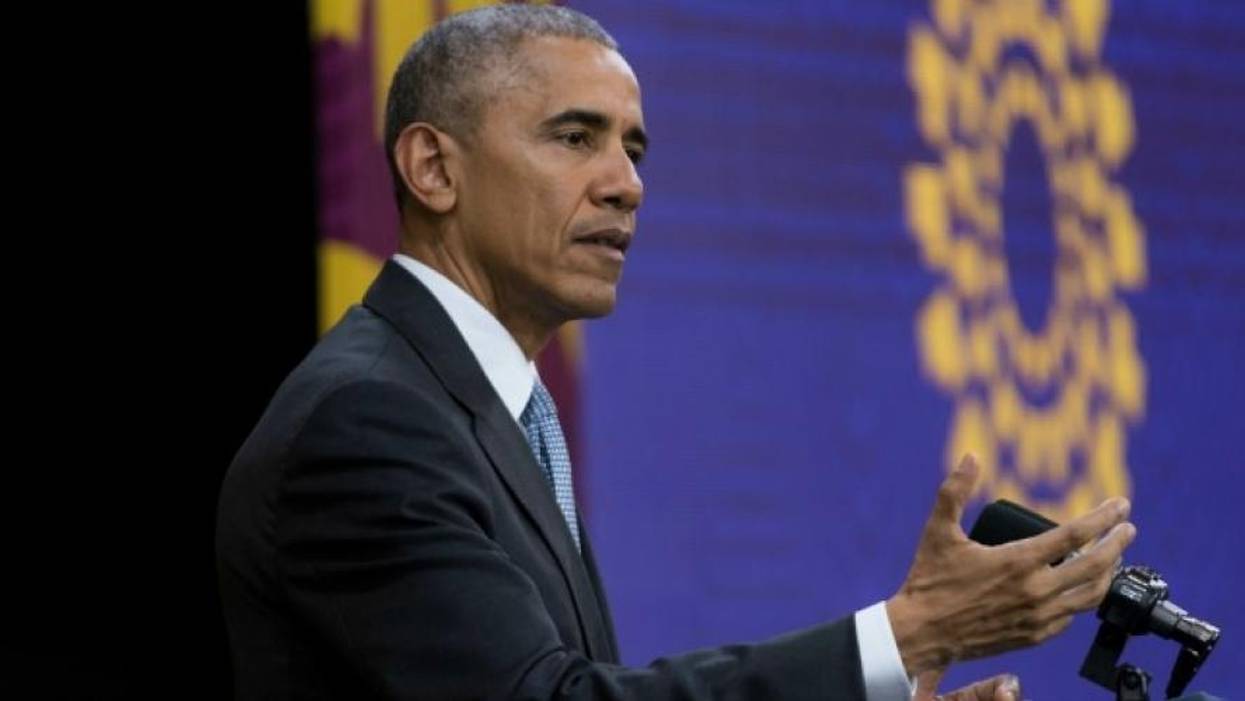
Former President Barack Obama on Monday night cautioned freshman members of the U.S. House against pushing for broadly popular, sweeping reforms by suggesting that voters will reject progressive policies due to their supposed high costs--despite evidence to the contrary.
At a meeting organized by House Speaker Nancy Pelosi (D-Calif.), Obama told several first-term members both that they should continue to pursue "bold" policy agendas--but also injected the familiar right-wing and centrist canard concerning the cost of such programs.
"He said we [as Democrats] shouldn't be afraid of big, bold ideas--but also need to think in the nitty-gritty about how those big, bold ideas will work and how you pay for them," one attendee told the Washington Post.
The two ideas struck many critics as contradictory. Some slammed the former president for appearing to try to tamp down the ambition, passion, and sense of urgency many freshman including Reps. Alexandria Ocasio-Cortez (D-N.Y.) and Rashida Tlaib (D-Mich.) have brought to their work--hoping to combat a climate crisis fueled by corporate greed and politicians' complicity; a for-profit health insurance system which has left tens of millions of Americans without healthcare; and rising economic inequality.
Obama's remarks also put him at odds with a number of 2020 Democratic presidential candidates, at least 10 of whom support a Green New Deal and a majority of whom have backed a Medicare for All plan, including several who have co-sponsored Sen. Bernie Sanders' (I-Vt.) bill in the Senate.
According to the Post, the former president mainly expressed concern with how voters will react to progressive policies that require financial investment.
However, the majority of the public supports the proposals, and most Americans surveyed by YouGov in January said that the wealthiest people in the country and corporations should be taxed at a higher rate in order to fund a Green New Deal. Fifty-nine percent of those surveyed by The Hill also said that the top marginal tax rate should be raised to 70 percent in order to combat inequality and fund progressive policies.
On social media, some critics added that Obama's comments crystallized the results of his two terms in the White House, during which he pushed for healthcare reforms that insulated the private insurance industry; bailed out the U.S. financial system without holding big banks accountable for causing the 2008 financial meltdown and leaving working Americans still struggling through a foreclosure crisis; and failed to propose ambitious targets for reducing fossil fuel emissions.
"No president since FDR has been handed as many opportunities to transform the U.S. into something that doesn't threaten the stability of life on this planet," wrote author Naomi Klein on Twitter, quoting a 2009 article she wrote for The Nation. "He has refused every one."
10 years ago I wrote about how Obama blew his #GreenNewDeal moment: "No President since FDR has been handed as many opportunities to transform the U.S. into something that doesn't threaten the stability of life on this planet. He has refused every one." https://t.co/2nlmeAO1OR https://t.co/ygiC3s9Hm3
-- Naomi Klein (@NaomiAKlein) March 26, 2019
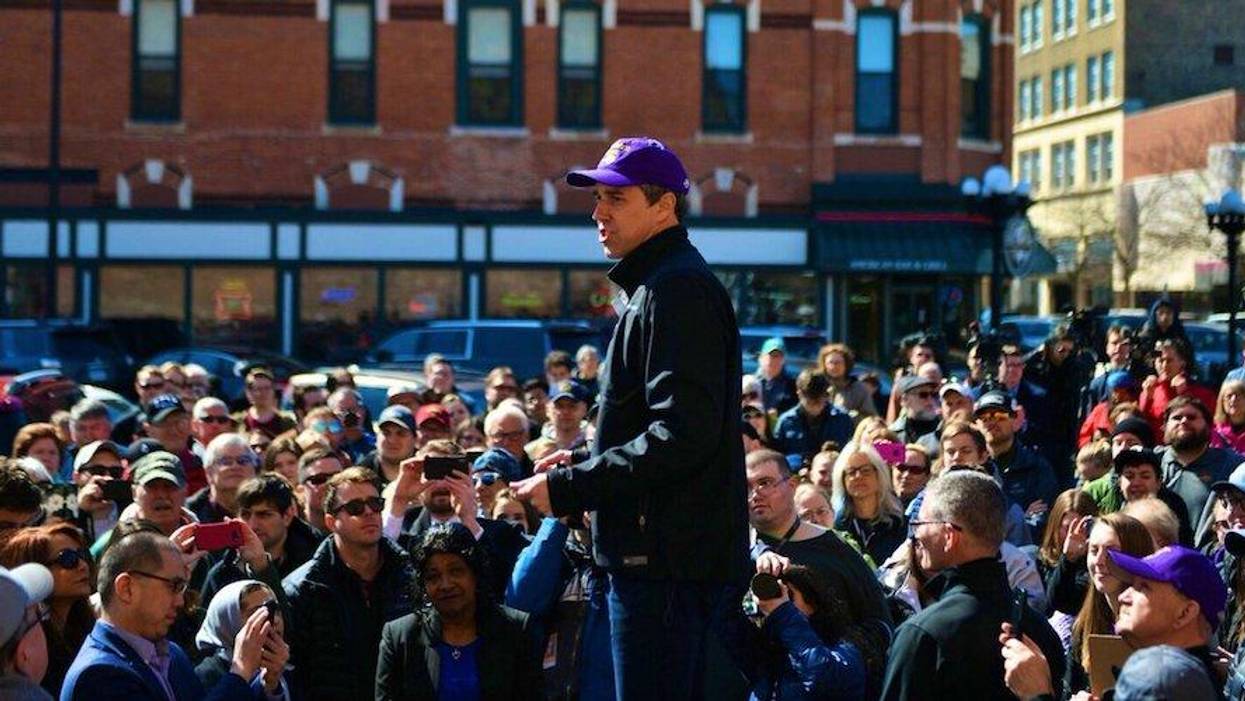
Beto O'Rourke is attracting criticism from Medicare for All proponents after the 2020 Democratic presidential candidate said he doesn't believe the existence of the for-profit insurance industry is a "function of greed" during a campaign stop in Iowa over the weekend.
O'Rourke, the former Texas Congressman who lost a narrow Senate election to Ted Cruz (R-Tex.) last November, made the remark in Independence, Iowa, during a barnstorming tour of the first in-the-nation caucus state. O'Rourke jumped into the crowded Democratic primary for president last Thursday, raising a record $6.1 million in his first 24 hours.
Medicare For All, the universal health care program proposed by Rep. Pramila Jayapal (D-Wash.) and Sen. Bernie Sanders (I-Vt.), is a major issue on the campaign trail this year.
Despite the policy's broad popularity, however, conservative Democrats have been hesitant to endorse universal health care. Instead, O'Rourke has promoted "Medicare for America," presenting Medicare as a public option that Americans have the option of buying into--allowing people to keep their employer insurance if they so choose.
"It complements what already exists with the need that we have for millions of Americans who do not have insurance and ensures that each of them can enroll in Medicare," O'Rourke said Saturday in Independence. "It then suggests additional investments in that program so it becomes the program of choice and people who have private insurance migrate over to the Medicare system."
That answer wasn't satisfactory to an audience member who originally asked O'Rourke for more concrete policy ideas.
"So the greed has to stay in the insurance industry in your opinion?" asked the man.
"I don't see it as a function of greed," said O'Rourke.
Political theorist Corey Robin, acriticized O'Rourke's premise that Americans are enamored with their insurance.
"I really want to meet these 'many Americans' who are so happy with their insurance," said Robin in a Facebook post he shared on Twitter, "who are so confident about stability of their current job (and its healthcare benefits), such that they think the best way to guarantee that they keep seeing their doctor is not to have Medicare For All."
In O'Rourke's view, he explained, people that like their insurance should be allowed to stay in their plans. The former Congressman analogized the issue to doctors in private practice and expressed his hope that the private insurance industry could work with public care in a "uniquely American" way.
"If we become too ideological or too prescribed in the solution, we may allow the perfect to become the enemy of the good," O'Rourke aded. "And there are fellow American human lives depending on us finding a solution."
Texas Tribune reporter Patrick Svitek called the back and forth "the most illuminating exchange on health care of @BetoORourke's Iowa trip so far."
Reaction was harsh from health care advocates who were dissatisfied by the response and what that indicates about O'Rourke's priorities.
It remains to be seen if O'Rourke's position on healthcare--whatever it is--will have an effect on his candidacy. But a lack of consistent messaging is beginning to wear on observers.
"He doesn't have a message right now," said Morning Joe host Joe Scarborough on Monday. "It's all goop."

Modern Monetary Theory (MMT) is getting significant media attention these days, after Rep. Alexandria Ocasio-Cortez said in an interview that it should "be a larger part of our conversation" when it comes to funding the "Green New Deal." According to MMT, the government can spend what it needs without worrying about deficits. MMT expert and Bernie Sanders adviser professor Stephanie Kelton says the government actually creates money when it spends. The real limit on spending is not an artificially imposed debt ceiling but a lack of labor and materials to do the work, leading to generalized price inflation. Only when that real ceiling is hit does the money need to be taxed back, but even then it's not to fund government spending. Instead, it's needed to shrink the money supply in an economy that has run out of resources to put the extra money to work.
Predictably, critics have been quick to rebut, calling the trend to endorse MMT "disturbing" and "a joke that's not funny." In a Feb. 1 post on the Daily Reckoning, Brian Maher darkly envisioned Bernie Sanders getting elected in 2020 and implementing "Quantitative Easing for the People" based on MMT theories. To debunk the notion that governments can just "print the money" to solve their economic problems, he raised the specter of Venezuela, where "money" is everywhere but bare essentials are out of reach for many, the storefronts are empty, unemployment is at 33 percent and inflation is predicted to hit 1 million percent by the end of the year.
Blogger Arnold Kling also pointed to the Venezuelan hyperinflation. He described MMT as "the doctrine that because the government prints money, it can spend whatever it wants . . . until it can't." He said:
To me, the hyperinflation in Venezuela exemplifies what happens when a country reaches the "it can't" point. The country is not at full employment. But the government can't seem to spend its way out of difficulty. Somebody should ask these MMT rock stars about the Venezuela example.
I'm not an MMT rock star and won't try to expound on its subtleties. (I would submit that under existing regulations, the government cannot actually create money when it spends, but that it should be able to. In fact, MMTers have acknowledged that problem; but it's a subject for another article.) What I want to address here is the hyperinflation issue, and why Venezuelan hyperinflation and "QE for the People" are completely different animals.
What Is Different About Venezuela
Venezuela's problems are not the result of the government issuing money and using it to hire people to build infrastructure, provide essential services and expand economic development. If it were, unemployment would not be at 33 percent and climbing. Venezuela has a problem the U.S. does not, and will never have: It owes massive debts in a currency it cannot print itself, namely, U.S. dollars. When oil (its principal resource) was booming, Venezuela was able to meet its repayment schedule. But when the price of oil plummeted, the government was reduced to printing Venezuelan bolivars and selling them for U.S. dollars on international currency exchanges. As speculators drove up the price of dollars, more and more printing was required by the government, massively deflating the national currency.
It was the same problem suffered by Weimar Germany and Zimbabwe, the two classic examples of hyperinflation typically raised to silence proponents of government expansion of the money supply before Venezuela suffered the same fate. Professor Michael Hudson, an actual economic rock star who supports MMT principles, has studied the hyperinflation question extensively. He confirms that those disasters were not due to governments issuing money to stimulate the economy. Rather, he writes, "Every hyperinflation in history has been caused by foreign debt service collapsing the exchange rate. The problem almost always has resulted from wartime foreign currency strains, not domestic spending."
Venezuela and other countries that are carrying massive debts in currencies that are not their own are not sovereign. Governments that are sovereign can and have engaged in issuing their own currencies for infrastructure and development quite successfully. I have discussed a number of contemporary and historical examples in my earlier articles, including in Japan, China, Australia and Canada.
Although Venezuela is not technically at war, it is suffering from foreign currency strains triggered by aggressive attacks by a foreign power. U.S. economic sanctions have been going on for years, causing the country at least $20 billion in losses. About $7 billion of its assets are now being held hostage by the U.S., which has waged an undeclared war against Venezuela ever since George W. Bush's failed military coup against President Hugo Chavez in 2002. Chavez boldly announced the "Bolivarian Revolution," a series of economic and social reforms that dramatically reduced poverty and illiteracy as well as improved health and living conditions for millions of Venezuelans. The reforms, which included nationalizing key components of the nation's economy, made Chavez a hero to millions of people and the enemy of Venezuela's oligarchs.
Nicolas Maduro was elected president following Chavez's death in 2013 and vowed to continue the Bolivarian Revolution. Recently, as Saddam Hussein and Moammar Gadhafi had done before him, he defiantly announced that Venezuela would not be trading oil in U.S. dollars following sanctions imposed by President Trump.
The notorious Elliott Abrams has now been appointed as special envoy to Venezuela. Considered a war criminal by many for covering up massacres committed by U.S.-backed death squads in Central America, Abrams was among the prominent neocons closely linked to Bush's failed Venezuelan coup in 2002. National security adviser John Bolton is another key neocon architect advocating regime change in Venezuela. At press conference on Jan. 28, he held a yellow legal pad prominently displaying the words "5,000 troops to Colombia," a country that shares a border with Venezuela. Clearly, the neocon contingent feels it has unfinished business there.
Bolton does not even pretend that it's all about restoring "democracy." He blatantly said on Fox News, "It will make a big difference to the United States economically if we could have American oil companies invest in and produce the oil capabilities in Venezuela." As President Nixon said of U.S. tactics against Salvador Allende's government in Chile, the point of sanctions and military threats is to squeeze the country economically.
Killing the Public Banking Revolution in Venezuela
It may be about more than oil, which recently hit record lows in the market. The U.S. hardly needs to invade a country to replenish its supplies. As with Libya and Iraq, another motive may be to suppress the banking revolution initiated by Venezuela's upstart leaders.
The banking crisis of 2009-10 exposed the corruption and systemic weakness of Venezuelan banks. Some banks were engaged in questionable business practices. Others were seriously undercapitalized. Others still were apparently lending top executives large sums of money. At least one financier could not prove where he got the money to buy the banks he owned.
Rather than bailing out the culprits, as was done in the U.S., in 2009 the government nationalized seven Venezuelan banks, accounting for around 12 percent of the nation's bank deposits. In 2010, more were taken over. Chavez's government arrested at least 16 bankers and issued more than 40 corruption-related arrest warrants for others who had fled the country. By the end of March 2011, only 37 banks were left, down from 59 at the end of November 2009. State-owned institutions took a larger role, holding 35 percent of assets as of March 2011, while foreign institutions held just 13.2 percent of assets.
Over the howls of the media, in 2010 Chavez took the bold step of passing legislation defining the banking industry as one of "public service." The legislation specified that 5 percent of the banks' net profits must go toward funding community council projects, designed and implemented by communities for the benefit of communities. The Venezuelan government directed the allocation of bank credit to preferred sectors of the economy, and it increasingly became involved in private financial institutions' operations. By law, nearly half the lending portfolios of Venezuelan banks had to be directed to particular mandated sectors of the economy, including small business and agriculture.
In a 2012 article titled "Venezuela Increases Banks' Obligatory Social Contributions, U.S. and Europe Do Not," Rachael Boothroyd said that the Venezuelan government was requiring the banks to give back. Housing was declared a constitutional right, and Venezuelan banks were obliged to contribute 15 percent of their yearly earnings to securing it. The government's Great Housing Mission aimed to build 2.7 million free houses for low-income families before 2019. The goal was to create a social banking system that contributed to the development of society rather than simply siphoning off its wealth. Boothroyd wrote:
... Venezuelans are in the fortunate position of having a national government which prioritizes their life quality, wellbeing and development over the health of bankers' and lobbyists' pay checks. If the 2009 financial crisis demonstrated anything, it was that capitalism is quite simply incapable of regulating itself, and that is precisely where progressive governments and progressive government legislation needs to step in.
That is also where, in the U.S., the progressive wing of the Democratic Party is stepping in--and why Ocasio-Cortez's proposals evoke howls in the media of the sort seen in Venezuela.
Article I, Section 8, of the Constitution gives Congress the power to create the nation's money supply. Congress needs to exercise that power. The key to restoring our economic sovereignty is to reclaim the power to issue money from a commercial banking system that acknowledges no public responsibility beyond maximizing profits for its shareholders. Bank-created money is backed by the full faith and credit of the United States, including federal deposit insurance, access to the Fed's lending window, and government bailouts when things go wrong. If we the people are backing the currency, it should be issued by the people through their representative government.
Today's government, however, does not adequately represent the people, which is why we first need to take our government back. Thankfully, that is exactly what Ocasio-Cortez and her congressional allies are attempting to do

A friend sent me an email the other day, complaining about the 70 percent marginal tax rate floated by Democratic Representative Alexandria Ocasio-Cortez and the new wealth tax proposed by Democratic Senator Elizabeth Warren.
Ocasio-Cortez first mentioned the 70 percent rate in response to a question from CNN's Anderson Cooper about how she proposes to pay for programs like a Green New Deal that could cost trillions of dollars. Higher tax rates, she suggested, might be one part of the answer.
Then Warren released a video explaining that her "ultra-millionaire tax" could raise nearly $3 trillion over 10 years, money that she says could be used to pay for programs like universal child care, a Green New Deal and student-debt forgiveness.
Oh, I forgot to mention, my friend is wealthy enough to get hit by both.
I've argued elsewhere that we can pay for a Green New Deal and that the obsession with finding a dollar of new "revenue" to offset every new dollar of spending is the wrong way to approach the federal budgeting process. My views belong to the macroeconomic school of thought known as Modern Monetary Theory -- MMT, for short.
I've debated those views here at Bloomberg Opinion, and they are beginning to gain a foothold in policy circles. But there is a long a way to go before politicians and the journalists who interview them stop demanding a road map to the source of funding for every new spending proposal.
My wealthy friend doesn't want to pay for your child care. He doesn't want to help pay off your student loans. And he sure as heck doesn't want to shell out the big bucks for a multi-trillion-dollar Green New Deal.
So where does that leave Democrats, who insist that they need the rich to pay for their progressive agenda? Here's what I told him.
"I am with the Democrats. I want to see us build a cleaner, safer, more prosperous world. I agree with billionaire hedge-fund manager Ray Dalio, who argues that inequality has become so extreme that it should be declared a "national emergency" and dealt with by presidential action.
"And I worry very much that it may prove impossible to raise taxes on the ultra-wealthy (who have enormous political power). Then what? The planet burns, our third-world infrastructure falls into total disrepair, and our society becomes ever more bifurcated until the tensions reach a boiling point and.... The pitchforks are coming.
"The problem is that every politician is confronted with the question, "How are you going to pay for it?" What these journalists are really asking is, 'Who's going to pay for it?'
"The question is designed to stop any meaningful policy debate by dividing us up, and get us fighting over where the money is going to come from. Since none of the headline politicians has really figured out how to respond -- by explaining that when Congress approves a budget, the Treasury Department instructs the Federal Reserve to credit a seller's bank account -- they all end up trying to answer it by pointing to some new revenue source.
"And then there are self-imposed constraints, like PAYGO, that require lawmakers to offset any new spending with higher taxes or cuts to some other part of the budget. That means you can't even get a piece of legislation to the floor for a vote if isn't fully "paid for." It also makes passing anything that much harder, since it requires politicians to raise taxes or carve out money from other programs. And don't even get me started on CBO.
"So that's why you see people like Representative Ocasio-Cortez and Senator Warren looking at the ultra-rich to fund their agendas. Billionaires are the magic money tree!
"To be blunt, the super-rich have become victims of their own successful marketing campaign. Conservative billionaires like Pete Peterson spent decades complaining about debt and deficits, putting enormous sums of money into a PR campaign to turn politicians and the public against deficit spending.
"So here we are. As Hillary Clinton said during the 2016 campaign, 'You have to go where the money is.' That means you!
"What can higher-income taxpayers do? I guess they could point the finger at Congress and say: "Don't look at us! That's where the money comes from!" Because the truth is, funding a Green New Deal with some deficit spending means we get good-paying jobs, a cleaner world and more safe assets (Treasuries) for everyone, including wealthier taxpayers."
To help my friend see the choices we face, I sent him a sketch that is shown here in a chart.
You don't need precise data to make the point. Just think of it, loosely, as a reflection of the gap between the top and the bottom. Start off with today's degree of disparity, represented by the black bar on the left.
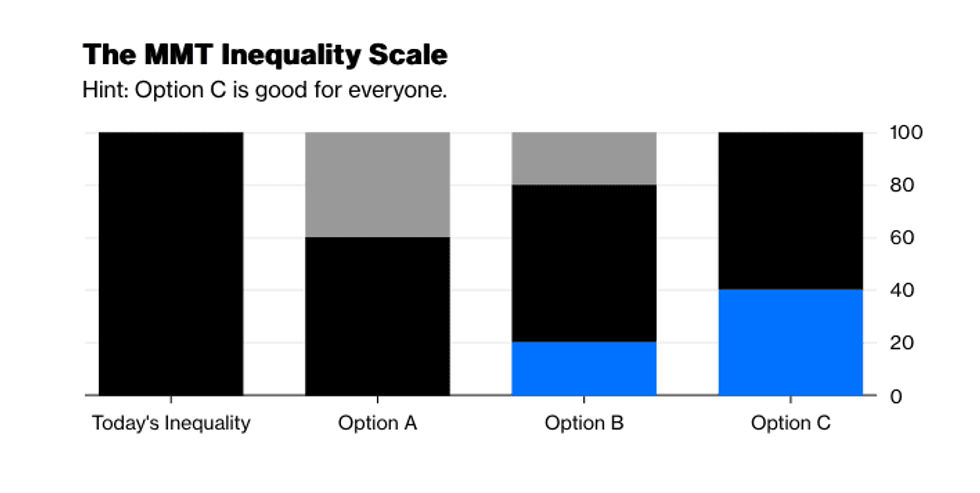
Now suppose someone offers you three different ways to reduce inequality, shown in bars A, B and C. Each will leave you with a less unequal society but the same absolute disparity between the top and the bottom.
To get outcome A, you simply tax money away from the rich (the part shown in gray at the top). This does nothing to improve the material well-being of anyone below, but it does compress the distribution, so inequality is diminished.
Option B is your standard Robin Hood redistribution. Money is taxed away from those at the top, and money is invested in programs to lift everyone else (shown in blue). Again, the distance (or degree of disparity) between the top and the bottom is the same as under Option A, but this time the top lost and the bottom gained.
Finally, consider what happens if we simply invest in programs to benefit the non-rich (student-debt forgiveness, free child care and so on) without treating the super-rich as our piggy bank. In Option C, the top doesn't move, but the bottom is boosted to new heights.
It's sort of incredible that the option that is clearly better for both groups is the one we're most afraid of. But that's what happens when deficit phobias force politicians to "pay for" everything by going where the money is.
After the incoming House Democratic majority's newly released rules package made clear that presumptive Speaker Nancy Pelosi (D-Calif.) is moving to ram through a fiscally conservative "pay-go" measure despite widespread grassroots opposition, progressives condemned the proposed rule as a harmful "roadblock" to a bold agenda and urged their representatives to vote it down.
"Pay-go isn't only bad economics; it's also a dark political maneuver designed to hamstring progress on healthcare and other legislation."
--Rep.-elect Alexandria Ocasio-Cortez (D-N.Y.)"In order for pay-go to go into effect, it needs to pass the House," Warren Gunnels, policy director for Sen. Bernie Sanders (I-Vt.), pointed out on Twitter. "If some 18 Democrats vote no, it fails. The vote will take place on Thursday. Will enough progressives have the courage to vote no on the first roadblock to Medicare for All, Green New Deal, and college for all? Let's see."
In a petition pressuring House Democrats to vote against any rules package containing pay-go, Social Security Works declared that the proposed provision "would leave Democrats fighting for working families with one arm tied behind their backs."
"Reject the pay-go rules that perpetuate deficit scaremongering and bolster claims that we need to cut Social Security and Medicare," reads the group's petition, which currently has over 23,800 signatures.
If implemented, pay-go would require all new spending to be offset by budget cuts or tax hikes. Such a restriction, progressive lawmakers and economists argue, would unnecessarily hamstring the House Democratic majority's ability to pursue the bold agenda that voters demanded in the November midterms.
"Let's stop this fiscal madness in its tracks. We need a flexible budget to rebalance our economy."
--Stephanie Kelton, Stony Brook University
"This is a terrible move from Pelosi and Democratic Party leadership and a slap in the face for movements demanding justice and prosperity for all--not just a privileged few," argued Justice Democrats communications director Waleed Shahid.
"There's enormous appetite in the Democratic Party and among all Americans for major public investment to tackle our nation's major crises: deepening inequality and structural racism and climate disaster," Shahid added in a statement. "Pelosi and the Democratic Party leadership's support of pay-go makes actually solving these crises all but impossible. The Democratic Party leadership is unilaterally disarming and shooting themselves in the foot."
Just hours after the House Democrats' proposed rules package was made public, Rep.-elect Alexandria Ocasio-Cortez (D-N.Y.)--who will be sworn in on Thursday--and Rep. Ro Khanna (D-Calif.) became the first lawmakers to vow to vote no if pay-go is included.
In a tweet, Khanna declared: "I will be voting no on the rules package with pay-go. It is terrible economics. The austerians were wrong about the Great Recession and Great Depression. At some point, politicians need to learn from mistakes and read economic history."
Echoing Khanna's opposition, Ocasio-Cortez announced that she will also oppose the rules package, arguing that pay-go is "a dark political maneuver designed to hamstring progress on healthcare and other legislation."
"We shouldn't hinder ourselves from the start," Ocasio-Cortez concluded.
As Common Dreams reported at the time, the Congressional Progressive Caucus (CPC) in December successfully killed a deeply regressive, Pelosi-backed tax rule that would have made progressive policy priorities like Medicare for All and a Green New Deal impossible to fund.
With a vote on the rules package slated for Thursday, advocacy groups and policy experts argued that the pay-go fight is another chance for the growing and emboldened CPC to flex its muscle and signal that it is prepared to fight for an ambitious agenda.
"We urge them to recognize that this era calls for bold leadership," declared Social Security Works. "That means improved Medicare for All, expanded Social Security, and taking on Big Pharma to lower prescription drug prices. Our government's priority should be delivering results for the people, not appeasing the Wall Street Journal editorial page."
"Let's stop this fiscal madness in its tracks," concluded Stony Brook University economics professor Stephanie Kelton, who has urged Democrats to ditch their deficit obsession and unleash "the power of the public purse" on behalf of progressive policies. "We need a flexible budget to rebalance our economy."
As President Donald Trump continues to throw a temper tantrum and threaten a government shutdown if he doesn't get billions of dollars to build his infamous border wall, Rep.-elect Alexandria Ocasio-Cortez (D-N.Y.) turned to Twitter on Friday to challenge the GOP trope that the federal government simply doesn't have the money to implement bold progressive policies such as Medicare for All or a Green New Deal.
Spending legislation advanced by the Republican-controlled House Thursday night would allocate $5.7 billion to the wall, but that bill--at odds with a Senate-approved measure that lacks wall funding--seems unlikely to get through the upper chamber without Trump's favored "nuclear option" of changing the Senate rules.
As the threat of a government shutdown looms, the incoming congresswoman highlighted the other ways--from increasing teacher pay to replacing water pipes--that lawmakers could spend the money:
Stony Brook University public policy and economics professor Stephanie Kelton, a former chief economist on the U.S. Senate Budget Committee, responded to Ocasio-Cortez by homing in on one of the key policy items backed by the incoming representative, tweeting: "Congress authorizes the spending. Period. The mechanics of paying for a #GreenNewDeal are exactly the same."
A Green New Deal, supported by climate advocates nationwide and a growing number of House Democrats, would couple measures to address the global climate crisis with policies to create jobs and a more just economy. While Ocasio-Cortez has called for the creation of a House Select Committee to craft such a deal, top Democrats including presumptive House Speaker Nancy Pelosi (Calif.) and Rep. Steny Hoyer (Md.) have been accused of trying to kill it.
Democratic Socialists of America (DSA)--which endorsed Ocasio-Cortez's successful bid to oust long-time Rep. Joe Crowley (D-N.Y.) last summer--responded to news of the potential $5.7 billion in border wall funding with a focus on healthcare. Along with a rising portion of the public, both DSA and Ocasio-Cortez support Medicare for All--a proposal championed by, among others, Sen. Bernie Sanders (I-Vt.) that would guarantee healthcare for all Americans.
Washington Post reporter Jeff Stein responded to Ocasio-Cortez with some figures--suggesting that the U.S. could implement universal pre-K or provide coverage to more than 800,000 uninsured Americans with the money the House GOP wants to give Trump to bolster his anti-immigrant policies and fulfill one of his key campaign promises:

It's been almost a year since the Republican Party and President Donald Trump delivered their behemoth giveaway to the nation's corporations and wealthiest individuals by passing a $1.5 trillion controversial tax bill that will ultimately blow a $5 trillion hole--or larger--in the nation's budget.
On Monday morning, Bloomberg reported that the amount of U.S. student loan debt has more than doubled since 2009 and now sits at a record $1.47 trillion.
That's interesting. Those numbers are very similar in size.
Meanwhile, also on Monday morning, Forbes noted how--due to the fraudulent practices of for-profit colleges and under orders from a federal court--the U.S. Department of Education will cancel $150 million in student loans, proving the federal government does, indeed, have the power to leverage its authority to correct an economic wrong.
As good as it might be for those students who are having their debt cancelled, $150 million is just 0.01 percent of the nearly $1.5 trillion in overall student debt liability.
While a majority loans are held by private institutions, Paul Della Guardia, economist at the Institute of International Finance, explained to Bloomberg that "over 90% of student loans are guaranteed by the U.S. Department of Education." When the next economic downturn hits or if "a recession causes a rise in youth unemployment and triggers mass defaults," warned Della Guardia, "this contingent liability could prove burdensome for the U.S. government budget."
So if it's possible to forgive a small portion of the overall student debt--and if the country can afford to give away $1.5 trillion in tax revenue, mostly to the wealthy and companies that don't need it--why not just forgive all of the outstanding U.S. student debt?
Some economists think it's a brilliant--and practical--idea. Earlier this year, a team economists published a paper (pdf) detailing the macroeconomics benefits of mass student debt cancellation.
According to the paper, put out through the Levy Economics Institute of Bard College, forgiving the more than $1.4 trillion in outstanding student loan debt held by approximately 44 million Americans would boost the nation's gross national product anywhere from $86 billion to $108 billion annually for the first decade following the debt cancellation. "Getting rid of the debt," reported MarketWatch at the time of the paper's release, "would also lower the average unemployment rate by 0.22 to 0.36 percentage points over 10 years and could add between 1.2 million and 1.5 million jobs per year."
In February of 2018, economist Stephanie Kelton, a fellow at the Sanders Institute and one of the authors of that study, sat down with Jane Sanders, co-founder of the institute, to discuss why the cancelling all U.S. student debt is not only possible, by a viable and smart financial prescription.
Watch:
Correction: An earlier version of this piece miscalculated the amount of student debt cancelled by the Department of Education as a percentage of total student debt.

When it comes to the perennial question of how to "pay for" the big-ticket items on the progressive agenda--from a Green New Deal to Medicare for All to tuition-free public college--economists and policy experts have comprehensively charted a number of viable paths forward.
"Of course Alexandria Ocasio-Cortez should be on Ways and Means and not another Wall Street politician using large corporate donations to masquerade as a so-called 'problem solver.'"
--Shaunna Thomas, UltraVioletBut putting theory and analysis into action requires the exercise of political power, and that is precisely what Rep.-elect Alexandria Ocasio-Cortez (D-N.Y.) is attempting to do by challenging Wall Street-friendly New York Democrat and self-described fiscal conservative Rep. Tom Suozzi for a seat on the House Ways and Means Committee.
As the House's primary tax-writing body, Ways and Means would be directly involved in the crafting of any potential Medicare for All and Green New Deal legislation--two causes Ocasio-Cortez has unabashedly championed alongside a record number of congressional Democrats.
"Ocasio-Cortez is routinely asked how she plans to pay for her aggressive economic agenda, and the first answer begins with securing a spot on the House's key tax-writing committee," noted The Intercept's Ryan Grim, who first reported on the New York democratic socialist's plan to vie for a Ways and Means seat on Tuesday. "Ocasio-Cortez's decision to go after a spot on the Ways and Means Committee is part of a broader strategy to grow progressive power in the coming Congress."
Though Ocasio-Cortez has yet to publicly acknowledge her push for a Ways and Means spot, progressive groups are already mobilizing in support of the effort, arguing that ambitious climate solutions and legislation like Medicare for All will not get off the ground unless bold progressives hold positions on powerful congressional committees.
House Minority Leader Nancy Pelosi (D-Calif.)--who is on track to become House Speaker in the next Congress--has the final say on committee assignments. As Grim pointed out, freshmen members "are almost never given spots" on the Ways and Means Committee.
"Democrats in Washington need to learn the lessons from this election and fast. Voters voted for change. Voters voted for bold and progressive leadership, not politicians beholden to the big banks and Wall Street," said Shaunna Thomas, executive director of UltraViolet. "Of course Alexandria Ocasio-Cortez should be on Ways and Means and not another Wall Street politician using large corporate donations to masquerade as a so-called 'problem solver.'"
Joe Dinkin, campaigns director for the Working Families Party, added that "Ocasio-Cortez is a powerful voice for the millions of Americans who want to see solutions from our leaders like the Green New Deal--ones that meet the scale of the crises we're facing."
Ocasio-Cortez's reported bid for a Ways and Means spot as a step toward pursuing her bold agenda comes as the House Democratic leadership is considering moving in the opposite direction by imposing two rules that progressive critics say would completely undermine ambitious policy moves.
One of the proposed rules, pushed by Pelosi, would "require a three-fifths supermajority to raise individual income taxes on the lowest-earning 80 percent of taxpayers"--a restriction that progressives said would make Medicare for All and a Green New Deal impossible to fund. Ocasio-Cortez has publicly denounced the proposed rule.
The other rule, also backed by Pelosi and incoming House Majority Leader Steny Hoyer (D-Md.), is known as "pay-go"--a fiscally conservative mandate requiring that all new spending be offset by budget cuts or tax hikes.
Economist Stephanie Kelton--who has urged Democrats to ditch concerns about the deficit and move ahead with a Green New Deal and other priorities--has argued that "pay-go" is "a self-imposed, economically illiterate approach to budgeting."
"Instead of vowing budget chastity," Kelton concluded in a recent interview, "Democrats should be articulating an agenda that excites voters so that they can unleash the full power of the public purse on their behalf."