

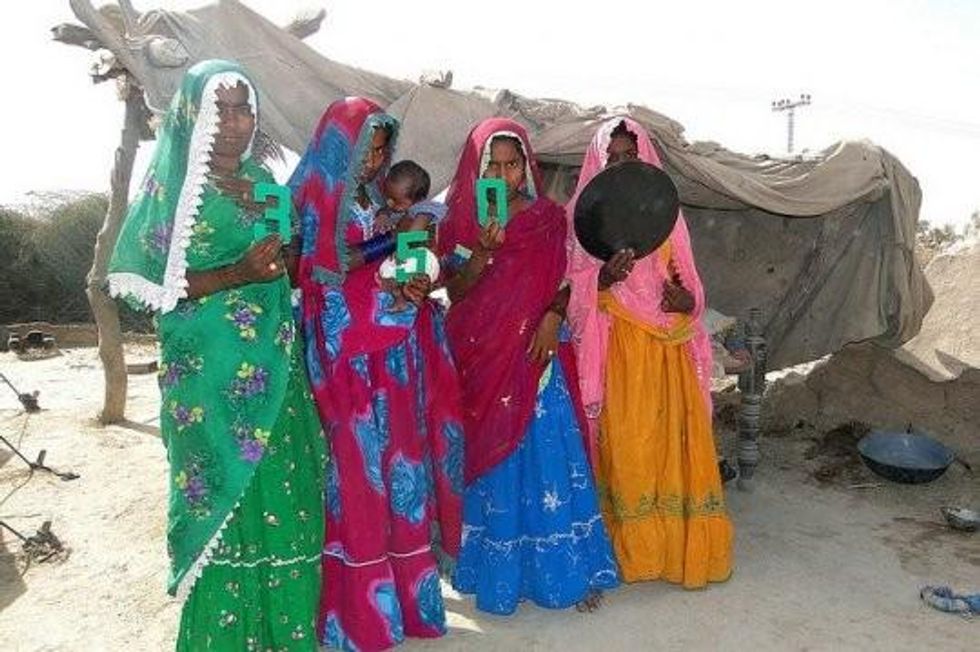
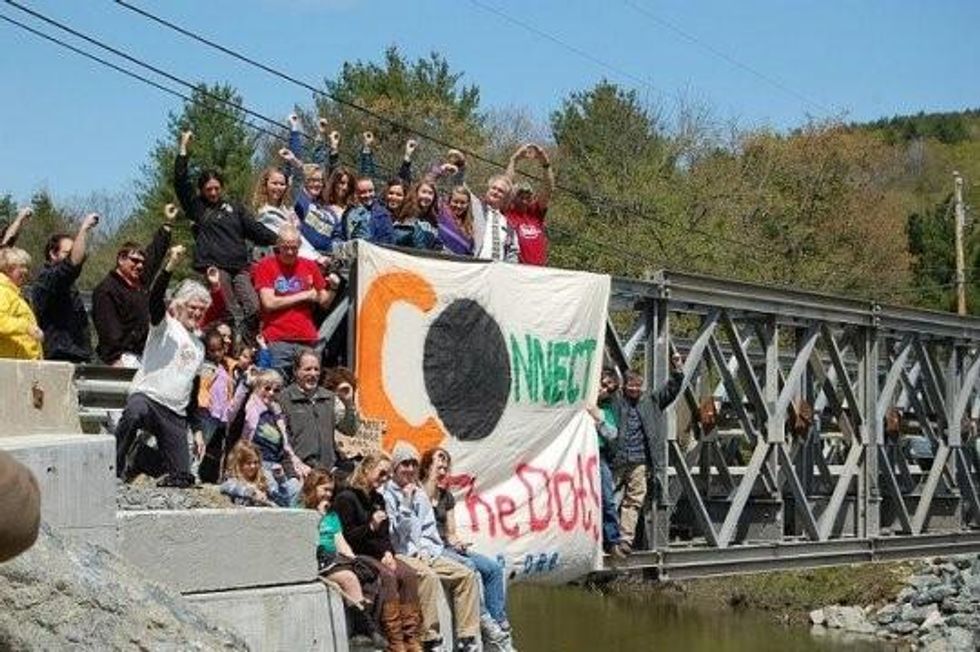
In New Mexico, firefighters stand in the remains of the Santa Fe Forest, which was burned last summer during the state's worst wildfire in history. In Pakistan, a group of women hold dots in front of the makeshift shelter that became their home after the devastating floods in 2010 that displaced over 20 million people. In Lebanon, over 1,000 students made their dots the wheels of a giant bicycle to protest air pollution and request more bike-lanes to combat the problem. And in Vermont, citizens unfurl a "dot" banner at the site of a covered bridge that was swept away in the devastating flooding brought on by Hurricane Irene last August.
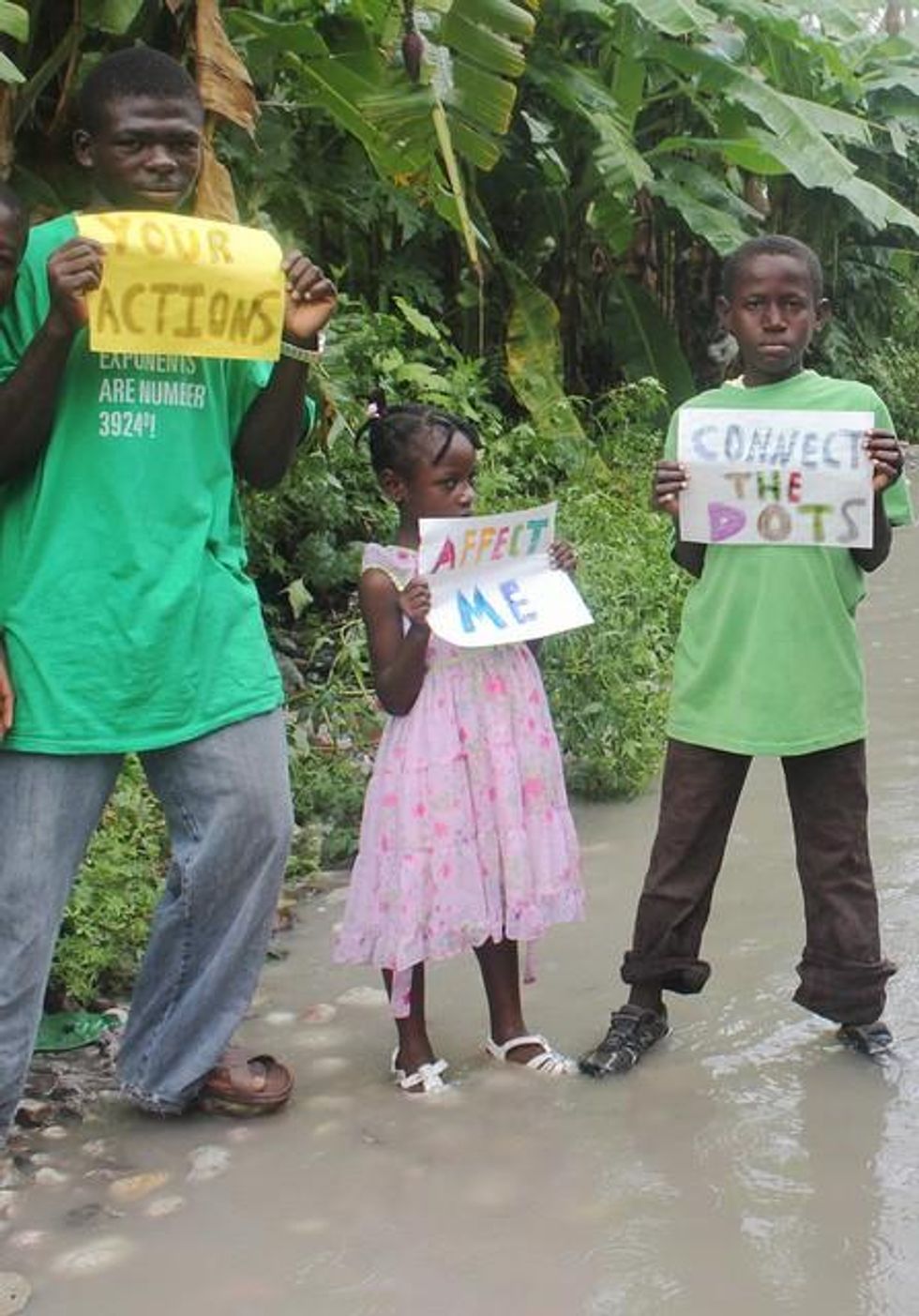
What do these seemingly disparate acts by people who live thousands of miles from one another have in common? According to the environmental group 350.org -- everything. And the images of these actions are part of a larger campaign organized to "connect the dots" between climate change extreme weather worldwide.
"We just celebrated Earth Day. May 5 is more like Broken Earth Day, a worldwide witness to the destruction global warming is already causing," said Bill McKibben, the founder of 350.org, the global climate campaign that is coordinating the events. "People everywhere are saying the same thing: our tragedy is not some isolated trauma, it's part of a pattern."
So, over the next 24 hours, climbers will unveil giant dots on melting glaciers, divers will carry dots underwater to bleached coral reefs, and hi-res photos and videos from all over the world will stream into the ClimateDots.org website that is serving as a virtual hub for Climate Impacts Day. "There will be at least 1,200 actions in more than 100 countries," said Jamie Henn, communications director for 350.org, in an interview with Inter Press Service's Stephen Leahy. "Recent opinion surveys show the more than 60 percent of the U.S. public are connecting extreme weather to climate change."
That is a reference to a recent poll conducted by Yale University which found that nearly seven in ten Americans now believe that "global warming is affecting the weather." Yale's Anthony A. Leiserowitz, one of the researchers who commissioned the new poll, told the New York Times recently that, "Most people in the country are looking at everything that's happened; it just seems to be one disaster after another after another[...] People are starting to connect the dots."
"It's no surprise," writes NRDC's Theo Spencer of those findings. "When you see massive snow storms on Halloween in the Northeast that left hundreds of thousands without power for many days, persistent drought in the Southeast and Southwest...the list goes on. All in all there were a record 14 weather events last year that caused more than $1 billion in damage."
350.org and its allies hope that their latest global day of action will draw attention to the perilous path the planet is on, but McKibben is under no illusions that the mainstream press will pay much attention. "So here's a prediction," he wrote this week for TomDispatch.com -- "Next Sunday, no matter how big and beautiful the demonstrations may be that we're mounting across the world, "Face the Nation" and "Meet the Press" won't be connecting the dots. They'll be gassing along about Newt Gingrich's retirement from the presidential race or Mitt Romney's coming nomination, and many of the commercials will come from oil companies lying about their environmental efforts. If we're going to tell this story -- and it's the most important story of our time -- we're going to have to tell it ourselves."
* * *
* * *
* * *
* * *
Event Highlights
- On the outskirts of Bujumbura, Burundi, students will gather with victims of recent flooding in the village of Gatumba that destroyed over 500 homes this March.
- In Northeastern Kenya, representatives from three districts will gather in Garissa to highlight how the ongoing drought in Eastern Africa has impoverished their communities and threatened their survival. `
- In Dakar, Senegal, students will hold dots on the beach to highlight the threat of sea level rise and storm surges to their city.
- In the Seychelles, people are organizing a moonlight "mutia," a traditional dance that is often used as social protest, to lament the impacts of rising seas on their islands.
- In Contonou, Benin, organizers will host a panel discussion on the failure of rich countries to provide appropriate climate financing for adaptation and mitigation efforts and point to a number of innovative sources of financing.
- In Livingston, Zambia, a local drama group is hosting a play to educate the community about the impacts of climate change and local solutions.
- In Mzuzu, Malawi, the Northern Youth Network will march through the city with posters showing how young people were affected by flooding in the Karonga District.
- In Lome, Togo, the Young Greens Togo organization will host a climate dot event focused on the problem of erosion caused by increased rainfall and flooding.
Pacific
- In Palau, organizers will hold dots in taro patches that suffered from saltwater inundation and at coral reefs that are suffering from the warming and acidification of the oceans.
- In Majuro Atoll, Marshall Islands, 350.org supporters will be amongst those first to see the sunrise on May 5 and greet the new day with large dots held to the sky. Another team will dive underwater to dying coral reefs to take a photo with a banner that reads, "Connect the Dots: Your Carbon Emissions are Killing our Coral."
- In Nauru, citizens will hang a giant dot banner on the island's desalination plant to represent how the community struggles to generate enough water during an increasing number of droughts.
- In American Samoa, the 350 Environment Club will run a "Connect the Dots" billboard design competition across every high school on the island. The five winners will have their work displayed on billboards around the island.
- In Melbourne, Australia, activists will roll a giant dot around downtown and stop at offices and buildings connected to companies, banks and institutions driving "extreme energy," like tar sands and coal seam gas.
- In Sydney, Australia organizers will unfurl a giant dot banner on the banks of the Parramatta River which is increasingly eroded from extreme weather events.
- On the shorefront in Aukland, New Zealand, activists will build a Human Wall of Dots representing the height of the sea-wall that will be necessary to prevent the inundation of the city by rising oceans.
- In Adelaide, Australia, 350.org supporters are hosting a "Dry Creek Regatta" in the Gawler and South Australian rivers to raise awareness about climate change and the threat of drought.
- In Hobart, Australia, people are gathering to form a giant dot on the eroded area in front of properties on Roches beach to show the impact of climate change on the community.
- In Wellington, New Zealand, people will hold dots in places around town that will be affected by sea level rise.
- In Rotorua, New Zealand, organizers will use old painted 33 LPs to highlight local or global extreme weather events and their connection to climate change.
- In Golden Bay, New Zealand, organizers will form a dot at the site of a house that was buried by a landslide from a "Once in 500 Year" Rain event last year.
Asia
- In Pakistan, the Pakistan Sustainability Network will host street theater in regions affected by the terrible flooding in 2010 and unfurl dot banners in communities still struggling to recover.
- On the beach in Orissa, India, famous artist Sundersan Pattanaik will create a sand sculpture that depicts the extreme heat facing India and connect the dots to climate disruption.
- In Delhi, India, students will tour government ministries with dots representing the different ways climate is impacting India's agriculture, economy, environment, and health.
- In Srinigar, India, young people will hold a giant dot on the banks of the river Jhelum which has dried to 1/3 of its flow over the years due to shrinking glaciers.
- In Kathmandu, Nepal, grandparents and their grandchildren will create a mandala that depicts the different ways that climate change is impacting Nepal.
- In Ayutthaya, Thailand Buddhist monks will hold dots outside the Ayutthaya temple that was damaged by last year's epic floods.
- In Ho Chi Minh City, Vietnam, organizers will hold dots on the banks of the Saigon River which is flooding more and more often due to higher tides and heavy rains.
- In Daegu, South Korea, students will gather with bags of rice and umbrellas to connect the dots between climate change, heavy rains, and the damage caused to South Korea's rice crop.
- In Dumaguete City, Philippines, organizers will host a climate dots event to raise awareness about the connection between global warming and typhoons. Last year's typhoon Sendong was the strongest typhoon ever recorded in Philippine history, impacting over 63,000 families.
- In Jakarta, Indonesia, 350.org volunteers will arrange photos of how climate change is impacting indonesia into a giant "350" and host a candlelit vigil.
- In Ulaanbaatar, Mongolia, will create a dot in the city to highlight how climate change is leading to desertification in the country.
- In Singapore, organizers are hosting a 3 hour interactive workshop on how climate change is impacting Singapore and taking a giant dot photo.
Middle East & Central Asia
- In Iran, students will hike to the top of Mt. Tochal outside of Tehran to observe how polluted the city has become and unfurl a dot banner at the top.
- In Amman, Jordan, Friends of the Earth Middle East will be forming a climate dot on the shores of the Dead Sea to draw attention to how drought due to climate change has been shrinking the sea.
- In Herzliya, Israel, people will form a dot on the beach to stand in solidarity with island nations and coastal communities around the world that are feeling the impacts of climate change.
- In Bishkek, Kyrgyzstan, 350.org supporters are organizing a two-day exhibit of art and photography on how climate change is currently impacting Kygrzstan and surrounding areas.
- In Beirut, Lebanon, activists will converge on one of city's busiest streets with umbrellas to form a giant dot.
- In Tripoli, Libya the Environmental Engineering and Sciences center at the Libyan National Academy will host a public presentation to educate the community, politicians, and media on how climate change threatens Libya.
- In Kutaisi, Georgia, volunteers are organizing a "Climate Photo Studio" in the city's central park to create images that show how climate change is impacting their country.
- In Salalah, Oman, students are inviting their elders to share accounts about how climate and weather events differ today from times past.
- In Riyadh, Saudi Arabia, students are creating dots to raise awareness about the many sand storms, wind storms, and flash floods that have been a common phenomenon during the past decade.
- In Garm, Tajikistan, staff with Cooperation for Development will conduct meetings with farmers, women, and youth on adapting traditional agriculture to the changing climate and take climate dot photos with farmers in their fields.
- In Rio Branco, Brazil, the Instituto de Pesquisa Ambiental de Amazonia is organizing an entire day dedicated to connecting the dots between the terrible flooding that has impacted the region and the broader climate crisis.
- In Ararangua, Brazil, people are hosting an event to examine the ways civil society and government have worked together to recover from 2004's Hurricane Catarina, the first tropical cyclone to ever hit shore in Brazil.
- In Sao Paulo, Brazil, activists are staging a big photo opp to connect the dots between climate change and deforestation to pressure President Dilma to veto the new forest code which is weak and full of loopholes for logging.
- In the Regiao Serrana area of Rio de Janeiro, Brazil, members of CARE Brazil and local 350.org supporters will create a climate dot in an area where heavy rains created landslides that led to death of many community members in the region.
- Outside of La Paz, Bolivia, members of Reaccion Climatica will create a climate dot on a retreating glacier to highlight the impact melting glaciers are having on the water supply to cities like La Paz and El Alto.
- In Monterrey, Mexico, people will host a climate dot event on the banks of the Santa Catharina river which were flooded out during 2010's Hurricane Alex, an event that caused $1.8 billion in damage and Nuevo Leon governor Rodrigo Medina de la Cruz described as "the worst weather phenomenon in [the state's] history."
- In Carhuas, Peru, high school students from the Callejon de Huaylas region will form a dot in the main plaza of the town to show solidarity with farmers whose crops are being affected by the lack of rain.
- In Cartagena, Colombia, 350.org volunteers will collect garbage and plant trees along a canal that is increasingly clogged and flooding due to heavier rains. Their dot will be created with the garbage that they collect.
- In the Monteverde Cloud Forest, Costa Rica, climate change ecologist Alan Pounds will give a lecture on how climate change is changing rainfall patterns in the forest and attendees will come up with 350 ways to mitigate the effects of climate change.
Europe
- In Copenhagen, Denmark, activists will unfurl a dot outside of the Canadian Embassy to connect the high carbon emissions from the Canadian tar sands to the global climate crisis.
- In Chamonix, France, climbers will create a huge red dot on one of the melting Mont Blanc glaciers.
- In Kiel, Germany, volunteers will invite pedestrians leaving one of the city's subway stations to put their fingerprint on "Connect the Dots" banner as a pledge to stand in solidarity with victims of climate change.
- In Jaca, Spain, climbers will create a dot out of melting snow from the Pyrenees.
- In Lund, Sweden, students are collecting used and second hand bikes and forming them into a solutions dot before shipping them to Cape Town, South Africa.
- In London, United Kingdom, the London Occupy Movement will host a creative "twist" on the game of Twister, with participants using their bodies to connect the dots between extreme weather events and climate change -- a large "dot" photo opp will also be taken in front of St. Paul's Cathedral.
- In Kiev, Ukraine, activists will parade through the streets with dots representing the threat of climate change to different regions of Ukraine.
- In Riederalp, Switzerland, climbers will unfurl a giant dot on the Aletsch glacier, a UNESCO heritage site that is currently melting due to climate change.
- In Kydymkar City, Russia, indigenous people of Komi-Permyak will perform traditional shamanic rituals to find the "Hub of the Universe," a sacred spiritual place connected with the state of the environment, and pray for an end to the wildfires that have devastated Russia in previous years.
North America
Canada
- In Halifax, Nova Scotia, the Citizens Climate Lobby is hosting a "Swimming for Survival" climate dots event to highlight the threat of rising seas to their communities.
- In Hamilton, Ontario people will gather with umbrellas to form a giant dot and highlight the 17 extreme rainstorms that have caused flooding in the city over the last eight years.
- In Nelson, British Columbia, organizers will hold dots in a forest decimated by the pine bark beetle that has been spreading across North America due to warmer temperatures.
- In Ottawa, Ontario, people will hold dots in the Rideau Canal, the world's longest skating rink. In the 1970s, the canal was open for skating an average 70 days a year, but in the last decade the average number of skating days has shrunk to 55. Last year, the canal was open for only 24 days.
- In Winnipeg, Manitoba, organizers will host a community feast to welcome First Nations people and their supporters as they travel on a Freedom Train to challenge the Enbridge Northern Gateway Pipeline and connect the dots between tar sands exploitation and climate change.
- In Nashville, Tennessee high school students will gather on their football field that was submerged in 2011's historic floods.
- In San Francisco, California, aerial artist Daniel Dancer and the Center for Biological Diversity will work with hundreds of people to form a giant, moving blue dot to represent the threat of sea level rise and ocean acidification to San Francisco and other coastal communities.
- In Cincinnati, Ohio, dozens of people will join an flashmob to make a giant dot with umbrellas to represent the historic rainfalls in Ohio -- 2011 was the wettest year on the record in the state.
- At the Bandelier National Monument in New Mexico, firefighters will take "dots" photo in a forest burned during the devastating fires that swept the southwest in the summer of 2011. The company will also be installing solar panels on their firehouse to do their part to combat climate change.
- In Aspen, Colorado, a "Climate Dots" event will connect climate change with pine beetle infestations, wildfires, and an increasing lack of snow with "The Climate Challenge Snowless Ski Race", attendees wearing white to fill in for the missing snow, and a film screening of "Chasing Ice".
- In Waitsfield, Vermont, 350.org founder and Vermont native Bill McKibben will join hundreds of people to connect the terrible flooding caused by 2011's Hurricane Irene to the climate crisis.
- In Louisville, Kentucky, activists attired in dot themed outfits and derby hats will host an event outside of the Kentucky Derby to educate the public about climate change with horse names like "Florida Under," "Missing Ice Cap," "Crappy Crops" and more.
- In California's Sierra Mountains, climbers will unfurl a giant banner on the Dana Glacier that reads "I'm Melting!"
- In Pensacola, Florida, activists will gather with dots on the bay front to recognize how climate disruption is already impacting coastal communities in Florida.
- In Miami, Florida, organizers will march with blue dots from Miami's famous beach front to the spot where seas will rise by 2030 if global warming is left unchecked (about the second story of most "beachfront" real estate).
- In Honolulu, Hawaii, organizers will bring their dots to Waikiki's beach front to raise awareness about the threat of sea level rise to the island.
- In Davenport, Iowa, students at Iowa State University will hold dots at a rally in front of the campus power plant to show how it connects to human health, climate change and other environmental challenges.
- In Winfield, Kansas, 350.org volunteers are hosting an event called, "Oz-Are we there yet?" where they will paint windows downtown with a state map and "dot" the location of recent tornadoes across Kansas.
- In Boston, Massachusetts, the Boston Climate Action Network will mark the 100 year anniversary of Fenway Park by organizing an event at the "Wake Up the Earth" festival in Jamaica Plain that focuses on how climate change is impacting important Red Sox locations: the Caribbean Islands (home to many top players), the team's training camp in southern Florida, and at home in Boston.
- In Boston, Massachusetts, volunteers with the fictional "Metro Boston Climate Defense" agency will distribute "Change in Service" flyers to subway riders showing ferries replacing subway lines where flooding is anticipated due to rising sea levels.
- In Wayland, Massachusetts, citizens will gather with dots at their local library that was inundated by a major flood in the spring of 2010.
- In Belfast, Maine, volunteers will raise awareness about climate impacts by putting up Burma Shave style signs along a local highway that read, "DEER TICKS BITE/THEY MAKE US SICK/INVADING MAINE/TOO DARN QUICK/ CLIMATE CHANGE."
- In Ada, Michigan, mycologists will organize a "mushroom count" to compare the number of spring mushrooms normally found in May to the number of summer mushrooms that are appearing sooner due to climate change.
- In Charlotte, North Carolina, activists will unfurl a giant dot banner in front of Bank of America headquarters that reads, "Climate Change Starts Here. BoA, Stop Funding Coal." The event kicks off a week of action against the Bank for funding dirty energy projects.
- In Weirs Beach, New Hampshire, locals are getting out their umbrellas to form a dot to commemorate the impact of Hurricane Irene on the state and call for climate action.
- In Mahwah, New Jersey, local activists and members of the Ramapough/Lunaape Nation will hike to the proposed site of a Fracked Gas pipeline and create a "Dot" to connect the project to the broader climate crisis.
- In Sante Fe, New Mexico, people will form a giant blue dot in the drought-stricken Santa Fe River to represent the water that should be flowing there.
- In New York City, 3rd Graders at the Children's Storefront School will be creating huge black dots with either red or green images on them showing problems (red) or solutions and things we need to protect (green) - demonstrating that all these things are linked to climate change.
- In Lower Manhattan, which sea-level rise is expected to wipe off the map, New Yorkers will hold up a giant blue dot that says "Underwater" and unfurl it in Battery Park with the Manhattan skyline behind them. Following that they'll collect some of the water from Manhattan Island's shores that will soon wash up to Wall Street's doors, and dump it on the Bank of America headquarters as a reminder of what their investments in coal and oil are bringing about.
- In Saratoga Springs, New York, students at Skidmore College will be "dotting the night," covering their campus with dots relaying extreme weather & climate related events.
- In Salem, Oregon, cyclists will bike to three different locations affected by a major flood in January 2012 to connect the dots between heavy rains and climate change.
- In Hood River, Oregon, activists will unfurl a giant red dot next to train tracks in town that increasingly see trains carrying coal to export facilities on the coast.
- In Portland, Oregon, organizers will host an umbrella decorating party to commemorate March 2012's new all-time record for monthly rainfall with 7.89 inches.
- In Northumberland, Pennsylvania, concerned-citizens will attend a teach-in to connect the dots between fracking and climate impacts hosted by the Interfaith Sacred Earth Coalition of the Susquehanna Valley.
- In Pittsburgh, Pennsylvania, members of Clean Water Action will display at giant dot on the Smithfield Street Bridge to connect fracking and the climate crisis.
- In Dallas, Texas, a group of people will create dots showing the rising number of 100-degree days over the past few years and display them in a photo opp.
- In Richmond, Virginia, people will from across the commonwealth will hold a giant dot in front of Dominion Virginia Power's headquarters to connect the dot between Dominion's coal and the earth's warming.
- In Virginia Beach, Virginia, activists will wade into the Atlantic Ocean for a photo-shoot featuring a big cutout of King Neptune submerged in the water -- the famous statue is threatened by rising seas and storm surges.
- In Brattleboro, Vermont, that Flat Street Brew Pub will host a candlelight event to remember the impact of Hurricane Irene on the local business which had to shut its doors for 10 weeks after flooding wrecked their building.
- In Hoquiam, Washington, birders will hold dots at the Grays Harbor National Wildlife Refuge to mark how changes in the climate are affecting bird migrations and endangering the habitats of many different species.
- In Anacortes, Washington, community members will take their dots to the gates of the Shell Oil Refinery to protest Shell's expansion of tar sands mining and drilling in the arctic.
- In Eau Claire, Wisconsin, students at the University of Wisconsin will create bright orange dots featuring different climate impacts and place them on the stumps of trees that were cut down to make way for steam lines from the university's power plant.
# # #
In New Mexico, firefighters stand in the remains of the Santa Fe Forest, which was burned last summer during the state's worst wildfire in history. In Pakistan, a group of women hold dots in front of the makeshift shelter that became their home after the devastating floods in 2010 that displaced over 20 million people. In Lebanon, over 1,000 students made their dots the wheels of a giant bicycle to protest air pollution and request more bike-lanes to combat the problem. And in Vermont, citizens unfurl a "dot" banner at the site of a covered bridge that was swept away in the devastating flooding brought on by Hurricane Irene last August.
What do these seemingly disparate acts by people who live thousands of miles from one another have in common? According to the environmental group 350.org -- everything. And the images of these actions are part of a larger campaign organized to "connect the dots" between climate change extreme weather worldwide.
"We just celebrated Earth Day. May 5 is more like Broken Earth Day, a worldwide witness to the destruction global warming is already causing," said Bill McKibben, the founder of 350.org, the global climate campaign that is coordinating the events. "People everywhere are saying the same thing: our tragedy is not some isolated trauma, it's part of a pattern."
So, over the next 24 hours, climbers will unveil giant dots on melting glaciers, divers will carry dots underwater to bleached coral reefs, and hi-res photos and videos from all over the world will stream into the ClimateDots.org website that is serving as a virtual hub for Climate Impacts Day. "There will be at least 1,200 actions in more than 100 countries," said Jamie Henn, communications director for 350.org, in an interview with Inter Press Service's Stephen Leahy. "Recent opinion surveys show the more than 60 percent of the U.S. public are connecting extreme weather to climate change."
That is a reference to a recent poll conducted by Yale University which found that nearly seven in ten Americans now believe that "global warming is affecting the weather." Yale's Anthony A. Leiserowitz, one of the researchers who commissioned the new poll, told the New York Times recently that, "Most people in the country are looking at everything that's happened; it just seems to be one disaster after another after another[...] People are starting to connect the dots."
"It's no surprise," writes NRDC's Theo Spencer of those findings. "When you see massive snow storms on Halloween in the Northeast that left hundreds of thousands without power for many days, persistent drought in the Southeast and Southwest...the list goes on. All in all there were a record 14 weather events last year that caused more than $1 billion in damage."
350.org and its allies hope that their latest global day of action will draw attention to the perilous path the planet is on, but McKibben is under no illusions that the mainstream press will pay much attention. "So here's a prediction," he wrote this week for TomDispatch.com -- "Next Sunday, no matter how big and beautiful the demonstrations may be that we're mounting across the world, "Face the Nation" and "Meet the Press" won't be connecting the dots. They'll be gassing along about Newt Gingrich's retirement from the presidential race or Mitt Romney's coming nomination, and many of the commercials will come from oil companies lying about their environmental efforts. If we're going to tell this story -- and it's the most important story of our time -- we're going to have to tell it ourselves."
* * *
* * *
* * *
* * *
Event Highlights
- On the outskirts of Bujumbura, Burundi, students will gather with victims of recent flooding in the village of Gatumba that destroyed over 500 homes this March.
- In Northeastern Kenya, representatives from three districts will gather in Garissa to highlight how the ongoing drought in Eastern Africa has impoverished their communities and threatened their survival. `
- In Dakar, Senegal, students will hold dots on the beach to highlight the threat of sea level rise and storm surges to their city.
- In the Seychelles, people are organizing a moonlight "mutia," a traditional dance that is often used as social protest, to lament the impacts of rising seas on their islands.
- In Contonou, Benin, organizers will host a panel discussion on the failure of rich countries to provide appropriate climate financing for adaptation and mitigation efforts and point to a number of innovative sources of financing.
- In Livingston, Zambia, a local drama group is hosting a play to educate the community about the impacts of climate change and local solutions.
- In Mzuzu, Malawi, the Northern Youth Network will march through the city with posters showing how young people were affected by flooding in the Karonga District.
- In Lome, Togo, the Young Greens Togo organization will host a climate dot event focused on the problem of erosion caused by increased rainfall and flooding.
Pacific
- In Palau, organizers will hold dots in taro patches that suffered from saltwater inundation and at coral reefs that are suffering from the warming and acidification of the oceans.
- In Majuro Atoll, Marshall Islands, 350.org supporters will be amongst those first to see the sunrise on May 5 and greet the new day with large dots held to the sky. Another team will dive underwater to dying coral reefs to take a photo with a banner that reads, "Connect the Dots: Your Carbon Emissions are Killing our Coral."
- In Nauru, citizens will hang a giant dot banner on the island's desalination plant to represent how the community struggles to generate enough water during an increasing number of droughts.
- In American Samoa, the 350 Environment Club will run a "Connect the Dots" billboard design competition across every high school on the island. The five winners will have their work displayed on billboards around the island.
- In Melbourne, Australia, activists will roll a giant dot around downtown and stop at offices and buildings connected to companies, banks and institutions driving "extreme energy," like tar sands and coal seam gas.
- In Sydney, Australia organizers will unfurl a giant dot banner on the banks of the Parramatta River which is increasingly eroded from extreme weather events.
- On the shorefront in Aukland, New Zealand, activists will build a Human Wall of Dots representing the height of the sea-wall that will be necessary to prevent the inundation of the city by rising oceans.
- In Adelaide, Australia, 350.org supporters are hosting a "Dry Creek Regatta" in the Gawler and South Australian rivers to raise awareness about climate change and the threat of drought.
- In Hobart, Australia, people are gathering to form a giant dot on the eroded area in front of properties on Roches beach to show the impact of climate change on the community.
- In Wellington, New Zealand, people will hold dots in places around town that will be affected by sea level rise.
- In Rotorua, New Zealand, organizers will use old painted 33 LPs to highlight local or global extreme weather events and their connection to climate change.
- In Golden Bay, New Zealand, organizers will form a dot at the site of a house that was buried by a landslide from a "Once in 500 Year" Rain event last year.
Asia
- In Pakistan, the Pakistan Sustainability Network will host street theater in regions affected by the terrible flooding in 2010 and unfurl dot banners in communities still struggling to recover.
- On the beach in Orissa, India, famous artist Sundersan Pattanaik will create a sand sculpture that depicts the extreme heat facing India and connect the dots to climate disruption.
- In Delhi, India, students will tour government ministries with dots representing the different ways climate is impacting India's agriculture, economy, environment, and health.
- In Srinigar, India, young people will hold a giant dot on the banks of the river Jhelum which has dried to 1/3 of its flow over the years due to shrinking glaciers.
- In Kathmandu, Nepal, grandparents and their grandchildren will create a mandala that depicts the different ways that climate change is impacting Nepal.
- In Ayutthaya, Thailand Buddhist monks will hold dots outside the Ayutthaya temple that was damaged by last year's epic floods.
- In Ho Chi Minh City, Vietnam, organizers will hold dots on the banks of the Saigon River which is flooding more and more often due to higher tides and heavy rains.
- In Daegu, South Korea, students will gather with bags of rice and umbrellas to connect the dots between climate change, heavy rains, and the damage caused to South Korea's rice crop.
- In Dumaguete City, Philippines, organizers will host a climate dots event to raise awareness about the connection between global warming and typhoons. Last year's typhoon Sendong was the strongest typhoon ever recorded in Philippine history, impacting over 63,000 families.
- In Jakarta, Indonesia, 350.org volunteers will arrange photos of how climate change is impacting indonesia into a giant "350" and host a candlelit vigil.
- In Ulaanbaatar, Mongolia, will create a dot in the city to highlight how climate change is leading to desertification in the country.
- In Singapore, organizers are hosting a 3 hour interactive workshop on how climate change is impacting Singapore and taking a giant dot photo.
Middle East & Central Asia
- In Iran, students will hike to the top of Mt. Tochal outside of Tehran to observe how polluted the city has become and unfurl a dot banner at the top.
- In Amman, Jordan, Friends of the Earth Middle East will be forming a climate dot on the shores of the Dead Sea to draw attention to how drought due to climate change has been shrinking the sea.
- In Herzliya, Israel, people will form a dot on the beach to stand in solidarity with island nations and coastal communities around the world that are feeling the impacts of climate change.
- In Bishkek, Kyrgyzstan, 350.org supporters are organizing a two-day exhibit of art and photography on how climate change is currently impacting Kygrzstan and surrounding areas.
- In Beirut, Lebanon, activists will converge on one of city's busiest streets with umbrellas to form a giant dot.
- In Tripoli, Libya the Environmental Engineering and Sciences center at the Libyan National Academy will host a public presentation to educate the community, politicians, and media on how climate change threatens Libya.
- In Kutaisi, Georgia, volunteers are organizing a "Climate Photo Studio" in the city's central park to create images that show how climate change is impacting their country.
- In Salalah, Oman, students are inviting their elders to share accounts about how climate and weather events differ today from times past.
- In Riyadh, Saudi Arabia, students are creating dots to raise awareness about the many sand storms, wind storms, and flash floods that have been a common phenomenon during the past decade.
- In Garm, Tajikistan, staff with Cooperation for Development will conduct meetings with farmers, women, and youth on adapting traditional agriculture to the changing climate and take climate dot photos with farmers in their fields.
- In Rio Branco, Brazil, the Instituto de Pesquisa Ambiental de Amazonia is organizing an entire day dedicated to connecting the dots between the terrible flooding that has impacted the region and the broader climate crisis.
- In Ararangua, Brazil, people are hosting an event to examine the ways civil society and government have worked together to recover from 2004's Hurricane Catarina, the first tropical cyclone to ever hit shore in Brazil.
- In Sao Paulo, Brazil, activists are staging a big photo opp to connect the dots between climate change and deforestation to pressure President Dilma to veto the new forest code which is weak and full of loopholes for logging.
- In the Regiao Serrana area of Rio de Janeiro, Brazil, members of CARE Brazil and local 350.org supporters will create a climate dot in an area where heavy rains created landslides that led to death of many community members in the region.
- Outside of La Paz, Bolivia, members of Reaccion Climatica will create a climate dot on a retreating glacier to highlight the impact melting glaciers are having on the water supply to cities like La Paz and El Alto.
- In Monterrey, Mexico, people will host a climate dot event on the banks of the Santa Catharina river which were flooded out during 2010's Hurricane Alex, an event that caused $1.8 billion in damage and Nuevo Leon governor Rodrigo Medina de la Cruz described as "the worst weather phenomenon in [the state's] history."
- In Carhuas, Peru, high school students from the Callejon de Huaylas region will form a dot in the main plaza of the town to show solidarity with farmers whose crops are being affected by the lack of rain.
- In Cartagena, Colombia, 350.org volunteers will collect garbage and plant trees along a canal that is increasingly clogged and flooding due to heavier rains. Their dot will be created with the garbage that they collect.
- In the Monteverde Cloud Forest, Costa Rica, climate change ecologist Alan Pounds will give a lecture on how climate change is changing rainfall patterns in the forest and attendees will come up with 350 ways to mitigate the effects of climate change.
Europe
- In Copenhagen, Denmark, activists will unfurl a dot outside of the Canadian Embassy to connect the high carbon emissions from the Canadian tar sands to the global climate crisis.
- In Chamonix, France, climbers will create a huge red dot on one of the melting Mont Blanc glaciers.
- In Kiel, Germany, volunteers will invite pedestrians leaving one of the city's subway stations to put their fingerprint on "Connect the Dots" banner as a pledge to stand in solidarity with victims of climate change.
- In Jaca, Spain, climbers will create a dot out of melting snow from the Pyrenees.
- In Lund, Sweden, students are collecting used and second hand bikes and forming them into a solutions dot before shipping them to Cape Town, South Africa.
- In London, United Kingdom, the London Occupy Movement will host a creative "twist" on the game of Twister, with participants using their bodies to connect the dots between extreme weather events and climate change -- a large "dot" photo opp will also be taken in front of St. Paul's Cathedral.
- In Kiev, Ukraine, activists will parade through the streets with dots representing the threat of climate change to different regions of Ukraine.
- In Riederalp, Switzerland, climbers will unfurl a giant dot on the Aletsch glacier, a UNESCO heritage site that is currently melting due to climate change.
- In Kydymkar City, Russia, indigenous people of Komi-Permyak will perform traditional shamanic rituals to find the "Hub of the Universe," a sacred spiritual place connected with the state of the environment, and pray for an end to the wildfires that have devastated Russia in previous years.
North America
Canada
- In Halifax, Nova Scotia, the Citizens Climate Lobby is hosting a "Swimming for Survival" climate dots event to highlight the threat of rising seas to their communities.
- In Hamilton, Ontario people will gather with umbrellas to form a giant dot and highlight the 17 extreme rainstorms that have caused flooding in the city over the last eight years.
- In Nelson, British Columbia, organizers will hold dots in a forest decimated by the pine bark beetle that has been spreading across North America due to warmer temperatures.
- In Ottawa, Ontario, people will hold dots in the Rideau Canal, the world's longest skating rink. In the 1970s, the canal was open for skating an average 70 days a year, but in the last decade the average number of skating days has shrunk to 55. Last year, the canal was open for only 24 days.
- In Winnipeg, Manitoba, organizers will host a community feast to welcome First Nations people and their supporters as they travel on a Freedom Train to challenge the Enbridge Northern Gateway Pipeline and connect the dots between tar sands exploitation and climate change.
- In Nashville, Tennessee high school students will gather on their football field that was submerged in 2011's historic floods.
- In San Francisco, California, aerial artist Daniel Dancer and the Center for Biological Diversity will work with hundreds of people to form a giant, moving blue dot to represent the threat of sea level rise and ocean acidification to San Francisco and other coastal communities.
- In Cincinnati, Ohio, dozens of people will join an flashmob to make a giant dot with umbrellas to represent the historic rainfalls in Ohio -- 2011 was the wettest year on the record in the state.
- At the Bandelier National Monument in New Mexico, firefighters will take "dots" photo in a forest burned during the devastating fires that swept the southwest in the summer of 2011. The company will also be installing solar panels on their firehouse to do their part to combat climate change.
- In Aspen, Colorado, a "Climate Dots" event will connect climate change with pine beetle infestations, wildfires, and an increasing lack of snow with "The Climate Challenge Snowless Ski Race", attendees wearing white to fill in for the missing snow, and a film screening of "Chasing Ice".
- In Waitsfield, Vermont, 350.org founder and Vermont native Bill McKibben will join hundreds of people to connect the terrible flooding caused by 2011's Hurricane Irene to the climate crisis.
- In Louisville, Kentucky, activists attired in dot themed outfits and derby hats will host an event outside of the Kentucky Derby to educate the public about climate change with horse names like "Florida Under," "Missing Ice Cap," "Crappy Crops" and more.
- In California's Sierra Mountains, climbers will unfurl a giant banner on the Dana Glacier that reads "I'm Melting!"
- In Pensacola, Florida, activists will gather with dots on the bay front to recognize how climate disruption is already impacting coastal communities in Florida.
- In Miami, Florida, organizers will march with blue dots from Miami's famous beach front to the spot where seas will rise by 2030 if global warming is left unchecked (about the second story of most "beachfront" real estate).
- In Honolulu, Hawaii, organizers will bring their dots to Waikiki's beach front to raise awareness about the threat of sea level rise to the island.
- In Davenport, Iowa, students at Iowa State University will hold dots at a rally in front of the campus power plant to show how it connects to human health, climate change and other environmental challenges.
- In Winfield, Kansas, 350.org volunteers are hosting an event called, "Oz-Are we there yet?" where they will paint windows downtown with a state map and "dot" the location of recent tornadoes across Kansas.
- In Boston, Massachusetts, the Boston Climate Action Network will mark the 100 year anniversary of Fenway Park by organizing an event at the "Wake Up the Earth" festival in Jamaica Plain that focuses on how climate change is impacting important Red Sox locations: the Caribbean Islands (home to many top players), the team's training camp in southern Florida, and at home in Boston.
- In Boston, Massachusetts, volunteers with the fictional "Metro Boston Climate Defense" agency will distribute "Change in Service" flyers to subway riders showing ferries replacing subway lines where flooding is anticipated due to rising sea levels.
- In Wayland, Massachusetts, citizens will gather with dots at their local library that was inundated by a major flood in the spring of 2010.
- In Belfast, Maine, volunteers will raise awareness about climate impacts by putting up Burma Shave style signs along a local highway that read, "DEER TICKS BITE/THEY MAKE US SICK/INVADING MAINE/TOO DARN QUICK/ CLIMATE CHANGE."
- In Ada, Michigan, mycologists will organize a "mushroom count" to compare the number of spring mushrooms normally found in May to the number of summer mushrooms that are appearing sooner due to climate change.
- In Charlotte, North Carolina, activists will unfurl a giant dot banner in front of Bank of America headquarters that reads, "Climate Change Starts Here. BoA, Stop Funding Coal." The event kicks off a week of action against the Bank for funding dirty energy projects.
- In Weirs Beach, New Hampshire, locals are getting out their umbrellas to form a dot to commemorate the impact of Hurricane Irene on the state and call for climate action.
- In Mahwah, New Jersey, local activists and members of the Ramapough/Lunaape Nation will hike to the proposed site of a Fracked Gas pipeline and create a "Dot" to connect the project to the broader climate crisis.
- In Sante Fe, New Mexico, people will form a giant blue dot in the drought-stricken Santa Fe River to represent the water that should be flowing there.
- In New York City, 3rd Graders at the Children's Storefront School will be creating huge black dots with either red or green images on them showing problems (red) or solutions and things we need to protect (green) - demonstrating that all these things are linked to climate change.
- In Lower Manhattan, which sea-level rise is expected to wipe off the map, New Yorkers will hold up a giant blue dot that says "Underwater" and unfurl it in Battery Park with the Manhattan skyline behind them. Following that they'll collect some of the water from Manhattan Island's shores that will soon wash up to Wall Street's doors, and dump it on the Bank of America headquarters as a reminder of what their investments in coal and oil are bringing about.
- In Saratoga Springs, New York, students at Skidmore College will be "dotting the night," covering their campus with dots relaying extreme weather & climate related events.
- In Salem, Oregon, cyclists will bike to three different locations affected by a major flood in January 2012 to connect the dots between heavy rains and climate change.
- In Hood River, Oregon, activists will unfurl a giant red dot next to train tracks in town that increasingly see trains carrying coal to export facilities on the coast.
- In Portland, Oregon, organizers will host an umbrella decorating party to commemorate March 2012's new all-time record for monthly rainfall with 7.89 inches.
- In Northumberland, Pennsylvania, concerned-citizens will attend a teach-in to connect the dots between fracking and climate impacts hosted by the Interfaith Sacred Earth Coalition of the Susquehanna Valley.
- In Pittsburgh, Pennsylvania, members of Clean Water Action will display at giant dot on the Smithfield Street Bridge to connect fracking and the climate crisis.
- In Dallas, Texas, a group of people will create dots showing the rising number of 100-degree days over the past few years and display them in a photo opp.
- In Richmond, Virginia, people will from across the commonwealth will hold a giant dot in front of Dominion Virginia Power's headquarters to connect the dot between Dominion's coal and the earth's warming.
- In Virginia Beach, Virginia, activists will wade into the Atlantic Ocean for a photo-shoot featuring a big cutout of King Neptune submerged in the water -- the famous statue is threatened by rising seas and storm surges.
- In Brattleboro, Vermont, that Flat Street Brew Pub will host a candlelight event to remember the impact of Hurricane Irene on the local business which had to shut its doors for 10 weeks after flooding wrecked their building.
- In Hoquiam, Washington, birders will hold dots at the Grays Harbor National Wildlife Refuge to mark how changes in the climate are affecting bird migrations and endangering the habitats of many different species.
- In Anacortes, Washington, community members will take their dots to the gates of the Shell Oil Refinery to protest Shell's expansion of tar sands mining and drilling in the arctic.
- In Eau Claire, Wisconsin, students at the University of Wisconsin will create bright orange dots featuring different climate impacts and place them on the stumps of trees that were cut down to make way for steam lines from the university's power plant.
# # #
In New Mexico, firefighters stand in the remains of the Santa Fe Forest, which was burned last summer during the state's worst wildfire in history. In Pakistan, a group of women hold dots in front of the makeshift shelter that became their home after the devastating floods in 2010 that displaced over 20 million people. In Lebanon, over 1,000 students made their dots the wheels of a giant bicycle to protest air pollution and request more bike-lanes to combat the problem. And in Vermont, citizens unfurl a "dot" banner at the site of a covered bridge that was swept away in the devastating flooding brought on by Hurricane Irene last August.
What do these seemingly disparate acts by people who live thousands of miles from one another have in common? According to the environmental group 350.org -- everything. And the images of these actions are part of a larger campaign organized to "connect the dots" between climate change extreme weather worldwide.
"We just celebrated Earth Day. May 5 is more like Broken Earth Day, a worldwide witness to the destruction global warming is already causing," said Bill McKibben, the founder of 350.org, the global climate campaign that is coordinating the events. "People everywhere are saying the same thing: our tragedy is not some isolated trauma, it's part of a pattern."
So, over the next 24 hours, climbers will unveil giant dots on melting glaciers, divers will carry dots underwater to bleached coral reefs, and hi-res photos and videos from all over the world will stream into the ClimateDots.org website that is serving as a virtual hub for Climate Impacts Day. "There will be at least 1,200 actions in more than 100 countries," said Jamie Henn, communications director for 350.org, in an interview with Inter Press Service's Stephen Leahy. "Recent opinion surveys show the more than 60 percent of the U.S. public are connecting extreme weather to climate change."
That is a reference to a recent poll conducted by Yale University which found that nearly seven in ten Americans now believe that "global warming is affecting the weather." Yale's Anthony A. Leiserowitz, one of the researchers who commissioned the new poll, told the New York Times recently that, "Most people in the country are looking at everything that's happened; it just seems to be one disaster after another after another[...] People are starting to connect the dots."
"It's no surprise," writes NRDC's Theo Spencer of those findings. "When you see massive snow storms on Halloween in the Northeast that left hundreds of thousands without power for many days, persistent drought in the Southeast and Southwest...the list goes on. All in all there were a record 14 weather events last year that caused more than $1 billion in damage."
350.org and its allies hope that their latest global day of action will draw attention to the perilous path the planet is on, but McKibben is under no illusions that the mainstream press will pay much attention. "So here's a prediction," he wrote this week for TomDispatch.com -- "Next Sunday, no matter how big and beautiful the demonstrations may be that we're mounting across the world, "Face the Nation" and "Meet the Press" won't be connecting the dots. They'll be gassing along about Newt Gingrich's retirement from the presidential race or Mitt Romney's coming nomination, and many of the commercials will come from oil companies lying about their environmental efforts. If we're going to tell this story -- and it's the most important story of our time -- we're going to have to tell it ourselves."
* * *
* * *
* * *
* * *
Event Highlights
- On the outskirts of Bujumbura, Burundi, students will gather with victims of recent flooding in the village of Gatumba that destroyed over 500 homes this March.
- In Northeastern Kenya, representatives from three districts will gather in Garissa to highlight how the ongoing drought in Eastern Africa has impoverished their communities and threatened their survival. `
- In Dakar, Senegal, students will hold dots on the beach to highlight the threat of sea level rise and storm surges to their city.
- In the Seychelles, people are organizing a moonlight "mutia," a traditional dance that is often used as social protest, to lament the impacts of rising seas on their islands.
- In Contonou, Benin, organizers will host a panel discussion on the failure of rich countries to provide appropriate climate financing for adaptation and mitigation efforts and point to a number of innovative sources of financing.
- In Livingston, Zambia, a local drama group is hosting a play to educate the community about the impacts of climate change and local solutions.
- In Mzuzu, Malawi, the Northern Youth Network will march through the city with posters showing how young people were affected by flooding in the Karonga District.
- In Lome, Togo, the Young Greens Togo organization will host a climate dot event focused on the problem of erosion caused by increased rainfall and flooding.
Pacific
- In Palau, organizers will hold dots in taro patches that suffered from saltwater inundation and at coral reefs that are suffering from the warming and acidification of the oceans.
- In Majuro Atoll, Marshall Islands, 350.org supporters will be amongst those first to see the sunrise on May 5 and greet the new day with large dots held to the sky. Another team will dive underwater to dying coral reefs to take a photo with a banner that reads, "Connect the Dots: Your Carbon Emissions are Killing our Coral."
- In Nauru, citizens will hang a giant dot banner on the island's desalination plant to represent how the community struggles to generate enough water during an increasing number of droughts.
- In American Samoa, the 350 Environment Club will run a "Connect the Dots" billboard design competition across every high school on the island. The five winners will have their work displayed on billboards around the island.
- In Melbourne, Australia, activists will roll a giant dot around downtown and stop at offices and buildings connected to companies, banks and institutions driving "extreme energy," like tar sands and coal seam gas.
- In Sydney, Australia organizers will unfurl a giant dot banner on the banks of the Parramatta River which is increasingly eroded from extreme weather events.
- On the shorefront in Aukland, New Zealand, activists will build a Human Wall of Dots representing the height of the sea-wall that will be necessary to prevent the inundation of the city by rising oceans.
- In Adelaide, Australia, 350.org supporters are hosting a "Dry Creek Regatta" in the Gawler and South Australian rivers to raise awareness about climate change and the threat of drought.
- In Hobart, Australia, people are gathering to form a giant dot on the eroded area in front of properties on Roches beach to show the impact of climate change on the community.
- In Wellington, New Zealand, people will hold dots in places around town that will be affected by sea level rise.
- In Rotorua, New Zealand, organizers will use old painted 33 LPs to highlight local or global extreme weather events and their connection to climate change.
- In Golden Bay, New Zealand, organizers will form a dot at the site of a house that was buried by a landslide from a "Once in 500 Year" Rain event last year.
Asia
- In Pakistan, the Pakistan Sustainability Network will host street theater in regions affected by the terrible flooding in 2010 and unfurl dot banners in communities still struggling to recover.
- On the beach in Orissa, India, famous artist Sundersan Pattanaik will create a sand sculpture that depicts the extreme heat facing India and connect the dots to climate disruption.
- In Delhi, India, students will tour government ministries with dots representing the different ways climate is impacting India's agriculture, economy, environment, and health.
- In Srinigar, India, young people will hold a giant dot on the banks of the river Jhelum which has dried to 1/3 of its flow over the years due to shrinking glaciers.
- In Kathmandu, Nepal, grandparents and their grandchildren will create a mandala that depicts the different ways that climate change is impacting Nepal.
- In Ayutthaya, Thailand Buddhist monks will hold dots outside the Ayutthaya temple that was damaged by last year's epic floods.
- In Ho Chi Minh City, Vietnam, organizers will hold dots on the banks of the Saigon River which is flooding more and more often due to higher tides and heavy rains.
- In Daegu, South Korea, students will gather with bags of rice and umbrellas to connect the dots between climate change, heavy rains, and the damage caused to South Korea's rice crop.
- In Dumaguete City, Philippines, organizers will host a climate dots event to raise awareness about the connection between global warming and typhoons. Last year's typhoon Sendong was the strongest typhoon ever recorded in Philippine history, impacting over 63,000 families.
- In Jakarta, Indonesia, 350.org volunteers will arrange photos of how climate change is impacting indonesia into a giant "350" and host a candlelit vigil.
- In Ulaanbaatar, Mongolia, will create a dot in the city to highlight how climate change is leading to desertification in the country.
- In Singapore, organizers are hosting a 3 hour interactive workshop on how climate change is impacting Singapore and taking a giant dot photo.
Middle East & Central Asia
- In Iran, students will hike to the top of Mt. Tochal outside of Tehran to observe how polluted the city has become and unfurl a dot banner at the top.
- In Amman, Jordan, Friends of the Earth Middle East will be forming a climate dot on the shores of the Dead Sea to draw attention to how drought due to climate change has been shrinking the sea.
- In Herzliya, Israel, people will form a dot on the beach to stand in solidarity with island nations and coastal communities around the world that are feeling the impacts of climate change.
- In Bishkek, Kyrgyzstan, 350.org supporters are organizing a two-day exhibit of art and photography on how climate change is currently impacting Kygrzstan and surrounding areas.
- In Beirut, Lebanon, activists will converge on one of city's busiest streets with umbrellas to form a giant dot.
- In Tripoli, Libya the Environmental Engineering and Sciences center at the Libyan National Academy will host a public presentation to educate the community, politicians, and media on how climate change threatens Libya.
- In Kutaisi, Georgia, volunteers are organizing a "Climate Photo Studio" in the city's central park to create images that show how climate change is impacting their country.
- In Salalah, Oman, students are inviting their elders to share accounts about how climate and weather events differ today from times past.
- In Riyadh, Saudi Arabia, students are creating dots to raise awareness about the many sand storms, wind storms, and flash floods that have been a common phenomenon during the past decade.
- In Garm, Tajikistan, staff with Cooperation for Development will conduct meetings with farmers, women, and youth on adapting traditional agriculture to the changing climate and take climate dot photos with farmers in their fields.
- In Rio Branco, Brazil, the Instituto de Pesquisa Ambiental de Amazonia is organizing an entire day dedicated to connecting the dots between the terrible flooding that has impacted the region and the broader climate crisis.
- In Ararangua, Brazil, people are hosting an event to examine the ways civil society and government have worked together to recover from 2004's Hurricane Catarina, the first tropical cyclone to ever hit shore in Brazil.
- In Sao Paulo, Brazil, activists are staging a big photo opp to connect the dots between climate change and deforestation to pressure President Dilma to veto the new forest code which is weak and full of loopholes for logging.
- In the Regiao Serrana area of Rio de Janeiro, Brazil, members of CARE Brazil and local 350.org supporters will create a climate dot in an area where heavy rains created landslides that led to death of many community members in the region.
- Outside of La Paz, Bolivia, members of Reaccion Climatica will create a climate dot on a retreating glacier to highlight the impact melting glaciers are having on the water supply to cities like La Paz and El Alto.
- In Monterrey, Mexico, people will host a climate dot event on the banks of the Santa Catharina river which were flooded out during 2010's Hurricane Alex, an event that caused $1.8 billion in damage and Nuevo Leon governor Rodrigo Medina de la Cruz described as "the worst weather phenomenon in [the state's] history."
- In Carhuas, Peru, high school students from the Callejon de Huaylas region will form a dot in the main plaza of the town to show solidarity with farmers whose crops are being affected by the lack of rain.
- In Cartagena, Colombia, 350.org volunteers will collect garbage and plant trees along a canal that is increasingly clogged and flooding due to heavier rains. Their dot will be created with the garbage that they collect.
- In the Monteverde Cloud Forest, Costa Rica, climate change ecologist Alan Pounds will give a lecture on how climate change is changing rainfall patterns in the forest and attendees will come up with 350 ways to mitigate the effects of climate change.
Europe
- In Copenhagen, Denmark, activists will unfurl a dot outside of the Canadian Embassy to connect the high carbon emissions from the Canadian tar sands to the global climate crisis.
- In Chamonix, France, climbers will create a huge red dot on one of the melting Mont Blanc glaciers.
- In Kiel, Germany, volunteers will invite pedestrians leaving one of the city's subway stations to put their fingerprint on "Connect the Dots" banner as a pledge to stand in solidarity with victims of climate change.
- In Jaca, Spain, climbers will create a dot out of melting snow from the Pyrenees.
- In Lund, Sweden, students are collecting used and second hand bikes and forming them into a solutions dot before shipping them to Cape Town, South Africa.
- In London, United Kingdom, the London Occupy Movement will host a creative "twist" on the game of Twister, with participants using their bodies to connect the dots between extreme weather events and climate change -- a large "dot" photo opp will also be taken in front of St. Paul's Cathedral.
- In Kiev, Ukraine, activists will parade through the streets with dots representing the threat of climate change to different regions of Ukraine.
- In Riederalp, Switzerland, climbers will unfurl a giant dot on the Aletsch glacier, a UNESCO heritage site that is currently melting due to climate change.
- In Kydymkar City, Russia, indigenous people of Komi-Permyak will perform traditional shamanic rituals to find the "Hub of the Universe," a sacred spiritual place connected with the state of the environment, and pray for an end to the wildfires that have devastated Russia in previous years.
North America
Canada
- In Halifax, Nova Scotia, the Citizens Climate Lobby is hosting a "Swimming for Survival" climate dots event to highlight the threat of rising seas to their communities.
- In Hamilton, Ontario people will gather with umbrellas to form a giant dot and highlight the 17 extreme rainstorms that have caused flooding in the city over the last eight years.
- In Nelson, British Columbia, organizers will hold dots in a forest decimated by the pine bark beetle that has been spreading across North America due to warmer temperatures.
- In Ottawa, Ontario, people will hold dots in the Rideau Canal, the world's longest skating rink. In the 1970s, the canal was open for skating an average 70 days a year, but in the last decade the average number of skating days has shrunk to 55. Last year, the canal was open for only 24 days.
- In Winnipeg, Manitoba, organizers will host a community feast to welcome First Nations people and their supporters as they travel on a Freedom Train to challenge the Enbridge Northern Gateway Pipeline and connect the dots between tar sands exploitation and climate change.
- In Nashville, Tennessee high school students will gather on their football field that was submerged in 2011's historic floods.
- In San Francisco, California, aerial artist Daniel Dancer and the Center for Biological Diversity will work with hundreds of people to form a giant, moving blue dot to represent the threat of sea level rise and ocean acidification to San Francisco and other coastal communities.
- In Cincinnati, Ohio, dozens of people will join an flashmob to make a giant dot with umbrellas to represent the historic rainfalls in Ohio -- 2011 was the wettest year on the record in the state.
- At the Bandelier National Monument in New Mexico, firefighters will take "dots" photo in a forest burned during the devastating fires that swept the southwest in the summer of 2011. The company will also be installing solar panels on their firehouse to do their part to combat climate change.
- In Aspen, Colorado, a "Climate Dots" event will connect climate change with pine beetle infestations, wildfires, and an increasing lack of snow with "The Climate Challenge Snowless Ski Race", attendees wearing white to fill in for the missing snow, and a film screening of "Chasing Ice".
- In Waitsfield, Vermont, 350.org founder and Vermont native Bill McKibben will join hundreds of people to connect the terrible flooding caused by 2011's Hurricane Irene to the climate crisis.
- In Louisville, Kentucky, activists attired in dot themed outfits and derby hats will host an event outside of the Kentucky Derby to educate the public about climate change with horse names like "Florida Under," "Missing Ice Cap," "Crappy Crops" and more.
- In California's Sierra Mountains, climbers will unfurl a giant banner on the Dana Glacier that reads "I'm Melting!"
- In Pensacola, Florida, activists will gather with dots on the bay front to recognize how climate disruption is already impacting coastal communities in Florida.
- In Miami, Florida, organizers will march with blue dots from Miami's famous beach front to the spot where seas will rise by 2030 if global warming is left unchecked (about the second story of most "beachfront" real estate).
- In Honolulu, Hawaii, organizers will bring their dots to Waikiki's beach front to raise awareness about the threat of sea level rise to the island.
- In Davenport, Iowa, students at Iowa State University will hold dots at a rally in front of the campus power plant to show how it connects to human health, climate change and other environmental challenges.
- In Winfield, Kansas, 350.org volunteers are hosting an event called, "Oz-Are we there yet?" where they will paint windows downtown with a state map and "dot" the location of recent tornadoes across Kansas.
- In Boston, Massachusetts, the Boston Climate Action Network will mark the 100 year anniversary of Fenway Park by organizing an event at the "Wake Up the Earth" festival in Jamaica Plain that focuses on how climate change is impacting important Red Sox locations: the Caribbean Islands (home to many top players), the team's training camp in southern Florida, and at home in Boston.
- In Boston, Massachusetts, volunteers with the fictional "Metro Boston Climate Defense" agency will distribute "Change in Service" flyers to subway riders showing ferries replacing subway lines where flooding is anticipated due to rising sea levels.
- In Wayland, Massachusetts, citizens will gather with dots at their local library that was inundated by a major flood in the spring of 2010.
- In Belfast, Maine, volunteers will raise awareness about climate impacts by putting up Burma Shave style signs along a local highway that read, "DEER TICKS BITE/THEY MAKE US SICK/INVADING MAINE/TOO DARN QUICK/ CLIMATE CHANGE."
- In Ada, Michigan, mycologists will organize a "mushroom count" to compare the number of spring mushrooms normally found in May to the number of summer mushrooms that are appearing sooner due to climate change.
- In Charlotte, North Carolina, activists will unfurl a giant dot banner in front of Bank of America headquarters that reads, "Climate Change Starts Here. BoA, Stop Funding Coal." The event kicks off a week of action against the Bank for funding dirty energy projects.
- In Weirs Beach, New Hampshire, locals are getting out their umbrellas to form a dot to commemorate the impact of Hurricane Irene on the state and call for climate action.
- In Mahwah, New Jersey, local activists and members of the Ramapough/Lunaape Nation will hike to the proposed site of a Fracked Gas pipeline and create a "Dot" to connect the project to the broader climate crisis.
- In Sante Fe, New Mexico, people will form a giant blue dot in the drought-stricken Santa Fe River to represent the water that should be flowing there.
- In New York City, 3rd Graders at the Children's Storefront School will be creating huge black dots with either red or green images on them showing problems (red) or solutions and things we need to protect (green) - demonstrating that all these things are linked to climate change.
- In Lower Manhattan, which sea-level rise is expected to wipe off the map, New Yorkers will hold up a giant blue dot that says "Underwater" and unfurl it in Battery Park with the Manhattan skyline behind them. Following that they'll collect some of the water from Manhattan Island's shores that will soon wash up to Wall Street's doors, and dump it on the Bank of America headquarters as a reminder of what their investments in coal and oil are bringing about.
- In Saratoga Springs, New York, students at Skidmore College will be "dotting the night," covering their campus with dots relaying extreme weather & climate related events.
- In Salem, Oregon, cyclists will bike to three different locations affected by a major flood in January 2012 to connect the dots between heavy rains and climate change.
- In Hood River, Oregon, activists will unfurl a giant red dot next to train tracks in town that increasingly see trains carrying coal to export facilities on the coast.
- In Portland, Oregon, organizers will host an umbrella decorating party to commemorate March 2012's new all-time record for monthly rainfall with 7.89 inches.
- In Northumberland, Pennsylvania, concerned-citizens will attend a teach-in to connect the dots between fracking and climate impacts hosted by the Interfaith Sacred Earth Coalition of the Susquehanna Valley.
- In Pittsburgh, Pennsylvania, members of Clean Water Action will display at giant dot on the Smithfield Street Bridge to connect fracking and the climate crisis.
- In Dallas, Texas, a group of people will create dots showing the rising number of 100-degree days over the past few years and display them in a photo opp.
- In Richmond, Virginia, people will from across the commonwealth will hold a giant dot in front of Dominion Virginia Power's headquarters to connect the dot between Dominion's coal and the earth's warming.
- In Virginia Beach, Virginia, activists will wade into the Atlantic Ocean for a photo-shoot featuring a big cutout of King Neptune submerged in the water -- the famous statue is threatened by rising seas and storm surges.
- In Brattleboro, Vermont, that Flat Street Brew Pub will host a candlelight event to remember the impact of Hurricane Irene on the local business which had to shut its doors for 10 weeks after flooding wrecked their building.
- In Hoquiam, Washington, birders will hold dots at the Grays Harbor National Wildlife Refuge to mark how changes in the climate are affecting bird migrations and endangering the habitats of many different species.
- In Anacortes, Washington, community members will take their dots to the gates of the Shell Oil Refinery to protest Shell's expansion of tar sands mining and drilling in the arctic.
- In Eau Claire, Wisconsin, students at the University of Wisconsin will create bright orange dots featuring different climate impacts and place them on the stumps of trees that were cut down to make way for steam lines from the university's power plant.
# # #