SUBSCRIBE TO OUR FREE NEWSLETTER
Daily news & progressive opinion—funded by the people, not the corporations—delivered straight to your inbox.
5
#000000
#FFFFFF
To donate by check, phone, or other method, see our More Ways to Give page.
Following an abrupt start to this year's tornado season, insurers have begun reconsidering tornado coverage in storm-prone states.
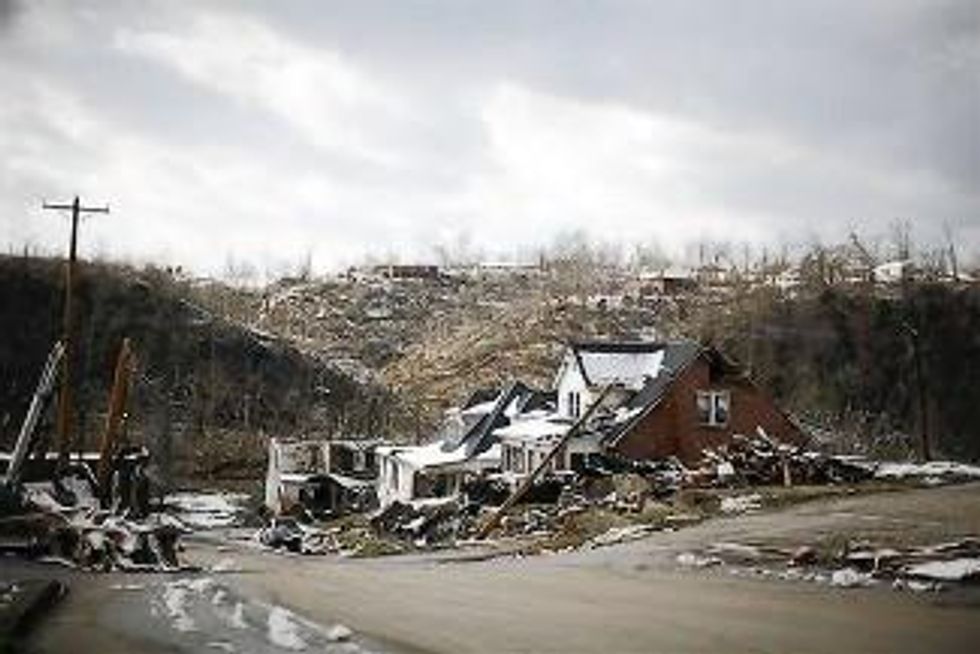
Over 150 tornadoes touched down between Feb 28 and March 3. Friday's thunderstorms generated more tornadoes in one day than the usual monthly average in all of March. 39 people died over a stretch of more than 1,000 miles according to Reuters.
Given the increase in extreme weather, property insurers are taking unprecedented losses in profits. The solution for many in the business is becoming clear: leave homeowners out in the open with no financial protection from natural disasters.
Reuters reports:
Unfortunately, homeowners may find themselves either paying substantially higher rates or not having insurance at all, as insurers try to manage their exposure to what is clearly a growing concern by diversifying geographically and tightening their standards. [...]
Disaster modeler Eqecat said the total number of tornadoes recorded this year to date is more than twice the seven-year average. It was Eqecat that estimated industry losses from last week's storms at $1 billion to $2 billion.
"While it's not to the same scale as what a major hurricane could do to a Florida or the Eastern coastal states, I think the risk of severe thunderstorms is growing and awareness is growing," said Brad Lemons, vice president of product and pricing at Nationwide Mutual, the eighth-largest property insurer in the country. [...]
Homeowners in hard-hit states are already paying the cost this year. For example, State Farm, the country's largest home and auto insurer, received approval from regulators for a 5 percent hike in owner-occupied homeowners insurance rates in Alabama as of last November. In Mississippi, it sought a 15.8 percent rate hike for its manufactured housing coverage. [...]
The Consumer Federation of America, in a February study written by a former Texas insurance commissioner, claimed homeowners were paying 10 times more out of pocket for damage after Katrina than after Hurricane Andrew in 1992, and rates have rose further since that time. [...]
The phrase "perfect storm" is overused, but in last Friday's case, it might well be true.
"Nearly every factor meteorologists look for when forecasting severe thunderstorms and tornadoes was in place," AccuWeather said in a report Monday.
Given how frequent twisters have become in the last year or so, one solution for the industry is to simply get out of the storms' way.
# # #
Following an abrupt start to this year's tornado season, insurers have begun reconsidering tornado coverage in storm-prone states.
Over 150 tornadoes touched down between Feb 28 and March 3. Friday's thunderstorms generated more tornadoes in one day than the usual monthly average in all of March. 39 people died over a stretch of more than 1,000 miles according to Reuters.
Given the increase in extreme weather, property insurers are taking unprecedented losses in profits. The solution for many in the business is becoming clear: leave homeowners out in the open with no financial protection from natural disasters.
Reuters reports:
Unfortunately, homeowners may find themselves either paying substantially higher rates or not having insurance at all, as insurers try to manage their exposure to what is clearly a growing concern by diversifying geographically and tightening their standards. [...]
Disaster modeler Eqecat said the total number of tornadoes recorded this year to date is more than twice the seven-year average. It was Eqecat that estimated industry losses from last week's storms at $1 billion to $2 billion.
"While it's not to the same scale as what a major hurricane could do to a Florida or the Eastern coastal states, I think the risk of severe thunderstorms is growing and awareness is growing," said Brad Lemons, vice president of product and pricing at Nationwide Mutual, the eighth-largest property insurer in the country. [...]
Homeowners in hard-hit states are already paying the cost this year. For example, State Farm, the country's largest home and auto insurer, received approval from regulators for a 5 percent hike in owner-occupied homeowners insurance rates in Alabama as of last November. In Mississippi, it sought a 15.8 percent rate hike for its manufactured housing coverage. [...]
The Consumer Federation of America, in a February study written by a former Texas insurance commissioner, claimed homeowners were paying 10 times more out of pocket for damage after Katrina than after Hurricane Andrew in 1992, and rates have rose further since that time. [...]
The phrase "perfect storm" is overused, but in last Friday's case, it might well be true.
"Nearly every factor meteorologists look for when forecasting severe thunderstorms and tornadoes was in place," AccuWeather said in a report Monday.
Given how frequent twisters have become in the last year or so, one solution for the industry is to simply get out of the storms' way.
# # #
Following an abrupt start to this year's tornado season, insurers have begun reconsidering tornado coverage in storm-prone states.
Over 150 tornadoes touched down between Feb 28 and March 3. Friday's thunderstorms generated more tornadoes in one day than the usual monthly average in all of March. 39 people died over a stretch of more than 1,000 miles according to Reuters.
Given the increase in extreme weather, property insurers are taking unprecedented losses in profits. The solution for many in the business is becoming clear: leave homeowners out in the open with no financial protection from natural disasters.
Reuters reports:
Unfortunately, homeowners may find themselves either paying substantially higher rates or not having insurance at all, as insurers try to manage their exposure to what is clearly a growing concern by diversifying geographically and tightening their standards. [...]
Disaster modeler Eqecat said the total number of tornadoes recorded this year to date is more than twice the seven-year average. It was Eqecat that estimated industry losses from last week's storms at $1 billion to $2 billion.
"While it's not to the same scale as what a major hurricane could do to a Florida or the Eastern coastal states, I think the risk of severe thunderstorms is growing and awareness is growing," said Brad Lemons, vice president of product and pricing at Nationwide Mutual, the eighth-largest property insurer in the country. [...]
Homeowners in hard-hit states are already paying the cost this year. For example, State Farm, the country's largest home and auto insurer, received approval from regulators for a 5 percent hike in owner-occupied homeowners insurance rates in Alabama as of last November. In Mississippi, it sought a 15.8 percent rate hike for its manufactured housing coverage. [...]
The Consumer Federation of America, in a February study written by a former Texas insurance commissioner, claimed homeowners were paying 10 times more out of pocket for damage after Katrina than after Hurricane Andrew in 1992, and rates have rose further since that time. [...]
The phrase "perfect storm" is overused, but in last Friday's case, it might well be true.
"Nearly every factor meteorologists look for when forecasting severe thunderstorms and tornadoes was in place," AccuWeather said in a report Monday.
Given how frequent twisters have become in the last year or so, one solution for the industry is to simply get out of the storms' way.
# # #