SUBSCRIBE TO OUR FREE NEWSLETTER
Daily news & progressive opinion—funded by the people, not the corporations—delivered straight to your inbox.
5
#000000
#FFFFFF
To donate by check, phone, or other method, see our More Ways to Give page.
When they say a picture is worth a thousand words, writers rebel (or they write 1,500 words). I mean, pictures are great, but they can't convey complicated concepts—except when they can.
Which would be the summer of 2015, on two separate occasions. Early in the summer, on the West Coast of the United States, "kayaktivists" in Seattle Harbor surrounded Shell Oil's giant Polar Pioneer drilling rig, trying to keep it from getting out of the harbor. They didn't succeed in that, of course--the Coast Guard cleared them out of the way--but they did succeed in reminding everyone of the scale of the destruction Shell has planned. Seeing those small, many kayaks against that one brute drilling platform brought home the existential nature of the struggle: it's all of us, the little guys, against the immense, concentrated wealth and power of the biggest companies on earth.

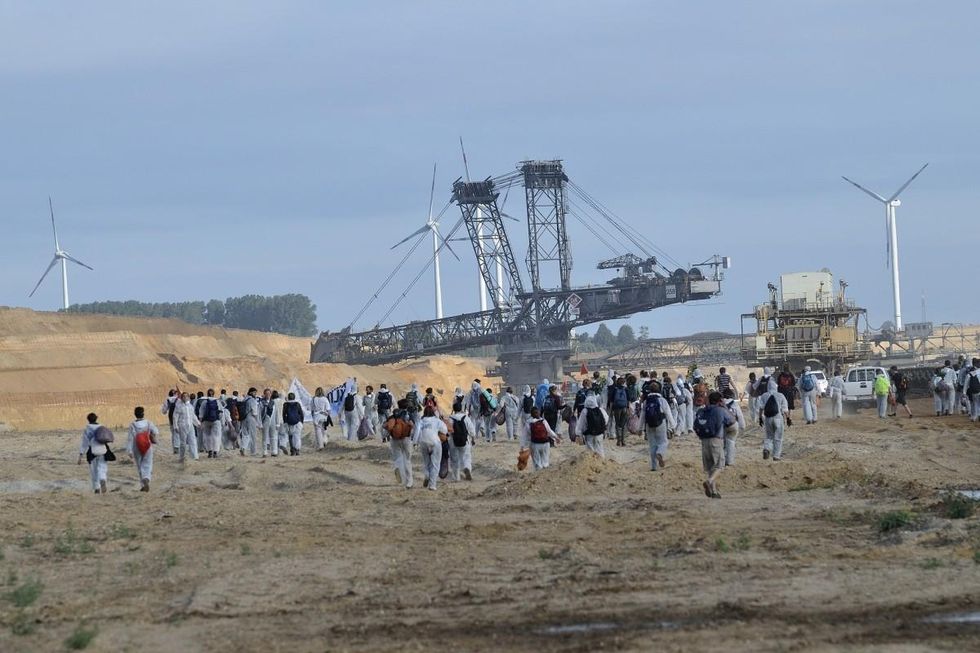
And then again last weekend in Germany, at the amazing #EndeGelande protests, when more than a thousand activists managed to elude authorities and congregate inside Europe's largest coal mine, in front of what are the world's single largest terrestrial machines. (One, the Bagger 288 is so big it even has its own song). They sat there for most of the day, and the great machines could do no work--and that means, since they move 240,000 tons of coal a day, that a lot of coal was not mined.
But activists can't stay there forever, and in the end, the picture will do the company and the German government more damage. The Star Wars-like image of people standing in front of the Jurassic digger makes the same point of the inhuman, absurd scale.
Pictures don't always turn the future, of course. The German images reminded me of the most famous picture of the Tiananmen saga...

... but sadly, the forces behind those tanks are still in control. His courage faced them down momentarily, but their implacable might won the day.
In the energy world, though, I'm willing to bet that these images poison the fossil fuel industry. It's not just because of their sheer, inhuman, oversized ugliness but because they manage to look somehow so antique. Or rather, so modern in a postmodern world. We're moving quickly to a planet where the small and distributed makes more sense than the centralized and gigantic--that's why you're likely getting your news from the net, not a TV channel. Even without understanding the science of climate change--the horror that the carbon from that digger and that drill rig is driving--, you have a visceral sense that they're in the wrong moment, the wrong mood.
The fight against Arctic oil and German coal will be long and hard. But we already know, once we've won, what the pictures in the textbooks will be.
When they say a picture is worth a thousand words, writers rebel (or they write 1,500 words). I mean, pictures are great, but they can't convey complicated concepts—except when they can.
Which would be the summer of 2015, on two separate occasions. Early in the summer, on the West Coast of the United States, "kayaktivists" in Seattle Harbor surrounded Shell Oil's giant Polar Pioneer drilling rig, trying to keep it from getting out of the harbor. They didn't succeed in that, of course--the Coast Guard cleared them out of the way--but they did succeed in reminding everyone of the scale of the destruction Shell has planned. Seeing those small, many kayaks against that one brute drilling platform brought home the existential nature of the struggle: it's all of us, the little guys, against the immense, concentrated wealth and power of the biggest companies on earth.
And then again last weekend in Germany, at the amazing #EndeGelande protests, when more than a thousand activists managed to elude authorities and congregate inside Europe's largest coal mine, in front of what are the world's single largest terrestrial machines. (One, the Bagger 288 is so big it even has its own song). They sat there for most of the day, and the great machines could do no work--and that means, since they move 240,000 tons of coal a day, that a lot of coal was not mined.
But activists can't stay there forever, and in the end, the picture will do the company and the German government more damage. The Star Wars-like image of people standing in front of the Jurassic digger makes the same point of the inhuman, absurd scale.
Pictures don't always turn the future, of course. The German images reminded me of the most famous picture of the Tiananmen saga...
... but sadly, the forces behind those tanks are still in control. His courage faced them down momentarily, but their implacable might won the day.
In the energy world, though, I'm willing to bet that these images poison the fossil fuel industry. It's not just because of their sheer, inhuman, oversized ugliness but because they manage to look somehow so antique. Or rather, so modern in a postmodern world. We're moving quickly to a planet where the small and distributed makes more sense than the centralized and gigantic--that's why you're likely getting your news from the net, not a TV channel. Even without understanding the science of climate change--the horror that the carbon from that digger and that drill rig is driving--, you have a visceral sense that they're in the wrong moment, the wrong mood.
The fight against Arctic oil and German coal will be long and hard. But we already know, once we've won, what the pictures in the textbooks will be.
When they say a picture is worth a thousand words, writers rebel (or they write 1,500 words). I mean, pictures are great, but they can't convey complicated concepts—except when they can.
Which would be the summer of 2015, on two separate occasions. Early in the summer, on the West Coast of the United States, "kayaktivists" in Seattle Harbor surrounded Shell Oil's giant Polar Pioneer drilling rig, trying to keep it from getting out of the harbor. They didn't succeed in that, of course--the Coast Guard cleared them out of the way--but they did succeed in reminding everyone of the scale of the destruction Shell has planned. Seeing those small, many kayaks against that one brute drilling platform brought home the existential nature of the struggle: it's all of us, the little guys, against the immense, concentrated wealth and power of the biggest companies on earth.
And then again last weekend in Germany, at the amazing #EndeGelande protests, when more than a thousand activists managed to elude authorities and congregate inside Europe's largest coal mine, in front of what are the world's single largest terrestrial machines. (One, the Bagger 288 is so big it even has its own song). They sat there for most of the day, and the great machines could do no work--and that means, since they move 240,000 tons of coal a day, that a lot of coal was not mined.
But activists can't stay there forever, and in the end, the picture will do the company and the German government more damage. The Star Wars-like image of people standing in front of the Jurassic digger makes the same point of the inhuman, absurd scale.
Pictures don't always turn the future, of course. The German images reminded me of the most famous picture of the Tiananmen saga...
... but sadly, the forces behind those tanks are still in control. His courage faced them down momentarily, but their implacable might won the day.
In the energy world, though, I'm willing to bet that these images poison the fossil fuel industry. It's not just because of their sheer, inhuman, oversized ugliness but because they manage to look somehow so antique. Or rather, so modern in a postmodern world. We're moving quickly to a planet where the small and distributed makes more sense than the centralized and gigantic--that's why you're likely getting your news from the net, not a TV channel. Even without understanding the science of climate change--the horror that the carbon from that digger and that drill rig is driving--, you have a visceral sense that they're in the wrong moment, the wrong mood.
The fight against Arctic oil and German coal will be long and hard. But we already know, once we've won, what the pictures in the textbooks will be.