

SUBSCRIBE TO OUR FREE NEWSLETTER
Daily news & progressive opinion—funded by the people, not the corporations—delivered straight to your inbox.
5
#000000
#FFFFFF
To donate by check, phone, or other method, see our More Ways to Give page.
Daily news & progressive opinion—funded by the people, not the corporations—delivered straight to your inbox.
When they say a picture is worth a thousand words, writers rebel (or they write 1,500 words). I mean, pictures are great, but they can't convey complicated concepts—except when they can.
Which would be the summer of 2015, on two separate occasions. Early in the summer, on the West Coast of the United States, "kayaktivists" in Seattle Harbor surrounded Shell Oil's giant Polar Pioneer drilling rig, trying to keep it from getting out of the harbor. They didn't succeed in that, of course--the Coast Guard cleared them out of the way--but they did succeed in reminding everyone of the scale of the destruction Shell has planned. Seeing those small, many kayaks against that one brute drilling platform brought home the existential nature of the struggle: it's all of us, the little guys, against the immense, concentrated wealth and power of the biggest companies on earth.

And then again last weekend in Germany, at the amazing #EndeGelande protests, when more than a thousand activists managed to elude authorities and congregate inside Europe's largest coal mine, in front of what are the world's single largest terrestrial machines. (One, the Bagger 288 is so big it even has its own song). They sat there for most of the day, and the great machines could do no work--and that means, since they move 240,000 tons of coal a day, that a lot of coal was not mined.
But activists can't stay there forever, and in the end, the picture will do the company and the German government more damage. The Star Wars-like image of people standing in front of the Jurassic digger makes the same point of the inhuman, absurd scale.
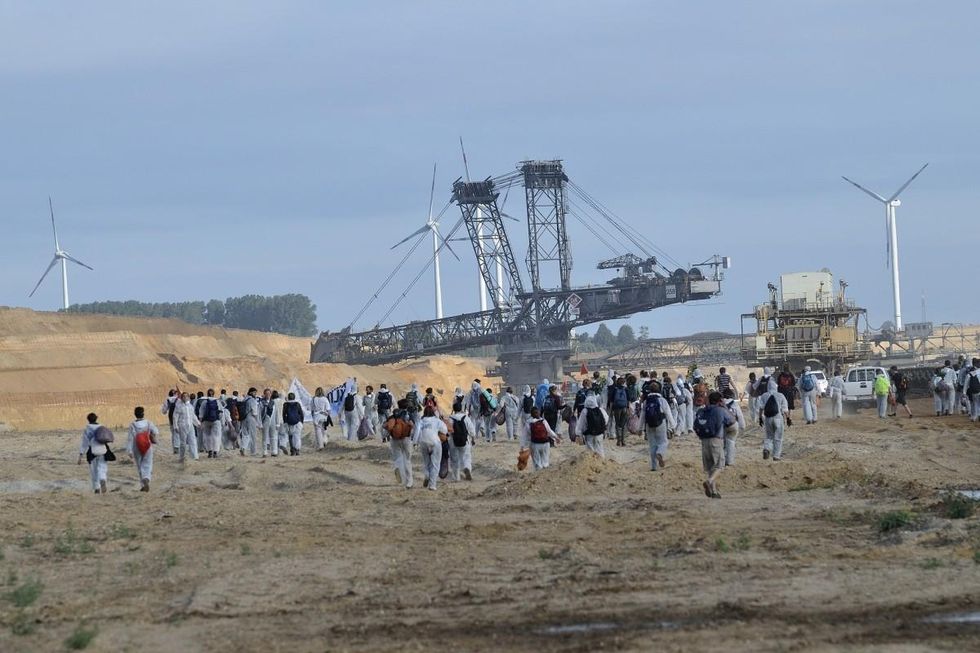
Pictures don't always turn the future, of course. The German images reminded me of the most famous picture of the Tiananmen saga...

... but sadly, the forces behind those tanks are still in control. His courage faced them down momentarily, but their implacable might won the day.
In the energy world, though, I'm willing to bet that these images poison the fossil fuel industry. It's not just because of their sheer, inhuman, oversized ugliness but because they manage to look somehow so antique. Or rather, so modern in a postmodern world. We're moving quickly to a planet where the small and distributed makes more sense than the centralized and gigantic--that's why you're likely getting your news from the net, not a TV channel. Even without understanding the science of climate change--the horror that the carbon from that digger and that drill rig is driving--, you have a visceral sense that they're in the wrong moment, the wrong mood.
The fight against Arctic oil and German coal will be long and hard. But we already know, once we've won, what the pictures in the textbooks will be.
Placing the "fate of the Arctic" in the care of Big Oil, the Obama administration granted Shell the final permit to drill deep into the waters off the Alaskan coast on Monday.
The permit, issued by the Bureau of Safety and Environmental Enforcement (BSEE), comes days after President Obama announced an upcoming Alaska visit, highlighting what he called "one of the greatest challenges we face this century: climate change."
Shell applied for the permit after the MSV Fennica icebreaker was held up due to damage. The vessel carries the "capping stack," which the BSEE requires to be easily deployed ahead of drilling in potential oil-bearing zones "in the unlikely event of a loss of well control."
"The capping stack, staged on the vessel M/V Fennica, is now in the region and capable of being deployed within 24 hours," the BSEE statement said.
In a statement, Greenpeace USA executive director Annie Leonard said the approval "means the Obama administration is leaving the fate of the Arctic up to Shell this summer. But that doesn't mean the future of the Arctic has to be in Shell's hands."
Referring to the groundswell of activism that has erupted in opposition to the Arctic drilling plan, Leonard added, "The President has seen how big the movement to save the Arctic and to keep fossil fuels in the ground has become, and it's only going to get bigger if he doesn't put a stop to this catastrophic plan."
It has been more than 15 years since tear gas filled the streets of Seattle and tens of thousands of people protested the meeting of the World Trade Organization, or WTO. That week of protests in late 1999 became known as "The Battle of Seattle," as the grass-roots organizers successfully blocked world leaders, government trade ministers and corporate executives from meeting to sign a global trade deal that many called deeply undemocratic, harming workers' rights, the environment and indigenous people globally.
It has been more than 15 years since tear gas filled the streets of Seattle and tens of thousands of people protested the meeting of the World Trade Organization, or WTO. That week of protests in late 1999 became known as "The Battle of Seattle," as the grass-roots organizers successfully blocked world leaders, government trade ministers and corporate executives from meeting to sign a global trade deal that many called deeply undemocratic, harming workers' rights, the environment and indigenous people globally.
A new Battle of Seattle has been raging in recent weeks, pitting a broad coalition of people against a multinational corporate behemoth, Shell Oil. Citizens and elected officials alike, concerned about Shell's plans to drill for oil in the Arctic, swarmed the waters around Seattle, trying to block the massive oil-drilling platform, Polar Pioneer, from leaving on its journey to the Arctic. As fossil-fuel corporations intensify their exploitation of the world's oil, protesters, as well as the pope, are weighing in as never before about the catastrophic effects of climate change.
The Polar Pioneer arrived in Puget Sound in mid-May in preparation for its trip to the Chukchi Sea in the Arctic Ocean. Royal Dutch Shell has the vessel under contract from Transocean, the same company whose Deepwater Horizon oil rig caused the blowout and oil-spill disaster in the Gulf of Mexico five years ago. As the platform was tugged into the Port of Seattle's Terminal 5, the first wave of the "Mosquito Fleet" paddled out to block it. The protest flotilla is made up of "kayaktivists," people in small kayaks that establish a blockade, much like the protesters in 1999 linked arms on the rainy streets of Seattle to block the delegates attempting to attend the WTO Ministerial Conference.
To the horror of many, President Barack Obama has approved Arctic-oil exploration. Subhankar Banerjee, renowned photographer, writer and activist who has spent the past 15 years working for the conservation of the Arctic, called the Obama administration "both irresponsible and reckless." Banerjee says, "What the administration has approved now is the exploration plans for Shell to drill this summer, starting from July to October. ... Shell still needs more permits from NOAA [National Oceanic and Atmospheric Administration], Fish and Wildlife Service and other federal agencies. So that's why the activists are working very hard to make sure that some of these permits are not granted."
Even legendary musician Paul McCartney has weighed in. In his foreword to a new book against Arctic drilling by Greenpeace activist Ben Stewart, McCartney writes: "As the ice retreats, the oil giants are moving in. Instead of seeing the melting as a grave warning to humanity, they are eyeing the previously inaccessible oil beneath the seabed at the top of the world. They're exploiting the disappearance of the ice to drill for the very same fuel that caused the melting in the first place."
Ultimately, the Polar Pioneer escaped Puget Sound. As the rig entered the open sea off the coast of Vancouver Island in Canada, Greenpeace Canada dispatched inflatable boats. Indigenous activist Audrey Siegl of the Musqueam First Nation stood on the bow of one small boat, holding her hands in a defiant order to stop. Meanwhile, two more people were swimming in the open ocean, in front of the gargantuan Shell vessel, treading water while holding a sign reading, "People vs Oil."
Farther north, in Alaska, environmentalists, indigenous people and fisherfolk are joining together to block a U.S. Navy training exercise called "Northern Edge." The Navy is reportedly unleashing thousands of sailors and other military members, along with several Navy destroyers, hundreds of aircraft, extensive weaponry and a submarine for naval exercises. The Navy also has permission to expend hundreds of thousands of pounds of bombs and other munitions, polluting the waters and disrupting marine life. Truthout reporter Dahr Jamail writes, "The waters in the Gulf of Alaska are some of the most pristine in the world." He told me on "Democracy Now!," "The city of Cordova ... passed a city resolution directly opposing the naval exercises, as did the City Council of Kodiak, Alaska. ... We've seen a over 150-boat flotilla in Cordova happened a few weeks ago ... another large flotilla of fishermen out of Kodiak did the same thing."
Just like the complex, interrelated issues of global trade brought together an unprecedented coalition in the streets of Seattle 15 years ago, so now does human-induced climate change. This threat is being met with a chorus of resistance, including Pope Francis, whose new encyclical on the environment calls for concerted action to confront global warming.
When the pope and paddlers unite, change cannot be far off.
Update 3:40 PM EDT
Rolling blockades of kayakers confronted the Shell rig as it navigated up Puget Sound, and early Monday afternoon, there were indications that the Polar Pioneer may have been grounded in shallow water off the coast of Bainbridge Island.
However, after a more than three-hour delay, the rig is now on the move, and activists say kayakers up the channel are prepared for more resistance.
Meanwhile, praise for the bravery of the 'kayaktivists' has come from all corners. "Today, the Puget Sound is the scene of some serious climate heroics," tweeted David Turnbull, campaigns director at Oil Change International.
350.org founder Bill McKibben wrote, " My favorite new word of 2015 is 'hacktivist,' and this a.m., they're giving Shell fits in Seattle's harbor."
Updates on the rig can be found on Twitter under the hashtag #SHellNo.
Earlier
In canoes and kayaks, anti-drilling activists early Monday faced down Shell's 40,000-ton drilling rig, the Polar Pioneer, as it attempted to set sail from Seattle's Puget Sound to Arctic waters.
At least ten of the "kayaktivists," including Seattle City Councilmember Mike O'Brien, were detained by the U.S. Coast Guard for alleging violating a previous injunction by overstepping a 500-yard restricted "safety" zone around the behemoth rig.
An estimated 40 to 50 supporting kayakers lined up in the waters behind the initial blockade while the group floated an enormous banner which read: "SHell No!"
Watch:
According to reporting on the scene by Yes! Magazine editor-in-chief Sarah van Gelder, after the first wave of arrests, more kayakers continued to blockade the rig as it made its way through the Sound.
The demonstrators hope to stall the rig long enough to thwart Shell's sensitive drilling timeline. They say they are putting their bodies on the line for the sake of the pristine Arctic ecosystem and the future of the planet—both of which are now at great risk due to the fossil fuel industry's insistence on extracting more oil from increasingly remote sources, such as the Arctic seabed or Canadian tar sands.
They note that this policy has enjoyed continued support from President Barack Obama's administration despite his repeated statements on the urgency of the climate crisis.
"Every minute that brave protesters can delay Shell's Arctic drilling plans is another chance for President Obama to reconsider his disastrous approval of oil drilling in Alaska," Greenpeace U.S. executive director Annie Leonard said in a statement. "The President's decision on Arctic drilling will be a dealbreaker for his climate legacy, but it's not too late for him to stop this catastrophe before it starts."
Paloma Henriques, one of the kayaktivists in the blockade, added: "I'm just one voice out here, but I know I'm not alone. I believe that confronting Shell will encourage more people to take a strong stand against them and other companies who are seeking to destroy this planet for profit."
In addition to blocking Shell, Henriques said that the group is sending "a message to President Obama that it's not too late to stop Shell from destroying the Arctic."
Over 300,000 people have signed a petition calling on Obama to abort the Arctic drilling plan.
Updates on the blockade are being shared online under the hashtag #SHellNo as well as on Greenpeace's live blog.
Shell has one or two rivals for the title of Planet's Most Irresponsible Company, but it's definitely the most ironic.
The grand irony, of course, is that, having watched the Arctic melt as global temperatures rose, Shell was first in line to drill the newly melted waters for yet more oil which would raise the temperature some more.
But lately, the planetary-scale irony was compounded by one of a more local variety, contained in the phrase safety zone.
Here's the backstory: In May, Shell convinced a federal judge in Alaska to enjoin Greenpeace from protesting too closely to Shell's Arctic drilling vessels. This restricted area, or safety zone, was set at 500 yards (457 metres) while these vessels transit in Seattle's Puget Sound. Then, last month, 500 kayaks congregated around one of Shell's giant Arctic drilling rigs as it sat in Puget Sound, a David-and-Goliath picture that flew across the web. And a couple of brave souls peacefully suspended themselves from another one of its drilling vessels, as others had done a month earlier.
No one was hurt. But Shell didn't like any of this, so the company, in a not-so-subtle attempt to intimidate opposing voices, decided to send out a copy of the Greenpeace injunction to 350.org and others who oppose its Arctic drilling plans.
Of course no court as yet has drawn a safety zone around the Arctic, even though a January study published in the journal Nature made it clear that if we open up the stores of gas and oil in the far north we won't be able to protect the climate from dramatic change. Instead, Barack Obama invited Shell to drill.
While the New York Times editorial board says, "The Paris [climate summit] may well be the world's last, best chance to get a grip on a problem that, absent urgent action over the next decade, could spin out of control", most are already bracing for another massive failure by the political elite at what is being disparagingly described as the "Conference of Polluters".
This is a reality is because the pledges being made by countries in advance of the COP21 in Paris are simply insufficient. Open Democracy has reported, "Cambridge University number cruncher Chris Hope concluded that if the European Union countries cut emissions by 40 percent by 2030 (as they have pledged), if the rest of the developed countries follow the U.S. commitment, and if the developing countries follow China's promise, the most likely result will be a [disastrous] global temperature rise of 3.6 degrees Celsius in 2100." As for Canada, the Harper government pledged an extremely weak 30 percent reduction below 2005 levels by 2030 (which equals 14 percent below 1990 levels by 2030).
In addition to this, Patrick Bond laments, "There are no reliable state allies of climate justice at present and indeed there really are no high-profile progressives working within the COPs. It's a huge problem for UN reformers because it leaves them without a policy jam-maker inside to accompany activist tree-shaking outside. The UN head of the COP process is an oft-compromised carbon trader, Christiana Figueres. Although once there were heroic delegates badgering the COP process, they are all gone now... If you are serious about climate justice, the message from these COP experiences is unmistakable: going inside is suicide."
But Bond writes there is hope in grassroots mobilization. He says, "A great deal of coalition building has occurred in France and indeed across Europe [since last August]. The proximate goal is to use awareness of the Paris COP21 to generate events around the world in national capitals on November 28 and 29 - just before the summit begins - and on December 12, as it climaxes. ...Projects [are being planned] like November 27-29 mass actions aimed at municipalities; a Brussels-Paris activist train; ...the Alternatiba alternatives project with 200 participating villages from the Basque country up to Brussels, which will culminate on September 26-27..."
In a similar track, Campaign Against Climate Change has proposed, "We want everyone to know that the students in Paris will be occupying their universities on Monday 7 December, and on Tuesday they will be dancing out of the colleges onto the streets and asking everyone to join them. ...We want to begin now campaigning for university and college occupations in our own countries. We will be doing that in the UK. We invite you to join us in your country."
Rising Tide North America is calling for a series of mass actions across the United States and Canada. They note, "From September to the end of November, Flood the System envisions an escalating series of direct actions and demonstrations targeting the economic and political systems at the root of the crisis, inspired by recent movements led by low-wage workers, immigrants, and communities responding to police brutality."
And ETC executive director Pat Mooney says, "[Paris] should start like [the big march this past September in] New York and end like Seattle. Shut the thing down."
The Council of Canadians is currently in the process of determining what our intervention will be at the time of the UN climate talks this November 30 to December 11.
We have been campaigning to stop the Energy East and Trans Mountain pipelines as well as other carbon intensive projects - like fracking and the Site C dam - because of their climate change impacts and calling for sustainable energy solutions, just transition strategies and good green jobs. Maude Barlow has also been highlighting, "If water is mentioned at all [in climate talks], it is as one more victim of climate change, almost always solely attributed to the burning of fossil fuels. The fact that destroying water-retentive landscapes is in and of itself a major cause of climate change is not part of the analysis or discussion in climate change circles."
We took part in the protests and counter-summits at the time of the UN climate talks in Copenhagen in 2009, Cancun in 2010 and Lima in 2014. We recognize both the importance and the very real limits of those strategies for Paris in 2015.
In the most recent issue of Adbusters, Gwynne Dyer writes that the "climate wars" of the future will be driven by three factors: the closing of borders to the waves of climate refugees who lack water and whose land has dried up and blown away; the proliferation of failed states who can no longer feed their people; and the increased number of dams between countries that share a river system. Mike Hodder writes in that same issue of Adbusters that, "A commitment was made to resolve the issues that collapsed in Lima once and for all this December in Paris, but world leaders have repeatedly let us down. If an agreement can't be made at the upcoming U.N. Climate Conference we are staring into the face of a global environmental genocide from which there is no turning back. Our only shot at curbing climate change - our only shot at survival, may be revolution."
The stakes are evidently planetary survival and the world will be watching Paris this year.