

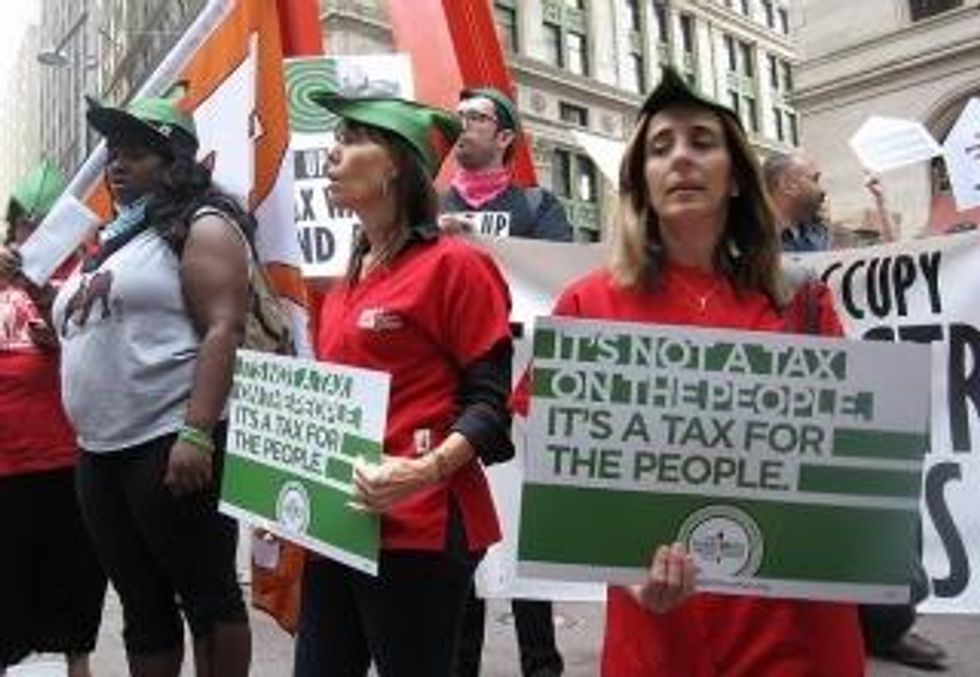
For many months, nurses, healthcare, environmental, labor, consumer, faith-based and other community activists have rallied on Wall Street, at banks and legislative offices, and outside the White House and Treasury Department, saying it is time to tax Wall Street to help revive our economy and nation.
Now it's no longer just a movement. It's also legislation, H.R. 6411, the Robin Hood tax, introduced in Congress by Rep. Keith Ellison, one of the most progressive voices in Washington.
H.R. 6411, formally known as the Inclusive Prosperity Act, would require the unaccountable Wall Street financiers and gamblers to begin to pay some restitution for all the damage they've caused to Main Street communities across the U.S.
Not coincidentally, the bill was introduced on the eve of the one year anniversary of the Occupy Wall Street movement, that historic convergence that provided a critical reminder of the pervasive disparity in incomes and wealth in the U.S., and the salient point that the bankers got bailouts and bonuses while so many others were left behind.
H.R. 6411 begins to provide some redress.
With a small tax, just 50 cents on every $100 of stock trades, and a lesser amount on other trades of bonds, derivatives, and other financial instruments. Even at those rates, H.R. 6411 could generate as much as $350 billion every year.
As economist Robert Pollin, co-director, Political Economy Research Institute (PERI), University of Massachusetts-Amherst, explains, "In its essentials, the idea of a financial market transaction tax is simple. It would mean that financial market traders would pay a small fee to the government every time they purchased any financial market instrument, including all stock, bond, options, futures, and swap trades. This would be the equivalent of sales taxes that Americans have long paid every time they buy an automobile, shirt, baseball glove, airline ticket, or pack of chewing gum, eat at a restaurant, or have their hair cut."
Imagine, the average sales tax rate in the U.S. that consumers pay on almost all goods and services is 9.6 percent - yet J.P. Morgan, Goldman Sachs, Morgan Stanley, and the other financial giants on Wall Street pay no sales tax on the thousands, even tens of thousands of trades, they carry out every second.
No wonder this movement has so much resonance, with more than 115 national endorsers of the Robin Hood Tax Campaign to date, joining because they think Wall Street should pay its fair share, and because they know of the critical need for the revenue that would be raised.
The funds raised by H.R. 6411 would be available for such basics as rebuilding our crumbling infrastructure with good paying jobs, expanding and improving Medicare and Medicaid, investment in education and job training, and housing assistance for low income households. In other words, the basic needs so essential to the survival of a civil society and nation.
"The American public provided hundreds of billions to bailout Wall Street during the global fiscal crisis yet bore the brunt of the crisis with lost jobs and reduced household wealth," said Rep. Ellison upon introduction of the bill. "This is a phenomenally wealthy nation, yet our tax and regulatory system allowed the financial titans to amass great riches while impoverishing the systems that enable inclusive prosperity. A financial transaction tax protects our financial markets from speculation and provides the revenue needed to invest in the education, health and communities of the American people."
"Last summer, scientists proved that we can actually end the AIDS pandemic if we just scale up our investment in treatment and prevention programs," said Jennifer Flynn, managing director of Health GAP (Global Access Project). "But when we go to Congress, all we hear about are budget cuts. We need to increase revenue and the Robin Hood Tax is the best of all proposals to do just that."
Funds would also be available for global sustainable programs to tackle poverty, climate change, AIDS, and other international assistance.
Those goals are emulated across the planet by an international Robin Hood tax campaign that has already seen similar taxes adopted by more than 30 other nations, most recently France, with growing support across Europe.
There's more. H.R. 6411 would add stability to the economy curbing turbulent short-term speculation - in some cases tens of millions of dollars in computerized trades occurring in minutes that has prompted huge upheavals in the market. Though the tax is tiny, it would make such rampant gambling less attractive to the investment banks, high frequency trading firms and hedge funds.
Introduction of H.R. 6411 does not mark an end to the great grassroots campaign for a Robin Hood tax that continues to grow, but an additional focus. In the coming days, weeks, and months, activists are planning more actions to build the campaign, and also asking supporters to urge other members of Congress to sign on to the bill.
For many months, nurses, healthcare, environmental, labor, consumer, faith-based and other community activists have rallied on Wall Street, at banks and legislative offices, and outside the White House and Treasury Department, saying it is time to tax Wall Street to help revive our economy and nation.
Now it's no longer just a movement. It's also legislation, H.R. 6411, the Robin Hood tax, introduced in Congress by Rep. Keith Ellison, one of the most progressive voices in Washington.
H.R. 6411, formally known as the Inclusive Prosperity Act, would require the unaccountable Wall Street financiers and gamblers to begin to pay some restitution for all the damage they've caused to Main Street communities across the U.S.
Not coincidentally, the bill was introduced on the eve of the one year anniversary of the Occupy Wall Street movement, that historic convergence that provided a critical reminder of the pervasive disparity in incomes and wealth in the U.S., and the salient point that the bankers got bailouts and bonuses while so many others were left behind.
H.R. 6411 begins to provide some redress.
With a small tax, just 50 cents on every $100 of stock trades, and a lesser amount on other trades of bonds, derivatives, and other financial instruments. Even at those rates, H.R. 6411 could generate as much as $350 billion every year.
As economist Robert Pollin, co-director, Political Economy Research Institute (PERI), University of Massachusetts-Amherst, explains, "In its essentials, the idea of a financial market transaction tax is simple. It would mean that financial market traders would pay a small fee to the government every time they purchased any financial market instrument, including all stock, bond, options, futures, and swap trades. This would be the equivalent of sales taxes that Americans have long paid every time they buy an automobile, shirt, baseball glove, airline ticket, or pack of chewing gum, eat at a restaurant, or have their hair cut."
Imagine, the average sales tax rate in the U.S. that consumers pay on almost all goods and services is 9.6 percent - yet J.P. Morgan, Goldman Sachs, Morgan Stanley, and the other financial giants on Wall Street pay no sales tax on the thousands, even tens of thousands of trades, they carry out every second.
No wonder this movement has so much resonance, with more than 115 national endorsers of the Robin Hood Tax Campaign to date, joining because they think Wall Street should pay its fair share, and because they know of the critical need for the revenue that would be raised.
The funds raised by H.R. 6411 would be available for such basics as rebuilding our crumbling infrastructure with good paying jobs, expanding and improving Medicare and Medicaid, investment in education and job training, and housing assistance for low income households. In other words, the basic needs so essential to the survival of a civil society and nation.
"The American public provided hundreds of billions to bailout Wall Street during the global fiscal crisis yet bore the brunt of the crisis with lost jobs and reduced household wealth," said Rep. Ellison upon introduction of the bill. "This is a phenomenally wealthy nation, yet our tax and regulatory system allowed the financial titans to amass great riches while impoverishing the systems that enable inclusive prosperity. A financial transaction tax protects our financial markets from speculation and provides the revenue needed to invest in the education, health and communities of the American people."
"Last summer, scientists proved that we can actually end the AIDS pandemic if we just scale up our investment in treatment and prevention programs," said Jennifer Flynn, managing director of Health GAP (Global Access Project). "But when we go to Congress, all we hear about are budget cuts. We need to increase revenue and the Robin Hood Tax is the best of all proposals to do just that."
Funds would also be available for global sustainable programs to tackle poverty, climate change, AIDS, and other international assistance.
Those goals are emulated across the planet by an international Robin Hood tax campaign that has already seen similar taxes adopted by more than 30 other nations, most recently France, with growing support across Europe.
There's more. H.R. 6411 would add stability to the economy curbing turbulent short-term speculation - in some cases tens of millions of dollars in computerized trades occurring in minutes that has prompted huge upheavals in the market. Though the tax is tiny, it would make such rampant gambling less attractive to the investment banks, high frequency trading firms and hedge funds.
Introduction of H.R. 6411 does not mark an end to the great grassroots campaign for a Robin Hood tax that continues to grow, but an additional focus. In the coming days, weeks, and months, activists are planning more actions to build the campaign, and also asking supporters to urge other members of Congress to sign on to the bill.
For many months, nurses, healthcare, environmental, labor, consumer, faith-based and other community activists have rallied on Wall Street, at banks and legislative offices, and outside the White House and Treasury Department, saying it is time to tax Wall Street to help revive our economy and nation.
Now it's no longer just a movement. It's also legislation, H.R. 6411, the Robin Hood tax, introduced in Congress by Rep. Keith Ellison, one of the most progressive voices in Washington.
H.R. 6411, formally known as the Inclusive Prosperity Act, would require the unaccountable Wall Street financiers and gamblers to begin to pay some restitution for all the damage they've caused to Main Street communities across the U.S.
Not coincidentally, the bill was introduced on the eve of the one year anniversary of the Occupy Wall Street movement, that historic convergence that provided a critical reminder of the pervasive disparity in incomes and wealth in the U.S., and the salient point that the bankers got bailouts and bonuses while so many others were left behind.
H.R. 6411 begins to provide some redress.
With a small tax, just 50 cents on every $100 of stock trades, and a lesser amount on other trades of bonds, derivatives, and other financial instruments. Even at those rates, H.R. 6411 could generate as much as $350 billion every year.
As economist Robert Pollin, co-director, Political Economy Research Institute (PERI), University of Massachusetts-Amherst, explains, "In its essentials, the idea of a financial market transaction tax is simple. It would mean that financial market traders would pay a small fee to the government every time they purchased any financial market instrument, including all stock, bond, options, futures, and swap trades. This would be the equivalent of sales taxes that Americans have long paid every time they buy an automobile, shirt, baseball glove, airline ticket, or pack of chewing gum, eat at a restaurant, or have their hair cut."
Imagine, the average sales tax rate in the U.S. that consumers pay on almost all goods and services is 9.6 percent - yet J.P. Morgan, Goldman Sachs, Morgan Stanley, and the other financial giants on Wall Street pay no sales tax on the thousands, even tens of thousands of trades, they carry out every second.
No wonder this movement has so much resonance, with more than 115 national endorsers of the Robin Hood Tax Campaign to date, joining because they think Wall Street should pay its fair share, and because they know of the critical need for the revenue that would be raised.
The funds raised by H.R. 6411 would be available for such basics as rebuilding our crumbling infrastructure with good paying jobs, expanding and improving Medicare and Medicaid, investment in education and job training, and housing assistance for low income households. In other words, the basic needs so essential to the survival of a civil society and nation.
"The American public provided hundreds of billions to bailout Wall Street during the global fiscal crisis yet bore the brunt of the crisis with lost jobs and reduced household wealth," said Rep. Ellison upon introduction of the bill. "This is a phenomenally wealthy nation, yet our tax and regulatory system allowed the financial titans to amass great riches while impoverishing the systems that enable inclusive prosperity. A financial transaction tax protects our financial markets from speculation and provides the revenue needed to invest in the education, health and communities of the American people."
"Last summer, scientists proved that we can actually end the AIDS pandemic if we just scale up our investment in treatment and prevention programs," said Jennifer Flynn, managing director of Health GAP (Global Access Project). "But when we go to Congress, all we hear about are budget cuts. We need to increase revenue and the Robin Hood Tax is the best of all proposals to do just that."
Funds would also be available for global sustainable programs to tackle poverty, climate change, AIDS, and other international assistance.
Those goals are emulated across the planet by an international Robin Hood tax campaign that has already seen similar taxes adopted by more than 30 other nations, most recently France, with growing support across Europe.
There's more. H.R. 6411 would add stability to the economy curbing turbulent short-term speculation - in some cases tens of millions of dollars in computerized trades occurring in minutes that has prompted huge upheavals in the market. Though the tax is tiny, it would make such rampant gambling less attractive to the investment banks, high frequency trading firms and hedge funds.
Introduction of H.R. 6411 does not mark an end to the great grassroots campaign for a Robin Hood tax that continues to grow, but an additional focus. In the coming days, weeks, and months, activists are planning more actions to build the campaign, and also asking supporters to urge other members of Congress to sign on to the bill.