

SUBSCRIBE TO OUR FREE NEWSLETTER
Daily news & progressive opinion—funded by the people, not the corporations—delivered straight to your inbox.
5
#000000
#FFFFFF
To donate by check, phone, or other method, see our More Ways to Give page.
Daily news & progressive opinion—funded by the people, not the corporations—delivered straight to your inbox.

Why a financial transaction tax deserves to be center stage for the upcoming 2025 tax policy fight.
This year’s presidential race has unfolded like a made-for-TV drama, with twists and turns aplenty. But no matter who wins the White House or Congress, a giant tax fight awaits them next year — when a number of the 2017 tax cuts for the rich and businesses expire.
Part of that fight will be about closing loopholes the very wealthy use to pay lower tax rates than teachers or custodians. But let’s not forget the Wall Street high rollers who gamble in our markets, putting everyone’s investments at risk.
One proposal that could make waves is a Wall Street tax — also called financial transaction tax, or FTT — on stock, bond, and derivative trades. Think of it as a small sales tax for Wall Street trades, like the taxes the rest of us pay when we buy shampoo or shoes.
My organization, Public Citizen, was one of over a hundred that signed a recent letter to Congress calling for meaningful tax reform that fairly generates more revenue and creates more inclusive economic growth.
And I’m here to say an FTT would check all of those boxes and more.
Just a 0.1 percent tax — that’s 10 cents on every $100 of stocks, bonds, and derivatives trades — would generate an estimated $752 billion over 10 years. That would be more than enough to cover free universal preschool, free community college, and national paid family and medical leave — combined.
In addition to a boon for revenue, an FTT would also be a win for tax fairness, since the bulk of it would be paid by the very wealthy, who own and trade the vast majority of stocks.
FTTs are a tried and true solution that many other nations have used to generate significant revenues from the very wealthy and put them into public programs for all — which is why the FTT is often called the “Robin Hood tax.” It could do the same thing in the United States, reinvesting those revenues into creating a more level playing field.
Another benefit? An FTT would tame high-frequency trading, where computer programs ping-pong trades in the blink of an eye, which allows them to get in front of slower moving traders and eke out a miniscule profit on each trade. Because of the volume of trading these firms engage in, all of those tiny profits stack up to huge paydays.
These high-frequency trading algorithms tend to follow each other, somewhat like lemmings throwing themselves off a cliff. That can wreak havoc in the market, as it did during the 2010 Flash Crash when $1 trillion was lost in the U.S. markets in a matter of minutes.
Even a tiny tax on all those trades would make that computer-driven, high-frequency trading less desirable — which would make our markets safer.
Given that it’s a win-win idea, many prominent voices favor taxing Wall Street trades. Former Treasury Department officials like Robert Rubin, Antonio Weiss, Kim Clausing, and Natasha Sarin support taxing financial transactions. Jared Bernstein, who chairs the U.S. Council of Economic Advisers, also supports FTTs.
With these financial all-stars backing the proposal — and even some conservative voices weighing in in favor of taxing Wall Street trades — FTTs deserve their time in center stage during the upcoming 2025 tax fight.
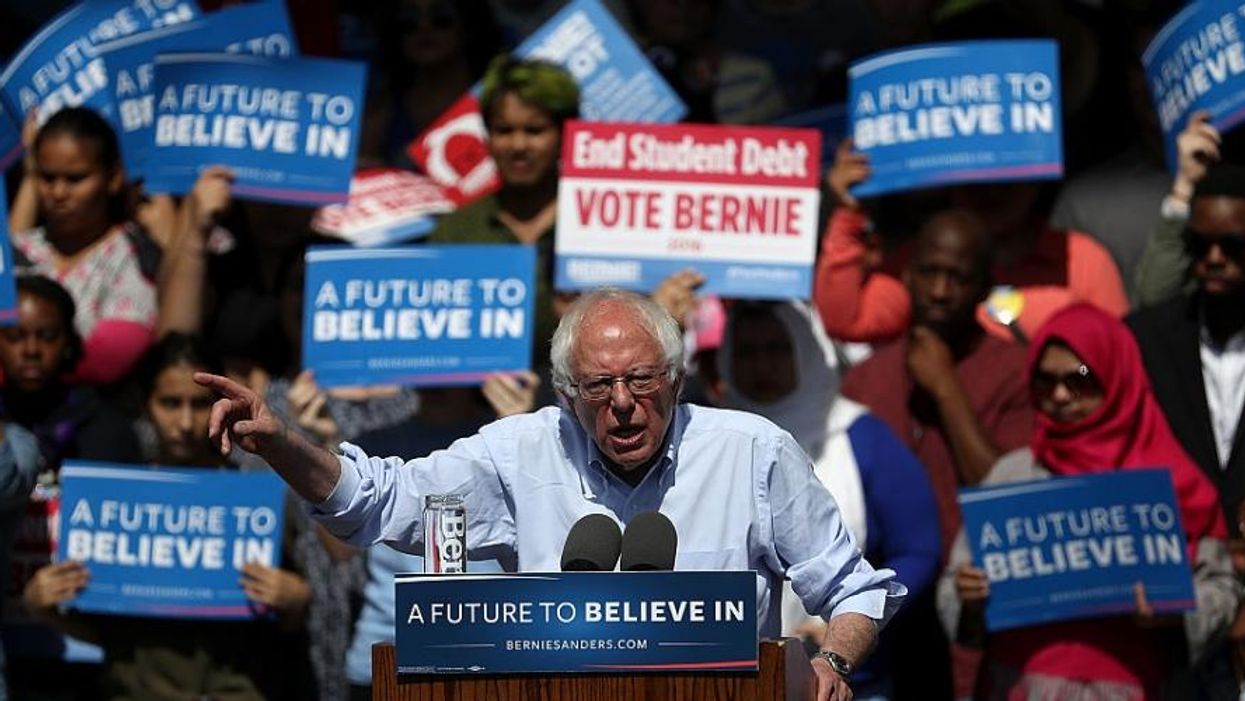
There are countless reasons why Bernie Sanders should run for president in the 2020 election.
But perhaps the threshold question is what if he does not run? What policy issues would be off the table? What demands for transformation would be watered down? The answer is that most progressive initiatives Sanders and his supporters have championed will never see the light of day.
Many of us have waited a lifetime for a leader with so deep a commitment to fundamental change to come along and galvanize our existing movements. While there will be a large and diverse field of candidates, the opportunity to elect someone who has dedicated his life to economic and social justice also gives us the chance to bring forth a more perfect union - one genuinely of the people, by the people, and for the people.
Without Bernie in 2020, what follows is just a partial catalog of what disappears or is seriously compromised.
1. An Improved Medicare for All
After decades of advocating for and working towards a single-payer system in the United States, the 2016 presidential campaign Sanders ran effectively and positively shifted the national discussion by making the moral argument that healthcare should not just be a privilege of the few, but a right enjoyed by every single person. The shift was so profound that many Democrats who once ran away from such a policy have now embraced the growing--and overwhelmingly popular--idea of "Medicare for All."
"Many of us have waited a lifetime for a leader to come along and galvanize a movement with so deep a commitment to fundamental change."
But while anyone can parrot the rational and emotional arguments for such a solution, there is nobody on the national stage at this point with the depth of understanding--a result of his years debating and educating on the issue--that Sanders possesses. With the moneyed health insurance industry ready to "buy off" any politician who threatens its for-profit model, or dilute any proposal considered by Congress, such a transformational policy stands almost no chance without a truly dedicated champion leading that bruising fight. Without someone committed to the very core, a genuinely improved and expanded Medicare For All will be displaced by inadequate reforms and the profiteering off of human suffering will continue unabated.
2. A Just Education System and Student Loan Forgiveness
When Sanders first injected the idea of tuition-free college into the 2016 campaign, the corporate media and most pundits dismissed the policy as unrealistic and laughable. But with student loan debt now at a record $1.5 trillion, the U.S. has created a system in which there is no right to higher education unless you are a) wealthy; or b) agree to saddle yourself with debt for years, decades, or the entirety of your life. But like with the healthcare system, there are powerful forces who will stop at nothing to keep this system going.
Without Sanders' continued fight for student loan forgiveness and equal access to education through tuition-free college, financial institutions and the student loan industry (of which the federal government is a key player) will continue to use their power and influence to relegate this issue to the back of the room, something not to be discussed and no bold solutions allowed.
3. More Peaceful Tomorrows and a Less Militaristic Foreign Policy
Sanders has highlighted the calamitous consequences of the right-wing both at home and abroad while at the same time striving to expand the political and moral consciousness of a nation that in recent decades has known too much war and not enough peace. With an understanding that the United States does not exist in a bubble, Sanders has made clear his belief that we must be an integral part of the international community in order to displace right-wing fanaticism with democracy and cooperation.
In addition to his wider call to bring to a close our endless wars abroad and rein in the "out-of-control" Pentagon budget, Sanders was the co-sponsor of Senate Joint Resolution 54 last year calling for an end of U.S. military support for the Saudi-led bombardment of Yemen. While more than 50,000 have been killed and 12 million pushed to within a knife's edge of starvation in Yemen, the historic resolution, with Bernie's leadership, was the first time the Senate invoked the 1973 War Powers Act.
While a tireless advocate of U.S. veterans, Sanders has long spoken out against the injustices suffered by those in foreign lands and has offered a clear-eyed and rational vision for global cooperation that rejects authoritarianism and tyranny while supporting the dignity and self-determination of all people. This cooperative approach, one which favors diplomacy over armed conflict, is in stark contrast to the routine use of military force. Sanders' presence in the 2020 campaign would greatly expand the foreign policy discourse and promote much-needed dialogue about needless and brutal wars while also providing a framework to rebuild tattered relations with allies around the world. Taken as a whole, these possibilities serve as a moral and political mandate for Sanders to enter the 2020 election.
4. Real Regulation of Wall Street and the Robin Hood Tax
The threshold question most pundits ask when confronted with social programs for the good of the overall population is "how can the country pay for them?" Sanders introduced a Financial Transaction Tax, the Robin Hood Tax, in the 2016 campaign and has continued to fight for its enactment. This would levy a fee on the accumulated windfalls of stock, bond, and securities trades of the 1% to be justly invested in programs for the 99% and the betterment of the country as a whole. Nobody else likely running in 2020 has centered taking on the corrupt influence of corporate power and Wall Street with the same consistency and moral vigor than Sanders. Nobody.
"Nobody else likely running in 2020 has centered taking on the corrupt influence of corporate power and Wall Street with the same consistency and moral vigor than Sanders. Nobody."
Without his voice in the 2020 presidential election this policy proposal, which is designed to limit the enormous political and economic power of the finance sector and mitigate gross economic inequality, will be largely jettisoned. While Democrats like to portray everyone in America as part of the "middle class," Sanders will continue to clarify the fiction of a classless society. He calls out the obscene hubris and greed of the wealthy at the expense of everyday people in our nation and has stood unabashedly with the poor and working people of this country against the extreme and exploitative excesses of the billionaire class. That legacy cannot be faked, and it must not be ignored.
5. A Progressive Populist Campaign
Sanders has done the difficult and courageous work of building a base of support around ideas - not party identity, rhetorical gimmicks, or time-worn cliches. His base is solid (and expanding) because it is grounded in action-oriented policy prescriptions aimed at solving real problems faced by tens of millions of real people each day. Even some of his more vitriolic critics have grudgingly acknowledged that Sanders fans are compelled by his authentic commitment to the issues he talks about. Imagine that?
"His supporters are dedicated to the ideals of democracy, which is why they are unwavering."
As simple as it sounds, Sanders supporters are not enamored by the person, but the ideas he has committed to putting forth. While he has shown great skill and leadership, any potential Sanders campaign is "owned" by the base inspired by the issues, not Bernie. His supporters are dedicated to the ideals of democracy, which is why they are unwavering. That is why I am unwavering in my support. Because you cannot fake authentic commitment. Ultimately, this is what falls to the wayside in the absence of Sanders.
6. The Promise of a Green New Deal That Centers Both the Planet and Workers
Sanders--an early proponent of the newly popularized Green New Deal--has been fighting to protect the natural world from polluters and damaging industries since his initial tenure as mayor of Burlington, Vermont decades ago, long before the true threat of the climate crisis was fully understood by most. Being a warrior for climate justice requires directly engaging the root problems of human-caused global warming, including the fossil fuel industry which has waged a war of misinformation and obstruction to protect their profits. Sanders has named names and gone after the perpetrators of climate destruction, because he understands that humanity is at a tipping point.
When asked during a 2016 debate what was the most serious national security issue facing our country, Sanders answered with two words: "climate change." During his first presidential campaign and since, Sanders has forced the topic into the national conversation, refused to entertain false solutions, and championed those clamoring for a far-reaching transformation of the nation's energy system while also lifting up workers and the economy. With the scientific community unified in its warnings that urgent action must be taken, the stakes are simply too high to put faith in a candidate who has not internalized the threat, embraced the challenge, and articulated a bold vision forward. With a message that argues we don't have to choose between saving the planet and working people, Bernie is that candidate.
7. A Candidate With a History of Defending Civil Rights
Senator Sanders was deeply engaged in the civil rights movement as a young man in the 1960s and has never ceased fighting alongside civil rights leaders throughout his career. He believes that civil rights are the rights of all persons in a civilized society irrespective of their national origins, heritage, religion, or immigration status. A committed advocate for racial justice, he does not pander at election time only to set aside the issue once elected and has long recognized the interplay between racial discrimination and an economy rigged against the poor and marginalized communities.
Absent Sanders' fight for a deep, genuine program to fundamentally address the obscene imbalance of wealth inequality, attain greater power for workers, and address the political economy of structural racism, there will be much discussion without a systemic solution.
8. A Feminist Candidate With a Deep Commitment to Gender Equality and Dignity for All
Senator Sanders has been a feminist in the best sense of the term for decades. In fact, I first noticed Sanders running for mayor of Burlington when I was in college in California and was taken by his embrace of women's equality and his demand for pay equity, choice, and opportunity. Most political candidates now will signal--at least rhetorical, if not substantive--support for women's issues, but Sanders has always gone further. Sanders battles for material real life changes for women by challenging at the basic structural level our politics of privilege and economic apartheid that demand the disenfranchisement of women and other vulnerable populations.
He does not posture about enhancing "equal access" or "fairness of access" to a deeply flawed and corrupt political and economic system. To do so confuses mere access or "fair access" to an unjust system with equality of access to a just political, economic and social order via a reinvigorated vision of democracy. For Sanders, democracy must be both fair and just. He fights for social justice for all women, including but not limited to the expansion of Social Security; a just wage system; better job opportunities with pay parity; improved protections against domestic violence at home and sexual harassment in the workplace; excellent and affordable healthcare; expanded protections for worker organizing; retirement security; paid time off for family leave; and other programs specifically directed to the wellbeing of women, such as: safe and affordable housing, reproductive care, early childhood education, and elder care.
9. A Warrior for Voting Rights and Democratic Reform
Senator Sanders stands solidly for voting rights and while this will be a grand talking point among all Democrats, Sanders seeks to eradicate the political, economic, and social factors that disenfranchise large segments of our population. Doing so will entail a direct challenge to the bad faith politics of gerrymandering electoral districts and voter suppression by the political class as well as ripping the mask off all structures that seek to make it harder, not easier, to cast a ballot and otherwise participate in open and transparent elections.
"If Sanders decides not to run it will be about our missed opportunity, not his."
As he works to build a mass movement to educate voters, Sanders will continue to put forth a pro-democracy platform by fighting aggressively to get big money out of politics by eschewing corporate money; promoting far-reaching campaign finance reform efforts; battling to reverse the Citizens United decision; and ending the malignant and racist voter suppression that remains pervasive across the country.
10. A Candidate Focused on Jobs as Well as the Workers and Unions That Will Build a Better Future
Bernie has always been the most pro-worker candidate in Congress. He understands the fundamental role that unions play in economic equality. Most recently, he propelled the Fight for 15 by forcing the giant Amazon to cede to raises for all workers. He was on the lines at Disney which resulted in winning raises. He understands the benefits of technology but also some of its dangers and is concerned that worker skill-enhancing technologies may be in danger of being displaced by skill-corrosive technologies in an ill-advised attempt to enhance corporate profits and assert greater control over the U.S. workforce.
Sanders stands with and for working people. He recognizes class differences and the need for the working class to organize and fight for themselves and the common good. Sanders seeks national policies and massive investments to rebuild our country's infrastructure such as roads, bridges, water systems, and railways as well as affordable housing--all built by America's workers.
And Lastly. A Chance to Reclaim Our National Dreams
Ultimately, and importantly, if Sanders decides not to run it will be about our missed opportunity, not his.
The chance to elect someone with such moral courage and clarity of vision is a chance for the people--and I mean all the people--to reclaim national dreams lost as well as hopes and promises betrayed.
In other words, because of his experience and commitment to the common good, he is the most qualified candidate. Just imagine what it looks like if Bernie wins. A warrior backing such fine and necessary policies would be a seismic shift for our lives, this nation, and the world.
As Sanders weighs what must certainly be the hardest decision of his life, those of us who believe in him know what we are asking.
We also know this: the stakes could not be higher.

Critics of the pharmaceutical industry have expressed outrage over a Wall Street Journal analysis that found the owner of a 40-year-old cancer drug used to treat brain tumors and Hodgkin's lymphoma has hiked the cost of the medication by 1,400 percent since acquiring it in 2013.
Lomustine, which was introduced in 1976, "has no generic competition, giving seller NextSource Biotechnology LLC significant pricing power," the Journal reports, noting that lomustine is just "one of at least 319 drugs for which U.S. patents have expired but which have no generic copies, according to a list the agency published earlier this month."
While the U.S. Food and Drug Administration is reportedly working to speed up the approval process for generic versions of these drugs, some critics say the report demonstrates a need for a broader overhaul of the nation's healthcare system, with the Robin Hood Tax campaign citing it as evidence for "why we need" Medicare For All, which has been promoted by Sen. Bernie Sanders (I-Vt.) and a growing number of Democrats in Congress.
Some critics compared the hikes to a similar move by Martin Shkreli, the founder of Turing Pharmaceuticals who provoked public condemnation after hiking the price of a life-saving AIDS drug called Daraprim by more than 5,000 percent. (He was later convicted of defrauding investors while he served as head of another drug company.)
NextSource, which rebranded lomustine as Gleostine, defended the hikes in a published statement, claiming that it based the decision to raise prices nine times over just four years "on a number of factors including product development costs, regulatory agency fees, class of product, benefit the treatment delivers to patients, and other determinants."
However, "the price hikes after the change in ownership are similar to what some other companies including Valeant Pharmaceuticals International Inc. and Turing Pharmaceuticals have done in recent years," the Journal notes, detailing how NextSource has repeatedly increased the price of 40-year-old drug:
For many years, lomustine was marketed under the brand name CeeNU by Bristol-Myers Squibb Co., which charged about $50 a capsule for the highest dose, before selling the product in 2013.
Now, the same capsule costs about $768, after nine price increases by a little-known Miami startup, NextSource, which supplies lomustine in a deal with the drug's new owner, manufacturer CordenPharma.
NextSource...most recently raised the price by 12 percent in November, on the heels of a 20 percent increase in August, according to analyses drug-price tracker Truven Health Analytics and Elsevier performed for the Wall Street Journal. Prices also have increased significantly for other doses of the drug.
"This is simply price gouging, period," concluded Henry Friedman, a neuro-oncologist at Duke University who wrote an editorial criticizing the lomustine price hikes earlier this year. "People are not going to be able to afford it, or they're going to pay a lot of money and have financial liability."

A financial transaction tax (FTT) -- a charge on the buying and selling of stocks, bonds and derivatives -- is an idea with widespread support amongst leading academics, many politicians and, most importantly, citizens. It was initially proposed by Maynard Keynes, the greatest economist of the twentieth century, and developed by Nobel Prize winner James Tobin.
A financial transaction tax (FTT) -- a charge on the buying and selling of stocks, bonds and derivatives -- is an idea with widespread support amongst leading academics, many politicians and, most importantly, citizens. It was initially proposed by Maynard Keynes, the greatest economist of the twentieth century, and developed by Nobel Prize winner James Tobin.
Numerous studies have shown a transaction tax helps diminish risks of costly financial crises by discouraging speculative behaviour and the short-term churning of assets. It is easy to implement, and can yield valuable tax revenue which can be used for financing investment. This in turn leads to inclusive and sustainable growth. Nicknamed the 'Robin Hood Tax', FTT is very progressive, as it is paid mainly by those with the deepest pockets. Indeed, a recent study by the US Tax Policy Center estimates that if an FTT were implemented in the US, the top one per cent of the population would pay 40 per cent of the total tax bill, and that the top 20 per cent would pay 75 per cent of the tax. This is because ownership of financial assets is concentrated among the richest people.
Numerous studies have shown a transaction tax helps diminish risks of costly financial crises by discouraging speculative behaviour and the short-term churning of assets.
It is encouraging that most recently the United Kingdom Labour Party, in its electoral manifesto, made a clear commitment to 'introduc[ing] a "Robin Hood Tax" on financial transactions'. Announcing the proposed tax, which would be an extension of the existing stamp duty, Shadow Chancellor John McDonnell said it would ensure the financial sector 'pay its fair share after it received huge public bailouts in the crash'.
Previously, there was important progress in the US, when language was approved at the 2016 Democratic Convention citing the FTT as part of the Democratic Party's platform for the first time:
'We support a financial transaction tax on Wall Street to curb excessive speculation and high-frequency trading, which has threatened financial markets. We acknowledge that there is room within our party for a diversity of views on a broader financial transaction tax.'
Bernie Sanders, the left-wing presidential candidate, had proposed a Wall Street Speculation Tax to pay the college fees of less well-off students. The policy received strong coverage in mainstream media, including an opinion piece in the New York Times. Sanders' democratic rival, Hillary Clinton, responded by proposing a narrower, but valuable use of FTT to help rein in the practice of high-frequency trading used to manipulate financial markets.
It is very encouraging that in both the US and the UK, with some of the largest financial markets in the world, progressives are now so strongly committed to implementing a financial transaction tax; hopefully once they come to power they will make it happen. Of course, as the International Monetary Fund wrote in a report to the G20, more than $30 billion worth of financial transaction taxes are already collected in the jurisdictions of 20 major countries. These countries, which include South Korea, Taiwan, and Switzerland, are amongst the most dynamic in the world. It just goes to show that financial transaction taxes do not have a negative impact on growth, as some claim, and may indeed contribute to it.
More than $30 billion worth of financial transactions taxes are already collected in the jurisdictions of 20... of the most dynamic countries in the world.
The UK Labour Party initiative proposes to expand and modernise the existing stamp duty, which applies only to shares. Currently, stamp duty - a tax that has existed for 300 years - raises PS3.3 billion (EUR3.6 billion) annually for the Exchequer. The Labour Party initiative would broaden this tax to cover transactions in corporate bonds and cash flows arising from equity and credit derivative transactions. It would also largely remove the market maker exemption.
The extensions to the UK stamp duty proposed by the Labour Party would raise an estimated PS4.7 billion (EUR5.1 billion) in additional tax a year, or PS23.5 billion (EUR25.4 billion) in a parliamentary term. This estimate comes from a rigorous study by Avinash Persaud, founder and Chairman of Intelligence Capital and a former financier.
Like taxes on carbon emissions, taxes on financial transactions such as the UK stamp duty aim to curb socially dangerous behaviour such as high-frequency trading, which is destabilising and has no positive social function. The proposed expanded UK stamp duty would probably discourage all such high-frequency trading. From an economic perspective, this is a tax on the build-up of systemic risks, and thus helps diminish the likelihood and scale of costly financial crises. The massive cost of such crises is not just fiscal (as taxpayers inevitably bail out the financial sector); it also results in lost output, investment, jobs and wages.
After the 2008/9 global financial crisis, there was strong support in Continental Europe for an EU-wide financial transaction tax. The European Commission actively supported the initiative and the European Parliament approved it. Not all countries wanted to join. The ten countries that did, representing over 80 per cent of Eurozone GDP, approved a European FTT in principle and have been hashing out the details for a couple of years, under the enhanced co-operation procedure. This grouping includes the EU's largest economies - Germany, France, Italy and Spain. Indeed, France and Italy have each unilaterally introduced limited versions of an FTT at home. However, progress on the joint European initiative has been painstakingly slow.
After the German elections in September, there will likely be a further push towards greater EU integration, spearheaded by France and Germany. An important part of this will be raising additional revenues, to be channelled into higher national and European public investment. This will be key to promoting more dynamic, sustainable and inclusive growth in the EU. The tax will raise resources mostly from the richer segments of society. Crucially, it will reduce the risk of future financial crises, which, as the US sub-prime crisis and the Eurozone debt crisis demonstrated, can be so destructive of people's livelihoods.
Civil society groups and progressive political parties were initially very successful in promoting financial transaction taxes in the EU after the 2008/9 financial crisis. When popular discontent with the financial sector was at its highest, with the public demanding the financial sector pay its fair share, even some centrist and centre-right parties in Europe seemed supportive.
Progressives now need to take hold of the baton and ensure the FTT not only stays on the EU policy agenda, but is implemented very soon. Equally, in the UK and the US progressive forces must continue to support the tax, so it can be implemented once Labour and the Democrats are elected.
Under a Europe-wide FTT, many more people would gain than lose. Adopting it soon would show that governments are able to design and adopt rational solutions that favour their citizens: a positive response to the right-wing populism that has swept much of Europe.
This article was written for International Politics and Society and is republished here with permission.
In a progressive push-back to the Trump administration's right-wing agenda--and amid rising inequality--Rep. Pramila Jayapal (D-Wash.) and Sen. Bernie Sanders (I-Vt.) on Monday unveiled their legislative plan for tuition-free public colleges to lift the burden of "crushing debt."
In a Facebook post, Jayapal said the College for All legislation was necessary "to give our young people a future, reduce wealth inequality, and grow our economy."
At an afternoon press conference introducing their proposal--which is also backed by Sen. Elizabeth Warren (D-Mass.), Rep. Keith Ellison (D-Minn.), Rep. Rick Nolan (D-Minn.)--Jayapal said, "This bill is not rocket science," and reiterated Warren's comment that "it's ridiculous that we're profiting off of student loans."
"I like to say that this bill creates a new normal. There's nothing normal about graduating with massive student debt," she added.
Funded by the so-called Robin Hood Tax, the legislation would make community college free for all students, and would make public colleges and universities free for students of families who make up to $125,000 a year. It is similar to legislation unveiled by Sanders and New York Gov. Andrew Cuomo in that state earlier this year.
Watch the press conference below:
In a series of tweets Jayapal, Sanders, and College for All supporters outlined how the legislation would work and why it's so necessary:
See these and more tweets from Twitter users using the hashtag #CollegeForAll: #CollegeForAll Tweets

The world's eight richest individuals possess the same amount of money as the world's poorest 3.6 billion.
According to Oxfam's annual assessment of wealth distribution, "collectively the poorest 50 percent of people have less than a quarter of 1 percent of global net wealth," based on data from Credit Suisse. Much of the vast wealth horded by the richest individuals and corporations is shielded from domestic taxes through offshore financial havens and other corporate loopholes.
"Trump's attempt to manage the budget like one of his businesses seems headed toward another one of his spectacular bankruptcies, and pushing a comprehensive alternative economic model might be the only counterweight to a deeply regressive budget."
But inequality takes different shapes in rich and poor nations. In the Global South, wealth maldistribution often takes the form of exploitation of local resources and deep social deprivation. But in the US, structural poverty is multifaceted and often oversimplified as a matter of personal success or failure. The US, despite having the world's most powerful economy, leads the "developed" world in the share of the workforce working low-wage jobs; nearly one third of workers earn less than $12 an hour, and are burdened by erratic schedules and poor working conditions. Moreover, these domestic trends disproportionately harm black, Latino and women workers.
Under Trump's "simplified" tax plan, millionaires would see taxes reduced by ten percent.
Now Trump, the great disruptor, threatens to further destabilize the most vulnerable workers, with a budget centered around tax cuts for the wealthiest. Though he has talked a big game about protectionist trade policies and closing unfair tax loopholes for exporters, his fiscal agenda is fundamentally about redistributing wealth upward.
Under Trump's "simplified" tax plan, millionaires would see taxes reduced by ten percent. Some families earning between $20,000 and $50,000 would pay more in taxes--for a shrinking social service infrastructure. The burden falls heaviest on lower-income workers, including the roughly 40 percent of the workforce earning less than $15 an hour. On the other side of the ledger, Trump seeks a $54 billion boost for military spending, to be offset by slashing social programs. Though these funds are technically considered "discretionary," they support essential social welfare programs and public services for struggling households, which have already suffered years of budget cuts.
Trump's vision to "strengthen" America would eviscerate the already disintegrating social-safety net. While he promised to rescue the dying middle class during his campaign, working-poor families will end up more vulnerable to global market volatility, with less job training, worse healthcare and weaker infrastructure. In turn, state budgets will be overwhelmed as pressure to maintain basic services falls on local agencies; as they pay higher taxes, poor households will see less public funding for their dilapidated school districts and community centers, as well as suffer more painful childcare costs. And while childcare subsidies for the poor might be axed, Trump has proposed a limited tax credit to finance childcare, through a capped sum that would largely target the middle and upper classes, not the neediest families.
But Trump still needs political support to pass his budget, particularly because fiscally conservative Republicans in Congress will likely oppose dramatic military spending increases, and prefer just slashing social welfare programs instead.
Perhaps Trump's popular base might become disillusioned as he shreds the healthcare system and slashes school budgets. And if he continues to suffer in the opinion polls, he might actually bend on some of his austerity drive. According to Oxfam America analyst Gawain Kripke, robust popular resistance could both stop the devastating cuts and push for new social investments in healthcare, education and the environment: "If the Trump administration goes off the rails... can we speak to the same audience and make a case for reform? There does seem to be a mobilizable base that can get angry."
But whether that anger can now be channeled productively depends on whether progressive populists have a coherent program for achieving real social equity.
As a corrective progressive alternative agenda, Oxfam points to forms of development that veer away from conventional neoliberal "free market" growth, and is instead based on "adequate--as opposed to maximum--profits." Alternatively structured industries would emphasize the development of worker-run cooperatives, rather than huge conglomerates, and democratically structured workplaces that prioritize "job security and egalitarian pay scales" over profits. Such companies, Oxfam suggests, "may also forego additional profits by paying workers and farmers fairer wages and prices, or incur greater costs in treating natural resources more sustainably."
"The big thing is to put a lasso on the superwealthy."
Rather than focus on GDP expansion (which Trump dramatically overestimates), Oxfam argues, public policy must focus on channeling wealth into equitable development that aims to correct social deficits, closing wealth divides, improving public health, addressing racial and gender segregation, and fostering democratic civic institutions.
In recent weeks, anti-Trump activists have protested the administration's brutal crackdowns on immigration and threatening protections for immigrants, people of color, poor women and other marginalized groups. Now as Trump rolls out the finances for his assault on civil rights and vulnerable communities, critics are tasked with advancing a counterproposal for an economic program that narrows the abysmal wealth gap and redistributes resources equitably.
"If you look at it decile by decile," Kripke says, "what's really happening is that the superwealthy is just taking off from the rest of the population. Yes we should be trying to raise the incomes...But the big thing is to put a lasso on the superwealthy... [to respond to the problem of] these fractions of the economy being captured by the superwealthy and have a sustainable economy. So taxing high incomes, taxing wealth, taxing inheritance, these are ideas and proposals that need to be taken seriously, if you're serious about reducing inequality."
European anti-austerity movements might provide models for a redistributative agenda. Populist uprisings in debt-plagued countries like Greece and Spain have rejected the neoliberal restructuring programs imposed by international finance institutions. Instead, progressive lawmakers have put forward plans for taxing excessive wealth. UK Labour Party leader Jeremy Corbyn has proposed executive pay caps to help narrow widening wealth gaps within firms and ensure fairer wage distribution. In the US, activists are pushing a "Robin Hood tax" on financial transactions, to curb Wall Street's runaway profits and redirect wealth toward social welfare.
Trump's attempt to manage the budget like one of his businesses seems headed toward another one of his spectacular bankruptcies, and pushing a comprehensive alternative economic model might be the only counterweight to a deeply regressive budget. Disillusionment with Trump's false "anti-establishment" politics could finally inspire a real populist uprising to rewrite the rules of the global economy from the bottom up.
As Trump vilifies the press, the courts, immigrants, Muslims, Democrats, protestors and anyone who disagrees with him, it isn't hard to imagine a modern day Mussolini... or worse. But, an even greater threat lies in the Republican's march towards full control of state government. If they get there, they will have the frightening power to amend the Constitution into their own authoritarian image... or Ayn Rand's.
As Trump vilifies the press, the courts, immigrants, Muslims, Democrats, protestors and anyone who disagrees with him, it isn't hard to imagine a modern day Mussolini... or worse. But, an even greater threat lies in the Republican's march towards full control of state government. If they get there, they will have the frightening power to amend the Constitution into their own authoritarian image... or Ayn Rand's.
Republicans now control 32 state legislatures and 33 governorships. They have majorities in both state legislative chambers as well as the governorships in 25 states. The Democrats have total control in only six states and legislative control in two more (see here).
If Republicans achieve veto-proof control in 38 states, they can do something that has never been done before -- hold a constitutional convention, and then ratify new amendments that are put forth. To date all amendments have been initiated from Congress where two-thirds of both houses are required. In either case 38 states would be needed to ratify the amendments. The Republicans are well on their way.
We know what they are likely to do: end collective bargaining, outlaw abortion, forbid progressive income, estate and Wall Street taxes; prohibit class action law suits, privatize social security, guarantee "free choice" in all school systems, and so on. They would do what they've always wanted to do -- outlaw the New Deal and its social democratic programs. And if they get crazy enough, they could end separation of church and state and undo other portions of the Bill of Rights.
A paranoid fantasy? Just say President Trump.
How did we get here?
Ask the corporate Democrats who have turned losing into an art form.
Since 2008, they have lost 917 state legislative seats. Explanations range from Koch brothers funding to gerrymandering, to voter suppression to the rise of the Tea Party. All partially true.
The Democrats also shoulder a good deal of the blame. Ever since Bill Clinton triangulated into NAFTA and away from working people, the Democratic party's embrace of financial and corporate elites have become the norm.
Hillary Clinton took $225,000 per speech from Goldman Sachs not because she was corrupt. Rather, this is simply the way the political game is played. You raise money from rich people, and then you back away from attacking their prerogatives while still trying to placate your liberal/worker base. Getting rich along the way is to be expected.
But as economist Jamie Galbraith put it, ultimately it is not possible for the Democrats to be both the party of the predators and the prey.
The failure and rebirth of progressivism?
The amazing acts of resistance popping up all over prove that the progressive spark is alive and well. Even seniors at the Progressive Forum in Deerfield Beach, Florida are planning to put their bodies on the line to stop ICE raids.
While raising hell all over the country, we also should re-examine how our strategies and structures may have contributed to the rise of the right. After all, this electoral coup happened on our watch.
Silo Organizing
Here's our working hypothesis for how progressives contributed to the rise of the right: We have failed to come out of our issue silos to build a national movement that directly confronts runaway inequality.
For more than a generation progressive organizations have shied away from big picture organizing around economic inequality. Instead we've constructed a dizzying array of issue silos -- environment, LBGQ, labor, immigration, women, people of color, criminal justice and so on. We are fractured into thousands of discreet issues, enabled by philanthropic foundations that are similarly siloed.
Few of our groups focused on the way Wall Street and corporate elites strip-mined the economy. Very few of us mobilized around the great crash. Few of us noticed as the CEO/worker income gap jumped from 45 to 1 in 1970 to an incredible 844 to 1 by 2015. We collectively missed how this growing economic inequality was causing and exacerbating nearly all of our silo issues.
We didn't connect the dots.
Most importantly, we failed to grasp how runaway inequality was alienating millions of working people who saw their incomes decline, their communities whither and their young unable to find decent jobs.
While the Tea Party and the right had a clear message -- big government is bad -- progressives had little to say collectively about runaway inequality.
Enter Occupy Wall Street
By the summer of 2010, the progressive failure was painfully obvious. After Wall Street had robbed us blind and crashed the economy, a Democratic president was about to enter a "grand bargain" with the Republicans to promote austerity. Think about this: While Wall Street got bailed out in full, Obama and the Democrats were about to cut Social Security. Amazing.
Then out of nowhere came Occupy Wall Street. (Out of nowhere is correct because the actions did not originate from any of our progressive silos.) In six months there were 900 encampments around the world. Thankfully, "We are the 99%." shifted the debate from austerity to inequality.
Unfortunately, Occupy believed in spontaneous political combustion and shunned any and all organizational structures and agendas. Social media, consensus decision making, horizontal anti-organizing, and anti-leadership were to carry the day. In six months they were gone.
Meanwhile the traditional progressive groups watched it rise and fall from the outside. We were spectators as we continued to press forward in our issue silos.
Enter Bernie Sanders
We got a second chance. Bernie Sanders, an independent socialist with a clear social democratic agenda, decided to challenge Hillary Clinton, the presumptive nominee. At first, few of us took him seriously. After all, he'd been around for 40 years, saying the same things but never gaining any traction outside of Vermont.
But like Occupy, he and his message hit a nerve, especially among the young and among disaffected working people who were entirely fed up with the corporate Democrats.
In a flash, Sanders did the impossible. He beat Hillary in several primaries. He drew much larger crowds. He even raised more money from small donors than the Clinton machine could raise from the rich. Progressive unions like the Communications Workers of America and National Nurses United went all in. For a few months the dream looked possible.
But too many other large unions and liberal issue groups committed early to Clinton, thinking she would win easily. That would allow them to gain more access for their issues and for themselves. Didn't happen.
Trump toppled the Clinton machine in the Rust Belt. Some say he did so with a toxic combination of racism, sexism and xenophobia and that certainly was the case for a good portion of his vote. Others are certain that Comey and Putin made the difference.
But in the Rust Belt Trump won because he picked up millions of those who previously had voted for Obama and Sanders. It is highly likely that runaway inequality, and the trade deals that exacerbated it, defeated Clinton in the Democratic strongholds of Wisconsin, Michigan, and Pennsylvania. In Michigan alone Hillary received 500,000 fewer votes than Obama. (see here)
What now?
We need to turn the marvelous anti-Trump resistance into a common national movement to that binds us together and that directly confronts runaway inequality. We need to come out of our silos because nearly every issue we work on is connected by growing inequality.
Such a movement requires the following:
1. A common analysis and agenda: As we've written elsewhere, resisting Trump is not enough. We need a proactive agenda about what we want that goes beyond halting the Trump lunacy.
The Sanders campaign offered a bold social democratic agenda to young people in particular. Progressive should be able to build broad support around a Robin Hood Tax on Wall Street, free higher education, criminal justice reform, humane immigration policies, Medicare for All, fair trade, real action on climate change, and a guaranteed job at a living wage for all those willing and able.
2. A common national organization: A big problem. We have no equivalent to the Tea Party. We have no grand alliance that links unions, community, groups, churches and our issue silos. There are excellent websites like Indivisible that are successfully encouraging widespread resistance on the congressional level. But they consider themselves to be purely defensive against Trump.
There are hundreds of demonstrations popping up all over but no organizational glue to hold them together. There's Our Revolution -- an outgrowth of the Sanders campaign -- that is still getting its sea legs. But to date we have no common center of gravity that is moving us forward organizationally.
Ideally we should all be able to become dues paying members of a national progressive alliance. We should be able to go from Paterson to Pensacola to Pomona and walk into similar meetings dedicated to fighting for our common agenda to reverse runaway inequality. Perhaps the hundreds of town hall meetings will head that way? It's too early to tell.
3. An education infrastructure: The Populist movement of the late 19th century waged a fierce battle against Wall Street. It wanted public ownership of banks and railroads. It wanted livestock and grain cooperatives. It wanted a progressive income tax on the rich and public banks. The organization grew by fielding 6,000 educators to explain to small farmers, black and white, how the system was rigged against them and what they could do about it.
We need about 30,000 educators to hold similar discussions with our neighbors about runaway inequality, how it binds us together and what we can do about. (If you're interested in getting involved see here.)
4. A new identity: Our toughest challenge. For 40 years we've been conditioned to the idea that runaway inequality is an immutable fact of life -- the inevitable result of automation, technology and competitive globalization. Along the way, neoliberal (free market) values shaped our awareness.
These mental constraints have got to go. We got here as the result of deliberative policy choices, not by acts of God. We need to reclaim a basic truth: the economy should work for its people and not the other way around.
Most importantly, we have to relearn the art of movement building which starts in our own minds--we have to believe that it is both necessary and possible, and that each and every one can contribute to it.
We desperately need a new identity--movement builder.
Is this so difficult to imagine?
Resistance is breaking out all over: the women's marches, the immigration airport protests and the defiant Sally Yates, the State Department mass dissents, the battle for the Supreme Court, with much more to come.
But where are we going? Are we simply calling for a return to the pre-Trump status quo of runaway inequality, the largest prison population in the world, inadequate and costly health care, unjust immigration policies and accelerating climate change? Or do we have a new vision for America? If so, what is it and how do we fight for it?
Resistance is breaking out all over: the women's marches, the immigration airport protests and the defiant Sally Yates, the State Department mass dissents, the battle for the Supreme Court, with much more to come.
But where are we going? Are we simply calling for a return to the pre-Trump status quo of runaway inequality, the largest prison population in the world, inadequate and costly health care, unjust immigration policies and accelerating climate change? Or do we have a new vision for America? If so, what is it and how do we fight for it?
Resisting Trump is protest by spontaneous combustion triggered by Tweets and Facebook posts. Too often, however, such uprisings lack staying power. Occupy Wall Street grew to 900 encampments around the world and changed the conversation in America from austerity to inequality. But it evaporated within six months. The spirited Arab Spring in Egypt took down the government, but paved the way for the highly organized Muslim Brotherhood and then a military dictatorship. We should know by now that without organizational infrastructure such wondrous uprisings are fragile at best. They require leadership, dues paying members, legislative agendas, and ways for participants to engage in decision making. Such constructions are very hard work that social media can assist but not replace.
Where's the glue?
Some hope that the Democratic Party will provide the infrastructure for an alternative vision and movement. Not likely. Too many party leaders are still deeply committed to Wall Street. Too many Democratic officials refuse to interfere with corporations that shift jobs abroad simply to secure lower paid labor and weaker environmental regulations. And, far too party leaders have an eye towards securing lucrative positions among America's financial elites.
"Sooner or later, we should go beyond resistance and advocate a vision for the future -- a common agenda that includes a Robin Hood Tax on Wall Street, free higher education, criminal justice reform, humane immigration policies, Medicare for All, an end to outsourcing, fair trade and a guaranteed job at a living wage for all those willing and able."
Could labor unions form the organizational core? In the 1930s the Congress of Industrial Organizations (CIO) played this role by organizing unskilled workers and pushing for an aggressive worker agenda that helped to secure Social Security, a minimum wage, the 40-hour work week, and much more. But today labor is torn. The Building Trades are applauding Trump for restarting the Keystone and Dakota Access pipelines. Manufacturing unions are taking a wait and see attitude given Trump's interventions to stop the off-shoring of jobs, his withdrawal from the anti-worker trade agreement (TPP), and his upcoming plans for massive infrastructure investments. Meanwhile, public and service sector unions, who after going all in for Hillary against Bernie, have yet to respond vociferously to Trump.
Can the remnants of the Sanders campaign fill this vacuum? The jury is out. Electoral campaigns tend to unravel unless the candidate decides to run again. Campaign operatives go back to their day jobs and young volunteers return to school. Our Revolution, the political extension of the Sanders campaign, has possibilities but so far it has not attracted a mass following. But all those young Bernie supporters are still interested in the broad social democratic agenda he so effectively popularized. How do they express their support?
A new formation?
There are many significant institutions with dues-paying members that could play a vital role. For starters there are the unions that supported Sanders, including the National Nurses United, the Communications Workers of America, the Amalgamated Transit Union and the American Postal Workers Unions. With a combined membership in the millions, they have enough funds and troops to launch a new national organization.
Ideally, they could be joined by the more progressive service sector unions like the Service Employees International Union as well as church, community and environmental organizations that represent millions of immigrants, lower income residents and environmentalists. Together they could form a new national political organization that we all could join.
The goal would be to popularize a Sanders-like agenda, organize protests to resist Trump while also building an alternative politics for the next round of elections.
Another key goal would be to bring back the working class Trump voters who previously voted for Obama and Sanders. There are millions of them. Unions that represent workers in manufacturing have found that up to 50 percent of their members (who voted) voted for Trump, largely because of Clinton's record on anti-worker trade deals like NAFTA and TPP. The goal of any new formation should be to win back those working class Sanders supporters.
Dream on?
Of course, it's a long shot. After all, the unions involved do not have a stellar history of working together. The community groups also have their own issue silos and funding imperatives that lead them to travel down separate paths. Environmentalists and manufacturing unions are likely to clash over jobs. Also, the questions of race, class and identity politics are certain to create tensions within any progressive formation.
But Trump could do wonders to help us overcome these difficulties. While we were in our silos, pushing our particular issues, the hard right took control of the country -- not just ideologically, but over the real levers of power. Since 2009, when Obama took office, the Democrats have lost 919 state legislative seats. The Republicans now control 68 percent of all state legislative chambers, and control both state chambers and the governorship in 24 states while the Democrats have such tri-partite control in only 6 states.
We can't blame this on Comey or Putin, or Stein or Bernie. No, we also have to look in the mirror and face up to the fact that as a progressive movement, we've been losing overall even as we've made some significant gains on human rights for the LBGT communities. The rise of the hard right to some degree is the result of our lackluster movement building efforts over the past three decades -- our failure to get out of our silos and link together. Current organization models and theories are failing against the challenges from the hard right.
The American Populist Movement
We could learn a great deal about organizing from the American Populist movement of the late 19th century. That movement, the first to challenge the power of Wall Street, called for the public ownership of railroads, public banks, a progressive income tax and grain/livestock cooperatives. The Populists put 6,000 educators into the field to spread the word and build local chapters mostly among black and white small farmers in the Midwest and South. Although they were eventually defeated, the Populists set the agenda for American progressivism, the New Deal and even the Sanders campaign. (For chapter and verse see The Populist Moment by Lawrence Goodwyn).
Before we can make sense of such organizational structures, we need an attitude adjustment. We need to broaden our identities to see ourselves as movement builders -- as activists who strive to put all the pieces together no matter which silo we inhabit. I may be a climate change activist but I also need to be a movement builder who is challenging the power of Wall Street. I may be fighting for criminal justice reform but I also need to be a movement builder uniting with others for Medicare for All and a $15 per hour minimum wage. It's all one fight. We are tied together by runaway inequality -- a system designed to enrich the few at the expense of the many.
Will resist turn into something more?
Due to Trump's divisive politics, the protests will continue. At some point, one would hope that those involved will begin building real structures to sustain these efforts and initiate more. Sooner or later, we should go beyond resistance and advocate a vision for the future -- a common agenda that includes a Robin Hood Tax on Wall Street, free higher education, criminal justice reform, humane immigration policies, Medicare for All, an end to outsourcing, fair trade and a guaranteed job at a living wage for all those willing and able.
Perhaps a little more time spent with the craziness of Trump will wake us up from our organizational stupor.
During the Sanders campaign I heard a high level official give a powerful speech blasting the Trans-Pacific Partnership Act (TPP) for the harm it would bring to workers, environmentalists and to all who cared about protecting democracy. Donald Trump now has signed an executive order pulling out of the TPP negotiations.
On the same day that Trump killed the TPP, he met with corporate executives saying he would cut taxes and regulations to spur business development. But he also warned that "... a company that wants to fire all of the people in the United States and build some factories someplace else and think the product is going to flow across the border, that is not going to happen." He said he would use "a substantial border tax" to stop those practices.
Breaking the Spell of Neoliberalism
Our answers may be clouded by four decades of the neoliberal catechism -- tax cuts on the wealthy, Wall Street deregulation, privatization of public services and "free" trade. Politicians, pundits and overpaid economists long ago concluded that such policies will encourage a "better business climate," which in turn will lead to all boats rising. Instead those very same policies led to a massive financial crash, runaway inequality, and a revolt against neoliberalism which fueled both the Sanders and Trump insurgencies. (See here for enough facts- not alternate facts -- to make you nauseous.)
"It's time for a broad-based common agenda that includes a Robin Hood Tax on Wall Street, free higher education, Medicare for All, an end to outsourcing, fair trade and a guaranteed job at a living wage for all those willing and able."
This ideology is so pervasive, that today no one is shocked or surprised to see Democratic governors on TV ads trying to lure business to their states by promising decades of tax holidays. No one gags when politicians lavish enormous tax gifts on corporations --even hedge funds-- in order to keep jobs from leaving their states. (See here.)
Similarly, we have grown accustomed to the neoliberal notion that we should go deeply into debt in order to gain access to higher education. Free higher education, which was the norm in New York and California until the 1970s, was "unrealistic" until Sanders rekindled the idea.
More troubling still, elites propagated the idea that public goods should not be free and available to all via progressive taxation. Rather public goods were denigrated and then offered up for privatization. Even civil rights icon Representative John Lewis used the neoliberal framework to attack Bernie Sanders' call for free higher education and universal health care:
"I think it's the wrong message to send to any group. There's not anything free in America. We all have to pay for something. Education is not free. Health care is not free. Food is not free. Water is not free. I think it's very misleading to say to the American people, we're going to give you something free."
Obama/Clinton didn't, Trump did
Ironically, while Lewis is defending neoliberalism, Trump actually is attacking two of its foundational elements -- "free" trade and unlimited capital mobility. Not only is Trump violating neoliberal theory but he also is clashing with the most basic way Wall Street cannibalizes us. Without the free movement of capital, assisted by trade deals, financial elites and their corporate partners would not be able to slash labor costs, destroy unions and siphon off wealth into their own pockets.
In particular, we should be extremely worried about how Trump is approaching the loss of manufacturing jobs. The neoliberal fog should not cause us to miss the obvious: Presidents Obama and Clinton did absolutely nothing to stop the hemorrhaging of middle class manufacturing jobs to low wage countries. (U.S. manufacturing fell from 20.1 percent of all jobs in 1980 to only 8.8 percent by 2013.) Not only did Obama and Clinton fail to stop even one factory from moving away, but they truly believed that capital mobility and free trade were good for America and the world. In other words they had sipped plenty of the neoliberal Kool-Aid.
Meanwhile, Trump is all in. He is saying that jobs in the U.S. are more important than the long run benefits of capital mobility and TPP/NAFTA agreements. If he keeps bashing corporations for moving jobs abroad and if he manages to ignite even a mini U.S. manufacturing jobs boom, Trump could be with us for eight long years.
But what about the poor in other countries?
To many progressives, saving American jobs sounds jingoistic and "protectionism" is a bad word. Isn't global trade helping the poor become less so around the world? Isn't it selfish only to protect American jobs? Isn't it more moral to share scarce manufacturing jobs with the poor in Mexico and Asia? After all, even if a plant closes in the Rust Belt, service sector jobs can be found at wages that still are far higher than what the poor can hope for in low wage countries.
You can be sure corporations will be playing this tune if Trump tightens the screws on capital mobility.
These arguments however have little to do with how the world actually functions:
No, it's not possible to make a credible progressive case for outsourcing your neighbor's job.
What do we do?
The progressive instinct, and rightfully so, is to trash Trump. If he's for it, we must be against it. When it comes to immigration, civil rights, abortion, freedom of the press and many, many other issues, that's a sound strategy. But trashing Trump for saving jobs in the U.S. is suicidal.
In opposing Trump, we must not slip into defending neoliberalism. It's not ok for corporations to pack up and leave. We should have some control over our economic lives and not leave all the crucial decisions to Wall Street and their corporate puppets. Trade deals are bad deals unless they enforce the highest health, safety, environmental and labor standards. And those measures must be enforceable by all the parties. The race to the bottom is real and must stop.
In the U.S. we should be mobilizing the following areas:
1. Organize the Outsourced: We should identify and organize all those at risk from off-shoring. We need to make sure Trump and Congress hear from these actual and potential victims. Trump needs to be reminded each and every day that there are millions of jobs that he must protect. At the same time we should be rounding up support for the Sanders bill to stop off-shoring.
2. Resist: Trump has made it clear to Corporate America that in exchange for job creation in the U.S. he will cut their taxes and regulations. We should demand that all tax "reforms" include a new financial speculation tax (Robin Hood Tax) on Wall Street to slow down their insatiable greed. Also, we need to fight tooth and nail against any weakening of workplace health, safety and environmental regulations. We have to destroy the Faustian bargain where jobs are protected but the workers and the communities are poisoned.
3. Connect: More than 3 million people protested against Trump. But it is doubtful that dislocated workers and those facing outsourcing were involved in these marches. That's because the progressive movement has gotten too comfortable with issue silos that often exclude these kinds of working class issues. That has to change in a hurry. We need to reach out to all workers in danger of off-shoring -- blue and white collar alike.
4. Expand: Many key issues -- from having the largest prison population in the world to having one the lowest life-spans -- are connected through runaway inequality. Outsourcing is deeply connected to the driving force behind runaway inequality -- a rapacious Wall Street and its constant pressure for higher returns. We need to broaden the outsourcing issue to include stock buybacks and the other techniques used by Wall Street to strip-mine our jobs and our communities. It's time for a broad-based common agenda that includes a Robin Hood Tax on Wall Street, free higher education, Medicare for All, an end to outsourcing, fair trade and a guaranteed job at a living wage for all those willing and able.
5. Educate: In order to build a sustained progressive movement we will need to develop a systematic educational campaign to counter neoliberal ideology. We need reading groups, study groups, formal classes, conferences, articles and more to undermine this pernicious ideology. Some of us are fortunate to be part of new train-the-trainer programs all over the country. We need to expand them so that we can field thousands of educators to carry this message.
Yes, all of this is very difficult, especially when it seems like a mad man is running the country. It is far easier to resist than to tear apart neoliberalism. But we have to try. We need to recapture the job outsourcing issue and rekindle the flames that ignited Occupy Wall Street and the Sanders campaign.
The rallies in Chicago and around the country evoke passion and sympathy from most of us, but just a shrug of the shoulders from those ultimately responsible for the carnage on our streets. These are the leaders of finance who use our infrastructure, technology, security, law, location, and especially our people to make billions in profits while paying almost nothing in return.
The rallies in Chicago and around the country evoke passion and sympathy from most of us, but just a shrug of the shoulders from those ultimately responsible for the carnage on our streets. These are the leaders of finance who use our infrastructure, technology, security, law, location, and especially our people to make billions in profits while paying almost nothing in return.
Especially the securities traders. An impoverished mother pays up to 10% in sales tax when she buys shoes for her kids, but the customers of companies with a quadrillion dollars in sales pay ZERO SALES TAX. Quadrillion sounds like gazillion, but it's a real number -- a thousand trillion, about four times the value of all the world's wealth.
The protesting mothers are angry at the people who are killing their children. Much of that anger should be directed at the financial districts of New York and Chicago.
The Shame of Chicago
With a quadrillion dollars in sales and the collection of transfer fees, contract fees, brokerage fees, Globex fees, clearing fees, and surcharges, the Chicago Mercantile Exchange achieved a profit margin (54%) higher than any of the top 100 companies in the nation from 2008 to 2010, and in recent years it's risen to nearly 60%.
Despite being the most profitable big firm, CME complained that its taxes were too high, and they demanded and received an $85 million tax break from the State of Illinois.
Meanwhile, Illinois Governor Bruce Rauner has cut funding for funerals, AIDS programs, "Meals on Wheels" for seniors, and programs for at-risk youth.
The Farce in New York
The good news is that New York has a financial transaction tax. The bad news is that as soon as the tax is paid, it's given back. That can only happen in the "strange world of taxes," according to the New York Times, which also admits that the financial transaction tax "is an idea whose time has finally come."
The absurdity of it all bears repeating. The state of New York is returning tax money to the industry with a corporate profit margin matched only by the price-gouging pharmaceutical industry. On top of all this, Wall Street traders gave themselves $25 billion in bonuses last year, while teachers at New York universities may have to go on strike to gain a fair contract.
Gibberish: Laughable Arguments Against a Financial Speculation Tax
Perhaps the Chicago Mercantile Exchange and the Chicago Sun-Times take their customers for fools. Both claim that a financial transaction tax would reduce tax revenues. CME said, "Transaction taxes on futures and options would be bad for business, resulting in....declines in state and local tax revenues." According to the Sun-Times, "A large financial transaction tax almost certainly would backfire....draining rather than growing Chicago's tax base."
In its usual unintelligible role is the Wall Street Journal, which claims that "A tax on securities trades would...create large economic and societal distortions." Perhaps the Journal has failed to notice the last 35 years of society-distorting inequality.
Solid Arguments FOR a Financial Speculation Tax
Reflecting on the Meaning of It All
For over 100 years the Chicago Mercantile Exchange has used the city's invaluable resources to make billions in profits. The company should be helping to rebuild Chicago's impoverished neighborhoods with job stipends for infrastructure repair. It should be providing small business grants to local entrepreneurs. It should assist in the establishment of affordable housing. It should be funding teacher education, to encourage college graduates in the inner city to remain as teachers in their communities. This isn't philanthropy. It's simply fair payment for an unparalleled wealth of subsidies from the American people.