

SUBSCRIBE TO OUR FREE NEWSLETTER
Daily news & progressive opinion—funded by the people, not the corporations—delivered straight to your inbox.
5
#000000
#FFFFFF
To donate by check, phone, or other method, see our More Ways to Give page.
Daily news & progressive opinion—funded by the people, not the corporations—delivered straight to your inbox.
In a move considered historic by supporters of medical marijuana, the American Medical Association's House of Delegates today adopted a new policy position calling for the review of marijuana's status as a Schedule I drug in the federal Controlled Substances Act. The old language in Policy H-95.952 had previously recommended that "marijuana be retained in Schedule I," which groups marijuana with drugs such as heroin, LSD and PCP that are deemed to have no accepted medical uses and to be unsafe for use even under medical supervision.
The revised policy, adopted today, states, "Our AMA urges that marijuana's status as a federal Schedule I controlled substance be reviewed with the goal of facilitating the conduct of clinical research and development of cannabinoid-based medicines, and alternate delivery methods." It goes on to explain that this position should not be construed as an endorsement of state medical marijuana programs.
"This shift, coming from what has historically been America's most cautious and conservative major medical organization, is historic," said Aaron Houston, director of government relations for the Marijuana Policy Project, who attended the AMA meeting. "Marijuana's Schedule I status is not just scientifically untenable, given the wealth of recent data showing it to be both safe and effective for chronic pain and other conditions, but it's been a major obstacle to needed research."
Drugs listed in Schedule II, for which medical use is permitted with strict controls, include cocaine, morphine and methamphetamine. A pill containing THC, the component responsible for marijuana's "high," is classed in Schedule III, whose looser requirements allow phoned-in prescriptions.
The Marijuana Policy Project (MPP) is the number one organization in the U.S. legalizing cannabis. We passed 13 medical cannabis laws in the past 15 years, and we ran winning campaigns in eight of the 11 legalization states. No organization in the movement has changed as many cannabis laws, impacted as many patients and consumers, created as many new markets, or done more to end cannabis prohibition in the U.S. than MPP.
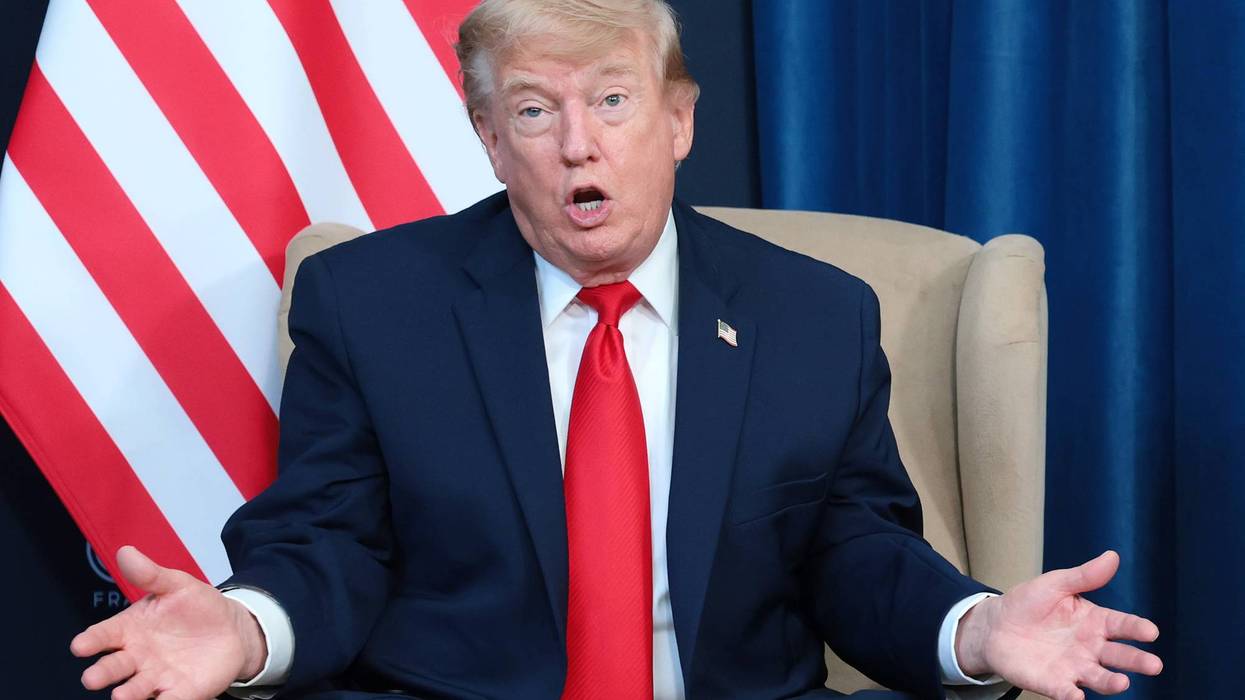
Despite the strait's closure, Trump insisted it was "open as far as we're concerned."
US President Donald Trump on Sunday twice told journalists to stop asking him about the status of the Strait of Hormuz, which Iran once again closed after the president declared an end to the ceasefire deal between the two countries.
The first instance came during an interview with NBC News' Kristen Welker, who pointed to conflicting statements from the Iranian government and US Central Command about the status of the strait, which is an essential shipping lane for global petroleum supplies.
Trump replied that "it's open, and I don't want to talk about it because I want to honor the life" of the late Sen. Lindsey Graham (R-SC), who died on Saturday from what his office described as "a brief and sudden illness."
"So I don't want to talk about it," Trump continued. "I told you that before the call."
WELKER: Iran says the Strait of Hormuz is closed. CENTCOM says it's open. Which is it?
TRUMP: It's open, and I don't want to talk about because I want to honor the life of Lindsey Graham, so I don't want to talk about it. I told you that before the call. pic.twitter.com/3ed7dN1bhK
— Aaron Rupar (@atrupar) July 12, 2026
Shortly after, during an interview with CNN's Jake Tapper, Trump was again asked whether the strait was still open.
"It's open as far as we're concerned," Trump told Tapper. "Don't talk about it. Talk about the reason you asked me to speak."
"Okay," Tapper replied. "We appreciate your time, sir."
TAPPER: Iran has declared the Strait of Hormuz closed. Is that true?
TRUMP: It's open as far as we're concerned. Don't talk about it. Talk about the reason you asked me to speak. pic.twitter.com/TwssTycQdF
— Aaron Rupar (@atrupar) July 12, 2026
Iran shut down shipping traffic in the strait after Trump launched an illegal war against the country in late February. The strait's closure resulted in spiking oil and gasoline prices, which coincided with further erosion in Trump's approval ratings.
Although traffic through the strait initially picked up in the wake of a June memorandum of understanding signed by the US and Iran, it has since slumped as the ceasefire between the two nations has fallen apart.
Ana Marie Cox, contributing editor at The New Republic, bashed both Welker and Tapper for heeding the president's requests and not pushing him to answer questions about the war he unlawfully started.
"Frankly astonished that supposed news sources agreed to terms to interview Trump and appeared to be deferential to them," Cox wrote in a social media post, "enough that they were apologetic in brining up other topics."
Cox's sentiment was echoed by Kai Ryssdal, host of NPR's Marketplace, who remarked that "the guy being interviewed doesn’t get to pick the questions."
Journalist Helen Kennedy challenged Trump's assertion that asking about the status of the Iran war was irrelevant when talking about Lindsey Graham.
"Making war with Iran was Lindsey Graham's favorite thing," Kennedy observed. "It's not like it's unrelated."

"Lindsey Graham will forever be remembered as an enabler of a regime that has murdered people, destroyed democratic norms, and caused irreparable harm to this county. What a horrific legacy," said one critic.
Sen. Lindsey Graham, one of the most relentless proponents for using US military force overseas, died on Saturday night at the age of 71.
In a statement posted on Graham's (R-SC) social media account, the senator's office said that he "passed away from a brief and sudden illness."
"Sen. Graham's family appreciates prayers at this time," the office added, "and asks for privacy during this incredibly difficult period."
During his life, Graham advocated either starting or getting involved in multiple wars across the world, and he was reportedly instrumental in convincing President Donald Trump to launch an illegal attack on Iran without any authorization from the US Congress.
Although Graham was once a Trump critic—he infamously declared in 2016 that the Republican Party would get "destroyed" if it made the former Celebrity Apprentice host its presidential nominee—the South Carolina Republican grew to become one of the president's staunchest allies.
Some critics of Graham reacted to his death by rehashing what they considered to be his least admirable traits.
David Dayen, executive editor of The American Prospect, remarked that Graham "never met a war he didn't want to send your kids to."
Alejandra Caraballo, clinical instructor at the Harvard Law School Cyberlaw Clinic, also reflected on Graham's lifetime of war mongering.
"You can say a lot about Lindsey Graham," Caraballo wrote, "but at least he got to see the thing he most wanted before he died, bombing school children in Iran."
Princeton historian Kevin Kruse predicted that Graham would leave behind a decidedly poor legacy.
"When Lindsey Graham appears in a history book," wrote Kruse, "it'll be his prediction in 2016 that the Republican Party would be destroyed for supporting Donald Trump and then a few lines about how he proved it by becoming Trump's toady. That's pretty much it. That's his legacy. Pathetic lickspittle."
Steve Schmidt, a former Republican strategist who left the party due to its embrace of Trump, wrote that Graham was "a simple, tragic man" who "lacked a moral core."
"The great empty spaces of his life were filled with an insatiable need for 'relevance,'" Schmidt observed. "He found it as a cast member in the most malignant reality show ever made."
Kenneth Roth, former executive director of Human Rights Watch, had a similar analysis of Graham's character.
"Lindsey Graham supported the International Criminal Court when it charged [Russian President Vladimir] Putin but turned on it when it charged [Israeli Prime Minister] Netanyahu," wrote Roth. "Principled, he wasn't."
Nicholas Grossman, professor of international relations at the University of Illinois, wrote that Graham "spent the last decade of his life in public service... trying hard to be remembered as an enemy of the Constitution who worked to destroy American democracy."
Grossman added that Graham "exhibited occasional signs that he knew why that was bad but kept doing it anyway."
Ruth Zakarin, CEO of the Massachusetts Coalition to Prevent Gun Violence, offered a grim assessment of the late senator.
"Lindsey Graham will forever be remembered as an enabler of a regime that has murdered people, destroyed democratic norms, and caused irreparable harm to this county," wrote Zakarin. "What a horrific legacy."

"Trump has turned Venezuela into an effective US colony," said one critic.
Some critics of the Trump administration are reacting with horror to revelations that US Secretary of State Marco Rubio has been serving as the de facto ruler of Venezuela.
According to a Saturday report in The New York Times, Rubio for the last several months has been acting informally as the "viceroy" of Venezuela ever since its recognized president, Nicolás Maduro, was abducted by the American military in January and brought to the US to face charges related to "narco-terrorism."
The Times' sources revealed that Rubio "effectively controls Venezuela’s finances, the distribution of its natural resources, and its government" and "is deeply involved in the country’s day-to-day operations," while maintaining regular contact with acting Venezuelan President Delcy Rodríguez.
Under current arrangements, the US Treasury Department takes in revenue from Venezuela's exports, including its petroleum, and then disperses the money back to the country through its private banks with strict conditions set by Rubio over what it can be spent on.
In explaining the system, the Times likened it to "parents handing out allowances to children," adding that it gives Rubio "immense leverage over... Rodríguez, who depends on the money to pay workers and prop up the national currency."
Elizabeth Saunders, professor of political science at Columbia University, described Rubio's power over Venezuela as "insane," as well as "derelict, unconscionable, and impeachable."
"The secretary of state's time is scarce, valuable, and not outsourcable," Saunders emphasized.
Orlando J. Pérez, professor of Political Science at the University of North Texas at Dallas, said the Times report made a mockery of Rubio's professed claims to want to bring democracy back to Venezuela.
"It appears Rubio has transformed from democracy promotion warrior," Pérez commented, "to transactional realpolitik operative!"
Kenneth Roth, former executive director at Human Rights Watch, wrote that US control over Venezuela appeared similar to the kind of imperial power wielded by European nations in the 19th Century.
"Trump has turned Venezuela into an effective US colony," said Roth, "with Marco Rubio as the viceroy and Washington controlling the country’s oil revenue and dictating major foreign and domestic policies. Democracy has been relegated to the distant future."
Bradley Simpson, historian at the University of Connecticut, also saw the current US arrangement with Venezuela as a return to overt imperialism.
"We are literally back in the Dollar Diplomacy days of the 1910s," Simpson wrote, "when the United States invaded countries and took over their financial systems and ran them as effective colonies. Flagrantly illegal, enormously corrupt. Where is the organization of American states or UN in denouncing this?"