SUBSCRIBE TO OUR FREE NEWSLETTER
Daily news & progressive opinion—funded by the people, not the corporations—delivered straight to your inbox.
5
#000000
#FFFFFF
To donate by check, phone, or other method, see our More Ways to Give page.
Daily news & progressive opinion—funded by the people, not the corporations—delivered straight to your inbox.
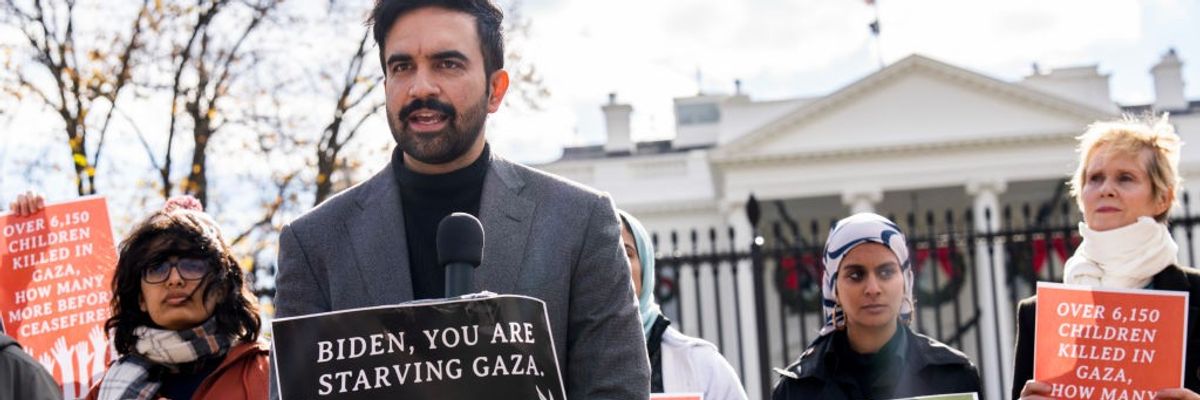
New York state Rep. Zohran Mamdani (D-36) speaks outside the White House to announce a hunger strike to demand that President Joe Biden "call for a permanent cease-fire and no military aid to Israel," on November 27, 2023.
Zohran Mamdani's opponents "made it a referendum on anti-Zionism being antisemitism," said journalist Spencer Ackerman. "They lost."
Following state Assemblymember Zohran Mamdani's upset victory in New York's Democratic mayoral primary on Tuesday, progressive writers and activists are making the case that strident support for Palestine was one of his key assets.
In the weeks leading up to Election Day, the 33-year-old democratic socialist was peppered with accusations of "antisemitism" from supporters of his centrist opponent, former New York Gov. Andrew Cuomo.
They singled out Mamdani's past calls to boycott Israel over human rights violations, his criticisms of Israel following the October 7, 2023 attacks, and his sponsorship of legislation to penalize nonprofits that fund illegal Israeli settlements in the West Bank.
But contrary to expectations that this would make his campaign a dead letter in the city with America's largest Jewish population, he not only defeated Cuomo by more than seven points on the first ballot, but did so with large amounts of Jewish support.
"Cuomo was counting on the idea that Zohran's support for Palestinian rights would be a liability for him, but what last night showed was that that's not true," said Beth Miller, the political director of Jewish Voice for Peace (JVP) Action in comments to Al Jazeera on Wednesday.
Mamdani's victory came at a historic nadir for pro-Israel sentiment among Democratic voters. In a Quinnipiac poll conducted from June 22 to 24, 63% of Democratic voters said they felt the U.S. was "too supportive of Israel," an all-time high.
That translated to how New Yorkers viewed the primary. In a May 28 poll from Emerson College, 46% of the Democrats surveyed said they did not think it was important for the city's next mayor to have pro-Israel views, compared to just 33% who said they believed it was.
Mamdani's view of Israel's actions in Gaza, which he has described as "genocide" and "war crimes," increasingly reflects that of Democratic voters. Cuomo, who previously served as part of the legal team defending Israeli Prime Minister Benjamin Netanyahu against war crimes charges, insisted that using such harsh language toward Israel's human rights abuses was fueling anti-Jewish hate crimes at home.
"They made it a referendum on anti-Zionism being antisemitism," journalist Spencer Ackerman, a supporter of Mamdani, told The Forward, a Jewish publication. "They lost."
Despite repeated questioning about his foreign policy stances on the campaign trail, Mamdani did not apologize or back off his stances. In comments to Al Jazeera, Heba Gowayed, a sociology professor at the City University of New York, said that his unwillingness to flip on his past stances only bolstered his sense of authenticity.
"The fact that he refused to back down from his position on Palestine is huge," Gowayed said. "In an atmosphere where we've been told that holding that position is politically disqualifying, it was a movement that not only insisted on this position but was, in a sense, predicated on it."
Mamdani's victory was not simply despite Jewish voters. He won in large part because of Jewish support. A poll from May showed him to be the second-most popular candidate among Jewish New Yorkers, behind only Cuomo.
He also forged a critical alliance with New York's highest-ranking Jewish elected official, Comptroller Brad Lander. Not only did Lander encourage his chunk of supporters to rank Mamdani, but he helped him fight back against the spurious accusations from the Cuomo camp, accusing the former governor, who has come under fire in the past for making negative remarks about Jews, of "trying to weaponize antisemitism for his own political gain."
Mamdani also received endorsements from influential progressive Jewish groups, including JVP Action and Jews for Racial and Economic Justice (JFREJ), who said the Democratic establishment took for granted that Jewish voters cared only about Israel.
Sophie Ellman-Golan, a spokesperson for JFREJ, a New York-based group with more than 6,000 members, said that Jewish New Yorkers were galvanized by Zohran's optimistic message about making the city affordable and prosperous for everyone.
"There's a fixation on, because we are Jews, we must be primarily focused on Israel," she told The Times of Israel Wednesday. "This is not to say these issues don't matter to Jews, of course they do, but we are also New Yorkers, and we are dealing with the same material conditions that other New Yorkers are."
Ellman-Golan elaborated in comments to the independent publication The Handbasket.
"Jewish New Yorkers are just like other New Yorkers. We also want affordable housing and childcare, and excellent public transit, and for this city to be a place where we can build a future," she said. "That's what Zohran ran on, and that's why New Yorkers—Jewish and non-Jewish alike—voted for him!"
Dear Common Dreams reader, It’s been nearly 30 years since I co-founded Common Dreams with my late wife, Lina Newhouser. We had the radical notion that journalism should serve the public good, not corporate profits. It was clear to us from the outset what it would take to build such a project. No paid advertisements. No corporate sponsors. No millionaire publisher telling us what to think or do. Many people said we wouldn't last a year, but we proved those doubters wrong. Together with a tremendous team of journalists and dedicated staff, we built an independent media outlet free from the constraints of profits and corporate control. Our mission has always been simple: To inform. To inspire. To ignite change for the common good. Building Common Dreams was not easy. Our survival was never guaranteed. When you take on the most powerful forces—Wall Street greed, fossil fuel industry destruction, Big Tech lobbyists, and uber-rich oligarchs who have spent billions upon billions rigging the economy and democracy in their favor—the only bulwark you have is supporters who believe in your work. But here’s the urgent message from me today. It's never been this bad out there. And it's never been this hard to keep us going. At the very moment Common Dreams is most needed, the threats we face are intensifying. We need your support now more than ever. We don't accept corporate advertising and never will. We don't have a paywall because we don't think people should be blocked from critical news based on their ability to pay. Everything we do is funded by the donations of readers like you. When everyone does the little they can afford, we are strong. But if that support retreats or dries up, so do we. Will you donate now to make sure Common Dreams not only survives but thrives? —Craig Brown, Co-founder |
Following state Assemblymember Zohran Mamdani's upset victory in New York's Democratic mayoral primary on Tuesday, progressive writers and activists are making the case that strident support for Palestine was one of his key assets.
In the weeks leading up to Election Day, the 33-year-old democratic socialist was peppered with accusations of "antisemitism" from supporters of his centrist opponent, former New York Gov. Andrew Cuomo.
They singled out Mamdani's past calls to boycott Israel over human rights violations, his criticisms of Israel following the October 7, 2023 attacks, and his sponsorship of legislation to penalize nonprofits that fund illegal Israeli settlements in the West Bank.
But contrary to expectations that this would make his campaign a dead letter in the city with America's largest Jewish population, he not only defeated Cuomo by more than seven points on the first ballot, but did so with large amounts of Jewish support.
"Cuomo was counting on the idea that Zohran's support for Palestinian rights would be a liability for him, but what last night showed was that that's not true," said Beth Miller, the political director of Jewish Voice for Peace (JVP) Action in comments to Al Jazeera on Wednesday.
Mamdani's victory came at a historic nadir for pro-Israel sentiment among Democratic voters. In a Quinnipiac poll conducted from June 22 to 24, 63% of Democratic voters said they felt the U.S. was "too supportive of Israel," an all-time high.
That translated to how New Yorkers viewed the primary. In a May 28 poll from Emerson College, 46% of the Democrats surveyed said they did not think it was important for the city's next mayor to have pro-Israel views, compared to just 33% who said they believed it was.
Mamdani's view of Israel's actions in Gaza, which he has described as "genocide" and "war crimes," increasingly reflects that of Democratic voters. Cuomo, who previously served as part of the legal team defending Israeli Prime Minister Benjamin Netanyahu against war crimes charges, insisted that using such harsh language toward Israel's human rights abuses was fueling anti-Jewish hate crimes at home.
"They made it a referendum on anti-Zionism being antisemitism," journalist Spencer Ackerman, a supporter of Mamdani, told The Forward, a Jewish publication. "They lost."
Despite repeated questioning about his foreign policy stances on the campaign trail, Mamdani did not apologize or back off his stances. In comments to Al Jazeera, Heba Gowayed, a sociology professor at the City University of New York, said that his unwillingness to flip on his past stances only bolstered his sense of authenticity.
"The fact that he refused to back down from his position on Palestine is huge," Gowayed said. "In an atmosphere where we've been told that holding that position is politically disqualifying, it was a movement that not only insisted on this position but was, in a sense, predicated on it."
Mamdani's victory was not simply despite Jewish voters. He won in large part because of Jewish support. A poll from May showed him to be the second-most popular candidate among Jewish New Yorkers, behind only Cuomo.
He also forged a critical alliance with New York's highest-ranking Jewish elected official, Comptroller Brad Lander. Not only did Lander encourage his chunk of supporters to rank Mamdani, but he helped him fight back against the spurious accusations from the Cuomo camp, accusing the former governor, who has come under fire in the past for making negative remarks about Jews, of "trying to weaponize antisemitism for his own political gain."
Mamdani also received endorsements from influential progressive Jewish groups, including JVP Action and Jews for Racial and Economic Justice (JFREJ), who said the Democratic establishment took for granted that Jewish voters cared only about Israel.
Sophie Ellman-Golan, a spokesperson for JFREJ, a New York-based group with more than 6,000 members, said that Jewish New Yorkers were galvanized by Zohran's optimistic message about making the city affordable and prosperous for everyone.
"There's a fixation on, because we are Jews, we must be primarily focused on Israel," she told The Times of Israel Wednesday. "This is not to say these issues don't matter to Jews, of course they do, but we are also New Yorkers, and we are dealing with the same material conditions that other New Yorkers are."
Ellman-Golan elaborated in comments to the independent publication The Handbasket.
"Jewish New Yorkers are just like other New Yorkers. We also want affordable housing and childcare, and excellent public transit, and for this city to be a place where we can build a future," she said. "That's what Zohran ran on, and that's why New Yorkers—Jewish and non-Jewish alike—voted for him!"
Following state Assemblymember Zohran Mamdani's upset victory in New York's Democratic mayoral primary on Tuesday, progressive writers and activists are making the case that strident support for Palestine was one of his key assets.
In the weeks leading up to Election Day, the 33-year-old democratic socialist was peppered with accusations of "antisemitism" from supporters of his centrist opponent, former New York Gov. Andrew Cuomo.
They singled out Mamdani's past calls to boycott Israel over human rights violations, his criticisms of Israel following the October 7, 2023 attacks, and his sponsorship of legislation to penalize nonprofits that fund illegal Israeli settlements in the West Bank.
But contrary to expectations that this would make his campaign a dead letter in the city with America's largest Jewish population, he not only defeated Cuomo by more than seven points on the first ballot, but did so with large amounts of Jewish support.
"Cuomo was counting on the idea that Zohran's support for Palestinian rights would be a liability for him, but what last night showed was that that's not true," said Beth Miller, the political director of Jewish Voice for Peace (JVP) Action in comments to Al Jazeera on Wednesday.
Mamdani's victory came at a historic nadir for pro-Israel sentiment among Democratic voters. In a Quinnipiac poll conducted from June 22 to 24, 63% of Democratic voters said they felt the U.S. was "too supportive of Israel," an all-time high.
That translated to how New Yorkers viewed the primary. In a May 28 poll from Emerson College, 46% of the Democrats surveyed said they did not think it was important for the city's next mayor to have pro-Israel views, compared to just 33% who said they believed it was.
Mamdani's view of Israel's actions in Gaza, which he has described as "genocide" and "war crimes," increasingly reflects that of Democratic voters. Cuomo, who previously served as part of the legal team defending Israeli Prime Minister Benjamin Netanyahu against war crimes charges, insisted that using such harsh language toward Israel's human rights abuses was fueling anti-Jewish hate crimes at home.
"They made it a referendum on anti-Zionism being antisemitism," journalist Spencer Ackerman, a supporter of Mamdani, told The Forward, a Jewish publication. "They lost."
Despite repeated questioning about his foreign policy stances on the campaign trail, Mamdani did not apologize or back off his stances. In comments to Al Jazeera, Heba Gowayed, a sociology professor at the City University of New York, said that his unwillingness to flip on his past stances only bolstered his sense of authenticity.
"The fact that he refused to back down from his position on Palestine is huge," Gowayed said. "In an atmosphere where we've been told that holding that position is politically disqualifying, it was a movement that not only insisted on this position but was, in a sense, predicated on it."
Mamdani's victory was not simply despite Jewish voters. He won in large part because of Jewish support. A poll from May showed him to be the second-most popular candidate among Jewish New Yorkers, behind only Cuomo.
He also forged a critical alliance with New York's highest-ranking Jewish elected official, Comptroller Brad Lander. Not only did Lander encourage his chunk of supporters to rank Mamdani, but he helped him fight back against the spurious accusations from the Cuomo camp, accusing the former governor, who has come under fire in the past for making negative remarks about Jews, of "trying to weaponize antisemitism for his own political gain."
Mamdani also received endorsements from influential progressive Jewish groups, including JVP Action and Jews for Racial and Economic Justice (JFREJ), who said the Democratic establishment took for granted that Jewish voters cared only about Israel.
Sophie Ellman-Golan, a spokesperson for JFREJ, a New York-based group with more than 6,000 members, said that Jewish New Yorkers were galvanized by Zohran's optimistic message about making the city affordable and prosperous for everyone.
"There's a fixation on, because we are Jews, we must be primarily focused on Israel," she told The Times of Israel Wednesday. "This is not to say these issues don't matter to Jews, of course they do, but we are also New Yorkers, and we are dealing with the same material conditions that other New Yorkers are."
Ellman-Golan elaborated in comments to the independent publication The Handbasket.
"Jewish New Yorkers are just like other New Yorkers. We also want affordable housing and childcare, and excellent public transit, and for this city to be a place where we can build a future," she said. "That's what Zohran ran on, and that's why New Yorkers—Jewish and non-Jewish alike—voted for him!"