SUBSCRIBE TO OUR FREE NEWSLETTER
Daily news & progressive opinion—funded by the people, not the corporations—delivered straight to your inbox.
5
#000000
#FFFFFF
To donate by check, phone, or other method, see our More Ways to Give page.
Key elements of the sprawling Republican budget package—including major components of its assault on Medicaid—are crumbling under scrutiny from Democratic staffers and the Senate parliamentarian, who has deemed dozens of provisions in violation of reconciliation rules.
On Thursday, Elizabeth MacDonough—who was appointed as parliamentarian in 2012 and has served under both Republican and Democratic leadership—advised against nine provisions of the GOP legislation that are under the Senate Finance Committee's jurisdiction.
One of the provisions seen as running afoul of the so-called Byrd Rule was the Senate GOP's proposal to sharply limit provider taxes that states use to fund their Medicaid programs—a change that experts said would result in catastrophic healthcare cuts.
Provisions targeted by the parliamentarian would be subject to a 60-vote threshold in the Senate if kept in the bill, meaning they would require Democratic support to pass. Republican leaders have indicated that they're rewriting some of the targeted provisions in an attempt to bring them into line with budget reconciliation rules, which bar provisions that don't have direct budgetary impacts.
"The parliamentarian has made clear that reconciliation can not be used to manipulate state provider tax policies, which would have resulted in massive Medicaid cuts that hurt kids, seniors, Americans with disabilities, and working families," Sen. Ron Wyden (D-Ore.), the top Democrat on the Senate Finance Committee, said in a statement Thursday following news of the parliamentarian's latest advisory rulings.
"With more decisions to come, this guidance results in more than $250 billion in healthcare cuts removed from the Republicans' big bad bill," said Wyden. "Democrats fought and won, striking healthcare cuts from this bill that would hurt Americans walking on an economic tightrope. This bill is rotten to its core, and I'll keep fighting the cuts in this morally bankrupt bill until the end."
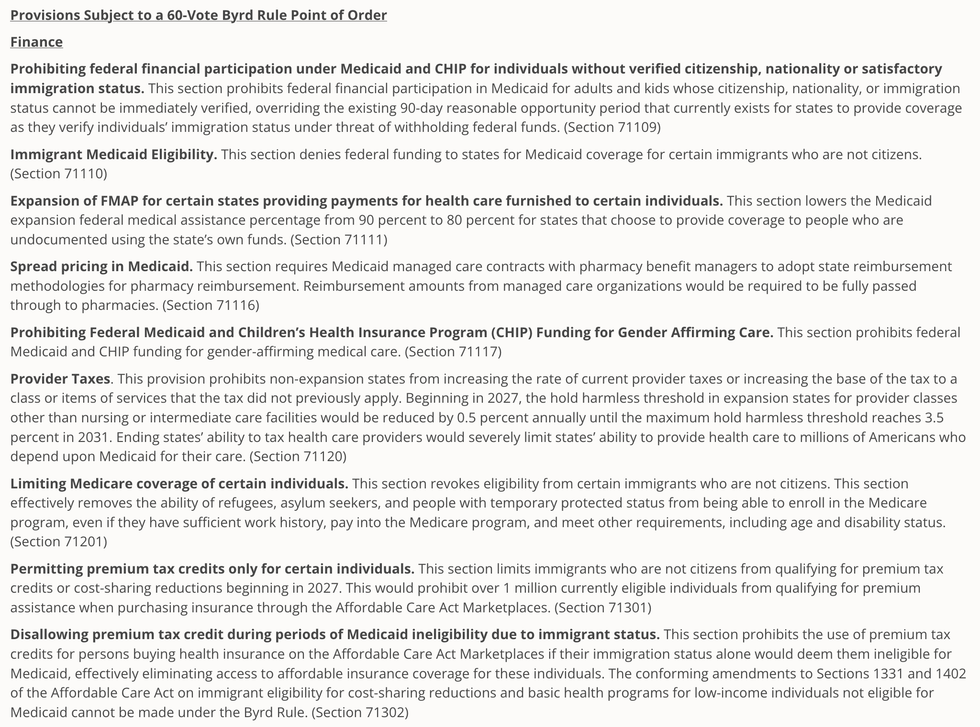
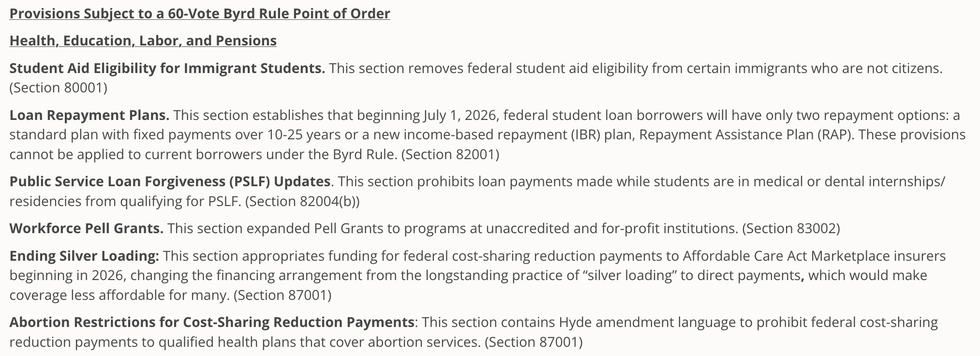
Senate Budget Committee Democrats, led by Sen. Jeff Merkley (D-Ore.), provided a summary of the latest provisions deemed in violation of reconciliation rules:
"Democrats are continuing to make the case against every provision in this Big, Beautiful Betrayal of a bill that violates Senate rules and hurts families and workers," Merkley said in a statement Thursday. "Democrats are fighting back against Republicans' plans to gut Medicaid, dismantle the Affordable Care Act, and kick kids, veterans, seniors, and folks with disabilities off of their health insurance—all to fund tax breaks for billionaires."
Under a behind-the-scenes process known as a "Byrd Bath," Senate committee staffers and the parliamentarian confer over whether a bill's provisions meet reconciliation guidelines.
In recent days, the parliamentarian has determined that dozens of provisions in the GOP legislation—including certain attacks on federal food aid, public lands, and the Consumer Financial Protection Bureau—don't comply with the Byrd rule and must either be removed or face a 60-vote threshold in the upper chamber.
Bobby Kogan, senior director of federal budget policy at the Center for American Progress, praised minority staffers on the Senate Budget and Health, Education, Labor, and Pensions Committees on Wednesday after the parliamentarian ruled against six separate provisions of the GOP bill.
"Republicans just lost 10% of the affirmative savings they wanted to get in reconciliation. Truly in awe of the Bernie Sanders HELP staff and the Jeff Merkley Budget staff," Kogan, a former Senate Budget Committee staffer, wrote on social media.
In a Thursday post responding to the parliamentarian's latest decisions, Kogan wrote, "We won on trans care in Medicaid, provider taxes, [Federal Medical Assistance Percentage], immigrants in Medicaid, and other issues."
"These victories are amazing for the people they help—and cost Rs more than $250 billion of their savings by rough calculations, largely not curable," Kogan added.
Democrats on the Senate Budget Committee indicated Thursday that the parliamentarian is still reviewing a number of provisions, including a section of the Republican bill that would prohibit Medicaid funding for Planned Parenthood.
"Republicans are scrambling to rewrite parts of this bill to continue advancing their families lose and billionaires win agenda, but Democrats stand ready to fully scrutinize any changes and ensure the Byrd Rule is enforced," Merkley said Thursday.
Key elements of the sprawling Republican budget package—including major components of its assault on Medicaid—are crumbling under scrutiny from Democratic staffers and the Senate parliamentarian, who has deemed dozens of provisions in violation of reconciliation rules.
On Thursday, Elizabeth MacDonough—who was appointed as parliamentarian in 2012 and has served under both Republican and Democratic leadership—advised against nine provisions of the GOP legislation that are under the Senate Finance Committee's jurisdiction.
One of the provisions seen as running afoul of the so-called Byrd Rule was the Senate GOP's proposal to sharply limit provider taxes that states use to fund their Medicaid programs—a change that experts said would result in catastrophic healthcare cuts.
Provisions targeted by the parliamentarian would be subject to a 60-vote threshold in the Senate if kept in the bill, meaning they would require Democratic support to pass. Republican leaders have indicated that they're rewriting some of the targeted provisions in an attempt to bring them into line with budget reconciliation rules, which bar provisions that don't have direct budgetary impacts.
"The parliamentarian has made clear that reconciliation can not be used to manipulate state provider tax policies, which would have resulted in massive Medicaid cuts that hurt kids, seniors, Americans with disabilities, and working families," Sen. Ron Wyden (D-Ore.), the top Democrat on the Senate Finance Committee, said in a statement Thursday following news of the parliamentarian's latest advisory rulings.
"With more decisions to come, this guidance results in more than $250 billion in healthcare cuts removed from the Republicans' big bad bill," said Wyden. "Democrats fought and won, striking healthcare cuts from this bill that would hurt Americans walking on an economic tightrope. This bill is rotten to its core, and I'll keep fighting the cuts in this morally bankrupt bill until the end."
Senate Budget Committee Democrats, led by Sen. Jeff Merkley (D-Ore.), provided a summary of the latest provisions deemed in violation of reconciliation rules:
"Democrats are continuing to make the case against every provision in this Big, Beautiful Betrayal of a bill that violates Senate rules and hurts families and workers," Merkley said in a statement Thursday. "Democrats are fighting back against Republicans' plans to gut Medicaid, dismantle the Affordable Care Act, and kick kids, veterans, seniors, and folks with disabilities off of their health insurance—all to fund tax breaks for billionaires."
Under a behind-the-scenes process known as a "Byrd Bath," Senate committee staffers and the parliamentarian confer over whether a bill's provisions meet reconciliation guidelines.
In recent days, the parliamentarian has determined that dozens of provisions in the GOP legislation—including certain attacks on federal food aid, public lands, and the Consumer Financial Protection Bureau—don't comply with the Byrd rule and must either be removed or face a 60-vote threshold in the upper chamber.
Bobby Kogan, senior director of federal budget policy at the Center for American Progress, praised minority staffers on the Senate Budget and Health, Education, Labor, and Pensions Committees on Wednesday after the parliamentarian ruled against six separate provisions of the GOP bill.
"Republicans just lost 10% of the affirmative savings they wanted to get in reconciliation. Truly in awe of the Bernie Sanders HELP staff and the Jeff Merkley Budget staff," Kogan, a former Senate Budget Committee staffer, wrote on social media.
In a Thursday post responding to the parliamentarian's latest decisions, Kogan wrote, "We won on trans care in Medicaid, provider taxes, [Federal Medical Assistance Percentage], immigrants in Medicaid, and other issues."
"These victories are amazing for the people they help—and cost Rs more than $250 billion of their savings by rough calculations, largely not curable," Kogan added.
Democrats on the Senate Budget Committee indicated Thursday that the parliamentarian is still reviewing a number of provisions, including a section of the Republican bill that would prohibit Medicaid funding for Planned Parenthood.
"Republicans are scrambling to rewrite parts of this bill to continue advancing their families lose and billionaires win agenda, but Democrats stand ready to fully scrutinize any changes and ensure the Byrd Rule is enforced," Merkley said Thursday.
Key elements of the sprawling Republican budget package—including major components of its assault on Medicaid—are crumbling under scrutiny from Democratic staffers and the Senate parliamentarian, who has deemed dozens of provisions in violation of reconciliation rules.
On Thursday, Elizabeth MacDonough—who was appointed as parliamentarian in 2012 and has served under both Republican and Democratic leadership—advised against nine provisions of the GOP legislation that are under the Senate Finance Committee's jurisdiction.
One of the provisions seen as running afoul of the so-called Byrd Rule was the Senate GOP's proposal to sharply limit provider taxes that states use to fund their Medicaid programs—a change that experts said would result in catastrophic healthcare cuts.
Provisions targeted by the parliamentarian would be subject to a 60-vote threshold in the Senate if kept in the bill, meaning they would require Democratic support to pass. Republican leaders have indicated that they're rewriting some of the targeted provisions in an attempt to bring them into line with budget reconciliation rules, which bar provisions that don't have direct budgetary impacts.
"The parliamentarian has made clear that reconciliation can not be used to manipulate state provider tax policies, which would have resulted in massive Medicaid cuts that hurt kids, seniors, Americans with disabilities, and working families," Sen. Ron Wyden (D-Ore.), the top Democrat on the Senate Finance Committee, said in a statement Thursday following news of the parliamentarian's latest advisory rulings.
"With more decisions to come, this guidance results in more than $250 billion in healthcare cuts removed from the Republicans' big bad bill," said Wyden. "Democrats fought and won, striking healthcare cuts from this bill that would hurt Americans walking on an economic tightrope. This bill is rotten to its core, and I'll keep fighting the cuts in this morally bankrupt bill until the end."
Senate Budget Committee Democrats, led by Sen. Jeff Merkley (D-Ore.), provided a summary of the latest provisions deemed in violation of reconciliation rules:
"Democrats are continuing to make the case against every provision in this Big, Beautiful Betrayal of a bill that violates Senate rules and hurts families and workers," Merkley said in a statement Thursday. "Democrats are fighting back against Republicans' plans to gut Medicaid, dismantle the Affordable Care Act, and kick kids, veterans, seniors, and folks with disabilities off of their health insurance—all to fund tax breaks for billionaires."
Under a behind-the-scenes process known as a "Byrd Bath," Senate committee staffers and the parliamentarian confer over whether a bill's provisions meet reconciliation guidelines.
In recent days, the parliamentarian has determined that dozens of provisions in the GOP legislation—including certain attacks on federal food aid, public lands, and the Consumer Financial Protection Bureau—don't comply with the Byrd rule and must either be removed or face a 60-vote threshold in the upper chamber.
Bobby Kogan, senior director of federal budget policy at the Center for American Progress, praised minority staffers on the Senate Budget and Health, Education, Labor, and Pensions Committees on Wednesday after the parliamentarian ruled against six separate provisions of the GOP bill.
"Republicans just lost 10% of the affirmative savings they wanted to get in reconciliation. Truly in awe of the Bernie Sanders HELP staff and the Jeff Merkley Budget staff," Kogan, a former Senate Budget Committee staffer, wrote on social media.
In a Thursday post responding to the parliamentarian's latest decisions, Kogan wrote, "We won on trans care in Medicaid, provider taxes, [Federal Medical Assistance Percentage], immigrants in Medicaid, and other issues."
"These victories are amazing for the people they help—and cost Rs more than $250 billion of their savings by rough calculations, largely not curable," Kogan added.
Democrats on the Senate Budget Committee indicated Thursday that the parliamentarian is still reviewing a number of provisions, including a section of the Republican bill that would prohibit Medicaid funding for Planned Parenthood.
"Republicans are scrambling to rewrite parts of this bill to continue advancing their families lose and billionaires win agenda, but Democrats stand ready to fully scrutinize any changes and ensure the Byrd Rule is enforced," Merkley said Thursday.