
Western nations--led by the United States--are selling large quantities of weapons to governments in the Middle East and North Africa, providing little oversight for how these arms are used and thereby fueling corruption and conflict in countries from Saudi Arabia to Egypt, a new report (pdf) from the watchdog organization Transparency International finds.
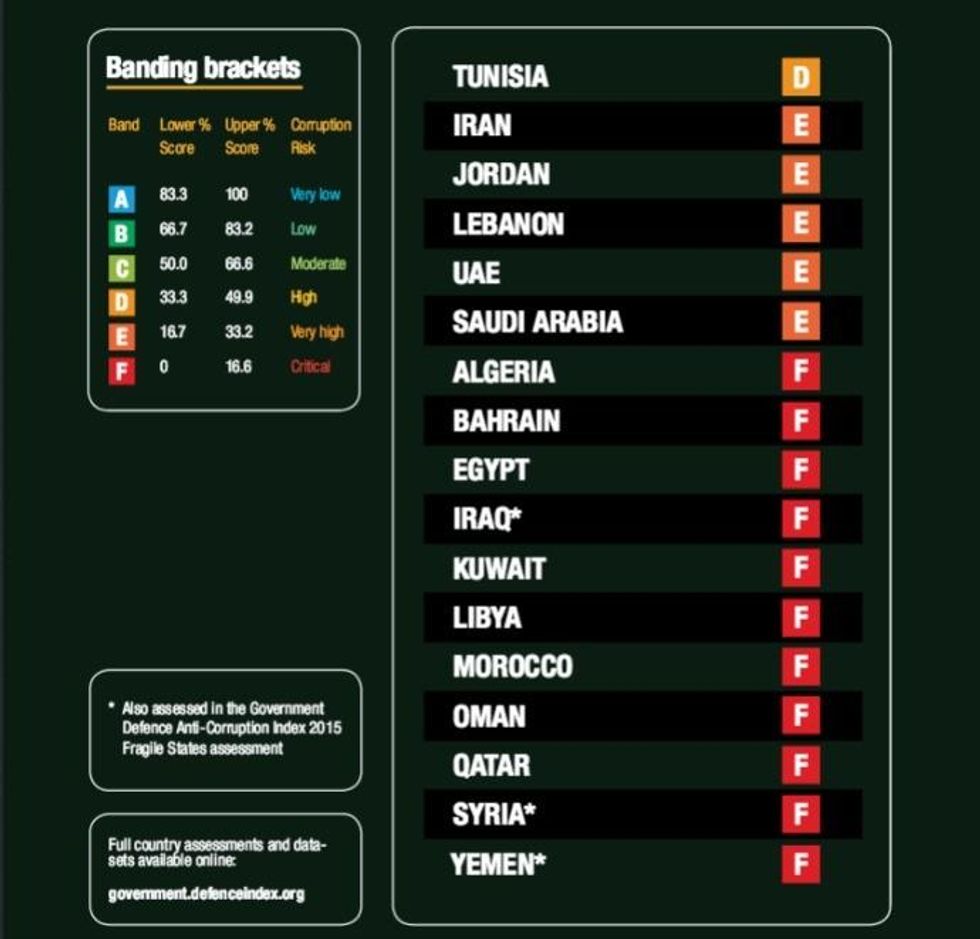
The investigation examines government defense corruption in Tunisia, Iran, Jordan, Lebanon, the UAE, Saudi Arabia, Algeria, Bahrain, Egypt, Iraq, Kuwait, Libya, Morocco, Oman, Qatar, Syria, and Yemen. Together, these countries spent $135 billion on military operations in 2014 alone, making their expenditures a percentage of GDP that is the "highest in the world," the report finds.
Researchers assigned all of these countries a "D," "E," or "F" grade for corruption, with the majority in the latter category denoting "critical" risk. The United States is the major supplier for most of these countries, with the United Kingdom, Germany, and Russia also significant exporters.
The report warns: "Corruption has fueled political unrest, extremism, and formed a narrative for violent extremist groups."
The role of the United States in driving this arms flow was well-established long before Transparency International's report. The Stockholm International Peace Research Institute found that between 2010 and 2014, the United States was the world's top arms supplier, accounting for 31 percent of global exports. This compared with 27 percent for Russia.
The IHS Jane's 360 report, released in March, found that Saudi Arabia was the "number one" military trading partner with the United States in 2014. Earlier this month, the U.S. Department of Defense announced its approval of an $11.25 billion deal to sell combat ships to Saudi Arabia, which has been waging a military assault against Yemen for more than six months.
The Transparency International report shows these sales fuel internal corruption and excessive militarization.
"In Saudi Arabia, the 'tactic of using defense purchases to solidify alliances' has resulted in significant misuse of the budget by purchasing different platforms that serve the same purpose," the report states. "The 2015 findings show that the state now holds large numbers of duplicative weapons systems, including the operationally similar Typhoon and F-15 fighter jets, and comparable armored personnel vehicles from Canada, Serbia, and Germany. This results in wasteful support structures and unnecessary compatibility problems."
"In Qatar," the investigation notes, "there is no evidence of meaningful oversight of, or accountability for, procurement. Our assessor indicated that purchase decisions are sometimes 'seemingly bizarre'--noting that it remains unclear why Qatar needs over 100 tanks given the state's small size, for example. The rationale underlying these purchases is not known or shared publicly. Evidence suggests that Qatar's key purchases have been politically strategic rather than being best suited for their military needs."
"Over a quarter of the world's most secretive defense spending is in the Middle East," Katherine Dixon, head of Transparency International's Defense and Security Program, told The Intercept. "Corruption puts international security at risk, as money and weapons can be diverted to fuel conflict."
Western nations--led by the United States--are selling large quantities of weapons to governments in the Middle East and North Africa, providing little oversight for how these arms are used and thereby fueling corruption and conflict in countries from Saudi Arabia to Egypt, a new report (pdf) from the watchdog organization Transparency International finds.
The investigation examines government defense corruption in Tunisia, Iran, Jordan, Lebanon, the UAE, Saudi Arabia, Algeria, Bahrain, Egypt, Iraq, Kuwait, Libya, Morocco, Oman, Qatar, Syria, and Yemen. Together, these countries spent $135 billion on military operations in 2014 alone, making their expenditures a percentage of GDP that is the "highest in the world," the report finds.
Researchers assigned all of these countries a "D," "E," or "F" grade for corruption, with the majority in the latter category denoting "critical" risk. The United States is the major supplier for most of these countries, with the United Kingdom, Germany, and Russia also significant exporters.
The report warns: "Corruption has fueled political unrest, extremism, and formed a narrative for violent extremist groups."
The role of the United States in driving this arms flow was well-established long before Transparency International's report. The Stockholm International Peace Research Institute found that between 2010 and 2014, the United States was the world's top arms supplier, accounting for 31 percent of global exports. This compared with 27 percent for Russia.
The IHS Jane's 360 report, released in March, found that Saudi Arabia was the "number one" military trading partner with the United States in 2014. Earlier this month, the U.S. Department of Defense announced its approval of an $11.25 billion deal to sell combat ships to Saudi Arabia, which has been waging a military assault against Yemen for more than six months.
The Transparency International report shows these sales fuel internal corruption and excessive militarization.
"In Saudi Arabia, the 'tactic of using defense purchases to solidify alliances' has resulted in significant misuse of the budget by purchasing different platforms that serve the same purpose," the report states. "The 2015 findings show that the state now holds large numbers of duplicative weapons systems, including the operationally similar Typhoon and F-15 fighter jets, and comparable armored personnel vehicles from Canada, Serbia, and Germany. This results in wasteful support structures and unnecessary compatibility problems."
"In Qatar," the investigation notes, "there is no evidence of meaningful oversight of, or accountability for, procurement. Our assessor indicated that purchase decisions are sometimes 'seemingly bizarre'--noting that it remains unclear why Qatar needs over 100 tanks given the state's small size, for example. The rationale underlying these purchases is not known or shared publicly. Evidence suggests that Qatar's key purchases have been politically strategic rather than being best suited for their military needs."
"Over a quarter of the world's most secretive defense spending is in the Middle East," Katherine Dixon, head of Transparency International's Defense and Security Program, told The Intercept. "Corruption puts international security at risk, as money and weapons can be diverted to fuel conflict."
Western nations--led by the United States--are selling large quantities of weapons to governments in the Middle East and North Africa, providing little oversight for how these arms are used and thereby fueling corruption and conflict in countries from Saudi Arabia to Egypt, a new report (pdf) from the watchdog organization Transparency International finds.
The investigation examines government defense corruption in Tunisia, Iran, Jordan, Lebanon, the UAE, Saudi Arabia, Algeria, Bahrain, Egypt, Iraq, Kuwait, Libya, Morocco, Oman, Qatar, Syria, and Yemen. Together, these countries spent $135 billion on military operations in 2014 alone, making their expenditures a percentage of GDP that is the "highest in the world," the report finds.
Researchers assigned all of these countries a "D," "E," or "F" grade for corruption, with the majority in the latter category denoting "critical" risk. The United States is the major supplier for most of these countries, with the United Kingdom, Germany, and Russia also significant exporters.
The report warns: "Corruption has fueled political unrest, extremism, and formed a narrative for violent extremist groups."
The role of the United States in driving this arms flow was well-established long before Transparency International's report. The Stockholm International Peace Research Institute found that between 2010 and 2014, the United States was the world's top arms supplier, accounting for 31 percent of global exports. This compared with 27 percent for Russia.
The IHS Jane's 360 report, released in March, found that Saudi Arabia was the "number one" military trading partner with the United States in 2014. Earlier this month, the U.S. Department of Defense announced its approval of an $11.25 billion deal to sell combat ships to Saudi Arabia, which has been waging a military assault against Yemen for more than six months.
The Transparency International report shows these sales fuel internal corruption and excessive militarization.
"In Saudi Arabia, the 'tactic of using defense purchases to solidify alliances' has resulted in significant misuse of the budget by purchasing different platforms that serve the same purpose," the report states. "The 2015 findings show that the state now holds large numbers of duplicative weapons systems, including the operationally similar Typhoon and F-15 fighter jets, and comparable armored personnel vehicles from Canada, Serbia, and Germany. This results in wasteful support structures and unnecessary compatibility problems."
"In Qatar," the investigation notes, "there is no evidence of meaningful oversight of, or accountability for, procurement. Our assessor indicated that purchase decisions are sometimes 'seemingly bizarre'--noting that it remains unclear why Qatar needs over 100 tanks given the state's small size, for example. The rationale underlying these purchases is not known or shared publicly. Evidence suggests that Qatar's key purchases have been politically strategic rather than being best suited for their military needs."
"Over a quarter of the world's most secretive defense spending is in the Middle East," Katherine Dixon, head of Transparency International's Defense and Security Program, told The Intercept. "Corruption puts international security at risk, as money and weapons can be diverted to fuel conflict."