SUBSCRIBE TO OUR FREE NEWSLETTER
Daily news & progressive opinion—funded by the people, not the corporations—delivered straight to your inbox.
5
#000000
#FFFFFF
To donate by check, phone, or other method, see our More Ways to Give page.
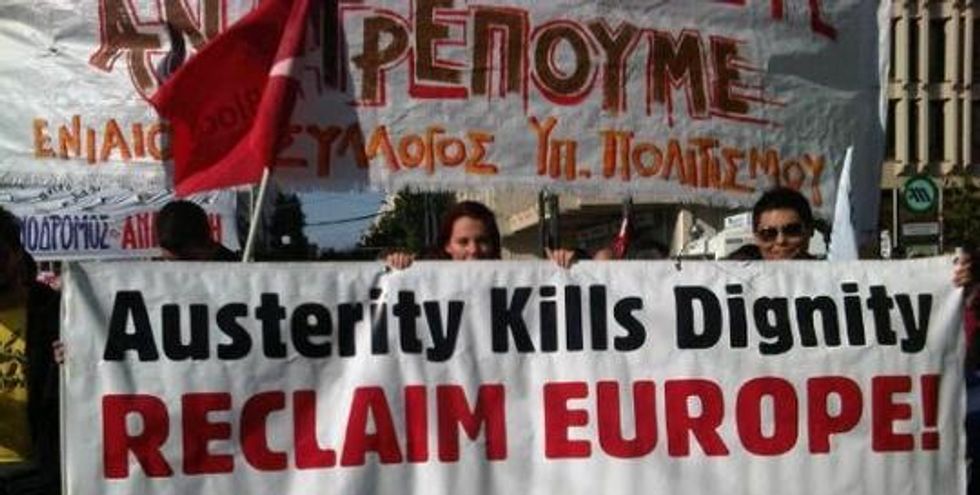
Various media outlets report transportation hubs at a standstill across southern Europe--where the pain of austerity has been most acutely felt--but also report actions of solidarity in northern, less-affected cities like Brussels and Paris. Clashes between protesters and police were reported in Spain and Italy but demonstrations remained largely peaceful in most places.
Reuters reports "millions of workers" joined the strike and called it "organized labor's biggest Europe-wide challenge to austerity" since the financial crisis took hold in 2009. "Hundreds of flights were cancelled, schools were shut, factories were at a standstill and trains barely ran in Spain and Portugal."
_____________________________________
_____________________________________
Approximately 40 trade union organizations from 23 countries are involved in the European day of action, with the strikers calling on government leaders to ignore or fight back against the demands of the European "troika"--which includes the EU, the European Central Bank (ECB), and the IMF--and to abandon austerity policies which they say are a proven "dead end."
Ongoing live coverage from The Guardian is reporting updates from cities across Europe, including: Athens, Rome, Brussels, Barcelona, Madrid, LIsbon, Paris, Milan, and others. The UK-based newspaper is also hosting a 'Readers' Gallery,' where protest participants are sending in their own photos of the day's events.
"By sowing austerity, we are reaping recession, rising poverty and social anxiety," said Bernadette Segol, General Secretary of the European Trade Union Confederation (ETUC), which first called for and helped organize the international day of action. "In some countries, people's exasperation is reaching a peak. We need urgent solutions to get the economy back on track, not stifle it with austerity."
"Europe's leaders are wrong not to listen to the anger of the people who are taking to the streets," she continued. "The Troika can no longer behave so arrogantly and brutally towards the countries which are in difficulty. They must urgently address the issues of jobs and social fiscal justice and they must stop their attacks on wages, social protection and public services."
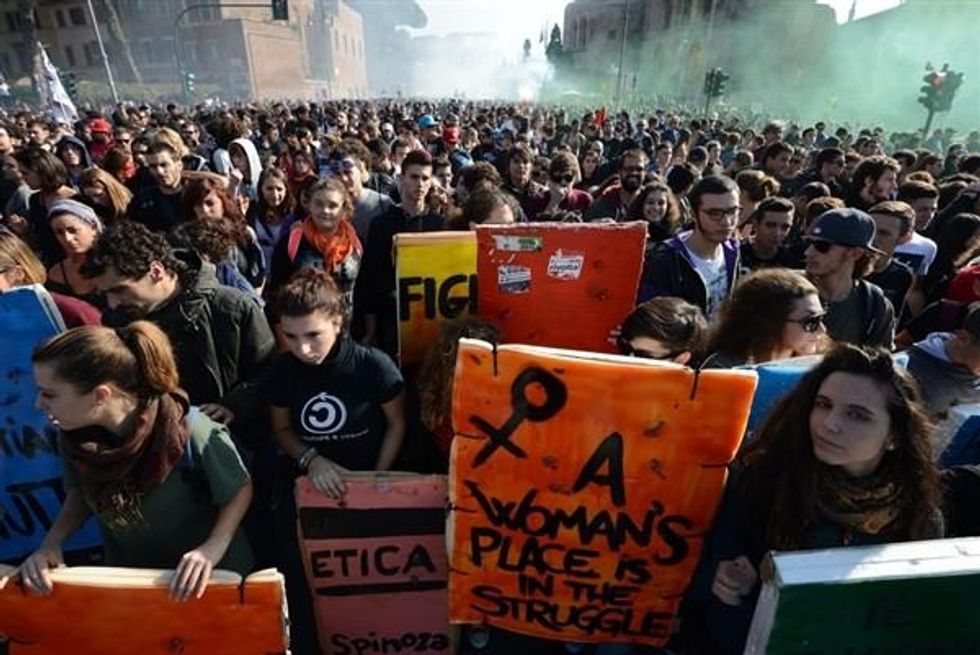
"Austerity means cuts in the public services and public companies and also cuts in the buying power for the working class," Belgian socialist union leader Filip Peers, told The Independent from Brussels. "Austerity means recession and it deepens the crisis."
The ETUC and its affiliates call for a new social compact for Europe, one that more properly places social dialogue, democracy, and economic justice above the demands of central bankers and unelected officials from the IMF.
The Associated Press reports:
The Spanish strike shut down most schools and while hospitals operated with a skeleton staff. Health and education have both suffered serious spending cutbacks and increased moves toward privatization.
In neighboring, bailed-out Portugal, where the government intends to intensify austerity measures next year, the second general strike in eight months left commuters stranded as trains ground to a virtual halt and the Lisbon subway shut down. Some 200 flights to and from Portugal -- about half the daily average -- were canceled.
Hospitals provided only minimum services in Portugal, and municipal trash was left uncollected overnight.
Airports across Europe suffered from the strikes, forced to cancel flights to and from striking nations.
In Belgium, a 24-hour rail stoppage and scattered strikes through the south of the nation disrupted daily life. Both the Thalys and Eurostar high-speed rail services that connect Brussels with London and Paris were severely disrupted.
###
Various media outlets report transportation hubs at a standstill across southern Europe--where the pain of austerity has been most acutely felt--but also report actions of solidarity in northern, less-affected cities like Brussels and Paris. Clashes between protesters and police were reported in Spain and Italy but demonstrations remained largely peaceful in most places.
Reuters reports "millions of workers" joined the strike and called it "organized labor's biggest Europe-wide challenge to austerity" since the financial crisis took hold in 2009. "Hundreds of flights were cancelled, schools were shut, factories were at a standstill and trains barely ran in Spain and Portugal."
_____________________________________
_____________________________________
Approximately 40 trade union organizations from 23 countries are involved in the European day of action, with the strikers calling on government leaders to ignore or fight back against the demands of the European "troika"--which includes the EU, the European Central Bank (ECB), and the IMF--and to abandon austerity policies which they say are a proven "dead end."
Ongoing live coverage from The Guardian is reporting updates from cities across Europe, including: Athens, Rome, Brussels, Barcelona, Madrid, LIsbon, Paris, Milan, and others. The UK-based newspaper is also hosting a 'Readers' Gallery,' where protest participants are sending in their own photos of the day's events.
"By sowing austerity, we are reaping recession, rising poverty and social anxiety," said Bernadette Segol, General Secretary of the European Trade Union Confederation (ETUC), which first called for and helped organize the international day of action. "In some countries, people's exasperation is reaching a peak. We need urgent solutions to get the economy back on track, not stifle it with austerity."
"Europe's leaders are wrong not to listen to the anger of the people who are taking to the streets," she continued. "The Troika can no longer behave so arrogantly and brutally towards the countries which are in difficulty. They must urgently address the issues of jobs and social fiscal justice and they must stop their attacks on wages, social protection and public services."
"Austerity means cuts in the public services and public companies and also cuts in the buying power for the working class," Belgian socialist union leader Filip Peers, told The Independent from Brussels. "Austerity means recession and it deepens the crisis."
The ETUC and its affiliates call for a new social compact for Europe, one that more properly places social dialogue, democracy, and economic justice above the demands of central bankers and unelected officials from the IMF.
The Associated Press reports:
The Spanish strike shut down most schools and while hospitals operated with a skeleton staff. Health and education have both suffered serious spending cutbacks and increased moves toward privatization.
In neighboring, bailed-out Portugal, where the government intends to intensify austerity measures next year, the second general strike in eight months left commuters stranded as trains ground to a virtual halt and the Lisbon subway shut down. Some 200 flights to and from Portugal -- about half the daily average -- were canceled.
Hospitals provided only minimum services in Portugal, and municipal trash was left uncollected overnight.
Airports across Europe suffered from the strikes, forced to cancel flights to and from striking nations.
In Belgium, a 24-hour rail stoppage and scattered strikes through the south of the nation disrupted daily life. Both the Thalys and Eurostar high-speed rail services that connect Brussels with London and Paris were severely disrupted.
###
Various media outlets report transportation hubs at a standstill across southern Europe--where the pain of austerity has been most acutely felt--but also report actions of solidarity in northern, less-affected cities like Brussels and Paris. Clashes between protesters and police were reported in Spain and Italy but demonstrations remained largely peaceful in most places.
Reuters reports "millions of workers" joined the strike and called it "organized labor's biggest Europe-wide challenge to austerity" since the financial crisis took hold in 2009. "Hundreds of flights were cancelled, schools were shut, factories were at a standstill and trains barely ran in Spain and Portugal."
_____________________________________
_____________________________________
Approximately 40 trade union organizations from 23 countries are involved in the European day of action, with the strikers calling on government leaders to ignore or fight back against the demands of the European "troika"--which includes the EU, the European Central Bank (ECB), and the IMF--and to abandon austerity policies which they say are a proven "dead end."
Ongoing live coverage from The Guardian is reporting updates from cities across Europe, including: Athens, Rome, Brussels, Barcelona, Madrid, LIsbon, Paris, Milan, and others. The UK-based newspaper is also hosting a 'Readers' Gallery,' where protest participants are sending in their own photos of the day's events.
"By sowing austerity, we are reaping recession, rising poverty and social anxiety," said Bernadette Segol, General Secretary of the European Trade Union Confederation (ETUC), which first called for and helped organize the international day of action. "In some countries, people's exasperation is reaching a peak. We need urgent solutions to get the economy back on track, not stifle it with austerity."
"Europe's leaders are wrong not to listen to the anger of the people who are taking to the streets," she continued. "The Troika can no longer behave so arrogantly and brutally towards the countries which are in difficulty. They must urgently address the issues of jobs and social fiscal justice and they must stop their attacks on wages, social protection and public services."
"Austerity means cuts in the public services and public companies and also cuts in the buying power for the working class," Belgian socialist union leader Filip Peers, told The Independent from Brussels. "Austerity means recession and it deepens the crisis."
The ETUC and its affiliates call for a new social compact for Europe, one that more properly places social dialogue, democracy, and economic justice above the demands of central bankers and unelected officials from the IMF.
The Associated Press reports:
The Spanish strike shut down most schools and while hospitals operated with a skeleton staff. Health and education have both suffered serious spending cutbacks and increased moves toward privatization.
In neighboring, bailed-out Portugal, where the government intends to intensify austerity measures next year, the second general strike in eight months left commuters stranded as trains ground to a virtual halt and the Lisbon subway shut down. Some 200 flights to and from Portugal -- about half the daily average -- were canceled.
Hospitals provided only minimum services in Portugal, and municipal trash was left uncollected overnight.
Airports across Europe suffered from the strikes, forced to cancel flights to and from striking nations.
In Belgium, a 24-hour rail stoppage and scattered strikes through the south of the nation disrupted daily life. Both the Thalys and Eurostar high-speed rail services that connect Brussels with London and Paris were severely disrupted.
###