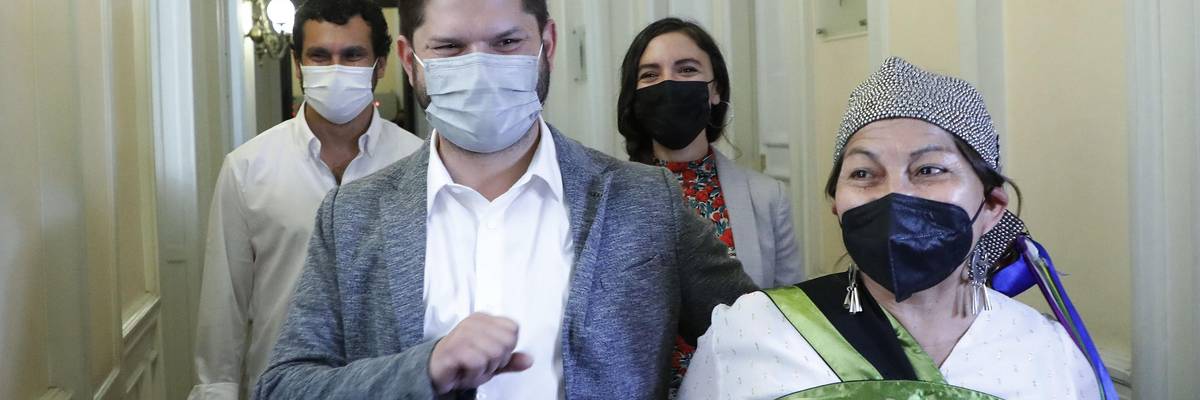
President of the Constituent Assembly Elisa Loncon and newly elected President Gabriel Boric walk ahead of a meeting with Vice President of the Constituent Assembly Jaime Bassa and Deputy Camila Vallejos for a meeting on December 21, 2021 in Santiago, Chile. (Photo: Dragomir Yancovic - Pool/Getty Images)
Left Wave Continues in Latin America With Historic Victory in Chile
When Gabriel Boric opened his presidential acceptance speech with words in the Mapuche language, he reaffirmed his commitment to solving the crisis in La Araucanía and his longtime campaign promise, "We believe in a plurinational state and the self-determination of our original peoples."
With 99.9% of the votes counted, Chile elected progressive Gabriel Boric over right-wing candidate Jose Antonio Kast on Sunday December 19, 2021. Boric won 55.9% (4,618,480) of the total votes, leaving Kast trailing with 44.1% (3,648,394) as polls closed at 6 pm local time.
The 12-point victory was achieved despite massive public transit interruptions on Sunday, resulting in long lines at bus stops and polling places during an unprecedented heat wave. Left-wing party members accused right-wing current president Sebastian Pinera of electoral interference since poor and working-class neighbourhoods were mostly affected by the transit outages. Still, voters turned out en masse to break a voter participation record with 55% of the eligible electorate casting their votes.
Boric will be the youngest Chilean president when he assumes office in March 2022 at the age of 36. His early involvement in politics began ten years ago in 2011, during the student protests when he headed the University of Chile Student Federation (FECH). Pinera was also president of the country at the time, and forcefully opposed the protests, which stemmed from extreme inequities in higher education.
The student protests grew and created alliances with labour and other social movements. Hundreds of thousands of people participated, thousands were arrested, some killed and many injured. In 2013, Boric was elected to parliament, representing his home district of Magallanes and Chilean Antarctic. The protests continued, culminating in a mass uprising in October 2019, when high school students climbed turnstiles and waved passengers into the Santiago metro system after the government hiked fares.
The financial success story that is Chile, based on commodities like copper, does not reach most Chileans. Half of residents earn less than 400,000 Chilean pesos (USD$550) a month. A 2017 United Nations study shows that only 1 percent of Chileans earn 33% of the country's gross national product. The Organization for Economic Cooperation and Development (OECD) ranks Chile in 2021 as its most unequal member, with inequitable taxation, low female participation in the marketplace and weak public spending on children's education.
At his acceptance speech on Sunday night, Boric greeted the crowd in Spanish, Aymara, Rapanui and the Mapuche national language Mapudungun. In 2014, he was a member of the government's Commission on Human Rights and Indigenous Peoples.
"Thank you to all the persons and peoples who inhabit this place we call Chile. What is important is that you voted, you made your voices heard, you showed your commitment to this country for each and every one of us." In a veiled reference to former dictator Augusto Pinochet, he added, "On such an important day, we cannot go back to a time when the people, for whatever reasons, were deprived of the right to vote."
Boric is a strong supporter of women's rights. Advancing legislation to legalize abortion up to 14 weeks gestation, Boric stated on January 19, 2021, "We must move forward towards legal, safe, free and guaranteed abortion for the public health of the nation... Abortion is an undeniable reality and its prohibition only creates greater inequality between those who can safely access it and those who cannot."
Boric and his Apruebo Dignidad (I Approve Dignity) party won over 60% of the votes in his home province of Magallanes, as well as in Metropolitan Santiago. But Republican Party leader Jose Antonio Kast reversed the percentage in the wine-growing and agricultural regions of Chile immediately to the south of the capital city.
One of those regions, La Araucania, where Kast had his strongest showing at 60%, is the homeland of the Mapuche people, who represent a third of the region's population. Tensions have been increasing this year between the Mapuche and landowners, with President Pinera declaring a state of emergency in that region "to confront violence linked to drug-trafficking, terrorism and organized crime."
But the Mapuche say they are fighting the government for rights to the land they have inhabited for centuries if not millennia. Traditionally subsistence farmers, their way of life is in direct conflict with intensive agriculture. Large tracts of Mapuche territory have been granted to non-Indigenous families and corporations, and in the 1980s, the government transferred remaining collectively held land into individual ownership, chipping it away through personal debt and bankruptcy. In March 2021, Mapuche leaders filed a lawsuit with the International Criminal Court in The Hague accusing the Pinera government of genocide.
So when Gabriel Boric opened his presidential acceptance speech with words in the Mapuche language, he reaffirmed his commitment to solving the crisis in La Araucania and his longtime campaign promise, "We believe in a plurinational state and the self-determination of our original peoples."
Urgent. It's never been this bad.
Dear Common Dreams reader, It’s been nearly 30 years since I co-founded Common Dreams with my late wife, Lina Newhouser. We had the radical notion that journalism should serve the public good, not corporate profits. It was clear to us from the outset what it would take to build such a project. No paid advertisements. No corporate sponsors. No millionaire publisher telling us what to think or do. Many people said we wouldn't last a year, but we proved those doubters wrong. Together with a tremendous team of journalists and dedicated staff, we built an independent media outlet free from the constraints of profits and corporate control. Our mission from the outset was simple. To inform. To inspire. To ignite change for the common good. Building Common Dreams was not easy. Our survival was never guaranteed. When you take on the most powerful forces—Wall Street greed, fossil fuel industry destruction, Big Tech lobbyists, and uber-rich oligarchs who have spent billions upon billions rigging the economy and democracy in their favor—the only bulwark you have is supporters who believe in your work. But here’s the urgent message from me today. It’s never been this bad out there. And it’s never been this hard to keep us going. At the very moment Common Dreams is most needed and doing some of its best and most important work, the threats we face are intensifying. Right now, with just three days to go in our Spring Campaign, we're falling short of our make-or-break goal. When everyone does the little they can afford, we are strong. But if that support retreats or dries up, so do we. Can you make a gift right now to make sure Common Dreams not only survives but thrives? There is no backup plan or rainy day fund. There is only you. —Craig Brown, Co-founder |
With 99.9% of the votes counted, Chile elected progressive Gabriel Boric over right-wing candidate Jose Antonio Kast on Sunday December 19, 2021. Boric won 55.9% (4,618,480) of the total votes, leaving Kast trailing with 44.1% (3,648,394) as polls closed at 6 pm local time.
The 12-point victory was achieved despite massive public transit interruptions on Sunday, resulting in long lines at bus stops and polling places during an unprecedented heat wave. Left-wing party members accused right-wing current president Sebastian Pinera of electoral interference since poor and working-class neighbourhoods were mostly affected by the transit outages. Still, voters turned out en masse to break a voter participation record with 55% of the eligible electorate casting their votes.
Boric will be the youngest Chilean president when he assumes office in March 2022 at the age of 36. His early involvement in politics began ten years ago in 2011, during the student protests when he headed the University of Chile Student Federation (FECH). Pinera was also president of the country at the time, and forcefully opposed the protests, which stemmed from extreme inequities in higher education.
The student protests grew and created alliances with labour and other social movements. Hundreds of thousands of people participated, thousands were arrested, some killed and many injured. In 2013, Boric was elected to parliament, representing his home district of Magallanes and Chilean Antarctic. The protests continued, culminating in a mass uprising in October 2019, when high school students climbed turnstiles and waved passengers into the Santiago metro system after the government hiked fares.
The financial success story that is Chile, based on commodities like copper, does not reach most Chileans. Half of residents earn less than 400,000 Chilean pesos (USD$550) a month. A 2017 United Nations study shows that only 1 percent of Chileans earn 33% of the country's gross national product. The Organization for Economic Cooperation and Development (OECD) ranks Chile in 2021 as its most unequal member, with inequitable taxation, low female participation in the marketplace and weak public spending on children's education.
At his acceptance speech on Sunday night, Boric greeted the crowd in Spanish, Aymara, Rapanui and the Mapuche national language Mapudungun. In 2014, he was a member of the government's Commission on Human Rights and Indigenous Peoples.
"Thank you to all the persons and peoples who inhabit this place we call Chile. What is important is that you voted, you made your voices heard, you showed your commitment to this country for each and every one of us." In a veiled reference to former dictator Augusto Pinochet, he added, "On such an important day, we cannot go back to a time when the people, for whatever reasons, were deprived of the right to vote."
Boric is a strong supporter of women's rights. Advancing legislation to legalize abortion up to 14 weeks gestation, Boric stated on January 19, 2021, "We must move forward towards legal, safe, free and guaranteed abortion for the public health of the nation... Abortion is an undeniable reality and its prohibition only creates greater inequality between those who can safely access it and those who cannot."
Boric and his Apruebo Dignidad (I Approve Dignity) party won over 60% of the votes in his home province of Magallanes, as well as in Metropolitan Santiago. But Republican Party leader Jose Antonio Kast reversed the percentage in the wine-growing and agricultural regions of Chile immediately to the south of the capital city.
One of those regions, La Araucania, where Kast had his strongest showing at 60%, is the homeland of the Mapuche people, who represent a third of the region's population. Tensions have been increasing this year between the Mapuche and landowners, with President Pinera declaring a state of emergency in that region "to confront violence linked to drug-trafficking, terrorism and organized crime."
But the Mapuche say they are fighting the government for rights to the land they have inhabited for centuries if not millennia. Traditionally subsistence farmers, their way of life is in direct conflict with intensive agriculture. Large tracts of Mapuche territory have been granted to non-Indigenous families and corporations, and in the 1980s, the government transferred remaining collectively held land into individual ownership, chipping it away through personal debt and bankruptcy. In March 2021, Mapuche leaders filed a lawsuit with the International Criminal Court in The Hague accusing the Pinera government of genocide.
So when Gabriel Boric opened his presidential acceptance speech with words in the Mapuche language, he reaffirmed his commitment to solving the crisis in La Araucania and his longtime campaign promise, "We believe in a plurinational state and the self-determination of our original peoples."
With 99.9% of the votes counted, Chile elected progressive Gabriel Boric over right-wing candidate Jose Antonio Kast on Sunday December 19, 2021. Boric won 55.9% (4,618,480) of the total votes, leaving Kast trailing with 44.1% (3,648,394) as polls closed at 6 pm local time.
The 12-point victory was achieved despite massive public transit interruptions on Sunday, resulting in long lines at bus stops and polling places during an unprecedented heat wave. Left-wing party members accused right-wing current president Sebastian Pinera of electoral interference since poor and working-class neighbourhoods were mostly affected by the transit outages. Still, voters turned out en masse to break a voter participation record with 55% of the eligible electorate casting their votes.
Boric will be the youngest Chilean president when he assumes office in March 2022 at the age of 36. His early involvement in politics began ten years ago in 2011, during the student protests when he headed the University of Chile Student Federation (FECH). Pinera was also president of the country at the time, and forcefully opposed the protests, which stemmed from extreme inequities in higher education.
The student protests grew and created alliances with labour and other social movements. Hundreds of thousands of people participated, thousands were arrested, some killed and many injured. In 2013, Boric was elected to parliament, representing his home district of Magallanes and Chilean Antarctic. The protests continued, culminating in a mass uprising in October 2019, when high school students climbed turnstiles and waved passengers into the Santiago metro system after the government hiked fares.
The financial success story that is Chile, based on commodities like copper, does not reach most Chileans. Half of residents earn less than 400,000 Chilean pesos (USD$550) a month. A 2017 United Nations study shows that only 1 percent of Chileans earn 33% of the country's gross national product. The Organization for Economic Cooperation and Development (OECD) ranks Chile in 2021 as its most unequal member, with inequitable taxation, low female participation in the marketplace and weak public spending on children's education.
At his acceptance speech on Sunday night, Boric greeted the crowd in Spanish, Aymara, Rapanui and the Mapuche national language Mapudungun. In 2014, he was a member of the government's Commission on Human Rights and Indigenous Peoples.
"Thank you to all the persons and peoples who inhabit this place we call Chile. What is important is that you voted, you made your voices heard, you showed your commitment to this country for each and every one of us." In a veiled reference to former dictator Augusto Pinochet, he added, "On such an important day, we cannot go back to a time when the people, for whatever reasons, were deprived of the right to vote."
Boric is a strong supporter of women's rights. Advancing legislation to legalize abortion up to 14 weeks gestation, Boric stated on January 19, 2021, "We must move forward towards legal, safe, free and guaranteed abortion for the public health of the nation... Abortion is an undeniable reality and its prohibition only creates greater inequality between those who can safely access it and those who cannot."
Boric and his Apruebo Dignidad (I Approve Dignity) party won over 60% of the votes in his home province of Magallanes, as well as in Metropolitan Santiago. But Republican Party leader Jose Antonio Kast reversed the percentage in the wine-growing and agricultural regions of Chile immediately to the south of the capital city.
One of those regions, La Araucania, where Kast had his strongest showing at 60%, is the homeland of the Mapuche people, who represent a third of the region's population. Tensions have been increasing this year between the Mapuche and landowners, with President Pinera declaring a state of emergency in that region "to confront violence linked to drug-trafficking, terrorism and organized crime."
But the Mapuche say they are fighting the government for rights to the land they have inhabited for centuries if not millennia. Traditionally subsistence farmers, their way of life is in direct conflict with intensive agriculture. Large tracts of Mapuche territory have been granted to non-Indigenous families and corporations, and in the 1980s, the government transferred remaining collectively held land into individual ownership, chipping it away through personal debt and bankruptcy. In March 2021, Mapuche leaders filed a lawsuit with the International Criminal Court in The Hague accusing the Pinera government of genocide.
So when Gabriel Boric opened his presidential acceptance speech with words in the Mapuche language, he reaffirmed his commitment to solving the crisis in La Araucania and his longtime campaign promise, "We believe in a plurinational state and the self-determination of our original peoples."