SUBSCRIBE TO OUR FREE NEWSLETTER
Daily news & progressive opinion—funded by the people, not the corporations—delivered straight to your inbox.
5
#000000
#FFFFFF
To donate by check, phone, or other method, see our More Ways to Give page.
Daily news & progressive opinion—funded by the people, not the corporations—delivered straight to your inbox.
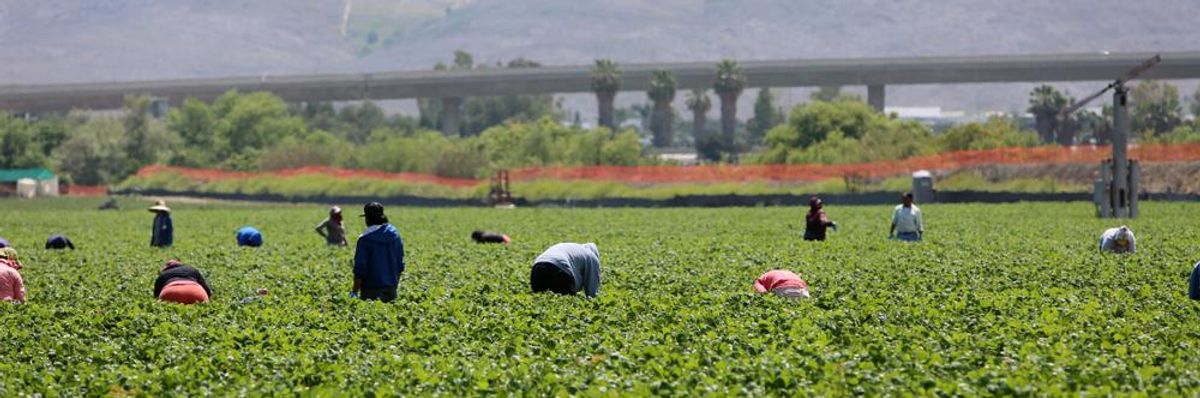
Migrant farm workers, Lake Forest, California (Photo: Shutterstock)
Throughout the pandemic, there's been an outpouring of public support for essential workers. But this has largely excluded migrant women farmworkers, despite their vital role in keeping food on American families' tables.
Monica Ramirez is working to change that.
"I'm the first generation in my family that didn't have to work in the fields to make a living," Ramirez told me. "So I was raised to be part of this movement and fight on behalf of my community."
Many women farmworkers do not even have access to their own income. Employers will often officially enroll a male employee while his wife and children work off the books.
Ramirez founded Justice for Migrant Women after creating the first legal project in the United States dedicated to addressing gender discrimination against farmworker women. That legal project became Esperanza: The Immigrant Women's Legal Initiative of the Southern Poverty Law Center.
She's witnessed firsthand the inequalities in the agriculture industry that made migrant women farmworkers particularly vulnerable.
One in four farmworkers are women, but Ramirez said that studies on the health risks of pesticide exposure have typically focused only on men. On top of the risks pesticides pose to everyone, hundreds of thousands of women farmworkers face particular threats to their reproductive health and to their children. Pesticides have been linked to poor birth outcomes, congenital anomalies, developmental deficits, and childhood tumors.
Current federal safeguards to address these inequalities are inadequate, according to Ramirez and other farmworker advocates. In many cases, the federal government isn't even collecting the data it would need to strengthen those protections.
The National Agricultural Worker Survey, conducted by the Department of Labor, collects demographic, employment, and health data in face-to-face interviews with farmworkers throughout the country. But it doesn't disaggregate its data by gender, which makes policymaking and advocacy difficult.
"When we don't know the real experiences of women migrant farmworkers," said Ramirez, "it makes it even more challenging for us to do the work to try and improve those conditions."
The U.S. Department of Agriculture's Farm Labor Survey also fails to make gender data available to the public. The survey is used to produce the annual Farm Labor Report which, among other things, helps establish wages under the H2-A temporary agricultural worker program.
Without gender-specific information, it is difficult to understand the full scope of the gender wage gap among migrant farmworkers, which in turn makes it difficult for organizers to mobilize around specific demands.
Ramirez managed to obtain the USDA's raw survey data and disaggregated it herself, finding the wage gap between men and women farmworkers to be about $5,000 annually.
But even this understates the disparities, since many women farmworkers do not even have access to their own income. Employers will often officially enroll a male employee while his wife and children work off the books.
"This is beneficial to the employer because they pay fewer taxes and benefits, but for the women it's really terrible," said Ramirez. "They of course should be entitled to their own wages, but this also makes it incredibly difficult for them to leave an abusive relationship or prove to immigration authorities that they work."
Other priorities for Ramirez's group include reforming the immigration system, addressing violence against women, and instituting mandatory workplace health and safety guidance--a demand which became even more urgent as migrant farmworkers were left out of some federal COVID-19 relief programs.
Ramirez believes transformative change will come when stories of inequality motivate others to fight for someone they do not know.
"In order to change things," she says, "everyday people who have never worked a day in the fields will need to link arms and call for change alongside migrant women. And that can't happen if people don't have a clear picture of these women's reality."
Dear Common Dreams reader, It’s been nearly 30 years since I co-founded Common Dreams with my late wife, Lina Newhouser. We had the radical notion that journalism should serve the public good, not corporate profits. It was clear to us from the outset what it would take to build such a project. No paid advertisements. No corporate sponsors. No millionaire publisher telling us what to think or do. Many people said we wouldn't last a year, but we proved those doubters wrong. Together with a tremendous team of journalists and dedicated staff, we built an independent media outlet free from the constraints of profits and corporate control. Our mission has always been simple: To inform. To inspire. To ignite change for the common good. Building Common Dreams was not easy. Our survival was never guaranteed. When you take on the most powerful forces—Wall Street greed, fossil fuel industry destruction, Big Tech lobbyists, and uber-rich oligarchs who have spent billions upon billions rigging the economy and democracy in their favor—the only bulwark you have is supporters who believe in your work. But here’s the urgent message from me today. It's never been this bad out there. And it's never been this hard to keep us going. At the very moment Common Dreams is most needed, the threats we face are intensifying. We need your support now more than ever. We don't accept corporate advertising and never will. We don't have a paywall because we don't think people should be blocked from critical news based on their ability to pay. Everything we do is funded by the donations of readers like you. When everyone does the little they can afford, we are strong. But if that support retreats or dries up, so do we. Will you donate now to make sure Common Dreams not only survives but thrives? —Craig Brown, Co-founder |
Throughout the pandemic, there's been an outpouring of public support for essential workers. But this has largely excluded migrant women farmworkers, despite their vital role in keeping food on American families' tables.
Monica Ramirez is working to change that.
"I'm the first generation in my family that didn't have to work in the fields to make a living," Ramirez told me. "So I was raised to be part of this movement and fight on behalf of my community."
Many women farmworkers do not even have access to their own income. Employers will often officially enroll a male employee while his wife and children work off the books.
Ramirez founded Justice for Migrant Women after creating the first legal project in the United States dedicated to addressing gender discrimination against farmworker women. That legal project became Esperanza: The Immigrant Women's Legal Initiative of the Southern Poverty Law Center.
She's witnessed firsthand the inequalities in the agriculture industry that made migrant women farmworkers particularly vulnerable.
One in four farmworkers are women, but Ramirez said that studies on the health risks of pesticide exposure have typically focused only on men. On top of the risks pesticides pose to everyone, hundreds of thousands of women farmworkers face particular threats to their reproductive health and to their children. Pesticides have been linked to poor birth outcomes, congenital anomalies, developmental deficits, and childhood tumors.
Current federal safeguards to address these inequalities are inadequate, according to Ramirez and other farmworker advocates. In many cases, the federal government isn't even collecting the data it would need to strengthen those protections.
The National Agricultural Worker Survey, conducted by the Department of Labor, collects demographic, employment, and health data in face-to-face interviews with farmworkers throughout the country. But it doesn't disaggregate its data by gender, which makes policymaking and advocacy difficult.
"When we don't know the real experiences of women migrant farmworkers," said Ramirez, "it makes it even more challenging for us to do the work to try and improve those conditions."
The U.S. Department of Agriculture's Farm Labor Survey also fails to make gender data available to the public. The survey is used to produce the annual Farm Labor Report which, among other things, helps establish wages under the H2-A temporary agricultural worker program.
Without gender-specific information, it is difficult to understand the full scope of the gender wage gap among migrant farmworkers, which in turn makes it difficult for organizers to mobilize around specific demands.
Ramirez managed to obtain the USDA's raw survey data and disaggregated it herself, finding the wage gap between men and women farmworkers to be about $5,000 annually.
But even this understates the disparities, since many women farmworkers do not even have access to their own income. Employers will often officially enroll a male employee while his wife and children work off the books.
"This is beneficial to the employer because they pay fewer taxes and benefits, but for the women it's really terrible," said Ramirez. "They of course should be entitled to their own wages, but this also makes it incredibly difficult for them to leave an abusive relationship or prove to immigration authorities that they work."
Other priorities for Ramirez's group include reforming the immigration system, addressing violence against women, and instituting mandatory workplace health and safety guidance--a demand which became even more urgent as migrant farmworkers were left out of some federal COVID-19 relief programs.
Ramirez believes transformative change will come when stories of inequality motivate others to fight for someone they do not know.
"In order to change things," she says, "everyday people who have never worked a day in the fields will need to link arms and call for change alongside migrant women. And that can't happen if people don't have a clear picture of these women's reality."
Throughout the pandemic, there's been an outpouring of public support for essential workers. But this has largely excluded migrant women farmworkers, despite their vital role in keeping food on American families' tables.
Monica Ramirez is working to change that.
"I'm the first generation in my family that didn't have to work in the fields to make a living," Ramirez told me. "So I was raised to be part of this movement and fight on behalf of my community."
Many women farmworkers do not even have access to their own income. Employers will often officially enroll a male employee while his wife and children work off the books.
Ramirez founded Justice for Migrant Women after creating the first legal project in the United States dedicated to addressing gender discrimination against farmworker women. That legal project became Esperanza: The Immigrant Women's Legal Initiative of the Southern Poverty Law Center.
She's witnessed firsthand the inequalities in the agriculture industry that made migrant women farmworkers particularly vulnerable.
One in four farmworkers are women, but Ramirez said that studies on the health risks of pesticide exposure have typically focused only on men. On top of the risks pesticides pose to everyone, hundreds of thousands of women farmworkers face particular threats to their reproductive health and to their children. Pesticides have been linked to poor birth outcomes, congenital anomalies, developmental deficits, and childhood tumors.
Current federal safeguards to address these inequalities are inadequate, according to Ramirez and other farmworker advocates. In many cases, the federal government isn't even collecting the data it would need to strengthen those protections.
The National Agricultural Worker Survey, conducted by the Department of Labor, collects demographic, employment, and health data in face-to-face interviews with farmworkers throughout the country. But it doesn't disaggregate its data by gender, which makes policymaking and advocacy difficult.
"When we don't know the real experiences of women migrant farmworkers," said Ramirez, "it makes it even more challenging for us to do the work to try and improve those conditions."
The U.S. Department of Agriculture's Farm Labor Survey also fails to make gender data available to the public. The survey is used to produce the annual Farm Labor Report which, among other things, helps establish wages under the H2-A temporary agricultural worker program.
Without gender-specific information, it is difficult to understand the full scope of the gender wage gap among migrant farmworkers, which in turn makes it difficult for organizers to mobilize around specific demands.
Ramirez managed to obtain the USDA's raw survey data and disaggregated it herself, finding the wage gap between men and women farmworkers to be about $5,000 annually.
But even this understates the disparities, since many women farmworkers do not even have access to their own income. Employers will often officially enroll a male employee while his wife and children work off the books.
"This is beneficial to the employer because they pay fewer taxes and benefits, but for the women it's really terrible," said Ramirez. "They of course should be entitled to their own wages, but this also makes it incredibly difficult for them to leave an abusive relationship or prove to immigration authorities that they work."
Other priorities for Ramirez's group include reforming the immigration system, addressing violence against women, and instituting mandatory workplace health and safety guidance--a demand which became even more urgent as migrant farmworkers were left out of some federal COVID-19 relief programs.
Ramirez believes transformative change will come when stories of inequality motivate others to fight for someone they do not know.
"In order to change things," she says, "everyday people who have never worked a day in the fields will need to link arms and call for change alongside migrant women. And that can't happen if people don't have a clear picture of these women's reality."