SUBSCRIBE TO OUR FREE NEWSLETTER
Daily news & progressive opinion—funded by the people, not the corporations—delivered straight to your inbox.
5
#000000
#FFFFFF
To donate by check, phone, or other method, see our More Ways to Give page.
Daily news & progressive opinion—funded by the people, not the corporations—delivered straight to your inbox.
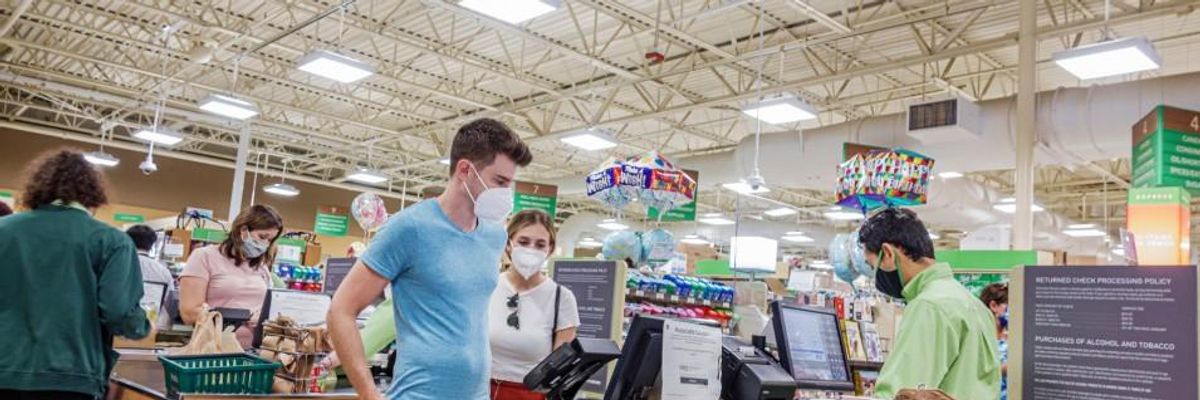
Customers and cashiers at a Publix supermarket in Orlando, Florida. (Photo: Jeffrey Greenberg/Education Images/Universal Images Group via Getty Images)
President-elect Joe Biden is taking office in a deeply divided country--a point dramatically brought home by the violence President Donald Trump invited into the Capitol on Wednesday.
Biden has promised to bring a divided electorate together. Is this even possible?
Social divisions may take a generation to heal. But with enough political will, the answer on policy questions should be a resounding yes.
The number of people officially living in poverty has risen by at least 8 million during the pandemic, but this is a vast undercount.
Despite our divisions, progressive responses to bread and butter issues enjoy broad, bipartisan support. Majority support exists for everything from cash relief payments during the COVID-19 crisis to increasing the minimum wage and expanding health care.
The most acute crisis facing the nation is the continuing pandemic and its fallout. Communities of color and low-income families have suffered the most, but Americans of all backgrounds and political parties have suffered sickness, death and growing economic insecurity.
The number of people officially living in poverty has risen by at least 8 million during the pandemic, but this is a vast undercount.
The actual level of hardship, the Poor People's Campaign and the Institute for Policy Studies found, is far higher -- at more than 140 million people in the United States. Meanwhile our death toll approaches an unthinkable 400,000.
Voters of all stripes are demanding action. COVID-19 relief took center stage in Georgia, with Democrats Raphael Warnock and Jon Ossoff campaigning for $2,000 cash payments and ousting Republican incumbents who'd helped GOP Senate leader Mitch McConnell squash them.
But support for relief goes even deeper than that. A recent Data for Progress poll found 65% support nationally not just for the one-time $2,000 payments McConnell has resisted, but for monthly $2,000 payments to support Americans through the crisis.
After months of resistance, McConnell agreed to an eleventh-hour relief package late last year. Many Americans were relieved to see their unemployment insurance continued and an extra $600 in their pockets, but these measures were too little, too late for millions behind on their bills. State and local governments have meanwhile been starved just when resources are needed the most.
McConnell held up cash payments and aid for local governments because he wanted immunity for corporations whose negligence gets their workers or customers infected during the pandemic. But a December Vox poll showed that 81% of Americans cared more about COVID-19 relief than liability protection for businesses.
Incoming President Biden has promised a "Marshall Plan" from the federal government to promote the needed distribution for state and local governments. Now, with a Democratic House and Senate, he should engage this broad bipartisan support to get one.
There's also broad bipartisan support about who should pay their fair share to support it: billionaires.
According to the Institute for Policy Studies, the combined wealth of America's billionaires has increased by more than $1 trillion during the pandemic. Poll after poll shows overwhelming support for raising taxes on this group, who got a huge tax cut under Trump. A recent Reuters poll found 77% of Democrats and 53% of Republicans supporting taxing billionaire wealth.
Other polls show support for popular ideas progressives have championed for years.
A recent CNBC poll found broad bipartisan support for raising the minimum wage to $15 an hour (60%), making public college free (57%), and "Medicare for All" (54%). Majorities of Republicans joined Democrats in supporting paid maternity leave and federally supported child care. More than 40% of GOP voters support increasing food assistance for people in poverty.
Even on hot-button issues where Trump has stoked partisan divides, Republican and Democratic voters are often united. A majority of Trump voters told pollsters this year they support protecting undocumented immigrants brought here as children from deportation, and majorities of both Democrats and Republicans support taking more action on climate change.
Finally, there's the U.S. Postal Service, which was badly battered and politicized under the Trump administration. Yet it remains the most popular federal agency of all, with over 90% of voters supporting crisis aid for the vital public service.
Bipartisanship won't solve all our problems. Republican support for racial equality and transgender rights still remains absent, so executive orders may be necessary to address these critical issues.
Yet it's clear that possibilities for bringing together such a deeply divided country not only exist but abound. Biden, Congress and voters must work hard to make sure the policies the majority of us support become law.
Dear Common Dreams reader, It’s been nearly 30 years since I co-founded Common Dreams with my late wife, Lina Newhouser. We had the radical notion that journalism should serve the public good, not corporate profits. It was clear to us from the outset what it would take to build such a project. No paid advertisements. No corporate sponsors. No millionaire publisher telling us what to think or do. Many people said we wouldn't last a year, but we proved those doubters wrong. Together with a tremendous team of journalists and dedicated staff, we built an independent media outlet free from the constraints of profits and corporate control. Our mission has always been simple: To inform. To inspire. To ignite change for the common good. Building Common Dreams was not easy. Our survival was never guaranteed. When you take on the most powerful forces—Wall Street greed, fossil fuel industry destruction, Big Tech lobbyists, and uber-rich oligarchs who have spent billions upon billions rigging the economy and democracy in their favor—the only bulwark you have is supporters who believe in your work. But here’s the urgent message from me today. It's never been this bad out there. And it's never been this hard to keep us going. At the very moment Common Dreams is most needed, the threats we face are intensifying. We need your support now more than ever. We don't accept corporate advertising and never will. We don't have a paywall because we don't think people should be blocked from critical news based on their ability to pay. Everything we do is funded by the donations of readers like you. When everyone does the little they can afford, we are strong. But if that support retreats or dries up, so do we. Will you donate now to make sure Common Dreams not only survives but thrives? —Craig Brown, Co-founder |
President-elect Joe Biden is taking office in a deeply divided country--a point dramatically brought home by the violence President Donald Trump invited into the Capitol on Wednesday.
Biden has promised to bring a divided electorate together. Is this even possible?
Social divisions may take a generation to heal. But with enough political will, the answer on policy questions should be a resounding yes.
The number of people officially living in poverty has risen by at least 8 million during the pandemic, but this is a vast undercount.
Despite our divisions, progressive responses to bread and butter issues enjoy broad, bipartisan support. Majority support exists for everything from cash relief payments during the COVID-19 crisis to increasing the minimum wage and expanding health care.
The most acute crisis facing the nation is the continuing pandemic and its fallout. Communities of color and low-income families have suffered the most, but Americans of all backgrounds and political parties have suffered sickness, death and growing economic insecurity.
The number of people officially living in poverty has risen by at least 8 million during the pandemic, but this is a vast undercount.
The actual level of hardship, the Poor People's Campaign and the Institute for Policy Studies found, is far higher -- at more than 140 million people in the United States. Meanwhile our death toll approaches an unthinkable 400,000.
Voters of all stripes are demanding action. COVID-19 relief took center stage in Georgia, with Democrats Raphael Warnock and Jon Ossoff campaigning for $2,000 cash payments and ousting Republican incumbents who'd helped GOP Senate leader Mitch McConnell squash them.
But support for relief goes even deeper than that. A recent Data for Progress poll found 65% support nationally not just for the one-time $2,000 payments McConnell has resisted, but for monthly $2,000 payments to support Americans through the crisis.
After months of resistance, McConnell agreed to an eleventh-hour relief package late last year. Many Americans were relieved to see their unemployment insurance continued and an extra $600 in their pockets, but these measures were too little, too late for millions behind on their bills. State and local governments have meanwhile been starved just when resources are needed the most.
McConnell held up cash payments and aid for local governments because he wanted immunity for corporations whose negligence gets their workers or customers infected during the pandemic. But a December Vox poll showed that 81% of Americans cared more about COVID-19 relief than liability protection for businesses.
Incoming President Biden has promised a "Marshall Plan" from the federal government to promote the needed distribution for state and local governments. Now, with a Democratic House and Senate, he should engage this broad bipartisan support to get one.
There's also broad bipartisan support about who should pay their fair share to support it: billionaires.
According to the Institute for Policy Studies, the combined wealth of America's billionaires has increased by more than $1 trillion during the pandemic. Poll after poll shows overwhelming support for raising taxes on this group, who got a huge tax cut under Trump. A recent Reuters poll found 77% of Democrats and 53% of Republicans supporting taxing billionaire wealth.
Other polls show support for popular ideas progressives have championed for years.
A recent CNBC poll found broad bipartisan support for raising the minimum wage to $15 an hour (60%), making public college free (57%), and "Medicare for All" (54%). Majorities of Republicans joined Democrats in supporting paid maternity leave and federally supported child care. More than 40% of GOP voters support increasing food assistance for people in poverty.
Even on hot-button issues where Trump has stoked partisan divides, Republican and Democratic voters are often united. A majority of Trump voters told pollsters this year they support protecting undocumented immigrants brought here as children from deportation, and majorities of both Democrats and Republicans support taking more action on climate change.
Finally, there's the U.S. Postal Service, which was badly battered and politicized under the Trump administration. Yet it remains the most popular federal agency of all, with over 90% of voters supporting crisis aid for the vital public service.
Bipartisanship won't solve all our problems. Republican support for racial equality and transgender rights still remains absent, so executive orders may be necessary to address these critical issues.
Yet it's clear that possibilities for bringing together such a deeply divided country not only exist but abound. Biden, Congress and voters must work hard to make sure the policies the majority of us support become law.
President-elect Joe Biden is taking office in a deeply divided country--a point dramatically brought home by the violence President Donald Trump invited into the Capitol on Wednesday.
Biden has promised to bring a divided electorate together. Is this even possible?
Social divisions may take a generation to heal. But with enough political will, the answer on policy questions should be a resounding yes.
The number of people officially living in poverty has risen by at least 8 million during the pandemic, but this is a vast undercount.
Despite our divisions, progressive responses to bread and butter issues enjoy broad, bipartisan support. Majority support exists for everything from cash relief payments during the COVID-19 crisis to increasing the minimum wage and expanding health care.
The most acute crisis facing the nation is the continuing pandemic and its fallout. Communities of color and low-income families have suffered the most, but Americans of all backgrounds and political parties have suffered sickness, death and growing economic insecurity.
The number of people officially living in poverty has risen by at least 8 million during the pandemic, but this is a vast undercount.
The actual level of hardship, the Poor People's Campaign and the Institute for Policy Studies found, is far higher -- at more than 140 million people in the United States. Meanwhile our death toll approaches an unthinkable 400,000.
Voters of all stripes are demanding action. COVID-19 relief took center stage in Georgia, with Democrats Raphael Warnock and Jon Ossoff campaigning for $2,000 cash payments and ousting Republican incumbents who'd helped GOP Senate leader Mitch McConnell squash them.
But support for relief goes even deeper than that. A recent Data for Progress poll found 65% support nationally not just for the one-time $2,000 payments McConnell has resisted, but for monthly $2,000 payments to support Americans through the crisis.
After months of resistance, McConnell agreed to an eleventh-hour relief package late last year. Many Americans were relieved to see their unemployment insurance continued and an extra $600 in their pockets, but these measures were too little, too late for millions behind on their bills. State and local governments have meanwhile been starved just when resources are needed the most.
McConnell held up cash payments and aid for local governments because he wanted immunity for corporations whose negligence gets their workers or customers infected during the pandemic. But a December Vox poll showed that 81% of Americans cared more about COVID-19 relief than liability protection for businesses.
Incoming President Biden has promised a "Marshall Plan" from the federal government to promote the needed distribution for state and local governments. Now, with a Democratic House and Senate, he should engage this broad bipartisan support to get one.
There's also broad bipartisan support about who should pay their fair share to support it: billionaires.
According to the Institute for Policy Studies, the combined wealth of America's billionaires has increased by more than $1 trillion during the pandemic. Poll after poll shows overwhelming support for raising taxes on this group, who got a huge tax cut under Trump. A recent Reuters poll found 77% of Democrats and 53% of Republicans supporting taxing billionaire wealth.
Other polls show support for popular ideas progressives have championed for years.
A recent CNBC poll found broad bipartisan support for raising the minimum wage to $15 an hour (60%), making public college free (57%), and "Medicare for All" (54%). Majorities of Republicans joined Democrats in supporting paid maternity leave and federally supported child care. More than 40% of GOP voters support increasing food assistance for people in poverty.
Even on hot-button issues where Trump has stoked partisan divides, Republican and Democratic voters are often united. A majority of Trump voters told pollsters this year they support protecting undocumented immigrants brought here as children from deportation, and majorities of both Democrats and Republicans support taking more action on climate change.
Finally, there's the U.S. Postal Service, which was badly battered and politicized under the Trump administration. Yet it remains the most popular federal agency of all, with over 90% of voters supporting crisis aid for the vital public service.
Bipartisanship won't solve all our problems. Republican support for racial equality and transgender rights still remains absent, so executive orders may be necessary to address these critical issues.
Yet it's clear that possibilities for bringing together such a deeply divided country not only exist but abound. Biden, Congress and voters must work hard to make sure the policies the majority of us support become law.