SUBSCRIBE TO OUR FREE NEWSLETTER
Daily news & progressive opinion—funded by the people, not the corporations—delivered straight to your inbox.
5
#000000
#FFFFFF
To donate by check, phone, or other method, see our More Ways to Give page.
Daily news & progressive opinion—funded by the people, not the corporations—delivered straight to your inbox.
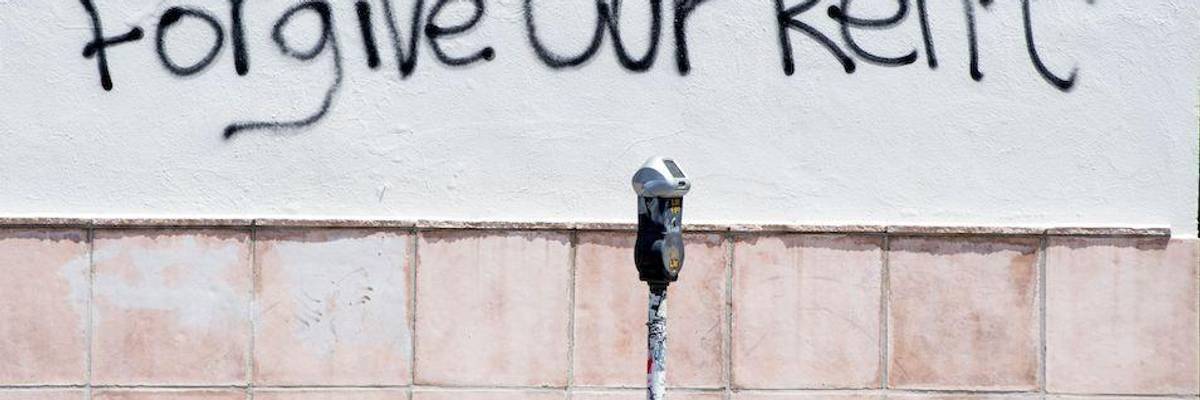
Despite the halt on legal eviction processes, landlords often find other ways to pressure tenants out of their homes, but renter organizing can have a powerful effect. (Photo:Valerie Macon/AFP/Getty Images)
n July 7, tenants in Brooklyn, New York, surrounded by their community, staged a dramatic face off with their landlord. The house was located at 1214 Dean Street, in a rapidly gentrifying part of Crown Heights. It was a nine-bedroom, apparently zoned as a single-family dwelling, but rented out room by room to individual tenants, many of whom were left unemployed when the pandemic shuttered much of the city's service industry.
The people in the street that night in Brooklyn understood that state power is used to protect private property, and that solidarity is the only way to change this relationship.
The landlord stood there filming as the tenants addressed him through a bullhorn, detailing a litany of intimidation tactics they said he'd used to get around the official hold on evictions. Elise Goldin, an organizer at St. Nicks Alliance who came out to join the home defense, said that "in ten years of organizing I've never seen anything like it."
The tenants had reached out to Equality for Flatbush, a people-of-color-led community organization formed to combat the twin forces of police repression and tenant harassment. The organization, like many that have grown up in the crisis decade, unites seemingly disparate groups of people to create safety and security for themselves through direct action and political struggle.
The people in the street that night in Brooklyn understood that state power is used to protect private property, and that solidarity is the only way to change this relationship. Their action, like the hundreds of thousands who have protested to defund police departments across the country, was another demonstration that "We keep us safe."
The pandemic and its attendant plunge in employment has amplified the insecurity so many people have been living with already. "Millions of people have lost income and cannot pay rent," Cea Weaver, a Brooklyn housing organizer, told me. Weaver is a campaign coordinator for Housing Justice for All, a statewide network of which Equality for Flatbush is a member.
This makes a spike in evictions "seemingly inevitable," she explained. Temporary moratoriums on evictions are beginning to expire, even as cases of COVID-19 spike and businesses in most states are only able to reopen under severe restrictions. Despite detailed proposals from elected officials like Representative Ilhan Omar, Democrat of Minnesota, calls for a full rent suspension or cancellation have gone largely unheeded. And with state governments hesitant to act further, large numbers of people--including the Dean Street tenants--have responded by organizing rent strikes. But as those strikes go on, tenants and communities have to be prepared to stand together, as the people of Crown Heights did for the Dean Street tenants. "We are building a statewide network to eliminate evictions, organizing to reject that 'inevitability,' " Weaver says.
Housing Justice for All has put forward a pledge--it's not just a petition, but rather, a sign-up for a rapid response network to scale up actions like the one at Dean Street.
For Elise Goldin, it was a rapid response email from the Crown Heights Tenant Union that brought her out to the action, which I followed on social media. She and others, including the Working Families Party's Nelini Stamp, fresh from the occupation at City Hall to defund the police, arrived to support the tenants. The community settled in to stay overnight, keeping an eye on things, and a new shift arrived to relieve them in the morning.
The tactics echoed those used in the wake of the Occupy Movement: driven out of the parks, organizers in many cities (most notably Atlanta and Minneapolis, both centers of recent protests), began staging home defenses. Today, those tactics are resurfacing, given new strength from months of mutual aid practices and from the wave of protests after the May 25 killing of George Floyd.
The networks of care that emerged in the wake of what Ruth Wilson Gilmore calls "organized abandonment" are building the solidarity required to turn up when an email lands in your inbox or your phone lights up with a text asking for support. Organizations like the Crown Heights Tenants Union, and housing organizing done by the Democratic Socialists of America mix young and often downwardly mobile renters with longtime neighborhood residents. This approach to organizing is built on an understanding that fighting the displacement at the heart of gentrification is in everyone's interest. (Well, everyone's but the landlord's.)
Housing has been a central issue of the coronavirus pandemic, notes Tara Raghuveer, the housing campaign director at People's Action and a housing organizer in Kansas City. "Without a vaccine to treat the pandemic, housing was the prescription. We were told to stay home," she says.
It is the tenants and their neighbors who are leading the fight and changing the way we think about private property and renting out homes for a profit.
From the beginning, activists have taken that prescription seriously, seizing the moment to ratchet up their existing campaigns for housing for all. In Los Angeles, houseless families moved into vacant, state-owned properties in order to safely self-isolate, and in Minneapolis, organizers took over an empty Sheraton hotel, while in Philadelphia, houseless activists have built an encampment near the art museum as both a protest and a safe place to live.
Housing, too, is key to the movement for Black lives. From redlining Black homebuyers out of some neighborhoods and into others, to what historian Keeanga-Yamahtta Taylor called the "predatory inclusion" of Black homebuyers into the market at a price, housing inequality is central to the racial inequality that pervades American life. Gentrification may have, according to Breonna Taylor's family, played a role in the police expedition that cost Taylor her life. This is why, as Raghuveer argues, a national Homes Guarantee is part of the project of unraveling racial capitalism.
Despite the halt on legal eviction processes, landlords often find other ways to pressure tenants out of their homes, but renter organizing can have a powerful effect. Even elected officials like Representative Alexandria Ocasio-Cortez are backing eviction defense training, seeing direct action as a way to bolster their political positions.
Likewise, the Homes Guarantee pledge, signed by more than seventy candidates from around the country, from Jamaal Bowman in New York to Charles Booker in Kentucky to Cori Bush in Missouri, begins with the promise "to advance policies that move housing from commodity to human right."
Such a statement has radical potential; the policies that flow from it would fundamentally change the power relationship on that Brooklyn street and thousands like it. But those policies will only be enacted if tenants are able to assert their collective power. Raghuveer calls these direct actions "expressions of community solidarity and leadership in the face of inaction from our elected leaders."
Indeed, it is the tenants and their neighbors who are leading the fight and changing the way we think about private property and renting out homes for a profit. But eviction defenses also go beyond the prefigurative to make a material difference in the here and now.
"Stopping evictions, by any means necessary," Raghuveer says, "is a matter of life or death."
Dear Common Dreams reader, It’s been nearly 30 years since I co-founded Common Dreams with my late wife, Lina Newhouser. We had the radical notion that journalism should serve the public good, not corporate profits. It was clear to us from the outset what it would take to build such a project. No paid advertisements. No corporate sponsors. No millionaire publisher telling us what to think or do. Many people said we wouldn't last a year, but we proved those doubters wrong. Together with a tremendous team of journalists and dedicated staff, we built an independent media outlet free from the constraints of profits and corporate control. Our mission has always been simple: To inform. To inspire. To ignite change for the common good. Building Common Dreams was not easy. Our survival was never guaranteed. When you take on the most powerful forces—Wall Street greed, fossil fuel industry destruction, Big Tech lobbyists, and uber-rich oligarchs who have spent billions upon billions rigging the economy and democracy in their favor—the only bulwark you have is supporters who believe in your work. But here’s the urgent message from me today. It's never been this bad out there. And it's never been this hard to keep us going. At the very moment Common Dreams is most needed, the threats we face are intensifying. We need your support now more than ever. We don't accept corporate advertising and never will. We don't have a paywall because we don't think people should be blocked from critical news based on their ability to pay. Everything we do is funded by the donations of readers like you. When everyone does the little they can afford, we are strong. But if that support retreats or dries up, so do we. Will you donate now to make sure Common Dreams not only survives but thrives? —Craig Brown, Co-founder |
n July 7, tenants in Brooklyn, New York, surrounded by their community, staged a dramatic face off with their landlord. The house was located at 1214 Dean Street, in a rapidly gentrifying part of Crown Heights. It was a nine-bedroom, apparently zoned as a single-family dwelling, but rented out room by room to individual tenants, many of whom were left unemployed when the pandemic shuttered much of the city's service industry.
The people in the street that night in Brooklyn understood that state power is used to protect private property, and that solidarity is the only way to change this relationship.
The landlord stood there filming as the tenants addressed him through a bullhorn, detailing a litany of intimidation tactics they said he'd used to get around the official hold on evictions. Elise Goldin, an organizer at St. Nicks Alliance who came out to join the home defense, said that "in ten years of organizing I've never seen anything like it."
The tenants had reached out to Equality for Flatbush, a people-of-color-led community organization formed to combat the twin forces of police repression and tenant harassment. The organization, like many that have grown up in the crisis decade, unites seemingly disparate groups of people to create safety and security for themselves through direct action and political struggle.
The people in the street that night in Brooklyn understood that state power is used to protect private property, and that solidarity is the only way to change this relationship. Their action, like the hundreds of thousands who have protested to defund police departments across the country, was another demonstration that "We keep us safe."
The pandemic and its attendant plunge in employment has amplified the insecurity so many people have been living with already. "Millions of people have lost income and cannot pay rent," Cea Weaver, a Brooklyn housing organizer, told me. Weaver is a campaign coordinator for Housing Justice for All, a statewide network of which Equality for Flatbush is a member.
This makes a spike in evictions "seemingly inevitable," she explained. Temporary moratoriums on evictions are beginning to expire, even as cases of COVID-19 spike and businesses in most states are only able to reopen under severe restrictions. Despite detailed proposals from elected officials like Representative Ilhan Omar, Democrat of Minnesota, calls for a full rent suspension or cancellation have gone largely unheeded. And with state governments hesitant to act further, large numbers of people--including the Dean Street tenants--have responded by organizing rent strikes. But as those strikes go on, tenants and communities have to be prepared to stand together, as the people of Crown Heights did for the Dean Street tenants. "We are building a statewide network to eliminate evictions, organizing to reject that 'inevitability,' " Weaver says.
Housing Justice for All has put forward a pledge--it's not just a petition, but rather, a sign-up for a rapid response network to scale up actions like the one at Dean Street.
For Elise Goldin, it was a rapid response email from the Crown Heights Tenant Union that brought her out to the action, which I followed on social media. She and others, including the Working Families Party's Nelini Stamp, fresh from the occupation at City Hall to defund the police, arrived to support the tenants. The community settled in to stay overnight, keeping an eye on things, and a new shift arrived to relieve them in the morning.
The tactics echoed those used in the wake of the Occupy Movement: driven out of the parks, organizers in many cities (most notably Atlanta and Minneapolis, both centers of recent protests), began staging home defenses. Today, those tactics are resurfacing, given new strength from months of mutual aid practices and from the wave of protests after the May 25 killing of George Floyd.
The networks of care that emerged in the wake of what Ruth Wilson Gilmore calls "organized abandonment" are building the solidarity required to turn up when an email lands in your inbox or your phone lights up with a text asking for support. Organizations like the Crown Heights Tenants Union, and housing organizing done by the Democratic Socialists of America mix young and often downwardly mobile renters with longtime neighborhood residents. This approach to organizing is built on an understanding that fighting the displacement at the heart of gentrification is in everyone's interest. (Well, everyone's but the landlord's.)
Housing has been a central issue of the coronavirus pandemic, notes Tara Raghuveer, the housing campaign director at People's Action and a housing organizer in Kansas City. "Without a vaccine to treat the pandemic, housing was the prescription. We were told to stay home," she says.
It is the tenants and their neighbors who are leading the fight and changing the way we think about private property and renting out homes for a profit.
From the beginning, activists have taken that prescription seriously, seizing the moment to ratchet up their existing campaigns for housing for all. In Los Angeles, houseless families moved into vacant, state-owned properties in order to safely self-isolate, and in Minneapolis, organizers took over an empty Sheraton hotel, while in Philadelphia, houseless activists have built an encampment near the art museum as both a protest and a safe place to live.
Housing, too, is key to the movement for Black lives. From redlining Black homebuyers out of some neighborhoods and into others, to what historian Keeanga-Yamahtta Taylor called the "predatory inclusion" of Black homebuyers into the market at a price, housing inequality is central to the racial inequality that pervades American life. Gentrification may have, according to Breonna Taylor's family, played a role in the police expedition that cost Taylor her life. This is why, as Raghuveer argues, a national Homes Guarantee is part of the project of unraveling racial capitalism.
Despite the halt on legal eviction processes, landlords often find other ways to pressure tenants out of their homes, but renter organizing can have a powerful effect. Even elected officials like Representative Alexandria Ocasio-Cortez are backing eviction defense training, seeing direct action as a way to bolster their political positions.
Likewise, the Homes Guarantee pledge, signed by more than seventy candidates from around the country, from Jamaal Bowman in New York to Charles Booker in Kentucky to Cori Bush in Missouri, begins with the promise "to advance policies that move housing from commodity to human right."
Such a statement has radical potential; the policies that flow from it would fundamentally change the power relationship on that Brooklyn street and thousands like it. But those policies will only be enacted if tenants are able to assert their collective power. Raghuveer calls these direct actions "expressions of community solidarity and leadership in the face of inaction from our elected leaders."
Indeed, it is the tenants and their neighbors who are leading the fight and changing the way we think about private property and renting out homes for a profit. But eviction defenses also go beyond the prefigurative to make a material difference in the here and now.
"Stopping evictions, by any means necessary," Raghuveer says, "is a matter of life or death."
n July 7, tenants in Brooklyn, New York, surrounded by their community, staged a dramatic face off with their landlord. The house was located at 1214 Dean Street, in a rapidly gentrifying part of Crown Heights. It was a nine-bedroom, apparently zoned as a single-family dwelling, but rented out room by room to individual tenants, many of whom were left unemployed when the pandemic shuttered much of the city's service industry.
The people in the street that night in Brooklyn understood that state power is used to protect private property, and that solidarity is the only way to change this relationship.
The landlord stood there filming as the tenants addressed him through a bullhorn, detailing a litany of intimidation tactics they said he'd used to get around the official hold on evictions. Elise Goldin, an organizer at St. Nicks Alliance who came out to join the home defense, said that "in ten years of organizing I've never seen anything like it."
The tenants had reached out to Equality for Flatbush, a people-of-color-led community organization formed to combat the twin forces of police repression and tenant harassment. The organization, like many that have grown up in the crisis decade, unites seemingly disparate groups of people to create safety and security for themselves through direct action and political struggle.
The people in the street that night in Brooklyn understood that state power is used to protect private property, and that solidarity is the only way to change this relationship. Their action, like the hundreds of thousands who have protested to defund police departments across the country, was another demonstration that "We keep us safe."
The pandemic and its attendant plunge in employment has amplified the insecurity so many people have been living with already. "Millions of people have lost income and cannot pay rent," Cea Weaver, a Brooklyn housing organizer, told me. Weaver is a campaign coordinator for Housing Justice for All, a statewide network of which Equality for Flatbush is a member.
This makes a spike in evictions "seemingly inevitable," she explained. Temporary moratoriums on evictions are beginning to expire, even as cases of COVID-19 spike and businesses in most states are only able to reopen under severe restrictions. Despite detailed proposals from elected officials like Representative Ilhan Omar, Democrat of Minnesota, calls for a full rent suspension or cancellation have gone largely unheeded. And with state governments hesitant to act further, large numbers of people--including the Dean Street tenants--have responded by organizing rent strikes. But as those strikes go on, tenants and communities have to be prepared to stand together, as the people of Crown Heights did for the Dean Street tenants. "We are building a statewide network to eliminate evictions, organizing to reject that 'inevitability,' " Weaver says.
Housing Justice for All has put forward a pledge--it's not just a petition, but rather, a sign-up for a rapid response network to scale up actions like the one at Dean Street.
For Elise Goldin, it was a rapid response email from the Crown Heights Tenant Union that brought her out to the action, which I followed on social media. She and others, including the Working Families Party's Nelini Stamp, fresh from the occupation at City Hall to defund the police, arrived to support the tenants. The community settled in to stay overnight, keeping an eye on things, and a new shift arrived to relieve them in the morning.
The tactics echoed those used in the wake of the Occupy Movement: driven out of the parks, organizers in many cities (most notably Atlanta and Minneapolis, both centers of recent protests), began staging home defenses. Today, those tactics are resurfacing, given new strength from months of mutual aid practices and from the wave of protests after the May 25 killing of George Floyd.
The networks of care that emerged in the wake of what Ruth Wilson Gilmore calls "organized abandonment" are building the solidarity required to turn up when an email lands in your inbox or your phone lights up with a text asking for support. Organizations like the Crown Heights Tenants Union, and housing organizing done by the Democratic Socialists of America mix young and often downwardly mobile renters with longtime neighborhood residents. This approach to organizing is built on an understanding that fighting the displacement at the heart of gentrification is in everyone's interest. (Well, everyone's but the landlord's.)
Housing has been a central issue of the coronavirus pandemic, notes Tara Raghuveer, the housing campaign director at People's Action and a housing organizer in Kansas City. "Without a vaccine to treat the pandemic, housing was the prescription. We were told to stay home," she says.
It is the tenants and their neighbors who are leading the fight and changing the way we think about private property and renting out homes for a profit.
From the beginning, activists have taken that prescription seriously, seizing the moment to ratchet up their existing campaigns for housing for all. In Los Angeles, houseless families moved into vacant, state-owned properties in order to safely self-isolate, and in Minneapolis, organizers took over an empty Sheraton hotel, while in Philadelphia, houseless activists have built an encampment near the art museum as both a protest and a safe place to live.
Housing, too, is key to the movement for Black lives. From redlining Black homebuyers out of some neighborhoods and into others, to what historian Keeanga-Yamahtta Taylor called the "predatory inclusion" of Black homebuyers into the market at a price, housing inequality is central to the racial inequality that pervades American life. Gentrification may have, according to Breonna Taylor's family, played a role in the police expedition that cost Taylor her life. This is why, as Raghuveer argues, a national Homes Guarantee is part of the project of unraveling racial capitalism.
Despite the halt on legal eviction processes, landlords often find other ways to pressure tenants out of their homes, but renter organizing can have a powerful effect. Even elected officials like Representative Alexandria Ocasio-Cortez are backing eviction defense training, seeing direct action as a way to bolster their political positions.
Likewise, the Homes Guarantee pledge, signed by more than seventy candidates from around the country, from Jamaal Bowman in New York to Charles Booker in Kentucky to Cori Bush in Missouri, begins with the promise "to advance policies that move housing from commodity to human right."
Such a statement has radical potential; the policies that flow from it would fundamentally change the power relationship on that Brooklyn street and thousands like it. But those policies will only be enacted if tenants are able to assert their collective power. Raghuveer calls these direct actions "expressions of community solidarity and leadership in the face of inaction from our elected leaders."
Indeed, it is the tenants and their neighbors who are leading the fight and changing the way we think about private property and renting out homes for a profit. But eviction defenses also go beyond the prefigurative to make a material difference in the here and now.
"Stopping evictions, by any means necessary," Raghuveer says, "is a matter of life or death."