SUBSCRIBE TO OUR FREE NEWSLETTER
Daily news & progressive opinion—funded by the people, not the corporations—delivered straight to your inbox.
5
#000000
#FFFFFF
To donate by check, phone, or other method, see our More Ways to Give page.
Daily news & progressive opinion—funded by the people, not the corporations—delivered straight to your inbox.
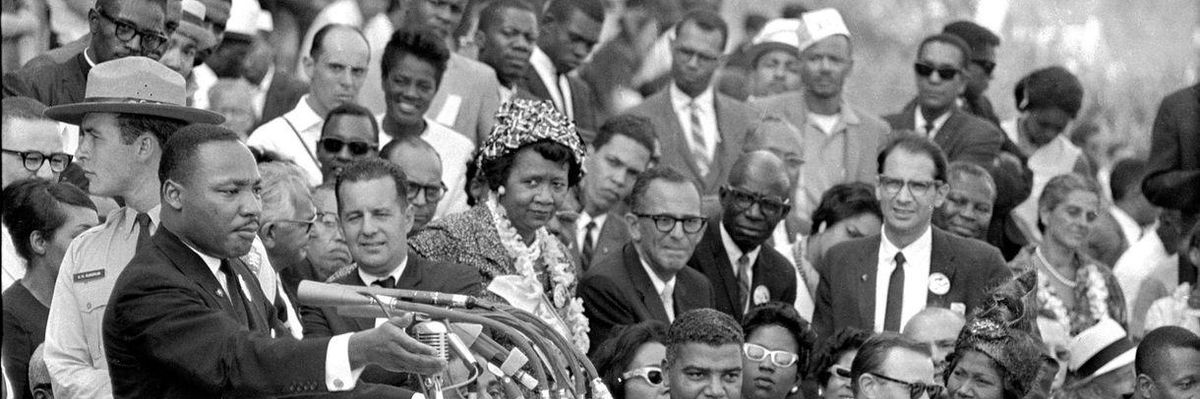
The Rev. Dr. Martin Luther King Jr., head of the Southern Christian Leadership Conference, speaks to thousands during his "I Have a Dream" speech in front of the Lincoln Memorial in Washington on Aug. 28, 1963 (Photo: TNS)
Schools across the country celebrate Dr. Martin Luther King Day today. At every level, students learn about King, the movement he helped lead and the teachings and legacy he left behind.
There are dramatic readings of his words. Many schools show his historic "I Have a Dream" speech at the Lincoln Memorial, a speech given before hundreds of thousands. Even in Key West, Florida, students at the local Montessori school hang handmade posters with quotes from King written in crayon. "Everyone can be great," reads one. "Civil rights should be equal," reads another. "We should remember that everything Hitler did was legal," reads a third.
His mission was to build a national movement of poor people who would march on Washington, calling on the nation to revive the War on Poverty, a war that was being lost in the jungles of Vietnam, as billions were squandered in that misbegotten war that might have been used to make America better.
I had the privilege of being with Dr. King on his last birthday. He had breakfast at home with his family. Then he came to work at the Southern Christian Leadership Conference headquarters. He was organizing the Poor People's Campaign, which he hoped would be the climax of the third chapter of the Civil Rights Movement, the struggle for economic justice.
He met with organizers from across races and regions--from members of the Latino community, to Native Americans, women and men, young and old. His mission was to build a national movement of poor people who would march on Washington, calling on the nation to revive the War on Poverty, a war that was being lost in the jungles of Vietnam, as billions were squandered in that misbegotten war that might have been used to make America better.
Later that day, King's staff surprised him with a cake and a celebration, bringing a smile to his face. But King was tireless in his mission. He seemed to sense that he had little time and there was so much yet to be done.
Dr. King's commitment provides a wonderful example for all of us, but particularly for the young. He did not order an army; he inspired people to act and to volunteer. He amassed no fortune. He did not hold high office. Yet, by the wisdom of his teaching, the justice of his cause, the intensity of his commitment, he helped transform America, leading it out of the shame of segregation and toward a more perfect union.
Dr. King believed that everyone could be great because everyone could serve. He was utterly committed to challenging injustice and to nonviolence as the only sane way to bring change. He believed that everyone had a decency within them, that by challenging injustice and at the same time, appealing to the humanity of the oppressors, change was possible. And the civil rights movement that he helped lead proved that to be true.
Today, Dr. King's example is more important than ever. Inequality has reached new extremes. We have a president that purposefully rouses racial and ethnic fears and divisions. Politics has become bitter, partisan, and increasingly marked by extreme and often hateful rhetoric. We are spending more and more on the Pentagon--already the largest military budget by far in the world--and cutting back on programs for the vulnerable, everything from food stamps, to Medicaid, to public housing and aid for poor schools and students. We end up with guided missiles and misguided young people--a tragic waste.
Today, a new Poor People's Campaign is building, organizing lines of race, region, and religion.
It has been marching on state legislatures and now is increasing pressure on Washington. It is not about right or left, but about right and wrong. Dr. King called on us to express the better angels of our souls. Now, as we celebrate his life, we would do well to put his lessons into practice.
Dear Common Dreams reader, It’s been nearly 30 years since I co-founded Common Dreams with my late wife, Lina Newhouser. We had the radical notion that journalism should serve the public good, not corporate profits. It was clear to us from the outset what it would take to build such a project. No paid advertisements. No corporate sponsors. No millionaire publisher telling us what to think or do. Many people said we wouldn't last a year, but we proved those doubters wrong. Together with a tremendous team of journalists and dedicated staff, we built an independent media outlet free from the constraints of profits and corporate control. Our mission has always been simple: To inform. To inspire. To ignite change for the common good. Building Common Dreams was not easy. Our survival was never guaranteed. When you take on the most powerful forces—Wall Street greed, fossil fuel industry destruction, Big Tech lobbyists, and uber-rich oligarchs who have spent billions upon billions rigging the economy and democracy in their favor—the only bulwark you have is supporters who believe in your work. But here’s the urgent message from me today. It's never been this bad out there. And it's never been this hard to keep us going. At the very moment Common Dreams is most needed, the threats we face are intensifying. We need your support now more than ever. We don't accept corporate advertising and never will. We don't have a paywall because we don't think people should be blocked from critical news based on their ability to pay. Everything we do is funded by the donations of readers like you. When everyone does the little they can afford, we are strong. But if that support retreats or dries up, so do we. Will you donate now to make sure Common Dreams not only survives but thrives? —Craig Brown, Co-founder |
Schools across the country celebrate Dr. Martin Luther King Day today. At every level, students learn about King, the movement he helped lead and the teachings and legacy he left behind.
There are dramatic readings of his words. Many schools show his historic "I Have a Dream" speech at the Lincoln Memorial, a speech given before hundreds of thousands. Even in Key West, Florida, students at the local Montessori school hang handmade posters with quotes from King written in crayon. "Everyone can be great," reads one. "Civil rights should be equal," reads another. "We should remember that everything Hitler did was legal," reads a third.
His mission was to build a national movement of poor people who would march on Washington, calling on the nation to revive the War on Poverty, a war that was being lost in the jungles of Vietnam, as billions were squandered in that misbegotten war that might have been used to make America better.
I had the privilege of being with Dr. King on his last birthday. He had breakfast at home with his family. Then he came to work at the Southern Christian Leadership Conference headquarters. He was organizing the Poor People's Campaign, which he hoped would be the climax of the third chapter of the Civil Rights Movement, the struggle for economic justice.
He met with organizers from across races and regions--from members of the Latino community, to Native Americans, women and men, young and old. His mission was to build a national movement of poor people who would march on Washington, calling on the nation to revive the War on Poverty, a war that was being lost in the jungles of Vietnam, as billions were squandered in that misbegotten war that might have been used to make America better.
Later that day, King's staff surprised him with a cake and a celebration, bringing a smile to his face. But King was tireless in his mission. He seemed to sense that he had little time and there was so much yet to be done.
Dr. King's commitment provides a wonderful example for all of us, but particularly for the young. He did not order an army; he inspired people to act and to volunteer. He amassed no fortune. He did not hold high office. Yet, by the wisdom of his teaching, the justice of his cause, the intensity of his commitment, he helped transform America, leading it out of the shame of segregation and toward a more perfect union.
Dr. King believed that everyone could be great because everyone could serve. He was utterly committed to challenging injustice and to nonviolence as the only sane way to bring change. He believed that everyone had a decency within them, that by challenging injustice and at the same time, appealing to the humanity of the oppressors, change was possible. And the civil rights movement that he helped lead proved that to be true.
Today, Dr. King's example is more important than ever. Inequality has reached new extremes. We have a president that purposefully rouses racial and ethnic fears and divisions. Politics has become bitter, partisan, and increasingly marked by extreme and often hateful rhetoric. We are spending more and more on the Pentagon--already the largest military budget by far in the world--and cutting back on programs for the vulnerable, everything from food stamps, to Medicaid, to public housing and aid for poor schools and students. We end up with guided missiles and misguided young people--a tragic waste.
Today, a new Poor People's Campaign is building, organizing lines of race, region, and religion.
It has been marching on state legislatures and now is increasing pressure on Washington. It is not about right or left, but about right and wrong. Dr. King called on us to express the better angels of our souls. Now, as we celebrate his life, we would do well to put his lessons into practice.
Schools across the country celebrate Dr. Martin Luther King Day today. At every level, students learn about King, the movement he helped lead and the teachings and legacy he left behind.
There are dramatic readings of his words. Many schools show his historic "I Have a Dream" speech at the Lincoln Memorial, a speech given before hundreds of thousands. Even in Key West, Florida, students at the local Montessori school hang handmade posters with quotes from King written in crayon. "Everyone can be great," reads one. "Civil rights should be equal," reads another. "We should remember that everything Hitler did was legal," reads a third.
His mission was to build a national movement of poor people who would march on Washington, calling on the nation to revive the War on Poverty, a war that was being lost in the jungles of Vietnam, as billions were squandered in that misbegotten war that might have been used to make America better.
I had the privilege of being with Dr. King on his last birthday. He had breakfast at home with his family. Then he came to work at the Southern Christian Leadership Conference headquarters. He was organizing the Poor People's Campaign, which he hoped would be the climax of the third chapter of the Civil Rights Movement, the struggle for economic justice.
He met with organizers from across races and regions--from members of the Latino community, to Native Americans, women and men, young and old. His mission was to build a national movement of poor people who would march on Washington, calling on the nation to revive the War on Poverty, a war that was being lost in the jungles of Vietnam, as billions were squandered in that misbegotten war that might have been used to make America better.
Later that day, King's staff surprised him with a cake and a celebration, bringing a smile to his face. But King was tireless in his mission. He seemed to sense that he had little time and there was so much yet to be done.
Dr. King's commitment provides a wonderful example for all of us, but particularly for the young. He did not order an army; he inspired people to act and to volunteer. He amassed no fortune. He did not hold high office. Yet, by the wisdom of his teaching, the justice of his cause, the intensity of his commitment, he helped transform America, leading it out of the shame of segregation and toward a more perfect union.
Dr. King believed that everyone could be great because everyone could serve. He was utterly committed to challenging injustice and to nonviolence as the only sane way to bring change. He believed that everyone had a decency within them, that by challenging injustice and at the same time, appealing to the humanity of the oppressors, change was possible. And the civil rights movement that he helped lead proved that to be true.
Today, Dr. King's example is more important than ever. Inequality has reached new extremes. We have a president that purposefully rouses racial and ethnic fears and divisions. Politics has become bitter, partisan, and increasingly marked by extreme and often hateful rhetoric. We are spending more and more on the Pentagon--already the largest military budget by far in the world--and cutting back on programs for the vulnerable, everything from food stamps, to Medicaid, to public housing and aid for poor schools and students. We end up with guided missiles and misguided young people--a tragic waste.
Today, a new Poor People's Campaign is building, organizing lines of race, region, and religion.
It has been marching on state legislatures and now is increasing pressure on Washington. It is not about right or left, but about right and wrong. Dr. King called on us to express the better angels of our souls. Now, as we celebrate his life, we would do well to put his lessons into practice.