SUBSCRIBE TO OUR FREE NEWSLETTER
Daily news & progressive opinion—funded by the people, not the corporations—delivered straight to your inbox.
5
#000000
#FFFFFF
To donate by check, phone, or other method, see our More Ways to Give page.
Daily news & progressive opinion—funded by the people, not the corporations—delivered straight to your inbox.
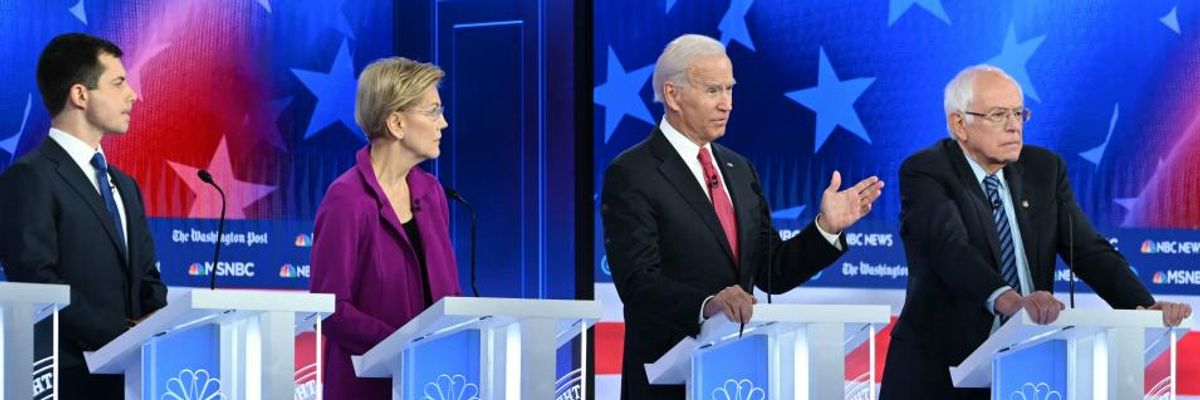
Democratic presidential hopefuls Mayor of South Bend Pete Buttigieg, Massachusetts Senator Elizabeth Warren, Former Vice President Joe Biden and Vermont Senator Bernie Sanders participate in the fifth Democratic primary debate of the 2020 presidential campaign season co-hosted by MSNBC and The Washington Post at Tyler Perry Studios in Atlanta, Georgia on November 20, 2019. (Photo: Saul Loeb/AFP/Getty Images)
Anyone who's been paying attention should get the picture by now. Overall, in subtle and sledgehammer ways, the mass media of the United States--owned and sponsored by corporate giants--are in the midst of a siege against the two progressive Democratic candidates who have a real chance to be elected president in 2020.
Some of the prevalent media bias has taken the form of protracted swoons for numerous "center lane" opponents of Bernie Sanders and Elizabeth Warren. The recent entry of Michael Bloomberg has further jammed that lane, adding a plutocrat "worth" upwards of $50 billion to a bevy of corporate politicians.
The mainline media are generally quite warm toward so-called "moderates," without bothering to question what's so moderate about such positions as bowing to corporate plunder, backing rampant militarism and refusing to seriously confront the climate emergency.
Critical reporting on debate performances and campaign operations has certainly been common. But the core of the "moderate" agenda routinely gets affirmation from elite journalists who told us in no uncertain terms four years ago that Hillary Clinton was obviously the nominee who could defeat Donald Trump.
This year, Sanders has taken most of the flak from reporters and pundits (often virtually indistinguishable), serving as a kind of "heat shield" for Warren. But as Warren gained ground in polling this fall, the attacks on her escalated--to the point that she now has a corporate media bullseye on her political back.
"What's at stake includes democracy--the informed consent of the governed--and so much more."
The disconnect between voters and corporate media is often huge. Meanwhile, with fly-on-the-wall pretenses, media outlets that have powerfully distorted proposals like Medicare for All are now reporting (with thinly veiled satisfaction) that voters are cool to those proposals.
The Washington Post, owned by one of the world's richest people Jeff Bezos, has routinely spun Medicare for All as some sort of government takeover. In a prominent Nov. 30 news story that largely attributed Warren's recent dip in polls to her positioning on healthcare, the Post matter-of-factly--and falsely--referred to Medicare for All as "government-run healthcare" and "a government-run health plan."
Such pervasive mass-media reporting smoothed the way for deceptions that have elevated Pete Buttigieg in polls during recent weeks with his deceptive "Medicare for All Who Want It" slogan. That rhetoric springboards from the false premises that Medicare for All would deprive people of meaningful choice and would somehow reduce coverage.
In late September, with scant media scrutiny, Buttigieg launched an ad campaign against Medicare for All that has continued. Using insurance-industry talking points, he is deliberately confusing the current "choice" of predatory for-profit insurance plans with the genuine full choice of healthcare providers that top-quality Medicare for everyone would offer.
Mainstream media outlets are ill-positioned to refute such distortions since they're routinely purveying such distortions themselves. Warren's backtracking step on Medicare for All in mid-November was a tribute to media pressure in tandem with attacks from centrist opponents.
The idea of implementing some form of a substantial "wealth tax" has also been denigrated by many corporate-employed journalists. Countless pundits and political beat reporters have warned that proposals like a wealth tax, from Warren and Sanders, risk dragging Democrats down with voters. The truth is that such proposals are unpopular with the punditocracy and the extremely wealthy--while it's a very different matter for most voters, who strongly favor a wealth tax.
On the same day this fall, the New York Times and the Washington Post published stories on Democratic elites' "anxiety" about the presidential election. The Post wrote that Democrats "fret" Warren and Sanders "are too liberal to win a general election." (With disdain, the article made a matter-of-fact reference to "the push for liberal purity.") The Times similarly wrote of "persistent questions about Senator Elizabeth Warren's viability in the general election." Contrary voices were absent in both news stories.
Assessing those articles, FAIR.org media analyst Julie Hollar pointed out: "The pieces interviewed a number of big donors and centrist party leaders, who fretted about their preferred candidate's struggles and expressed hope for someone more corporate-friendly than Warren to enter the race and challenge her rise."
Hollar added: "The thinking of powerful people in the Democratic Party is worth writing about. But it's crucial not to just take their claims at face value. . . . What establishment Democrats are really worried about, of course, is their own power in the party, which is threatened by a surging left wing. Don't look to their establishment media counterparts to report on that transparently."
Part of the problem is the TV network that many Democrats (mistakenly) trust. MSNBC is becoming notorious for its hostility to Bernie Sanders, often expressed through egregious omission or mathematical fib if not direct antipathy.
Ongoing media analysis is crucial, but even more important is activist pushback against the 24/7 onslaught of corporate-minded propaganda, often couched as common sense and incontrovertible reality. Among the needed counterpunches are these:
You shouldn't have to be an active supporter of Bernie Sanders (as I am) or of Elizabeth Warren to voice outrage about corporate media biases. What's at stake includes democracy--the informed consent of the governed--and so much more.
History is unfolding in real time. It's not a product on the media shelf, to be passively bought and consumed. As Bernie 2020 campaign co-chair Nina Turner says, "All that we love is on the line."
Dear Common Dreams reader, It’s been nearly 30 years since I co-founded Common Dreams with my late wife, Lina Newhouser. We had the radical notion that journalism should serve the public good, not corporate profits. It was clear to us from the outset what it would take to build such a project. No paid advertisements. No corporate sponsors. No millionaire publisher telling us what to think or do. Many people said we wouldn't last a year, but we proved those doubters wrong. Together with a tremendous team of journalists and dedicated staff, we built an independent media outlet free from the constraints of profits and corporate control. Our mission has always been simple: To inform. To inspire. To ignite change for the common good. Building Common Dreams was not easy. Our survival was never guaranteed. When you take on the most powerful forces—Wall Street greed, fossil fuel industry destruction, Big Tech lobbyists, and uber-rich oligarchs who have spent billions upon billions rigging the economy and democracy in their favor—the only bulwark you have is supporters who believe in your work. But here’s the urgent message from me today. It's never been this bad out there. And it's never been this hard to keep us going. At the very moment Common Dreams is most needed, the threats we face are intensifying. We need your support now more than ever. We don't accept corporate advertising and never will. We don't have a paywall because we don't think people should be blocked from critical news based on their ability to pay. Everything we do is funded by the donations of readers like you. When everyone does the little they can afford, we are strong. But if that support retreats or dries up, so do we. Will you donate now to make sure Common Dreams not only survives but thrives? —Craig Brown, Co-founder |
Norman Solomon is the national director of RootsAction.org and executive director of the Institute for Public Accuracy. The paperback edition of his latest book, War Made Invisible: How America Hides the Human Toll of Its Military Machine, includes an afterword about the Gaza war.
Anyone who's been paying attention should get the picture by now. Overall, in subtle and sledgehammer ways, the mass media of the United States--owned and sponsored by corporate giants--are in the midst of a siege against the two progressive Democratic candidates who have a real chance to be elected president in 2020.
Some of the prevalent media bias has taken the form of protracted swoons for numerous "center lane" opponents of Bernie Sanders and Elizabeth Warren. The recent entry of Michael Bloomberg has further jammed that lane, adding a plutocrat "worth" upwards of $50 billion to a bevy of corporate politicians.
The mainline media are generally quite warm toward so-called "moderates," without bothering to question what's so moderate about such positions as bowing to corporate plunder, backing rampant militarism and refusing to seriously confront the climate emergency.
Critical reporting on debate performances and campaign operations has certainly been common. But the core of the "moderate" agenda routinely gets affirmation from elite journalists who told us in no uncertain terms four years ago that Hillary Clinton was obviously the nominee who could defeat Donald Trump.
This year, Sanders has taken most of the flak from reporters and pundits (often virtually indistinguishable), serving as a kind of "heat shield" for Warren. But as Warren gained ground in polling this fall, the attacks on her escalated--to the point that she now has a corporate media bullseye on her political back.
"What's at stake includes democracy--the informed consent of the governed--and so much more."
The disconnect between voters and corporate media is often huge. Meanwhile, with fly-on-the-wall pretenses, media outlets that have powerfully distorted proposals like Medicare for All are now reporting (with thinly veiled satisfaction) that voters are cool to those proposals.
The Washington Post, owned by one of the world's richest people Jeff Bezos, has routinely spun Medicare for All as some sort of government takeover. In a prominent Nov. 30 news story that largely attributed Warren's recent dip in polls to her positioning on healthcare, the Post matter-of-factly--and falsely--referred to Medicare for All as "government-run healthcare" and "a government-run health plan."
Such pervasive mass-media reporting smoothed the way for deceptions that have elevated Pete Buttigieg in polls during recent weeks with his deceptive "Medicare for All Who Want It" slogan. That rhetoric springboards from the false premises that Medicare for All would deprive people of meaningful choice and would somehow reduce coverage.
In late September, with scant media scrutiny, Buttigieg launched an ad campaign against Medicare for All that has continued. Using insurance-industry talking points, he is deliberately confusing the current "choice" of predatory for-profit insurance plans with the genuine full choice of healthcare providers that top-quality Medicare for everyone would offer.
Mainstream media outlets are ill-positioned to refute such distortions since they're routinely purveying such distortions themselves. Warren's backtracking step on Medicare for All in mid-November was a tribute to media pressure in tandem with attacks from centrist opponents.
The idea of implementing some form of a substantial "wealth tax" has also been denigrated by many corporate-employed journalists. Countless pundits and political beat reporters have warned that proposals like a wealth tax, from Warren and Sanders, risk dragging Democrats down with voters. The truth is that such proposals are unpopular with the punditocracy and the extremely wealthy--while it's a very different matter for most voters, who strongly favor a wealth tax.
On the same day this fall, the New York Times and the Washington Post published stories on Democratic elites' "anxiety" about the presidential election. The Post wrote that Democrats "fret" Warren and Sanders "are too liberal to win a general election." (With disdain, the article made a matter-of-fact reference to "the push for liberal purity.") The Times similarly wrote of "persistent questions about Senator Elizabeth Warren's viability in the general election." Contrary voices were absent in both news stories.
Assessing those articles, FAIR.org media analyst Julie Hollar pointed out: "The pieces interviewed a number of big donors and centrist party leaders, who fretted about their preferred candidate's struggles and expressed hope for someone more corporate-friendly than Warren to enter the race and challenge her rise."
Hollar added: "The thinking of powerful people in the Democratic Party is worth writing about. But it's crucial not to just take their claims at face value. . . . What establishment Democrats are really worried about, of course, is their own power in the party, which is threatened by a surging left wing. Don't look to their establishment media counterparts to report on that transparently."
Part of the problem is the TV network that many Democrats (mistakenly) trust. MSNBC is becoming notorious for its hostility to Bernie Sanders, often expressed through egregious omission or mathematical fib if not direct antipathy.
Ongoing media analysis is crucial, but even more important is activist pushback against the 24/7 onslaught of corporate-minded propaganda, often couched as common sense and incontrovertible reality. Among the needed counterpunches are these:
You shouldn't have to be an active supporter of Bernie Sanders (as I am) or of Elizabeth Warren to voice outrage about corporate media biases. What's at stake includes democracy--the informed consent of the governed--and so much more.
History is unfolding in real time. It's not a product on the media shelf, to be passively bought and consumed. As Bernie 2020 campaign co-chair Nina Turner says, "All that we love is on the line."
Norman Solomon is the national director of RootsAction.org and executive director of the Institute for Public Accuracy. The paperback edition of his latest book, War Made Invisible: How America Hides the Human Toll of Its Military Machine, includes an afterword about the Gaza war.
Anyone who's been paying attention should get the picture by now. Overall, in subtle and sledgehammer ways, the mass media of the United States--owned and sponsored by corporate giants--are in the midst of a siege against the two progressive Democratic candidates who have a real chance to be elected president in 2020.
Some of the prevalent media bias has taken the form of protracted swoons for numerous "center lane" opponents of Bernie Sanders and Elizabeth Warren. The recent entry of Michael Bloomberg has further jammed that lane, adding a plutocrat "worth" upwards of $50 billion to a bevy of corporate politicians.
The mainline media are generally quite warm toward so-called "moderates," without bothering to question what's so moderate about such positions as bowing to corporate plunder, backing rampant militarism and refusing to seriously confront the climate emergency.
Critical reporting on debate performances and campaign operations has certainly been common. But the core of the "moderate" agenda routinely gets affirmation from elite journalists who told us in no uncertain terms four years ago that Hillary Clinton was obviously the nominee who could defeat Donald Trump.
This year, Sanders has taken most of the flak from reporters and pundits (often virtually indistinguishable), serving as a kind of "heat shield" for Warren. But as Warren gained ground in polling this fall, the attacks on her escalated--to the point that she now has a corporate media bullseye on her political back.
"What's at stake includes democracy--the informed consent of the governed--and so much more."
The disconnect between voters and corporate media is often huge. Meanwhile, with fly-on-the-wall pretenses, media outlets that have powerfully distorted proposals like Medicare for All are now reporting (with thinly veiled satisfaction) that voters are cool to those proposals.
The Washington Post, owned by one of the world's richest people Jeff Bezos, has routinely spun Medicare for All as some sort of government takeover. In a prominent Nov. 30 news story that largely attributed Warren's recent dip in polls to her positioning on healthcare, the Post matter-of-factly--and falsely--referred to Medicare for All as "government-run healthcare" and "a government-run health plan."
Such pervasive mass-media reporting smoothed the way for deceptions that have elevated Pete Buttigieg in polls during recent weeks with his deceptive "Medicare for All Who Want It" slogan. That rhetoric springboards from the false premises that Medicare for All would deprive people of meaningful choice and would somehow reduce coverage.
In late September, with scant media scrutiny, Buttigieg launched an ad campaign against Medicare for All that has continued. Using insurance-industry talking points, he is deliberately confusing the current "choice" of predatory for-profit insurance plans with the genuine full choice of healthcare providers that top-quality Medicare for everyone would offer.
Mainstream media outlets are ill-positioned to refute such distortions since they're routinely purveying such distortions themselves. Warren's backtracking step on Medicare for All in mid-November was a tribute to media pressure in tandem with attacks from centrist opponents.
The idea of implementing some form of a substantial "wealth tax" has also been denigrated by many corporate-employed journalists. Countless pundits and political beat reporters have warned that proposals like a wealth tax, from Warren and Sanders, risk dragging Democrats down with voters. The truth is that such proposals are unpopular with the punditocracy and the extremely wealthy--while it's a very different matter for most voters, who strongly favor a wealth tax.
On the same day this fall, the New York Times and the Washington Post published stories on Democratic elites' "anxiety" about the presidential election. The Post wrote that Democrats "fret" Warren and Sanders "are too liberal to win a general election." (With disdain, the article made a matter-of-fact reference to "the push for liberal purity.") The Times similarly wrote of "persistent questions about Senator Elizabeth Warren's viability in the general election." Contrary voices were absent in both news stories.
Assessing those articles, FAIR.org media analyst Julie Hollar pointed out: "The pieces interviewed a number of big donors and centrist party leaders, who fretted about their preferred candidate's struggles and expressed hope for someone more corporate-friendly than Warren to enter the race and challenge her rise."
Hollar added: "The thinking of powerful people in the Democratic Party is worth writing about. But it's crucial not to just take their claims at face value. . . . What establishment Democrats are really worried about, of course, is their own power in the party, which is threatened by a surging left wing. Don't look to their establishment media counterparts to report on that transparently."
Part of the problem is the TV network that many Democrats (mistakenly) trust. MSNBC is becoming notorious for its hostility to Bernie Sanders, often expressed through egregious omission or mathematical fib if not direct antipathy.
Ongoing media analysis is crucial, but even more important is activist pushback against the 24/7 onslaught of corporate-minded propaganda, often couched as common sense and incontrovertible reality. Among the needed counterpunches are these:
You shouldn't have to be an active supporter of Bernie Sanders (as I am) or of Elizabeth Warren to voice outrage about corporate media biases. What's at stake includes democracy--the informed consent of the governed--and so much more.
History is unfolding in real time. It's not a product on the media shelf, to be passively bought and consumed. As Bernie 2020 campaign co-chair Nina Turner says, "All that we love is on the line."