SUBSCRIBE TO OUR FREE NEWSLETTER
Daily news & progressive opinion—funded by the people, not the corporations—delivered straight to your inbox.
5
#000000
#FFFFFF
To donate by check, phone, or other method, see our More Ways to Give page.
Daily news & progressive opinion—funded by the people, not the corporations—delivered straight to your inbox.
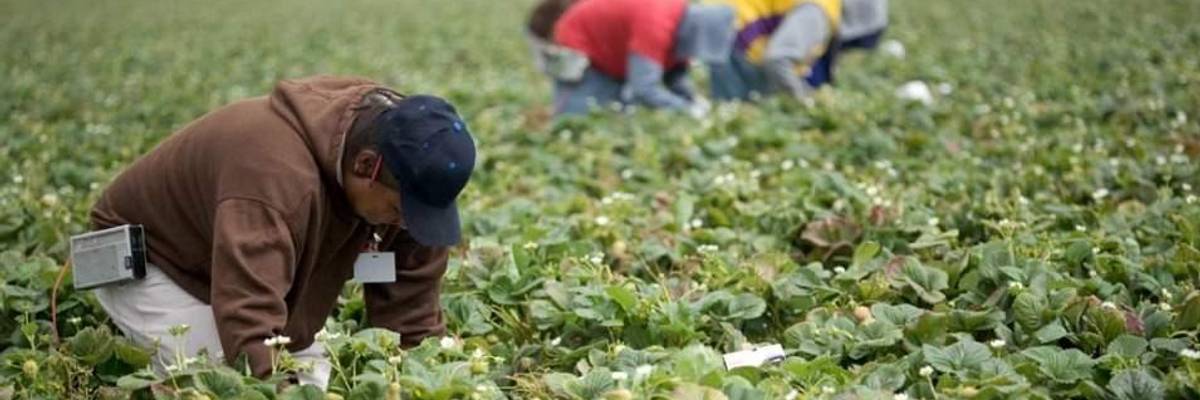
Farmworkers--according to some estimates numbering approximately three million--are forced to work for next to nothing as the landowners that employ them receive prices that are well below the cost of production. (Photo: Michael Davidson/flickr/cc)
Democrats need to study history and follow the example of Theodore Roosevelt, in other words, become "trust busters." Roosevelt was a Republican and his willingness to confront the monopolists of his day earned him scorn from some, yet enough support to win the Presidency in 1904. Eventually, the Democratic Party took up the gauntlet of Progressivism from Roosevelt and other courageous and successful politicians, like Bob LaFollette - finally passing it to Franklin Roosevelt, a man of wealth accused of being "a traitor to his class".
Progressivism is growing within the Democratic party. Senators Cory Booker (D-NJ) and Jon Tester (D-MT) and Representative Mark Pocan (D-WI) have coauthored a bill to place an immediate moratorium on large acquisitions and mergers in the food and agriculture sector. Presidential candidates Elizabeth Warren and Bernie Sanders have insisted it is long past time to break up agribusiness giants.
The problems are clear - overall, farm incomes in 2018 reached a 12-year low. As 2019 unfolds, a positive turnaround is uncertain. In Wisconsin, farm bankruptcies continue, and the ongoing trade dispute with the Chinese government led by the Trump administration continues to pull down grain prices.
Food industry monopolists are behind the dismal economic reality of rural America.Food industry monopolists are behind the dismal economic reality of rural America.
According to data compiled by the University of Missouri-Columbia in 2012, the four largest food and agriculture companies controlled 82 percent of the beef packing industry, 85 percent of soybean processing and 63 percent of pork. Market concentration drives up the prices that farmers pay for inputs, such as seeds, and forces them to accept lower prices due to the lack of any pretense of a competitive marketplace.
Farmworkers - according to some estimates numbering approximately three million - are forced to work for next to nothing as the landowners that employ them receive prices that are well below the cost of production. The inequity of the market that oppresses farmers and farmworkers does not benefit consumers either. According to Food and Water Watch, the prices that consumers pay at the grocery store have remained steady as those who produce our food struggle to make ends meet.
Not everyone in the food industry is hurting. In 2018, Brazilian agribusiness giant JBS, the world's leading beef and pork processor, Land O'Lakes, a major player in dairy processing and seeds, grain marketer Cargill and the meat processor and marketer, Tyson, all increased their profits over the 2017 fiscal year.
Many of these same actors have been accused of breaking antitrust laws. Recently, Tyson, Cargill, and JBS have been accused of fixing prices to increase profit margins at the expense of farmers and ranchers. In another settlement, Tyson agreed to an out of court payment to food system workers for wage theft. Land O'Lakes, has also settled out of court for fixing prices on eggs and milk, while Dean Foods, paid dairy farmers millions just a few years ago for price fixing.
The economy is rigged and Washington has done nothing outside of the $12 billion "farmer aid package" that was issued in 2018, and yet another ad hoc $16 billion bailout that was announced May 23rd. With a final twist of the knife, the USDA eliminated the Grain Inspection, Packers and Stockyards Administration (GIPSA), and with it, any hope for anti-trust enforcement in the meatpacking industry.
Truth is, farmers don't want to put taxpayers on the hook. Farmers want fair trade and an end to Trump's tariffs, a personal fight that has created uncertainty in the marketplace. The Booker/Pocan/Tester Bill is a start, but more can be done. The Democratic candidates need to talk about corporate concentration and antitrust seriously, starting with the Progressive Era Sherman, Clayton and Federal Trade Commission Acts. Over one hundred years ago, these laws were created to investigate and punish corporations for anti-competitive practices -- such as mergers, price fixing and rigging contracts.
The Reagan administration, challenged the federal government's antitrust philosophy, claiming that "bigger was better," and that relaxing antitrust law enforcement would benefit everyone. Since the Reagan era, efforts to dismantle antitrust enforcement have been put on steroids in every sector of the economy. We know how the game has played out. Corporations cash in as farmers and farmworkers see their incomes plummet, and consumers get swindled at the grocery store.
The Department of Justice - at the federal and state levels must launch serious investigations into the illegal practices of agribusiness corporations, including the effects of mergers and acquisitions on food system workers. Next, breaking up corporations must be seriously considered - this means overturning past mergers, as well as looking into breaking up the corporate processors, retailers, and distributors that currently control the food system.
Anti-trust enforcement, like the greed it seeks to beat down, is never ending . The enforcement of anti-trust laws means continual oversight and regulation of corporate practices. This will require increased funding for the Department of Justice and the Federal Trade Commission to support a staff committed to public, not corporate service.
For decades Democrats and Republicans have let corporate concentration and power grow, while the incomes of farmers and farmworkers shrink. We have seen a steady erosion of regulation, when we need more of it. It's heartening that the Democrats have realized that rural America is out there, and that market concentration is a very real problem. Taking on the monopolists is a serious task; now, it's up to the Democrats to decide if they are truly willing to invest in our food system and rural America.
Dear Common Dreams reader, It’s been nearly 30 years since I co-founded Common Dreams with my late wife, Lina Newhouser. We had the radical notion that journalism should serve the public good, not corporate profits. It was clear to us from the outset what it would take to build such a project. No paid advertisements. No corporate sponsors. No millionaire publisher telling us what to think or do. Many people said we wouldn't last a year, but we proved those doubters wrong. Together with a tremendous team of journalists and dedicated staff, we built an independent media outlet free from the constraints of profits and corporate control. Our mission has always been simple: To inform. To inspire. To ignite change for the common good. Building Common Dreams was not easy. Our survival was never guaranteed. When you take on the most powerful forces—Wall Street greed, fossil fuel industry destruction, Big Tech lobbyists, and uber-rich oligarchs who have spent billions upon billions rigging the economy and democracy in their favor—the only bulwark you have is supporters who believe in your work. But here’s the urgent message from me today. It's never been this bad out there. And it's never been this hard to keep us going. At the very moment Common Dreams is most needed, the threats we face are intensifying. We need your support now more than ever. We don't accept corporate advertising and never will. We don't have a paywall because we don't think people should be blocked from critical news based on their ability to pay. Everything we do is funded by the donations of readers like you. When everyone does the little they can afford, we are strong. But if that support retreats or dries up, so do we. Will you donate now to make sure Common Dreams not only survives but thrives? —Craig Brown, Co-founder |
Democrats need to study history and follow the example of Theodore Roosevelt, in other words, become "trust busters." Roosevelt was a Republican and his willingness to confront the monopolists of his day earned him scorn from some, yet enough support to win the Presidency in 1904. Eventually, the Democratic Party took up the gauntlet of Progressivism from Roosevelt and other courageous and successful politicians, like Bob LaFollette - finally passing it to Franklin Roosevelt, a man of wealth accused of being "a traitor to his class".
Progressivism is growing within the Democratic party. Senators Cory Booker (D-NJ) and Jon Tester (D-MT) and Representative Mark Pocan (D-WI) have coauthored a bill to place an immediate moratorium on large acquisitions and mergers in the food and agriculture sector. Presidential candidates Elizabeth Warren and Bernie Sanders have insisted it is long past time to break up agribusiness giants.
The problems are clear - overall, farm incomes in 2018 reached a 12-year low. As 2019 unfolds, a positive turnaround is uncertain. In Wisconsin, farm bankruptcies continue, and the ongoing trade dispute with the Chinese government led by the Trump administration continues to pull down grain prices.
Food industry monopolists are behind the dismal economic reality of rural America.Food industry monopolists are behind the dismal economic reality of rural America.
According to data compiled by the University of Missouri-Columbia in 2012, the four largest food and agriculture companies controlled 82 percent of the beef packing industry, 85 percent of soybean processing and 63 percent of pork. Market concentration drives up the prices that farmers pay for inputs, such as seeds, and forces them to accept lower prices due to the lack of any pretense of a competitive marketplace.
Farmworkers - according to some estimates numbering approximately three million - are forced to work for next to nothing as the landowners that employ them receive prices that are well below the cost of production. The inequity of the market that oppresses farmers and farmworkers does not benefit consumers either. According to Food and Water Watch, the prices that consumers pay at the grocery store have remained steady as those who produce our food struggle to make ends meet.
Not everyone in the food industry is hurting. In 2018, Brazilian agribusiness giant JBS, the world's leading beef and pork processor, Land O'Lakes, a major player in dairy processing and seeds, grain marketer Cargill and the meat processor and marketer, Tyson, all increased their profits over the 2017 fiscal year.
Many of these same actors have been accused of breaking antitrust laws. Recently, Tyson, Cargill, and JBS have been accused of fixing prices to increase profit margins at the expense of farmers and ranchers. In another settlement, Tyson agreed to an out of court payment to food system workers for wage theft. Land O'Lakes, has also settled out of court for fixing prices on eggs and milk, while Dean Foods, paid dairy farmers millions just a few years ago for price fixing.
The economy is rigged and Washington has done nothing outside of the $12 billion "farmer aid package" that was issued in 2018, and yet another ad hoc $16 billion bailout that was announced May 23rd. With a final twist of the knife, the USDA eliminated the Grain Inspection, Packers and Stockyards Administration (GIPSA), and with it, any hope for anti-trust enforcement in the meatpacking industry.
Truth is, farmers don't want to put taxpayers on the hook. Farmers want fair trade and an end to Trump's tariffs, a personal fight that has created uncertainty in the marketplace. The Booker/Pocan/Tester Bill is a start, but more can be done. The Democratic candidates need to talk about corporate concentration and antitrust seriously, starting with the Progressive Era Sherman, Clayton and Federal Trade Commission Acts. Over one hundred years ago, these laws were created to investigate and punish corporations for anti-competitive practices -- such as mergers, price fixing and rigging contracts.
The Reagan administration, challenged the federal government's antitrust philosophy, claiming that "bigger was better," and that relaxing antitrust law enforcement would benefit everyone. Since the Reagan era, efforts to dismantle antitrust enforcement have been put on steroids in every sector of the economy. We know how the game has played out. Corporations cash in as farmers and farmworkers see their incomes plummet, and consumers get swindled at the grocery store.
The Department of Justice - at the federal and state levels must launch serious investigations into the illegal practices of agribusiness corporations, including the effects of mergers and acquisitions on food system workers. Next, breaking up corporations must be seriously considered - this means overturning past mergers, as well as looking into breaking up the corporate processors, retailers, and distributors that currently control the food system.
Anti-trust enforcement, like the greed it seeks to beat down, is never ending . The enforcement of anti-trust laws means continual oversight and regulation of corporate practices. This will require increased funding for the Department of Justice and the Federal Trade Commission to support a staff committed to public, not corporate service.
For decades Democrats and Republicans have let corporate concentration and power grow, while the incomes of farmers and farmworkers shrink. We have seen a steady erosion of regulation, when we need more of it. It's heartening that the Democrats have realized that rural America is out there, and that market concentration is a very real problem. Taking on the monopolists is a serious task; now, it's up to the Democrats to decide if they are truly willing to invest in our food system and rural America.
Democrats need to study history and follow the example of Theodore Roosevelt, in other words, become "trust busters." Roosevelt was a Republican and his willingness to confront the monopolists of his day earned him scorn from some, yet enough support to win the Presidency in 1904. Eventually, the Democratic Party took up the gauntlet of Progressivism from Roosevelt and other courageous and successful politicians, like Bob LaFollette - finally passing it to Franklin Roosevelt, a man of wealth accused of being "a traitor to his class".
Progressivism is growing within the Democratic party. Senators Cory Booker (D-NJ) and Jon Tester (D-MT) and Representative Mark Pocan (D-WI) have coauthored a bill to place an immediate moratorium on large acquisitions and mergers in the food and agriculture sector. Presidential candidates Elizabeth Warren and Bernie Sanders have insisted it is long past time to break up agribusiness giants.
The problems are clear - overall, farm incomes in 2018 reached a 12-year low. As 2019 unfolds, a positive turnaround is uncertain. In Wisconsin, farm bankruptcies continue, and the ongoing trade dispute with the Chinese government led by the Trump administration continues to pull down grain prices.
Food industry monopolists are behind the dismal economic reality of rural America.Food industry monopolists are behind the dismal economic reality of rural America.
According to data compiled by the University of Missouri-Columbia in 2012, the four largest food and agriculture companies controlled 82 percent of the beef packing industry, 85 percent of soybean processing and 63 percent of pork. Market concentration drives up the prices that farmers pay for inputs, such as seeds, and forces them to accept lower prices due to the lack of any pretense of a competitive marketplace.
Farmworkers - according to some estimates numbering approximately three million - are forced to work for next to nothing as the landowners that employ them receive prices that are well below the cost of production. The inequity of the market that oppresses farmers and farmworkers does not benefit consumers either. According to Food and Water Watch, the prices that consumers pay at the grocery store have remained steady as those who produce our food struggle to make ends meet.
Not everyone in the food industry is hurting. In 2018, Brazilian agribusiness giant JBS, the world's leading beef and pork processor, Land O'Lakes, a major player in dairy processing and seeds, grain marketer Cargill and the meat processor and marketer, Tyson, all increased their profits over the 2017 fiscal year.
Many of these same actors have been accused of breaking antitrust laws. Recently, Tyson, Cargill, and JBS have been accused of fixing prices to increase profit margins at the expense of farmers and ranchers. In another settlement, Tyson agreed to an out of court payment to food system workers for wage theft. Land O'Lakes, has also settled out of court for fixing prices on eggs and milk, while Dean Foods, paid dairy farmers millions just a few years ago for price fixing.
The economy is rigged and Washington has done nothing outside of the $12 billion "farmer aid package" that was issued in 2018, and yet another ad hoc $16 billion bailout that was announced May 23rd. With a final twist of the knife, the USDA eliminated the Grain Inspection, Packers and Stockyards Administration (GIPSA), and with it, any hope for anti-trust enforcement in the meatpacking industry.
Truth is, farmers don't want to put taxpayers on the hook. Farmers want fair trade and an end to Trump's tariffs, a personal fight that has created uncertainty in the marketplace. The Booker/Pocan/Tester Bill is a start, but more can be done. The Democratic candidates need to talk about corporate concentration and antitrust seriously, starting with the Progressive Era Sherman, Clayton and Federal Trade Commission Acts. Over one hundred years ago, these laws were created to investigate and punish corporations for anti-competitive practices -- such as mergers, price fixing and rigging contracts.
The Reagan administration, challenged the federal government's antitrust philosophy, claiming that "bigger was better," and that relaxing antitrust law enforcement would benefit everyone. Since the Reagan era, efforts to dismantle antitrust enforcement have been put on steroids in every sector of the economy. We know how the game has played out. Corporations cash in as farmers and farmworkers see their incomes plummet, and consumers get swindled at the grocery store.
The Department of Justice - at the federal and state levels must launch serious investigations into the illegal practices of agribusiness corporations, including the effects of mergers and acquisitions on food system workers. Next, breaking up corporations must be seriously considered - this means overturning past mergers, as well as looking into breaking up the corporate processors, retailers, and distributors that currently control the food system.
Anti-trust enforcement, like the greed it seeks to beat down, is never ending . The enforcement of anti-trust laws means continual oversight and regulation of corporate practices. This will require increased funding for the Department of Justice and the Federal Trade Commission to support a staff committed to public, not corporate service.
For decades Democrats and Republicans have let corporate concentration and power grow, while the incomes of farmers and farmworkers shrink. We have seen a steady erosion of regulation, when we need more of it. It's heartening that the Democrats have realized that rural America is out there, and that market concentration is a very real problem. Taking on the monopolists is a serious task; now, it's up to the Democrats to decide if they are truly willing to invest in our food system and rural America.