SUBSCRIBE TO OUR FREE NEWSLETTER
Daily news & progressive opinion—funded by the people, not the corporations—delivered straight to your inbox.
5
#000000
#FFFFFF
To donate by check, phone, or other method, see our More Ways to Give page.


Daily news & progressive opinion—funded by the people, not the corporations—delivered straight to your inbox.

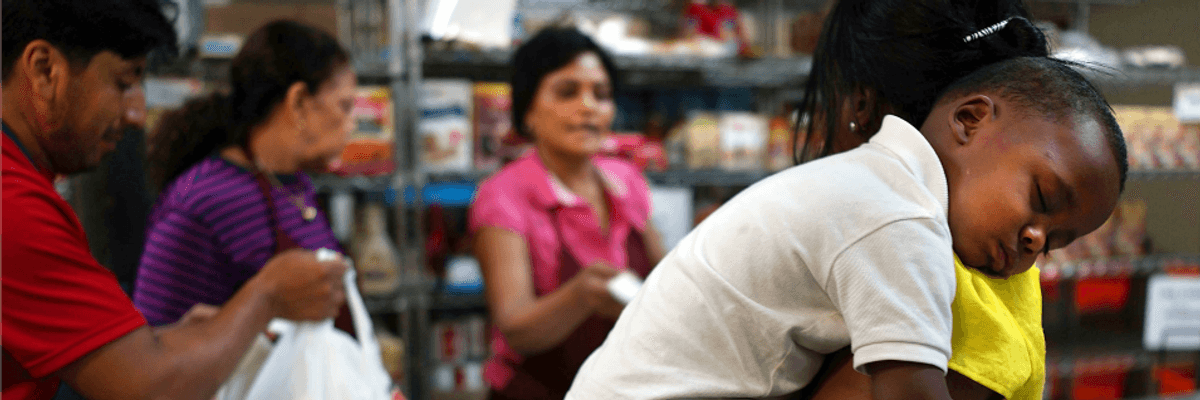
A young boy rests on his mother's shoulder at the West Side Campaign Against Hunger food bank on July 24, 2013 in New York City. The food bank assists thousands of qualifying New York residents in providing a monthly allotment of food. (Photo: Spencer Platt/Getty Images)
I was born to teenage parents who got married young and divorced early. My mother raised me herself, along with my six younger siblings, in Cleveland, and life wasn't easy even in the best of times. At age 42, she died, and it fell on me, then aged 22 and working minimum wage, to take care of all of us. At the time, I was newly married with a baby son. And I was deeply afraid for our future.
My mother was born into a solidly middle-class family, but, as all too many Americans understand, everything doesn't always go as planned--no matter how hard you work. She died on welfare. Without the support of the state, I shudder to think of where we would have ended up. As is true for millions of Americans, the social safety net saved us. It saved my mother when she was raising her children, and it saved us after she was gone. If not for food stamps, Medicaid, and various job programs, I would never have gone on to be the first in my family to go to college, the first black woman to represent my ward on the Cleveland City Council, and, ultimately, a State Senator.
"How bad do things have to get before we demand real change?"
For millions of families in this country like the one I grew up in, the stakes are literally life or death when it comes to benefiting from universal programs--or lack thereof. About 20,000 people a year die from not being able to afford health insurance. And Hispanic and black Americans are particularly impacted by our fatally costly health-care system: One out of four non-elderly Hispanic Americans and almost one out of 10 non-elderly black Americans are under- or uninsured. Given that medical bills are the number one cause of bankruptcy in this country, of course health-care costs fuel the already shameful wealth disparity between people of color and white Americans. Many families lose their homes and go into debt in order to pay for medical services.
In the fight against poverty, the difference between a $12 minimum wage and a $15 minimum is anything but immaterial. To be cavalier about that $3 difference (as some critics are, even among liberals)--a difference that is nearly half of the federal minimum wage--is, frankly, an act of privilege. And women disproportionately suffer from the austerity of low pay: Most minimum-wage workers are female, and in all but one state women make up at least 60 percent of the low-wage workforce. And in 15 states, that number is two-thirds. As my friend Kerri Evelyn Harris at Working Hero Action often points out, it takes about three hours of work at the federal minimum wage to afford one box of off-brand diapers. It takes two hours of work to buy the ingredients to make a peanut-butter-and-jelly sandwich.
In no state in this country can a person earning the minimum wage afford the average rent of a one-bedroom apartment. Forty percent of Americans cannot come up with the money to address a $400 emergency. And college costs have grown so exponentially that between just 2004 and 2017 the average student debt rose from $18,650 to $38,000.
Black women carry more student debt after graduation than any other group. Without federal Pell Grants and financial aid, I would never have been able to go to college while taking care of my family, but I'm still paying back loans to this day. My community embraced the narrative that education was the ticket to equality, and black women have become the most educated group in America. But what do we have to show for it? Black women still make 37 percent less than their white male counterparts. And we have fewer opportunities to save money, start businesses, and grow intergenerational wealth because we're indebted to a system that yields inadequate dividends.
How bad do things have to get before we demand real change?
In 2014, I ran for Ohio secretary of state on anti-poverty measures, campaign-finance reform, and ballot access. I ran on those issues that impact my community the most--not based merely on polls or focus groups but based on my own personal experiences, on knowing deeply that Americans need support from better, more just policies to enable them to thrive. The litany of inequities black people and particularly black women face isn't just the product of happenstance. These statistics are evidence of a rigged system, of a body politic that puts the interests of insurance companies, corporations, and pharmaceutical companies before the citizens who make this country worth protecting. Structural problems require structural solutions, and importantly they require leadership sufficiently independent from corporate influence that it will battle the wealthiest and most powerful interests in the country even at personal political risk.
I'm tired of politicians who kick the can of equality down the road to subsequent generations while the people we know and love suffer today. I'm tired of conversations around the big changes I have fought for and am fighting for still--like Medicare for All, free college tuition, and a $15 minimum wage--dismissing these ideas as too radical or carried out in terms of dollars instead of dignity. I know how much these ideas would have helped my own mother and my own family when we needed it. I want better for my son. I want better for myself.

Dear Common Dreams reader, It’s been nearly 30 years since I co-founded Common Dreams with my late wife, Lina Newhouser. We had the radical notion that journalism should serve the public good, not corporate profits. It was clear to us from the outset what it would take to build such a project. No paid advertisements. No corporate sponsors. No millionaire publisher telling us what to think or do. Many people said we wouldn't last a year, but we proved those doubters wrong. Together with a tremendous team of journalists and dedicated staff, we built an independent media outlet free from the constraints of profits and corporate control. Our mission has always been simple: To inform. To inspire. To ignite change for the common good. Building Common Dreams was not easy. Our survival was never guaranteed. When you take on the most powerful forces—Wall Street greed, fossil fuel industry destruction, Big Tech lobbyists, and uber-rich oligarchs who have spent billions upon billions rigging the economy and democracy in their favor—the only bulwark you have is supporters who believe in your work. But here’s the urgent message from me today. It's never been this bad out there. And it's never been this hard to keep us going. At the very moment Common Dreams is most needed, the threats we face are intensifying. We need your support now more than ever. We don't accept corporate advertising and never will. We don't have a paywall because we don't think people should be blocked from critical news based on their ability to pay. Everything we do is funded by the donations of readers like you. When everyone does the little they can afford, we are strong. But if that support retreats or dries up, so do we. Will you donate now to make sure Common Dreams not only survives but thrives? —Craig Brown, Co-founder |
I was born to teenage parents who got married young and divorced early. My mother raised me herself, along with my six younger siblings, in Cleveland, and life wasn't easy even in the best of times. At age 42, she died, and it fell on me, then aged 22 and working minimum wage, to take care of all of us. At the time, I was newly married with a baby son. And I was deeply afraid for our future.
My mother was born into a solidly middle-class family, but, as all too many Americans understand, everything doesn't always go as planned--no matter how hard you work. She died on welfare. Without the support of the state, I shudder to think of where we would have ended up. As is true for millions of Americans, the social safety net saved us. It saved my mother when she was raising her children, and it saved us after she was gone. If not for food stamps, Medicaid, and various job programs, I would never have gone on to be the first in my family to go to college, the first black woman to represent my ward on the Cleveland City Council, and, ultimately, a State Senator.
"How bad do things have to get before we demand real change?"
For millions of families in this country like the one I grew up in, the stakes are literally life or death when it comes to benefiting from universal programs--or lack thereof. About 20,000 people a year die from not being able to afford health insurance. And Hispanic and black Americans are particularly impacted by our fatally costly health-care system: One out of four non-elderly Hispanic Americans and almost one out of 10 non-elderly black Americans are under- or uninsured. Given that medical bills are the number one cause of bankruptcy in this country, of course health-care costs fuel the already shameful wealth disparity between people of color and white Americans. Many families lose their homes and go into debt in order to pay for medical services.
In the fight against poverty, the difference between a $12 minimum wage and a $15 minimum is anything but immaterial. To be cavalier about that $3 difference (as some critics are, even among liberals)--a difference that is nearly half of the federal minimum wage--is, frankly, an act of privilege. And women disproportionately suffer from the austerity of low pay: Most minimum-wage workers are female, and in all but one state women make up at least 60 percent of the low-wage workforce. And in 15 states, that number is two-thirds. As my friend Kerri Evelyn Harris at Working Hero Action often points out, it takes about three hours of work at the federal minimum wage to afford one box of off-brand diapers. It takes two hours of work to buy the ingredients to make a peanut-butter-and-jelly sandwich.
In no state in this country can a person earning the minimum wage afford the average rent of a one-bedroom apartment. Forty percent of Americans cannot come up with the money to address a $400 emergency. And college costs have grown so exponentially that between just 2004 and 2017 the average student debt rose from $18,650 to $38,000.
Black women carry more student debt after graduation than any other group. Without federal Pell Grants and financial aid, I would never have been able to go to college while taking care of my family, but I'm still paying back loans to this day. My community embraced the narrative that education was the ticket to equality, and black women have become the most educated group in America. But what do we have to show for it? Black women still make 37 percent less than their white male counterparts. And we have fewer opportunities to save money, start businesses, and grow intergenerational wealth because we're indebted to a system that yields inadequate dividends.
How bad do things have to get before we demand real change?
In 2014, I ran for Ohio secretary of state on anti-poverty measures, campaign-finance reform, and ballot access. I ran on those issues that impact my community the most--not based merely on polls or focus groups but based on my own personal experiences, on knowing deeply that Americans need support from better, more just policies to enable them to thrive. The litany of inequities black people and particularly black women face isn't just the product of happenstance. These statistics are evidence of a rigged system, of a body politic that puts the interests of insurance companies, corporations, and pharmaceutical companies before the citizens who make this country worth protecting. Structural problems require structural solutions, and importantly they require leadership sufficiently independent from corporate influence that it will battle the wealthiest and most powerful interests in the country even at personal political risk.
I'm tired of politicians who kick the can of equality down the road to subsequent generations while the people we know and love suffer today. I'm tired of conversations around the big changes I have fought for and am fighting for still--like Medicare for All, free college tuition, and a $15 minimum wage--dismissing these ideas as too radical or carried out in terms of dollars instead of dignity. I know how much these ideas would have helped my own mother and my own family when we needed it. I want better for my son. I want better for myself.
I was born to teenage parents who got married young and divorced early. My mother raised me herself, along with my six younger siblings, in Cleveland, and life wasn't easy even in the best of times. At age 42, she died, and it fell on me, then aged 22 and working minimum wage, to take care of all of us. At the time, I was newly married with a baby son. And I was deeply afraid for our future.
My mother was born into a solidly middle-class family, but, as all too many Americans understand, everything doesn't always go as planned--no matter how hard you work. She died on welfare. Without the support of the state, I shudder to think of where we would have ended up. As is true for millions of Americans, the social safety net saved us. It saved my mother when she was raising her children, and it saved us after she was gone. If not for food stamps, Medicaid, and various job programs, I would never have gone on to be the first in my family to go to college, the first black woman to represent my ward on the Cleveland City Council, and, ultimately, a State Senator.
"How bad do things have to get before we demand real change?"
For millions of families in this country like the one I grew up in, the stakes are literally life or death when it comes to benefiting from universal programs--or lack thereof. About 20,000 people a year die from not being able to afford health insurance. And Hispanic and black Americans are particularly impacted by our fatally costly health-care system: One out of four non-elderly Hispanic Americans and almost one out of 10 non-elderly black Americans are under- or uninsured. Given that medical bills are the number one cause of bankruptcy in this country, of course health-care costs fuel the already shameful wealth disparity between people of color and white Americans. Many families lose their homes and go into debt in order to pay for medical services.
In the fight against poverty, the difference between a $12 minimum wage and a $15 minimum is anything but immaterial. To be cavalier about that $3 difference (as some critics are, even among liberals)--a difference that is nearly half of the federal minimum wage--is, frankly, an act of privilege. And women disproportionately suffer from the austerity of low pay: Most minimum-wage workers are female, and in all but one state women make up at least 60 percent of the low-wage workforce. And in 15 states, that number is two-thirds. As my friend Kerri Evelyn Harris at Working Hero Action often points out, it takes about three hours of work at the federal minimum wage to afford one box of off-brand diapers. It takes two hours of work to buy the ingredients to make a peanut-butter-and-jelly sandwich.
In no state in this country can a person earning the minimum wage afford the average rent of a one-bedroom apartment. Forty percent of Americans cannot come up with the money to address a $400 emergency. And college costs have grown so exponentially that between just 2004 and 2017 the average student debt rose from $18,650 to $38,000.
Black women carry more student debt after graduation than any other group. Without federal Pell Grants and financial aid, I would never have been able to go to college while taking care of my family, but I'm still paying back loans to this day. My community embraced the narrative that education was the ticket to equality, and black women have become the most educated group in America. But what do we have to show for it? Black women still make 37 percent less than their white male counterparts. And we have fewer opportunities to save money, start businesses, and grow intergenerational wealth because we're indebted to a system that yields inadequate dividends.
How bad do things have to get before we demand real change?
In 2014, I ran for Ohio secretary of state on anti-poverty measures, campaign-finance reform, and ballot access. I ran on those issues that impact my community the most--not based merely on polls or focus groups but based on my own personal experiences, on knowing deeply that Americans need support from better, more just policies to enable them to thrive. The litany of inequities black people and particularly black women face isn't just the product of happenstance. These statistics are evidence of a rigged system, of a body politic that puts the interests of insurance companies, corporations, and pharmaceutical companies before the citizens who make this country worth protecting. Structural problems require structural solutions, and importantly they require leadership sufficiently independent from corporate influence that it will battle the wealthiest and most powerful interests in the country even at personal political risk.
I'm tired of politicians who kick the can of equality down the road to subsequent generations while the people we know and love suffer today. I'm tired of conversations around the big changes I have fought for and am fighting for still--like Medicare for All, free college tuition, and a $15 minimum wage--dismissing these ideas as too radical or carried out in terms of dollars instead of dignity. I know how much these ideas would have helped my own mother and my own family when we needed it. I want better for my son. I want better for myself.