SUBSCRIBE TO OUR FREE NEWSLETTER
Daily news & progressive opinion—funded by the people, not the corporations—delivered straight to your inbox.
5
#000000
#FFFFFF
To donate by check, phone, or other method, see our More Ways to Give page.
Daily news & progressive opinion—funded by the people, not the corporations—delivered straight to your inbox.
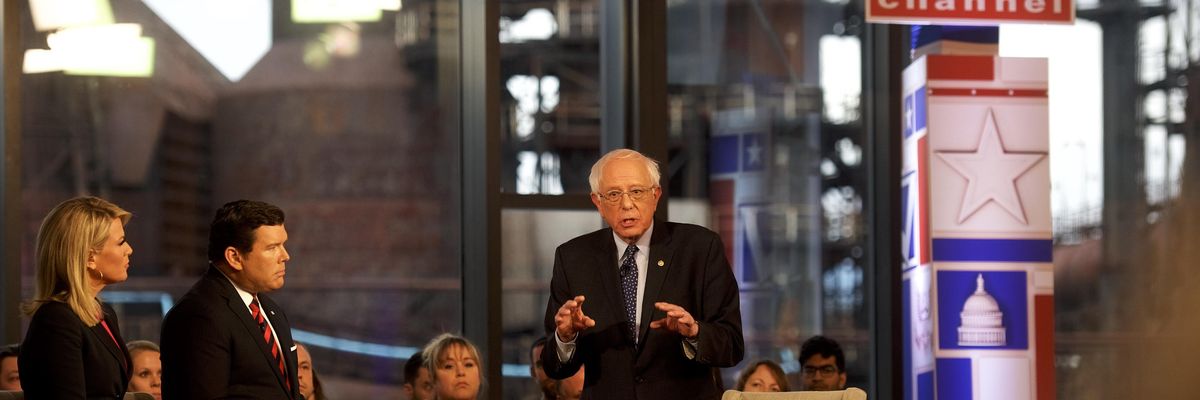
This line of Centrist critique is quite revealing. It perpetuates a prevailing discourse that progressives exist at the political extreme and therefore would like to further split the nation into warring camps. (Photo by Mark Makela/Getty Images)
Bernie Sanders shocked the mainstream establishment this week by appearing on a Fox News Town Hall. Even more surprisingly, he was triumphant on a station most known for its fervent support for Trump and extreme Conservatism. In the citadel of right wing media he effectively and convincingly promoted progressive policies such as medicare for all. Even if only for a night, he showed that a left wing agenda that promised to address people's real economic and social problems could unify the country in a common radical purpose.
Even if only for a night, he showed that a left wing agenda that promised to address people's real economic and social problems could unify the country in a common radical purpose.
Not surprisingly, though, prominent Democrats were less than impressed. Instead they criticized Sanders leading up to the event as a divider, someone more interested in populist rhetoric than actually leading the country. This came on the heels of a widely seen interview with Democratic Speaker of the House Nancy Pelosi where she directly attacked progressives as being an insignificant minority who would inevitably bow to her more "moderate" agenda. She proclaimed that they "were like five people" and that "by and large, whatever orientation they came to Congress with, they know that we have to hold the center. That we have to be, go down the mainstream"
This line of Centrist critique is quite revealing. It perpetuates a prevailing discourse that progressives exist at the political extreme and therefore would like to further split the nation into warring camps. By contrast, they offer the possibility of rising above these partisan passions with a message of shared hope and unity. According to a recent Washington Post article:
The divide over Sanders reflects a dilemma at the heart of the Democratic primary: Should the party nominate a Democratic version of Trump who can match his combativeness, energizing liberals and taking the fight to the president? Or should it embrace a consensus builder, one who can rise above the country's partisan anger and bring people together?
This, of course, is a strange message given that Sanders' campaign slogan is literally "Us, Not Me." Yet it also represents a more profound misconception of the Centrism. While it basks in the glow of unifying rhetoric, its policies maintain a status quo that worsens actual social, economic, and political inequality. Moreover, their notion of the unifying middle, is really a disappearing middle class who can embrace their compromised politics of incremental change, social liberalism for the 1%, and continuing oligarchy.
It further mask the deep seated partisanship at the heart of such self-proclaimed "moderation." Anyone who disagrees with their politics are either "deplorables" or "fanatics." Their hatred for the far right is perhaps only exceeded by their disdain for the "far left." In their efforts to be all things to all people, at once doing the bidding of their corporate donors while claiming to represent those most impacted by it, they rely on a base a rabidly partisan and unreflective as those faith based evangelicals and ignorant Trump supporters they most loathe.
What needs to be questioned, then, is who they are truly trying to unify and for what ideological and political purpose. It is telling that after the 2016 election Clinton still parroted the old Blue Dog refrain that the "real" America was neither rightwing or leftwing but squarely in the middle. Clinton declared in an interview with Ezra Klein on Vox that:
"We've shrunk the political process to such a narrow set of questions, and that's in the interests of both the far right and the far left, both of whom want to blow up system and undermine it. I think we operate better when we're kind of between center right and center left, because that's where, at least up until recently, most American were."
This statement exposed the fact that for Democrats the goal was to build a coalition of economic winners alongside those suffering economic and social injustice but with nowhere else to go. This unity would ensure that actually changing the system would be seen as either undesirable or impossible.
For Centrists the goal is bringing the country together in support of the status quo and ultimately all the class, racial, and gender divisions it intentionally and unintentionally perpetuates.
Sanders and other progressives offer a radically different notion of national unity. Notably, while declaring himself a "democratic socialist" his policies are firmly in the left of centre liberal tradition of Roosevelt in the US and Social Democrats in Europe. Where he and his acolytes are perhaps more revolutionary is in their commitment to a new type of political unity--one based on a shared desire to transform a corrupt system rather than tribal party allegiances. His appearance on Fox News was less a media stunt than a reflection of the progressive desire to bring the nation together in reducing inequality and rebalancing political power for the advantage of the majority.
Importantly, they preach and are increasingly putting into practice a politics of solidarity rather than merely coalition. It is premised on supporting each other against both the common oppression of free market capitalism and the individualised struggles that this also demands. Already this is being witnessed in the rise of the teacher's strikes across the country and the increasingly successful fight for a liveable minimum wage. Further, it coalesces around real demands for change rather than simply opposing the current demonised Republican in the White House and the promise of a new era of "lesser evils."
At its core, Centrism and Progressivism put forward two competing visions of the American Future. Both share in their desire to defeat Republicans and conservative ideologies. Each is passionate about the need to confront the rise of the far-right. However, for Centrists the goal is bringing the country together in support of the status quo and ultimately all the class, racial, and gender divisions it intentionally and unintentionally perpetuates. For progressives, it is about bridging these differences through constructing a shared radical politics of systematic change. In demanding that all people have a right to material security and political power, they are promoting a society where our common humanity transcends our socially constructed divisions, and where our differences are a source of strength not weakness.
In 2020, the first priority for most is and perhaps should be defeating Trump and stemming the rising tide of fascism. It is also imperative we overcome the limits of the divisive Centre--the mainstream ideas and politicians that continue to divide us according to class, geography, and party. To truly proclaim victory over Trump and all he stands for means embracing the possibilities of a unifying Left.
Dear Common Dreams reader, It’s been nearly 30 years since I co-founded Common Dreams with my late wife, Lina Newhouser. We had the radical notion that journalism should serve the public good, not corporate profits. It was clear to us from the outset what it would take to build such a project. No paid advertisements. No corporate sponsors. No millionaire publisher telling us what to think or do. Many people said we wouldn't last a year, but we proved those doubters wrong. Together with a tremendous team of journalists and dedicated staff, we built an independent media outlet free from the constraints of profits and corporate control. Our mission has always been simple: To inform. To inspire. To ignite change for the common good. Building Common Dreams was not easy. Our survival was never guaranteed. When you take on the most powerful forces—Wall Street greed, fossil fuel industry destruction, Big Tech lobbyists, and uber-rich oligarchs who have spent billions upon billions rigging the economy and democracy in their favor—the only bulwark you have is supporters who believe in your work. But here’s the urgent message from me today. It's never been this bad out there. And it's never been this hard to keep us going. At the very moment Common Dreams is most needed, the threats we face are intensifying. We need your support now more than ever. We don't accept corporate advertising and never will. We don't have a paywall because we don't think people should be blocked from critical news based on their ability to pay. Everything we do is funded by the donations of readers like you. When everyone does the little they can afford, we are strong. But if that support retreats or dries up, so do we. Will you donate now to make sure Common Dreams not only survives but thrives? —Craig Brown, Co-founder |
Bernie Sanders shocked the mainstream establishment this week by appearing on a Fox News Town Hall. Even more surprisingly, he was triumphant on a station most known for its fervent support for Trump and extreme Conservatism. In the citadel of right wing media he effectively and convincingly promoted progressive policies such as medicare for all. Even if only for a night, he showed that a left wing agenda that promised to address people's real economic and social problems could unify the country in a common radical purpose.
Even if only for a night, he showed that a left wing agenda that promised to address people's real economic and social problems could unify the country in a common radical purpose.
Not surprisingly, though, prominent Democrats were less than impressed. Instead they criticized Sanders leading up to the event as a divider, someone more interested in populist rhetoric than actually leading the country. This came on the heels of a widely seen interview with Democratic Speaker of the House Nancy Pelosi where she directly attacked progressives as being an insignificant minority who would inevitably bow to her more "moderate" agenda. She proclaimed that they "were like five people" and that "by and large, whatever orientation they came to Congress with, they know that we have to hold the center. That we have to be, go down the mainstream"
This line of Centrist critique is quite revealing. It perpetuates a prevailing discourse that progressives exist at the political extreme and therefore would like to further split the nation into warring camps. By contrast, they offer the possibility of rising above these partisan passions with a message of shared hope and unity. According to a recent Washington Post article:
The divide over Sanders reflects a dilemma at the heart of the Democratic primary: Should the party nominate a Democratic version of Trump who can match his combativeness, energizing liberals and taking the fight to the president? Or should it embrace a consensus builder, one who can rise above the country's partisan anger and bring people together?
This, of course, is a strange message given that Sanders' campaign slogan is literally "Us, Not Me." Yet it also represents a more profound misconception of the Centrism. While it basks in the glow of unifying rhetoric, its policies maintain a status quo that worsens actual social, economic, and political inequality. Moreover, their notion of the unifying middle, is really a disappearing middle class who can embrace their compromised politics of incremental change, social liberalism for the 1%, and continuing oligarchy.
It further mask the deep seated partisanship at the heart of such self-proclaimed "moderation." Anyone who disagrees with their politics are either "deplorables" or "fanatics." Their hatred for the far right is perhaps only exceeded by their disdain for the "far left." In their efforts to be all things to all people, at once doing the bidding of their corporate donors while claiming to represent those most impacted by it, they rely on a base a rabidly partisan and unreflective as those faith based evangelicals and ignorant Trump supporters they most loathe.
What needs to be questioned, then, is who they are truly trying to unify and for what ideological and political purpose. It is telling that after the 2016 election Clinton still parroted the old Blue Dog refrain that the "real" America was neither rightwing or leftwing but squarely in the middle. Clinton declared in an interview with Ezra Klein on Vox that:
"We've shrunk the political process to such a narrow set of questions, and that's in the interests of both the far right and the far left, both of whom want to blow up system and undermine it. I think we operate better when we're kind of between center right and center left, because that's where, at least up until recently, most American were."
This statement exposed the fact that for Democrats the goal was to build a coalition of economic winners alongside those suffering economic and social injustice but with nowhere else to go. This unity would ensure that actually changing the system would be seen as either undesirable or impossible.
For Centrists the goal is bringing the country together in support of the status quo and ultimately all the class, racial, and gender divisions it intentionally and unintentionally perpetuates.
Sanders and other progressives offer a radically different notion of national unity. Notably, while declaring himself a "democratic socialist" his policies are firmly in the left of centre liberal tradition of Roosevelt in the US and Social Democrats in Europe. Where he and his acolytes are perhaps more revolutionary is in their commitment to a new type of political unity--one based on a shared desire to transform a corrupt system rather than tribal party allegiances. His appearance on Fox News was less a media stunt than a reflection of the progressive desire to bring the nation together in reducing inequality and rebalancing political power for the advantage of the majority.
Importantly, they preach and are increasingly putting into practice a politics of solidarity rather than merely coalition. It is premised on supporting each other against both the common oppression of free market capitalism and the individualised struggles that this also demands. Already this is being witnessed in the rise of the teacher's strikes across the country and the increasingly successful fight for a liveable minimum wage. Further, it coalesces around real demands for change rather than simply opposing the current demonised Republican in the White House and the promise of a new era of "lesser evils."
At its core, Centrism and Progressivism put forward two competing visions of the American Future. Both share in their desire to defeat Republicans and conservative ideologies. Each is passionate about the need to confront the rise of the far-right. However, for Centrists the goal is bringing the country together in support of the status quo and ultimately all the class, racial, and gender divisions it intentionally and unintentionally perpetuates. For progressives, it is about bridging these differences through constructing a shared radical politics of systematic change. In demanding that all people have a right to material security and political power, they are promoting a society where our common humanity transcends our socially constructed divisions, and where our differences are a source of strength not weakness.
In 2020, the first priority for most is and perhaps should be defeating Trump and stemming the rising tide of fascism. It is also imperative we overcome the limits of the divisive Centre--the mainstream ideas and politicians that continue to divide us according to class, geography, and party. To truly proclaim victory over Trump and all he stands for means embracing the possibilities of a unifying Left.
Bernie Sanders shocked the mainstream establishment this week by appearing on a Fox News Town Hall. Even more surprisingly, he was triumphant on a station most known for its fervent support for Trump and extreme Conservatism. In the citadel of right wing media he effectively and convincingly promoted progressive policies such as medicare for all. Even if only for a night, he showed that a left wing agenda that promised to address people's real economic and social problems could unify the country in a common radical purpose.
Even if only for a night, he showed that a left wing agenda that promised to address people's real economic and social problems could unify the country in a common radical purpose.
Not surprisingly, though, prominent Democrats were less than impressed. Instead they criticized Sanders leading up to the event as a divider, someone more interested in populist rhetoric than actually leading the country. This came on the heels of a widely seen interview with Democratic Speaker of the House Nancy Pelosi where she directly attacked progressives as being an insignificant minority who would inevitably bow to her more "moderate" agenda. She proclaimed that they "were like five people" and that "by and large, whatever orientation they came to Congress with, they know that we have to hold the center. That we have to be, go down the mainstream"
This line of Centrist critique is quite revealing. It perpetuates a prevailing discourse that progressives exist at the political extreme and therefore would like to further split the nation into warring camps. By contrast, they offer the possibility of rising above these partisan passions with a message of shared hope and unity. According to a recent Washington Post article:
The divide over Sanders reflects a dilemma at the heart of the Democratic primary: Should the party nominate a Democratic version of Trump who can match his combativeness, energizing liberals and taking the fight to the president? Or should it embrace a consensus builder, one who can rise above the country's partisan anger and bring people together?
This, of course, is a strange message given that Sanders' campaign slogan is literally "Us, Not Me." Yet it also represents a more profound misconception of the Centrism. While it basks in the glow of unifying rhetoric, its policies maintain a status quo that worsens actual social, economic, and political inequality. Moreover, their notion of the unifying middle, is really a disappearing middle class who can embrace their compromised politics of incremental change, social liberalism for the 1%, and continuing oligarchy.
It further mask the deep seated partisanship at the heart of such self-proclaimed "moderation." Anyone who disagrees with their politics are either "deplorables" or "fanatics." Their hatred for the far right is perhaps only exceeded by their disdain for the "far left." In their efforts to be all things to all people, at once doing the bidding of their corporate donors while claiming to represent those most impacted by it, they rely on a base a rabidly partisan and unreflective as those faith based evangelicals and ignorant Trump supporters they most loathe.
What needs to be questioned, then, is who they are truly trying to unify and for what ideological and political purpose. It is telling that after the 2016 election Clinton still parroted the old Blue Dog refrain that the "real" America was neither rightwing or leftwing but squarely in the middle. Clinton declared in an interview with Ezra Klein on Vox that:
"We've shrunk the political process to such a narrow set of questions, and that's in the interests of both the far right and the far left, both of whom want to blow up system and undermine it. I think we operate better when we're kind of between center right and center left, because that's where, at least up until recently, most American were."
This statement exposed the fact that for Democrats the goal was to build a coalition of economic winners alongside those suffering economic and social injustice but with nowhere else to go. This unity would ensure that actually changing the system would be seen as either undesirable or impossible.
For Centrists the goal is bringing the country together in support of the status quo and ultimately all the class, racial, and gender divisions it intentionally and unintentionally perpetuates.
Sanders and other progressives offer a radically different notion of national unity. Notably, while declaring himself a "democratic socialist" his policies are firmly in the left of centre liberal tradition of Roosevelt in the US and Social Democrats in Europe. Where he and his acolytes are perhaps more revolutionary is in their commitment to a new type of political unity--one based on a shared desire to transform a corrupt system rather than tribal party allegiances. His appearance on Fox News was less a media stunt than a reflection of the progressive desire to bring the nation together in reducing inequality and rebalancing political power for the advantage of the majority.
Importantly, they preach and are increasingly putting into practice a politics of solidarity rather than merely coalition. It is premised on supporting each other against both the common oppression of free market capitalism and the individualised struggles that this also demands. Already this is being witnessed in the rise of the teacher's strikes across the country and the increasingly successful fight for a liveable minimum wage. Further, it coalesces around real demands for change rather than simply opposing the current demonised Republican in the White House and the promise of a new era of "lesser evils."
At its core, Centrism and Progressivism put forward two competing visions of the American Future. Both share in their desire to defeat Republicans and conservative ideologies. Each is passionate about the need to confront the rise of the far-right. However, for Centrists the goal is bringing the country together in support of the status quo and ultimately all the class, racial, and gender divisions it intentionally and unintentionally perpetuates. For progressives, it is about bridging these differences through constructing a shared radical politics of systematic change. In demanding that all people have a right to material security and political power, they are promoting a society where our common humanity transcends our socially constructed divisions, and where our differences are a source of strength not weakness.
In 2020, the first priority for most is and perhaps should be defeating Trump and stemming the rising tide of fascism. It is also imperative we overcome the limits of the divisive Centre--the mainstream ideas and politicians that continue to divide us according to class, geography, and party. To truly proclaim victory over Trump and all he stands for means embracing the possibilities of a unifying Left.