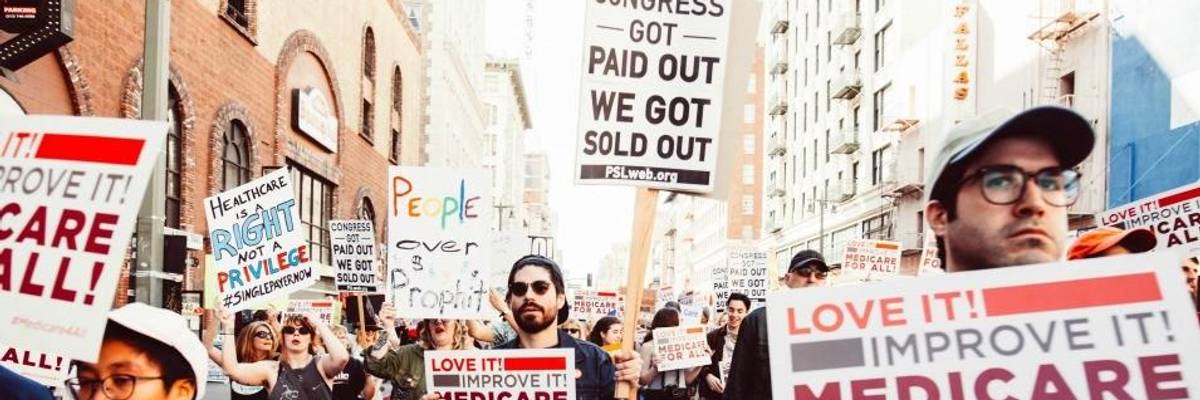
Recent polling by the Kaiser Family Foundation has shown that a majority of Americans support a Medicare for All healthcare program. (Photo: Molly Adams/Flickr/cc)
Mr. Trump, If You Love Medicare, Improve It and Expand It to All
Can the U.S. afford to expand Medicare to all? The real question is, can we afford not to?
Oct 11, 2018
Well, now I've heard everything: Donald Trump wants to keep "the government" away from Medicare and protect seniors from attempts to improve it.
Huh?
Mr. President, take it from me--a newly-minted senior citizen and a doctor--you need to sit down and read the bill that single-payer supporters consider the gold standard for universal coverage: H.R. 676, the Expanded and Improved Medicare for All Act. Don't worry, it's a much easier read than the average commercial health insurance policy.
Here's the deal: H.R. 676 would vastly upgrade Medicare for seniors by covering all medically necessary care, including dental, vision, hearing, mental health, and long-term care--none of which are currently covered. We learned very early on in medical school that, yes, the eyes, ears, mouth, and brain are all part of the human body and all those parts need care.
"The argument that expanding Medicare's coverage to younger Americans will somehow hurt seniors is preposterous."
H.R. 676 would also provide tremendous financial relief for seniors by eliminating Part B and D premiums and doing away with all copays and deductibles. Doctors know copays and deductibles only discourage patients from seeking care, and nobody should have to choose between buying groceries and paying for doctor visits.
Today, Medicare beneficiaries' average out-of-pocket health care spending was 41 percent of average Social Security income and 36 percent of those in traditional Medicare spent at least 20 percent of their income on out-of-pocket health care costs in 2013. H.R. 676 would provide the financial freedom that many seniors (and everyone else for that matter) need and deserve.
The seniors I talk to aren't fooled by restrictive Medicare Advantage plans, either. They just want one, simple plan that gives them full choice of hospitals and doctors. Commercially administered Medicare Advantage plans don't offer a full range of choices. Why? Because it would cut into their obscene, taxpayer-funded profits.
The argument that expanding Medicare's coverage to younger Americans will somehow hurt seniors is preposterous. Mr. Trump, I know that you're old enough to remember when Medicare was first signed into law in 1964. When 19 million seniors enrolled in Medicare in the first year, there was no significant increase in the total number of doctor visits in the U.S., no evidence of reduced clinical capacity, no waiting lists, and no "rationing" of care.
The same happy story repeated itself when we provided coverage to millions of children through the Children's Health Insurance Program (CHIP) and low-income adults through Medicaid.
Our public health programs--especially Medicare--are an American success story, and an ideal foundation for a system that ensures high-quality care for everyone. The reason for that success is Medicare's remarkable administrative efficiency: Traditional Medicare's overhead is just over 3 percent, compared to private plans, including Medicare Advantage plans, whose overhead averages 30 percent.
Can the U.S. afford to expand Medicare to all? The real question is, can we afford not to? Moving to a streamlined, national single-payer program like H.R. 676 would save an estimated $617 billion annually by slashing the administrative waste of private health insurance and the paperwork imposed on hospitals and doctors ($504 billion), and by bargaining down drug prices ($113 billion). That would free up enough money for universal coverage without any net increase in U.S. health spending.
You try to frighten us with a $32 trillion price tag but fail to mention that if we maintain the status quo, we are on target to spend $50 trillion on health care over the next 10 years.
This desperate fear-mongering about Medicare for all is no surprise, given the surge in support for the idea, which is now favored by a majority of Americans (including a majority ofRepublicans!) and a majority of doctors like me.
If you love Medicare, fight to make it better and expand it to every one of your constituents.
An Urgent Message From Our Co-Founder
Dear Common Dreams reader, It’s been nearly 30 years since I co-founded Common Dreams with my late wife, Lina Newhouser. We had the radical notion that journalism should serve the public good, not corporate profits. It was clear to us from the outset what it would take to build such a project. No paid advertisements. No corporate sponsors. No millionaire publisher telling us what to think or do. Many people said we wouldn't last a year, but we proved those doubters wrong. Together with a tremendous team of journalists and dedicated staff, we built an independent media outlet free from the constraints of profits and corporate control. Our mission has always been simple: To inform. To inspire. To ignite change for the common good. Building Common Dreams was not easy. Our survival was never guaranteed. When you take on the most powerful forces—Wall Street greed, fossil fuel industry destruction, Big Tech lobbyists, and uber-rich oligarchs who have spent billions upon billions rigging the economy and democracy in their favor—the only bulwark you have is supporters who believe in your work. But here’s the urgent message from me today. It's never been this bad out there. And it's never been this hard to keep us going. At the very moment Common Dreams is most needed, the threats we face are intensifying. We need your support now more than ever. We don't accept corporate advertising and never will. We don't have a paywall because we don't think people should be blocked from critical news based on their ability to pay. Everything we do is funded by the donations of readers like you. When everyone does the little they can afford, we are strong. But if that support retreats or dries up, so do we. Will you donate now to make sure Common Dreams not only survives but thrives? —Craig Brown, Co-founder |
Our work is licensed under Creative Commons (CC BY-NC-ND 3.0). Feel free to republish and share widely.
Dr. Carol Paris
Dr. Carol Paris is a psychiatrist and president of Physicians for a National Health Program (PNHP).
bernie sandersmedicaremedicare for allphysicians for a national health program (pnhp)single-payertrumpism
Well, now I've heard everything: Donald Trump wants to keep "the government" away from Medicare and protect seniors from attempts to improve it.
Huh?
Mr. President, take it from me--a newly-minted senior citizen and a doctor--you need to sit down and read the bill that single-payer supporters consider the gold standard for universal coverage: H.R. 676, the Expanded and Improved Medicare for All Act. Don't worry, it's a much easier read than the average commercial health insurance policy.
Here's the deal: H.R. 676 would vastly upgrade Medicare for seniors by covering all medically necessary care, including dental, vision, hearing, mental health, and long-term care--none of which are currently covered. We learned very early on in medical school that, yes, the eyes, ears, mouth, and brain are all part of the human body and all those parts need care.
"The argument that expanding Medicare's coverage to younger Americans will somehow hurt seniors is preposterous."
H.R. 676 would also provide tremendous financial relief for seniors by eliminating Part B and D premiums and doing away with all copays and deductibles. Doctors know copays and deductibles only discourage patients from seeking care, and nobody should have to choose between buying groceries and paying for doctor visits.
Today, Medicare beneficiaries' average out-of-pocket health care spending was 41 percent of average Social Security income and 36 percent of those in traditional Medicare spent at least 20 percent of their income on out-of-pocket health care costs in 2013. H.R. 676 would provide the financial freedom that many seniors (and everyone else for that matter) need and deserve.
The seniors I talk to aren't fooled by restrictive Medicare Advantage plans, either. They just want one, simple plan that gives them full choice of hospitals and doctors. Commercially administered Medicare Advantage plans don't offer a full range of choices. Why? Because it would cut into their obscene, taxpayer-funded profits.
The argument that expanding Medicare's coverage to younger Americans will somehow hurt seniors is preposterous. Mr. Trump, I know that you're old enough to remember when Medicare was first signed into law in 1964. When 19 million seniors enrolled in Medicare in the first year, there was no significant increase in the total number of doctor visits in the U.S., no evidence of reduced clinical capacity, no waiting lists, and no "rationing" of care.
The same happy story repeated itself when we provided coverage to millions of children through the Children's Health Insurance Program (CHIP) and low-income adults through Medicaid.
Our public health programs--especially Medicare--are an American success story, and an ideal foundation for a system that ensures high-quality care for everyone. The reason for that success is Medicare's remarkable administrative efficiency: Traditional Medicare's overhead is just over 3 percent, compared to private plans, including Medicare Advantage plans, whose overhead averages 30 percent.
Can the U.S. afford to expand Medicare to all? The real question is, can we afford not to? Moving to a streamlined, national single-payer program like H.R. 676 would save an estimated $617 billion annually by slashing the administrative waste of private health insurance and the paperwork imposed on hospitals and doctors ($504 billion), and by bargaining down drug prices ($113 billion). That would free up enough money for universal coverage without any net increase in U.S. health spending.
You try to frighten us with a $32 trillion price tag but fail to mention that if we maintain the status quo, we are on target to spend $50 trillion on health care over the next 10 years.
This desperate fear-mongering about Medicare for all is no surprise, given the surge in support for the idea, which is now favored by a majority of Americans (including a majority ofRepublicans!) and a majority of doctors like me.
If you love Medicare, fight to make it better and expand it to every one of your constituents.
Dr. Carol Paris
Dr. Carol Paris is a psychiatrist and president of Physicians for a National Health Program (PNHP).
Well, now I've heard everything: Donald Trump wants to keep "the government" away from Medicare and protect seniors from attempts to improve it.
Huh?
Mr. President, take it from me--a newly-minted senior citizen and a doctor--you need to sit down and read the bill that single-payer supporters consider the gold standard for universal coverage: H.R. 676, the Expanded and Improved Medicare for All Act. Don't worry, it's a much easier read than the average commercial health insurance policy.
Here's the deal: H.R. 676 would vastly upgrade Medicare for seniors by covering all medically necessary care, including dental, vision, hearing, mental health, and long-term care--none of which are currently covered. We learned very early on in medical school that, yes, the eyes, ears, mouth, and brain are all part of the human body and all those parts need care.
"The argument that expanding Medicare's coverage to younger Americans will somehow hurt seniors is preposterous."
H.R. 676 would also provide tremendous financial relief for seniors by eliminating Part B and D premiums and doing away with all copays and deductibles. Doctors know copays and deductibles only discourage patients from seeking care, and nobody should have to choose between buying groceries and paying for doctor visits.
Today, Medicare beneficiaries' average out-of-pocket health care spending was 41 percent of average Social Security income and 36 percent of those in traditional Medicare spent at least 20 percent of their income on out-of-pocket health care costs in 2013. H.R. 676 would provide the financial freedom that many seniors (and everyone else for that matter) need and deserve.
The seniors I talk to aren't fooled by restrictive Medicare Advantage plans, either. They just want one, simple plan that gives them full choice of hospitals and doctors. Commercially administered Medicare Advantage plans don't offer a full range of choices. Why? Because it would cut into their obscene, taxpayer-funded profits.
The argument that expanding Medicare's coverage to younger Americans will somehow hurt seniors is preposterous. Mr. Trump, I know that you're old enough to remember when Medicare was first signed into law in 1964. When 19 million seniors enrolled in Medicare in the first year, there was no significant increase in the total number of doctor visits in the U.S., no evidence of reduced clinical capacity, no waiting lists, and no "rationing" of care.
The same happy story repeated itself when we provided coverage to millions of children through the Children's Health Insurance Program (CHIP) and low-income adults through Medicaid.
Our public health programs--especially Medicare--are an American success story, and an ideal foundation for a system that ensures high-quality care for everyone. The reason for that success is Medicare's remarkable administrative efficiency: Traditional Medicare's overhead is just over 3 percent, compared to private plans, including Medicare Advantage plans, whose overhead averages 30 percent.
Can the U.S. afford to expand Medicare to all? The real question is, can we afford not to? Moving to a streamlined, national single-payer program like H.R. 676 would save an estimated $617 billion annually by slashing the administrative waste of private health insurance and the paperwork imposed on hospitals and doctors ($504 billion), and by bargaining down drug prices ($113 billion). That would free up enough money for universal coverage without any net increase in U.S. health spending.
You try to frighten us with a $32 trillion price tag but fail to mention that if we maintain the status quo, we are on target to spend $50 trillion on health care over the next 10 years.
This desperate fear-mongering about Medicare for all is no surprise, given the surge in support for the idea, which is now favored by a majority of Americans (including a majority ofRepublicans!) and a majority of doctors like me.
If you love Medicare, fight to make it better and expand it to every one of your constituents.
We've had enough. The 1% own and operate the corporate media. They are doing everything they can to defend the status quo, squash dissent and protect the wealthy and the powerful. The Common Dreams media model is different. We cover the news that matters to the 99%. Our mission? To inform. To inspire. To ignite change for the common good. How? Nonprofit. Independent. Reader-supported. Free to read. Free to republish. Free to share. With no advertising. No paywalls. No selling of your data. Thousands of small donations fund our newsroom and allow us to continue publishing. Can you chip in? We can't do it without you. Thank you.
To inform. To inspire. To ignite change for the common good.
News & Opinion
Trending
Common Dreams, Inc. Founded 1997. Registered 501(c3) Non-Profit
Privacy Policy