SUBSCRIBE TO OUR FREE NEWSLETTER
Daily news & progressive opinion—funded by the people, not the corporations—delivered straight to your inbox.
5
#000000
#FFFFFF
To donate by check, phone, or other method, see our More Ways to Give page.
Bill Clinton bears as much responsibility as any politician for the worst economic crisis since the Great Depression, and the wild applause for his disingenuous speech at the Democratic National Convention last week is a sure sign of the poverty of what passes for progressive politics.
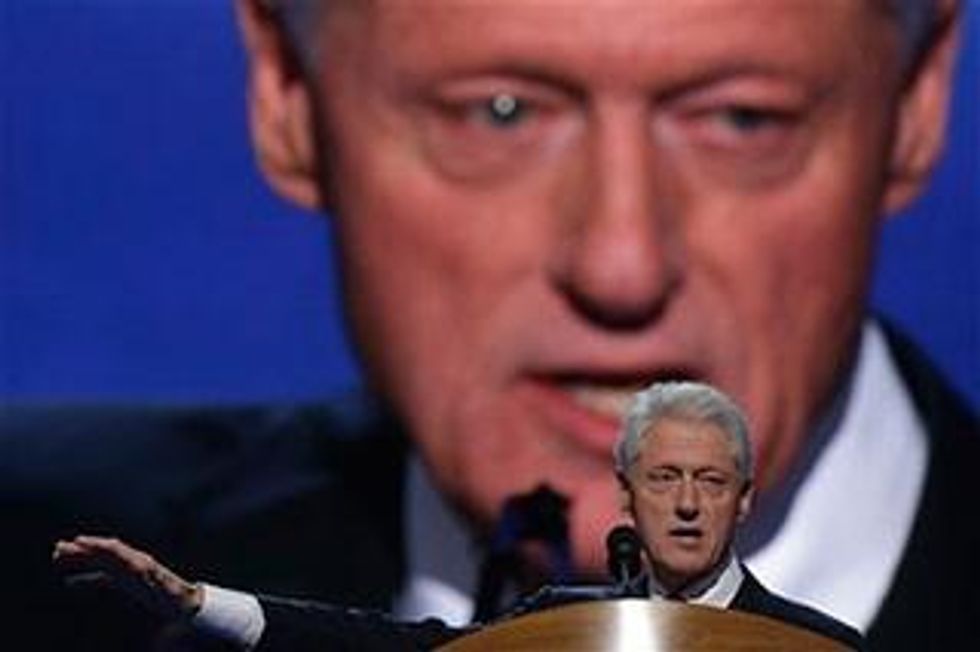
Do those convention delegates, and the fawning media that were wowed by the former president's rhetorical seductions, not recall that just before he left office Clinton signed off on the game-changing legislation that ended the sensible rules imposed on Wall Street during the Great Depression? It was Clinton who cooperated with the Republicans in reversing the legacy of FDR's New Deal, opening the floodgates of unfettered avarice that almost drowned the world's economy during the reign of George W. Bush.
How convenient to ignore the Financial Services Modernization Act, which Clinton signed into law to summarily end the Glass-Steagall barrier against the commingling of investment and commercial banking. Do the Democrats not remember that Citigroup, the first too-big-to-fail bank made legal by the law Clinton signed, became the $15 million employer of Robert Rubin, the Clinton treasury secretary who led the fight for the law that legalized the creation of Citigroup? Or that Citigroup--led by Sanford Weill, to whom Clinton gave one of the souvenir pens he used to approve that onerous legislation--went on to be a major player in the subprime mortgage swindles and had to be bailed out with more than $50 billion of taxpayer funds?
Those scams were based on bundling suspect mortgages into collateralized debt obligations (CDOs), backed by the phony insurance of credit default swaps (CDSs), all of which were given "legal certainty," to quote Lawrence Summers, who replaced Rubin as Clinton's treasury secretary. It was Summers who encouraged Clinton to sign the Commodity Futures Modernization Act, which declared CDOs and CDSs immune to any existing regulatory law and the purview of any regulatory agency.
Timothy Geithner, a protege of Rubin and Summers in the Clinton Treasury Department, was appointed, with Rubin's enthusiastic endorsement, to be head of the New York Fed while Bush was president. Geithner happily partnered with the Bush administration in saving AIG and funneling trillions of dollars to the banks that had caused the crisis. When Barack Obama appointed Geithner as treasury secretary, the new president committed to the Bush strategy of saving the bankers rather than those in the middle class who had much of their life savings tied up in the vanished equity in their homes.
The Democrats who boast so much about their inclusion of black and brown people have not seemed to notice that the accumulated wealth of both groups has declined by more than half since the onset of this crisis, wiping out much of the economic gains of the civil rights movement.
Sorry, I couldn't dance at the party as I did with the Democrats the last time around. Of course I prefer Obama over Republican Mitt Romney, who is backed by a rapacious crowd of hucksters who have rallied around the former CEO of Bain Capital as one of their own.
If Wall Street financial moguls are now giving more money to Romney than to Obama, it is a measure of the extent of their greed rather than Obama's effectiveness in curtailing that greed. The banks are bigger and more powerful than ever. The quite-limited victories for consumers cited in convention speeches by Massachusetts Senate candidate Elizabeth Warren and California Attorney General Kamala Harris--both truly heroic fighters for consumer rights--were accomplished over the objections of White House insiders.
Obama has followed the examples of Summers and Geithner instead of those of Warren and Harris, and that is what has made the election a tossup as voters continue to suffer in an economy that Democrats as well as Republicans wrecked.
Once again, the thing that saves the Democrats is the capricious evil that now defines the Republican Party. In another time, Romney might have been in the mold of Dwight Eisenhower, a moderate and socially sensitive leader who offered a perhaps more efficient but no less caring alternative to the big-city-based Democrats of his era. As Clinton pointed out in his address, it was Eisenhower who sent federal troops to guarantee the integration of Little Rock High School in Arkansas over the objection of many Southern Democratic politicians and who also built the federal highway system. In short, Ike was a balanced and thoroughly decent GOP leader of the sort that Romney's own father, George, aspired to be.
Not so the son, who attacks the automobile industry bailout that his auto manufacturer father would have embraced, as he would have Obama's moderate health care program, based in every significant detail on Mitt Romney's version in Massachusetts. Romney is an unmitigated liar unrestrained by any moral or logical standard, as demonstrated in his defense of the Bain Capital experience. That part Clinton got right.
Bill Clinton bears as much responsibility as any politician for the worst economic crisis since the Great Depression, and the wild applause for his disingenuous speech at the Democratic National Convention last week is a sure sign of the poverty of what passes for progressive politics.
Do those convention delegates, and the fawning media that were wowed by the former president's rhetorical seductions, not recall that just before he left office Clinton signed off on the game-changing legislation that ended the sensible rules imposed on Wall Street during the Great Depression? It was Clinton who cooperated with the Republicans in reversing the legacy of FDR's New Deal, opening the floodgates of unfettered avarice that almost drowned the world's economy during the reign of George W. Bush.
How convenient to ignore the Financial Services Modernization Act, which Clinton signed into law to summarily end the Glass-Steagall barrier against the commingling of investment and commercial banking. Do the Democrats not remember that Citigroup, the first too-big-to-fail bank made legal by the law Clinton signed, became the $15 million employer of Robert Rubin, the Clinton treasury secretary who led the fight for the law that legalized the creation of Citigroup? Or that Citigroup--led by Sanford Weill, to whom Clinton gave one of the souvenir pens he used to approve that onerous legislation--went on to be a major player in the subprime mortgage swindles and had to be bailed out with more than $50 billion of taxpayer funds?
Those scams were based on bundling suspect mortgages into collateralized debt obligations (CDOs), backed by the phony insurance of credit default swaps (CDSs), all of which were given "legal certainty," to quote Lawrence Summers, who replaced Rubin as Clinton's treasury secretary. It was Summers who encouraged Clinton to sign the Commodity Futures Modernization Act, which declared CDOs and CDSs immune to any existing regulatory law and the purview of any regulatory agency.
Timothy Geithner, a protege of Rubin and Summers in the Clinton Treasury Department, was appointed, with Rubin's enthusiastic endorsement, to be head of the New York Fed while Bush was president. Geithner happily partnered with the Bush administration in saving AIG and funneling trillions of dollars to the banks that had caused the crisis. When Barack Obama appointed Geithner as treasury secretary, the new president committed to the Bush strategy of saving the bankers rather than those in the middle class who had much of their life savings tied up in the vanished equity in their homes.
The Democrats who boast so much about their inclusion of black and brown people have not seemed to notice that the accumulated wealth of both groups has declined by more than half since the onset of this crisis, wiping out much of the economic gains of the civil rights movement.
Sorry, I couldn't dance at the party as I did with the Democrats the last time around. Of course I prefer Obama over Republican Mitt Romney, who is backed by a rapacious crowd of hucksters who have rallied around the former CEO of Bain Capital as one of their own.
If Wall Street financial moguls are now giving more money to Romney than to Obama, it is a measure of the extent of their greed rather than Obama's effectiveness in curtailing that greed. The banks are bigger and more powerful than ever. The quite-limited victories for consumers cited in convention speeches by Massachusetts Senate candidate Elizabeth Warren and California Attorney General Kamala Harris--both truly heroic fighters for consumer rights--were accomplished over the objections of White House insiders.
Obama has followed the examples of Summers and Geithner instead of those of Warren and Harris, and that is what has made the election a tossup as voters continue to suffer in an economy that Democrats as well as Republicans wrecked.
Once again, the thing that saves the Democrats is the capricious evil that now defines the Republican Party. In another time, Romney might have been in the mold of Dwight Eisenhower, a moderate and socially sensitive leader who offered a perhaps more efficient but no less caring alternative to the big-city-based Democrats of his era. As Clinton pointed out in his address, it was Eisenhower who sent federal troops to guarantee the integration of Little Rock High School in Arkansas over the objection of many Southern Democratic politicians and who also built the federal highway system. In short, Ike was a balanced and thoroughly decent GOP leader of the sort that Romney's own father, George, aspired to be.
Not so the son, who attacks the automobile industry bailout that his auto manufacturer father would have embraced, as he would have Obama's moderate health care program, based in every significant detail on Mitt Romney's version in Massachusetts. Romney is an unmitigated liar unrestrained by any moral or logical standard, as demonstrated in his defense of the Bain Capital experience. That part Clinton got right.
Bill Clinton bears as much responsibility as any politician for the worst economic crisis since the Great Depression, and the wild applause for his disingenuous speech at the Democratic National Convention last week is a sure sign of the poverty of what passes for progressive politics.
Do those convention delegates, and the fawning media that were wowed by the former president's rhetorical seductions, not recall that just before he left office Clinton signed off on the game-changing legislation that ended the sensible rules imposed on Wall Street during the Great Depression? It was Clinton who cooperated with the Republicans in reversing the legacy of FDR's New Deal, opening the floodgates of unfettered avarice that almost drowned the world's economy during the reign of George W. Bush.
How convenient to ignore the Financial Services Modernization Act, which Clinton signed into law to summarily end the Glass-Steagall barrier against the commingling of investment and commercial banking. Do the Democrats not remember that Citigroup, the first too-big-to-fail bank made legal by the law Clinton signed, became the $15 million employer of Robert Rubin, the Clinton treasury secretary who led the fight for the law that legalized the creation of Citigroup? Or that Citigroup--led by Sanford Weill, to whom Clinton gave one of the souvenir pens he used to approve that onerous legislation--went on to be a major player in the subprime mortgage swindles and had to be bailed out with more than $50 billion of taxpayer funds?
Those scams were based on bundling suspect mortgages into collateralized debt obligations (CDOs), backed by the phony insurance of credit default swaps (CDSs), all of which were given "legal certainty," to quote Lawrence Summers, who replaced Rubin as Clinton's treasury secretary. It was Summers who encouraged Clinton to sign the Commodity Futures Modernization Act, which declared CDOs and CDSs immune to any existing regulatory law and the purview of any regulatory agency.
Timothy Geithner, a protege of Rubin and Summers in the Clinton Treasury Department, was appointed, with Rubin's enthusiastic endorsement, to be head of the New York Fed while Bush was president. Geithner happily partnered with the Bush administration in saving AIG and funneling trillions of dollars to the banks that had caused the crisis. When Barack Obama appointed Geithner as treasury secretary, the new president committed to the Bush strategy of saving the bankers rather than those in the middle class who had much of their life savings tied up in the vanished equity in their homes.
The Democrats who boast so much about their inclusion of black and brown people have not seemed to notice that the accumulated wealth of both groups has declined by more than half since the onset of this crisis, wiping out much of the economic gains of the civil rights movement.
Sorry, I couldn't dance at the party as I did with the Democrats the last time around. Of course I prefer Obama over Republican Mitt Romney, who is backed by a rapacious crowd of hucksters who have rallied around the former CEO of Bain Capital as one of their own.
If Wall Street financial moguls are now giving more money to Romney than to Obama, it is a measure of the extent of their greed rather than Obama's effectiveness in curtailing that greed. The banks are bigger and more powerful than ever. The quite-limited victories for consumers cited in convention speeches by Massachusetts Senate candidate Elizabeth Warren and California Attorney General Kamala Harris--both truly heroic fighters for consumer rights--were accomplished over the objections of White House insiders.
Obama has followed the examples of Summers and Geithner instead of those of Warren and Harris, and that is what has made the election a tossup as voters continue to suffer in an economy that Democrats as well as Republicans wrecked.
Once again, the thing that saves the Democrats is the capricious evil that now defines the Republican Party. In another time, Romney might have been in the mold of Dwight Eisenhower, a moderate and socially sensitive leader who offered a perhaps more efficient but no less caring alternative to the big-city-based Democrats of his era. As Clinton pointed out in his address, it was Eisenhower who sent federal troops to guarantee the integration of Little Rock High School in Arkansas over the objection of many Southern Democratic politicians and who also built the federal highway system. In short, Ike was a balanced and thoroughly decent GOP leader of the sort that Romney's own father, George, aspired to be.
Not so the son, who attacks the automobile industry bailout that his auto manufacturer father would have embraced, as he would have Obama's moderate health care program, based in every significant detail on Mitt Romney's version in Massachusetts. Romney is an unmitigated liar unrestrained by any moral or logical standard, as demonstrated in his defense of the Bain Capital experience. That part Clinton got right.