SUBSCRIBE TO OUR FREE NEWSLETTER
Daily news & progressive opinion—funded by the people, not the corporations—delivered straight to your inbox.
5
#000000
#FFFFFF
To donate by check, phone, or other method, see our More Ways to Give page.
A few weeks before the U.S. invaded Iraq, the late Edward Said wrote:
Millions of people will be affected, [by a war with Iraq] yet America contemptuously plans for their future without consulting them. ... Will no one come out into the light of day to express a vision for our future that isn't based on a script written by Donald Rumsfeld and Paul Wolfowitz?
-Guardian/UK, January 25, 2003
Nine years later - with President Obama collaborating with Israel on cyberwarfare against Iran, and protecting his Presidential "kill list" from public scrutiny while asserting that anyone who gets in the way of our drones must deserve to die - we should be asking a similar question: Will no one come into the light of public politics with a vision for our future not based on scripts written for political or economic power?
Or, to put it another way: Is there any way for "We-the-People" to free ourselves from these scripts and take control of our own government?
Which brings us face to face with a pair of fundamental questions: Who Are we? What do we want to do?
These questions deal with identity, vision and values, and answering the first one stops us cold.
Most of us define "We" by those who are "Not We", and who we want excluded from participation in our civil society/ government: Immigrants; gays; non-Christians; socialists; Arabs; poor people; drug addicts; union members; strangers of any color or conviction. My last column noted that our local TEA Party stated openly that " those who do not believe as we do ... should not be involved in our government." Some of us believe that African-Americans or women don't deserve to be included.
In 2010 the"Citizens United" decision of the Supreme Court decreed that "We-the-People" included corporations and money itself, entitled to the same free speech granted to individuals by the First Amendment.
And now our political system, designed to be controlled by "We-the-People" is largely controlled by money. George Monbiot, in the Guardian/UK, recently observed "Political systems that were supposed to represent everyone now return governments of millionaires, financed by and acting on behalf of billionaires."
And their money is mostly invested in advertising that drives programming about sex, sin, and celebrities, with headline news about Jerry Sandusky and IPOs for cyber- media systems; advertising that sells goods by glorifying violence, vengeance, and violation of persons and property.
Most seriously, advertising is skewing the fundamental process of politics: the allocation of Earth's resources. Thirty years ago William R. Catton Jr. warned in "Overshoot" (1982):
...we should begin to recognize the increasingly anti-social ramifications of advertising. We need to discredit and wind down this want-multiplying industry, perhaps even legally suppress it. In an overpopulated and resource-depleted world, an industry fundamentally devoted to making people dissatisfied with what they have... is an industry dedicated to augmenting human frustration. In an age of overshoot it is bound to foster the resentful attitudes that could turn inescapable competition into destructive conflict. (pg 235)
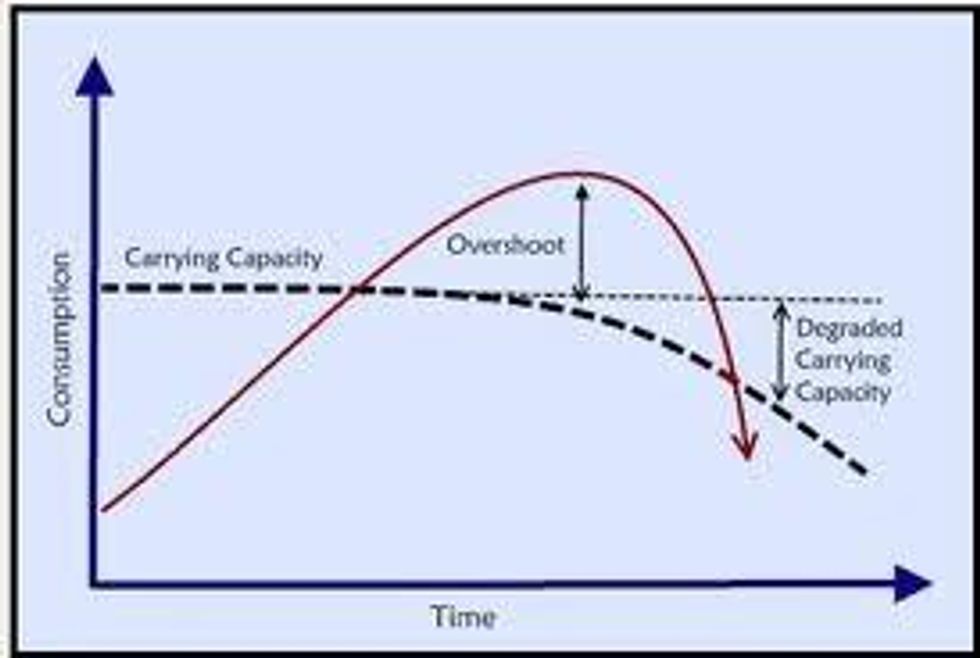
Catton's book documented that 30 years ago humans had already overshot Earth's carrying capacity and that we needed to start looking at Earth's resources in terms of savings and income: Deposits of coal, oil, and gas, fossil aquifers, ores and minerals, forests and oceans are Earth's Savings Account; Earth's Income is its systems of renewable energy and natural recycling.
We now have ample evidence that unless we make drastic changes in our consumption of Earth's Savings, we won't have a future to write scripts for.
I find myself reduced to imagining fanciful scripts:
These may be good scripts for screenplays or online games of alternative reality, but only the first two are remotely within reach of We-the-People, and none of them are likely to create a cohesive society of respectful neighbors living within the means of a planet with already compromised systems.
Who are we? What do we want to do? Apparently we are clever social animals with a Stone Age suspicion of strangers, a taste for violence, the moral discernment of chimpanzees, poor skills in long-term planning, and a vision of endless growth in consumption. We can't agree; don't want to agree; we want to get rich and change other peoples' behaviors.
Who's going to write the scripts for the future of human life on Earth? We-the-People, or a wealthy elite seeking dominion over both Earth's Income and Earth's Savings?
A few weeks before the U.S. invaded Iraq, the late Edward Said wrote:
Millions of people will be affected, [by a war with Iraq] yet America contemptuously plans for their future without consulting them. ... Will no one come out into the light of day to express a vision for our future that isn't based on a script written by Donald Rumsfeld and Paul Wolfowitz?
-Guardian/UK, January 25, 2003
Nine years later - with President Obama collaborating with Israel on cyberwarfare against Iran, and protecting his Presidential "kill list" from public scrutiny while asserting that anyone who gets in the way of our drones must deserve to die - we should be asking a similar question: Will no one come into the light of public politics with a vision for our future not based on scripts written for political or economic power?
Or, to put it another way: Is there any way for "We-the-People" to free ourselves from these scripts and take control of our own government?
Which brings us face to face with a pair of fundamental questions: Who Are we? What do we want to do?
These questions deal with identity, vision and values, and answering the first one stops us cold.
Most of us define "We" by those who are "Not We", and who we want excluded from participation in our civil society/ government: Immigrants; gays; non-Christians; socialists; Arabs; poor people; drug addicts; union members; strangers of any color or conviction. My last column noted that our local TEA Party stated openly that " those who do not believe as we do ... should not be involved in our government." Some of us believe that African-Americans or women don't deserve to be included.
In 2010 the"Citizens United" decision of the Supreme Court decreed that "We-the-People" included corporations and money itself, entitled to the same free speech granted to individuals by the First Amendment.
And now our political system, designed to be controlled by "We-the-People" is largely controlled by money. George Monbiot, in the Guardian/UK, recently observed "Political systems that were supposed to represent everyone now return governments of millionaires, financed by and acting on behalf of billionaires."
And their money is mostly invested in advertising that drives programming about sex, sin, and celebrities, with headline news about Jerry Sandusky and IPOs for cyber- media systems; advertising that sells goods by glorifying violence, vengeance, and violation of persons and property.
Most seriously, advertising is skewing the fundamental process of politics: the allocation of Earth's resources. Thirty years ago William R. Catton Jr. warned in "Overshoot" (1982):
...we should begin to recognize the increasingly anti-social ramifications of advertising. We need to discredit and wind down this want-multiplying industry, perhaps even legally suppress it. In an overpopulated and resource-depleted world, an industry fundamentally devoted to making people dissatisfied with what they have... is an industry dedicated to augmenting human frustration. In an age of overshoot it is bound to foster the resentful attitudes that could turn inescapable competition into destructive conflict. (pg 235)
Catton's book documented that 30 years ago humans had already overshot Earth's carrying capacity and that we needed to start looking at Earth's resources in terms of savings and income: Deposits of coal, oil, and gas, fossil aquifers, ores and minerals, forests and oceans are Earth's Savings Account; Earth's Income is its systems of renewable energy and natural recycling.
We now have ample evidence that unless we make drastic changes in our consumption of Earth's Savings, we won't have a future to write scripts for.
I find myself reduced to imagining fanciful scripts:
These may be good scripts for screenplays or online games of alternative reality, but only the first two are remotely within reach of We-the-People, and none of them are likely to create a cohesive society of respectful neighbors living within the means of a planet with already compromised systems.
Who are we? What do we want to do? Apparently we are clever social animals with a Stone Age suspicion of strangers, a taste for violence, the moral discernment of chimpanzees, poor skills in long-term planning, and a vision of endless growth in consumption. We can't agree; don't want to agree; we want to get rich and change other peoples' behaviors.
Who's going to write the scripts for the future of human life on Earth? We-the-People, or a wealthy elite seeking dominion over both Earth's Income and Earth's Savings?
A few weeks before the U.S. invaded Iraq, the late Edward Said wrote:
Millions of people will be affected, [by a war with Iraq] yet America contemptuously plans for their future without consulting them. ... Will no one come out into the light of day to express a vision for our future that isn't based on a script written by Donald Rumsfeld and Paul Wolfowitz?
-Guardian/UK, January 25, 2003
Nine years later - with President Obama collaborating with Israel on cyberwarfare against Iran, and protecting his Presidential "kill list" from public scrutiny while asserting that anyone who gets in the way of our drones must deserve to die - we should be asking a similar question: Will no one come into the light of public politics with a vision for our future not based on scripts written for political or economic power?
Or, to put it another way: Is there any way for "We-the-People" to free ourselves from these scripts and take control of our own government?
Which brings us face to face with a pair of fundamental questions: Who Are we? What do we want to do?
These questions deal with identity, vision and values, and answering the first one stops us cold.
Most of us define "We" by those who are "Not We", and who we want excluded from participation in our civil society/ government: Immigrants; gays; non-Christians; socialists; Arabs; poor people; drug addicts; union members; strangers of any color or conviction. My last column noted that our local TEA Party stated openly that " those who do not believe as we do ... should not be involved in our government." Some of us believe that African-Americans or women don't deserve to be included.
In 2010 the"Citizens United" decision of the Supreme Court decreed that "We-the-People" included corporations and money itself, entitled to the same free speech granted to individuals by the First Amendment.
And now our political system, designed to be controlled by "We-the-People" is largely controlled by money. George Monbiot, in the Guardian/UK, recently observed "Political systems that were supposed to represent everyone now return governments of millionaires, financed by and acting on behalf of billionaires."
And their money is mostly invested in advertising that drives programming about sex, sin, and celebrities, with headline news about Jerry Sandusky and IPOs for cyber- media systems; advertising that sells goods by glorifying violence, vengeance, and violation of persons and property.
Most seriously, advertising is skewing the fundamental process of politics: the allocation of Earth's resources. Thirty years ago William R. Catton Jr. warned in "Overshoot" (1982):
...we should begin to recognize the increasingly anti-social ramifications of advertising. We need to discredit and wind down this want-multiplying industry, perhaps even legally suppress it. In an overpopulated and resource-depleted world, an industry fundamentally devoted to making people dissatisfied with what they have... is an industry dedicated to augmenting human frustration. In an age of overshoot it is bound to foster the resentful attitudes that could turn inescapable competition into destructive conflict. (pg 235)
Catton's book documented that 30 years ago humans had already overshot Earth's carrying capacity and that we needed to start looking at Earth's resources in terms of savings and income: Deposits of coal, oil, and gas, fossil aquifers, ores and minerals, forests and oceans are Earth's Savings Account; Earth's Income is its systems of renewable energy and natural recycling.
We now have ample evidence that unless we make drastic changes in our consumption of Earth's Savings, we won't have a future to write scripts for.
I find myself reduced to imagining fanciful scripts:
These may be good scripts for screenplays or online games of alternative reality, but only the first two are remotely within reach of We-the-People, and none of them are likely to create a cohesive society of respectful neighbors living within the means of a planet with already compromised systems.
Who are we? What do we want to do? Apparently we are clever social animals with a Stone Age suspicion of strangers, a taste for violence, the moral discernment of chimpanzees, poor skills in long-term planning, and a vision of endless growth in consumption. We can't agree; don't want to agree; we want to get rich and change other peoples' behaviors.
Who's going to write the scripts for the future of human life on Earth? We-the-People, or a wealthy elite seeking dominion over both Earth's Income and Earth's Savings?