

SUBSCRIBE TO OUR FREE NEWSLETTER
Daily news & progressive opinion—funded by the people, not the corporations—delivered straight to your inbox.
5
#000000
#FFFFFF
To donate by check, phone, or other method, see our More Ways to Give page.
Daily news & progressive opinion—funded by the people, not the corporations—delivered straight to your inbox.
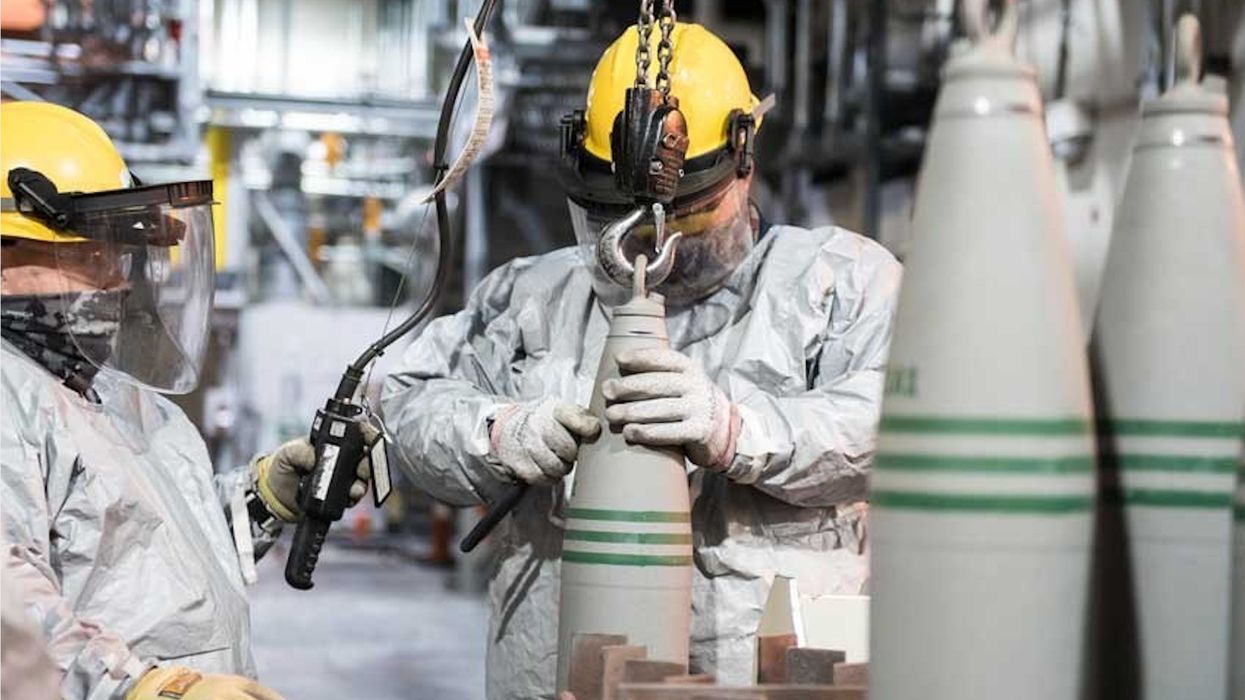
"Honestly, I never thought this day would come," said the head of the citizens advisory commission overseeing the destruction.
The White House announced Friday that the United States has destroyed what remains of its once-massive military chemical weapons arsenal, while vowing to "prevent the stockpiling, production, and use" of the internationally banned weapons of mass destruction.
"For more than 30 years, the United States has worked tirelessly to eliminate our chemical weapons stockpile. Today, I am proud to announce that the United States has safely destroyed the final munition in that stockpile—bringing us one step closer to a world free from the horrors of chemical weapons," President Joe Biden said in a statement.
"Successive administrations have determined that these weapons should never again be developed or deployed," the president continued, "and this accomplishment not only makes good on our long-standing commitment under the Chemical Weapons Convention, it marks the first time an international body has verified destruction of an entire category of declared weapons of mass destruction."
While the U.S. military no longer has a chemical stockpile, tear gas—a chemical weapon banned in war—remains an integral part of law enforcement crowd suppression arsenals.
"Today—as we mark this significant milestone—we must also renew our commitment to forging a future free from chemical weapons," Biden said. "I continue to encourage the remaining nations to join the Chemical Weapons Convention so that the global ban on chemical weapons can reach its fullest potential."
Under the treaty, the U.S. committed to destroying its chemical arsenal by 2007; that deadline was later extended to 2012.
The Organization for the Prohibition of Chemical Weapons (OPCW) confirmed Friday that "all declared chemical weapons stockpiles" around the world have now been "verified as irreversibly destroyed."
"The end of the destruction of all declared chemical weapons stockpiles is an important milestone for the organization. It is a critical step towards achieving its mission to permanently eliminate all chemical weapons," OPCW Director-General Fernando Arias said in a statement.
"Yet, more challenges lie ahead of us, which require the international community's continued attention," Arias added. "Four countries have yet to join the convention. Abandoned and old chemical weapons still need to be recovered and destroyed."
Egypt, Israel, North Korea, and South Sudan are not party to the Chemical Weapons Convention, which took effect in 1997.
As The New York Times reported Thursay:
The American stockpile, built up over generations, was shocking in its scale: Cluster bombs and landmines filled with nerve agent. Artillery shells that could blanket whole forests with a blistering mustard fog. Tanks full of poison that could be loaded on jets and sprayed on targets below.
They were a class of weapons deemed so inhumane that their use was condemned after World War I, but even so, the United States and other powers continued to develop and amass them. Some held deadlier versions of the chlorine and mustard agents made infamous in the trenches of the Western Front. Others held nerve agents developed later, like VX and Sarin, that are lethal even in tiny quantities.
American armed forces are not known to have used lethal chemical weapons in battle since 1918, though during the Vietnam War they used herbicides like Agent Orange that were harmful to humans.
The United States once also had a sprawling germ warfare and biological weapons program; those weapons were destroyed in the 1970s.
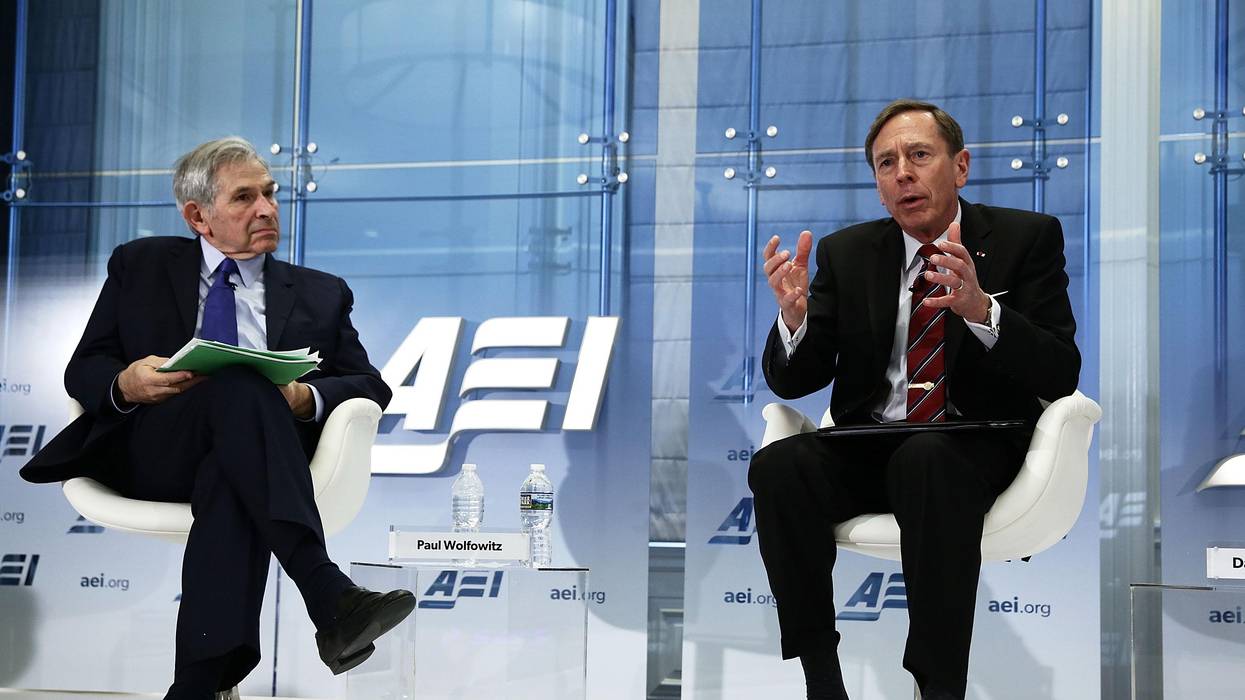
Even after the Cold War ended, the United States was drafting plans for the possible use of chemical weapons. In service of U.S. global hegemony, then-Undersecretary of Defense Paul Wolfowitz and his deputy Scooter Libby authored a 1992 strategy plan, "Defense Policy Guidance," that called for possible preemptive nuclear, biological, or chemical warfare against countries that potentially posed threats to American dominance—even if they did not have or use weapons of mass destruction.
"Honestly, I never thought this day would come," Irene Kornelly, who chairs the citizens' advisory commission that has overseen the destruction of U.S. chemical weapons at the Army's Pueblo Chemical Depot in Colorado for 30 years, told the Times. "The military didn't know if they could trust the people, and the people didn't know if they could trust the military."
As Kornelly spoke, the depot's manager blasted the rock band Europe's 1986 hit "The Final Countdown" and handed out red, white, and blue Bomb Pop popsicles.
"Most people today don't have a clue that this all happened—they never had to worry about it," Kornelly said. "And I think that's just as well."
The war in Ukraine is the culmination of a 30-year project of the American neoconservative movement. The Biden Administration is packed with the same neocons who championed the US wars of choice in Serbia (1999), Afghanistan (2001), Iraq (2003), Syria (2011), Libya (2011), and who did so much to provoke Russia's invasion of Ukraine. The neocon track record is one of unmitigated disaster, yet Biden has staffed his team with neocons. As a result, Biden is steering Ukraine, the US, and the European Union towards yet another geopolitical debacle. If Europe has any insight, it will separate itself from these US foreign policy debacles.
The neocon outlook is based on an overriding false premise: that the US military, financial, technological, and economic superiority enables it to dictate terms in all regions of the world.
The neocon movement emerged in the 1970s around a group of public intellectuals, several of whom were influenced by University of Chicago political scientist Leo Strauss and Yale University classicist Donald Kagan. Neocon leaders included Norman Podhoretz, Irving Kristol, Paul Wolfowitz, Robert Kagan (son of Donald), Frederick Kagan (son of Donald), Victoria Nuland (wife of Robert), Elliott Cohen, Elliott Abrams, and Kimberley Allen Kagan (wife of Frederick).
The main message of the neocons is that the US must predominate in military power in every region of the world, and must confront rising regional powers that could someday challenge US global or regional dominance, most important Russia and China. For this purpose, US military force should be pre-positioned in hundreds of military bases around the world and the US should be prepared to lead wars of choice as necessary. The United Nations is to be used by the US only when useful for US purposes.
This approach was spelled out first by Paul Wolfowitz in his draft Defense Policy Guidance (DPG) written for the Department of Defense in 2002. The draft called for extending the US-led security network to the Central and Eastern Europe despite the explicit promise by German Foreign Minister Hans-Dietrich Genscher in 1990 that German unification would not be followed by NATO's eastward enlargement. Wolfowitz also made the case for American wars of choice, defending America's right to act independently, even alone, in response to crises of concern to the US. According to General Wesley Clark, Wolfowitz already made clear to Clark in May 1991 that the US would lead regime-change operations in Iraq, Syria, and other former Soviet allies.
The neocons championed NATO enlargement to Ukraine even before that became official US policy under George W. Bush, Jr. in 2008. They viewed Ukraine's NATO membership as key to US regional and global dominance. Robert Kagan spelled out the neocon case for NATO enlargement in April 2006:
[T]he Russians and Chinese see nothing natural in [the "color revolutions" of the former Soviet Union], only Western-backed coups designed to advance Western influence in strategically vital parts of the world. Are they so wrong? Might not the successful liberalization of Ukraine, urged and supported by the Western democracies, be but the prelude to the incorporation of that nation into NATO and the European Union--in short, the expansion of Western liberalhegemony?
Kagan acknowledged the dire implication of NATO enlargement. He quotes one expert as saying, "the Kremlin is getting ready for the 'battle for Ukraine' in all seriousness." The neocons sought this battle. After the fall of the Soviet Union, both the US and Russia should have sought a neutral Ukraine, as a prudent buffer and safety valve. Instead, the neocons wanted US "hegemony" while the Russians took up the battle partly in defense and partly out of their own imperial pretentions as well. Shades of the Crimean War (1853-6), when Britain and France sought to weaken Russia in the Black Sea following Russian pressures on the Ottoman empire.
Kagan penned the article as a private citizen while his wife Victoria Nuland was the US Ambassador to NATO under George W. Bush, Jr. Nuland has been the neocon operative par excellence. In addition to serving as Bush's Ambassador to NATO, Nuland was Barack Obama's Assistant Secretary of State for European and Eurasian Affairs during 2013-17, where she participated in the overthrow of Ukraine's pro-Russian president Viktor Yanukovych, and now serves as Biden's Undersecretary of State guiding US policy vis-a-vis the war in Ukraine.
In the "battle for Ukraine," the neocons were ready to provoke a military confrontation with Russia by expanding NATO over Russia's vehement objections because they fervently believe that Russia will be defeated by US financial sanctions and NATO weaponry.
The neocon outlook is based on an overriding false premise: that the US military, financial, technological, and economic superiority enables it to dictate terms in all regions of the world. It is a position of both remarkable hubris and remarkable disdain of evidence. Since the 1950s, the US has been stymied or defeated in nearly every regional conflict in which it has participated. Yet in the "battle for Ukraine," the neocons were ready to provoke a military confrontation with Russia by expanding NATO over Russia's vehement objections because they fervently believe that Russia will be defeated by US financial sanctions and NATO weaponry.
The Institute for the Study of War (ISW), a neocon think-tank led by Kimberley Allen Kagan (and backed by a who's who of defense contractors such as General Dynamics and Raytheon), continues to promise a Ukrainian victory. Regarding Russia's advances, the ISW offered a typical comment: "[R]egardless of which side holds the city [of Sievierodonetsk], the Russian offensive at the operational and strategic levels will probably have culminated, giving Ukraine the chance to restart its operational-level counteroffensives to push Russian forces back."
The facts on the ground, however, suggest otherwise. The West's economic sanctions have had little adverse impact on Russia, while their "boomerang" effect on the rest of the world has been large. Moreover, the US capacity to resupply Ukraine with ammunition and weaponry is seriously hamstrung by America's limited production capacity and broken supply chains. Russia's industrial capacity of course dwarfs that of Ukraine's. Russia's GDP was roughly 10X that of Ukraine before war, and Ukraine has now lost much of its industrial capacity in the war.
The most likely outcome of the current fighting is that Russia will conquer a large swath of Ukraine, perhaps leaving Ukraine landlocked or nearly so. Frustration will rise in Europe and the US with the military losses and the stagflationary consequences of war and sanctions. The knock-on effects could be devastating, if a right-wing demagogue in the US rises to power (or in the case of Trump, returns to power) promising to restore America's faded military glory through dangerous escalation.
Instead of risking this disaster, the real solution is to end the neocon fantasies of the past 30 years and for Ukraine and Russia to return to the negotiating table, with NATO committing to end its commitment to the eastward enlargement to Ukraine and Georgia in return for a viable peace that respects and protects Ukraine's sovereignty and territorial integrity.
As President Donald Trump spent the early days of 2020 instigating and then backing down from a potentially catastrophic confrontation with Iran, corporate media in the U.S. turned to the very same people who promoted the country's worst foreign policy disaster in a generation to advocate for repeating the mistakes of two decades ago.
The decision of networks and cable news outlets like CNN, MSNBC, and Fox News to bring on a stream of past advocates for and architects of the 2003 invasion of Iraq was panned by progressives who watched in horror and frustration as the same arguments were deployed in service of all-out war with Iran.
"It's War Inc. all over again," tweeted The Nation's Dave Zirin.
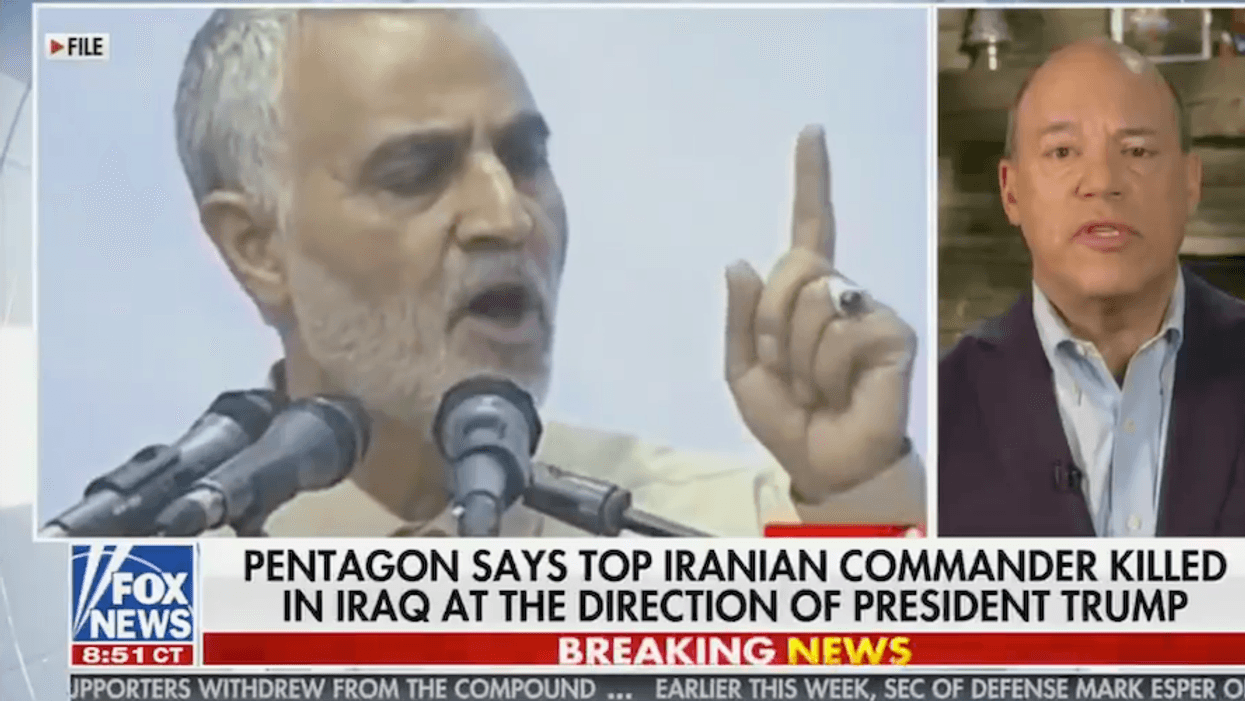
Trump's ordered assassination of Iranian military commander Qasem Soleimani on January 3 proved the catalyst for escalated tensions between the U.S. and Iran. It also opened the door for news outlets to welcome back some of the key Bush-era war cheerleaders.
"In a sane and just society, the architects of the nearly 17-year-old war in Iraq--which is still ongoing and has left an estimated half-million people dead--would face war crimes charges and those who cheered them on would be thoroughly discredited."
--Jessica Schulberg, HuffPost
The more things change, the more they stay the same, wrote Rolling Stone's Tim Dickinson.
"The Trump administration's sudden, violent confrontation with Iran stands in contrast to the methodical march to war with Iraq under George W. Bush and his neoconservative cabinet in 2003," Dickinson wrote. "But the rhetoric around the two conflicts has been strikingly similar--as has the reliance on 'razor thin' evidence of an imminent threat to establish a cause for war."
Soleimani's death by drone strike was celebrated in real time by former Bush press secretary Ari Fleischer, who spent the run-up to the Iraq War selling the public on the necessity of the conflict.
"I think it is entirely possible that this is going to be a catalyst inside Iran where the people celebrate this killing of Soleimani," Fleischer told Fox in the hours after Soleimani's killing, flanked by Bush administration advisor Karl Rove.
In contrast to Fleischer's prediction, Soleimani's funeral and remembrance ceremonies over the weekend turned out mourners enraged at the assassination across Iran in the millions. Former Vice President Dick Cheney's similar claim in 2002 that U.S. troops in Iraq would be "welcomed as liberators" was equally true.
Fleischer was nonetheless welcomed back to Fox on Tuesday and Wednesday to give his thoughts on the conflict and attack Democrats for questioning the rush to war.
"It's concerning, to say the least, to see some of the biggest backers of the Iraq War--an abject failure that, coupled with the ongoing war in Afghanistan, has cost the United States trillions of dollars and thousands of lives--are publicly (and in some instances, gleefully) opining about the potential impact of war with Iran, in some cases even using the same rhetorical stylings to do so," said Vox's Jane Coaston of the similarity in rhetoric.
On MSNBC, which bills itself as a liberal alternative to right-wing behemoth Fox, host Ari Melber on January 7 in the wake of Iranian retaliation for the assassination spoke to former General Barry McCaffrey, who called for a devastating response against Iran.
"Our only good response at this point is an overwhelming dominance of air and naval power that can be employed against the Iranian homeland," said McCaffrey.
Unmentioned in the segment was McCaffrey's position on the board of Raytheon, a major U.S. weapons suppplier.
The next day, Melber hosted former Sen. Joe Lieberman, a one-time Democrat whose embrace of the Bush administration's push for war across the Middle East led to an unofficial expulsion from the Democratic Party in 2006, though Lieberman was re-elected as an independent.
Not disclosed by Melber to his audience? The fact that Lieberman works for Israel Aerospace Industries, a defense company with $1 billion in sales in the U.S.
Melber did not respond to a request for comment at press time.
As Popular Information's Judd Legum reported Thursday morning, Lieberman and McCaffrey are hardly alone in advocating for war in the media without revealing their financial interests in the conflict. Legum lists nine former government officials with ties to the defense industry who are being presented to the American people as experts without noting their connections to the military industrial complex.
One of the people profiled by Legum is Michael Chertoff, the former Bush-era secretary of Homeland Security. On CNN, Chertoff claimed Trump has unilateral power to attack Iran and start a war.
But, Legum pointed out, there was some context for those remarks conveniently left out of the coverage:
Neither Chertoff nor CNN disclosed that Chertoff is chairman of the board of the American subsidiary of BAE Systems, the fourth largest weapons manufacturer in the world.
Print media was not immune to the lack of accountability shown by tv. On January 5, the Washington Post ran a piece by former Bush administration national security advisor Stephen Hadley saluting the assassination of Soleimani and calling for war if necessary.
That Hadley is on the board of Raytheon alongside MSNBC's McCaffrey did not receive a mention.
The onus for disclosure, wrote Eyes on the Ties reporter Rob Galbraith, is on the Post's editor Fred Hiatt:
Running another hawkish column by Hadley without noting his enormous financial incentive to stoke the engines of war shows that the Post in general, and Hiatt in particular, has failed to learn anything from Syria, Iraq, or any of the other times that war profiteers have used their pages to clamor for missile strikes and invasions. This is made all the more egregious since, however dismissively, Hiatt acknowledged Hadley's conflict of interest in 2013, and yet still went ahead and printed his op-ed today without disclosing this conflict--again.
"It's not 2003, but it sure feels like it," wrote HuffPost's Jessica Schulberg in a piece detailing a number of the Bush administration officials and varied Iraq War boosters brought on by the corporate media to discuss the push for war.
"In a sane and just society, the architects of the nearly 17-year-old war in Iraq--which is still ongoing and has left an estimated half-million people dead--would face war crimes charges and those who cheered them on would be thoroughly discredited," Schulberg continued. "Instead, they are the 'experts' praising President Donald Trump's decision to assassinate top Iranian military commander Gen. Qasem Soleimani and offering the public insight on the way forward with Iran."

From the CIA's funneling of over a billion dollars to Islamic militants in the 1970s war in Afghanistan against the Soviet Union to the billion dollars spent on training and equipping the radical jihadists currently fighting in Syria, the United States has repeatedly empowered extremists who have filled the vacuums of failed states it created. The extremists have turned with a vengeance on their sponsors. Washington's fueling of these conflicts was directly responsible for the rise of figures such as Ayman al-Zawahiri and Osama bin Laden and ultimately laid the groundwork for the 9/11 attacks. It also spawned the rabid Islamophobia in Europe and the United States that lies at the core of Trump's racist worldview and has been successfully used to justify the eradication of basic civil liberties and democratic rights.
The misguided interventions by the national security apparatus have resulted in hundreds of thousands of deaths, over 5 million desperate refugees fleeing to Europe, the destruction of entire cities, the squandering of some $5 trillion of U.S. taxpayer money, rampant corruption and criminality.
The misguided interventions by the national security apparatus have resulted in hundreds of thousands of deaths, over 5 million desperate refugees fleeing to Europe, the destruction of entire cities, the squandering of some $5 trillion of U.S. taxpayer money, rampant corruption and criminality. The mandarins of national security, rather than blunt the rise of radical jihadism, have ensured its spread across the globe. The architects of this imperial folly have a symbiotic relationship with those they profess to hate. The two radical extremes--the interventionists in the national security apparatus and the radical jihadists--play off of each other to countenance ever-greater acts of savagery. The more perfidious your enemy, the more your own extremism is justified. We are locked in a macabre dance with the killers we created and empowered, matching war crime for war crime, torture for torture and murder for murder.
The binary view of the world imagined by right-wing ideologues such as Richard Pipes during the Cold War, defined as a battle to the death against godless communism, has been reimagined by Israeli Prime Minister Benjamin Netanyahu and American neocons such as Mike Pompeo, John Bolton, Robert Kagan, Steve Bannon, William Kristol, Paul Wolfowitz and Donald Rumsfeld and leaders of the Christian right including Gary Bauer and William Bennett to become a battle to the death between the "barbarity" of Islam and the "civilized" ethic of the Judeo-Christian West. It is a rebranding of the Cold War, so useful to the retrograde forces of capitalism in crushing popular dissent and so profitable to the arms industry. Its most prominent voices are a bizarre collection of neofascist ideologues and quack conspiracy theorists such as Bannon, Sean Hannity, Stephen Miller and Pam Geller, who claims that Barack Obama is the love child of Malcolm X.
This ideology, like the ideology of anti-communism, erases not only history but context. Those who oppose us are removed from the realm of the rational. They are seen as incomprehensible. Their hate has no justification. They are human embodiments of evil that must be eradicated. They hate us for our "values" or because they are driven by a perverted form of Islam. The failure, as Blumenthal writes, to place these conflicts in context, to examine our own complicity in fueling a justifiable anger, even rage, dooms us to perpetual misunderstanding and perpetual warfare. Our response is to employ greater and greater levels of violence that only expand the extremism at home and abroad. This demented project, as Blumenthal writes, collapses "the fragile space where multi-confessional societies survive." It bifurcates political space into competing forms of extremism between the jihadists and the counter-jihadists. It creates a strange and even comforting "mutually reinforcing symbiosis" that depends "on a constantly escalating sense of antagonism."
The methods used on a wary public by the national security state, especially the FBI and the intelligence agencies, to justify and advance these wars are increasingly unsavory. Muslims, many suffering from emotional and mental disabilities, are baited by law enforcement into "terrorist" plots that few of them could have conceived or organized on their own. The highly publicized arrests and quashing of these nascent "terrorist plots" exaggerate the presence of radical jihadists within the country. They keep fear high among the U.S. population. Trevor Aaronson, the author of "Terror Factory: Inside the FBI's Manufactured War on Terror," found that nearly half of all terror prosecutions between Sept. 11, 2001, and 2010 involved informants, including some with criminal backgrounds who were paid as much as $100,000 by the FBI. Aaronson noted that during the last year of the George W. Bush administration the government did not prosecute anyone arrested in a terrorist "sting." But such stings exploded under Barack Obama, a tactic that Blumenthal writes was "designed to cast his administration as just as tough on terror as any Republican"--the Obama administration "announced an arrest resulting from a terrorism sting every sixty days." This suggested, Aaronson writes, "that there are a lot of ineffective terrorists in the United States, or that the FBI has become effective at creating the very enemy it is hunting."
The paranoid and racist narratives of the far right have poisoned the mainstream dialogue. These racist tropes are repeated by the White House, members of Congress and the press.
The longer and more confusing the "war on terror" becomes, nearly two decades on, the more irrational our national discourse becomes. The paranoid and racist narratives of the far right have poisoned the mainstream dialogue. These racist tropes are repeated by the White House, members of Congress and the press.
"Islamophobia had become the language of a wounded empire, the guttural roar of its malevolent violence turned back from the sands of Iraq and the mountain passes of Afghanistan, and leveled against the mosque down the turnpike, the hijabi in the checkout line, the Sikh behind the cash register--the neighbors who looked like The Enemy," Blumenthal writes.
Far-right parties are riding this rampant Islamophobia, fueled by the catastrophic failures in the Middle East, to power in Germany, Italy, France, Britain, Sweden, Poland and Hungary. This toxic hatred is also a central theme of the Trump administration, which demonizes Muslims, especially Muslim refugees, and seeks to bar them from entering the United States.
The arrival of millions of Muslim refugees in Europe from states such as Libya, Syria (which alone has produced a million refugees in Europe), Iraq and Afghanistan has dramatically bolstered the appeal of European neofascists. Nearly 73 percent of those who voted in Britain for the nation to leave the European Union cited the arrival of immigrants as their most important reason for supporting the referendum.
The radical jihadists have long expressed a desire to extinguish democratic space in the West. They are aware that the curtailment of civil liberties, evisceration of democratic institutions, especially the judicial system, and overt hatred of Muslims push Muslims in the West into their arms. Such conditions also increase the military blunders of the United States and its allies abroad, providing jihadists with a steady supply of new recruits and failed states from which they can operate. Their strategy is working. In the year before the 2016 presidential election, violence against Muslims in the United States soared, including shootings and arson attacks on mosques. Public disapproval of Muslims, according to opinion polls, is at a record high.
The Democratic Party, signing on to the forever crusade by the national security state in the name of humanitarian intervention, is as complicit. The Obama administration not only accelerated the sting operations in the United States against supposed terrorists but, in its foreign operations, increased the use of militarized drones, sent more troops to Afghanistan and foolishly toppled the regime of Moammar Gadhafi in Libya to create yet another failed state and safe haven for jihadists.
The radical jihadists, in an irony not lost on Blumenthal, are often deliberately armed and empowered by the U.S. national security apparatus, along with Israel, as a way to pressure and topple regimes deemed antagonistic to Israel and the United States. Obama's secretary of state, John Kerry, in audio leaked from a closed meeting with Syrian opposition activists, admitted that the U.S. had used Islamic State as a tool for pressuring the Syrian government. He also acknowledged that Washington's complicity in the growth of IS in Syria was the major cause for Russian intervention there.
In a 2016 op-ed titled "The Destruction of Islamic State Is a Strategic Mistake," Efraim Inbar, the director of the Begin-Sadat Center for Strategic Studies, argued that "[t]he West should seek the further weakening of Islamic State, but not its destruction." He said the West should exploit IS as a "useful tool" in the fight against Iran and its proxy, Hezbollah. "A weak IS is, counterintuitively, preferable to a destroyed IS," Inbar concluded. Inbar went on to argue for prolonging the conflict in Syria, saying that extended sectarian bloodshed would produce "positive change."
Earlier in 2016, Israel's former Defense Minister Moshe Ya'alon had said similarly, "In Syria, if the choice is between Iran and the Islamic State, I choose the Islamic State."
Israel seeks to create buffer zones between itself and Hezbollah in southern Lebanon. It sees its neighbor Syria, because of its alliance with Iran, as a mortal enemy. The solution has been to cripple these traditional enemies by temporarily empowering radical Sunni jihadists and al-Qaida. There are numerous reports of Israel, along with the United States, using its aircraft and military in Syria to aid the very jihadists Washington and Jerusalem claim to want to wipe from the face of the earth.
This intractable morass, Blumenthal argues, led directly to the demonization of Russia. Trump's anti-interventionist rhetoric, however disingenuous, triggered what Blumenthal calls "a wild hysteria" among the foreign policy elites. Trump calls the invasion of Iraq a mistake. He questions the arming of Syrian jihadists and deployment of U.S. forces in Syria. He is critical of NATO. At the same time, he has called for better relations with Russia.
"Joining with the dead-enders of Hillary Clinton's campaign, who were desperate to deflect from their crushing loss, the mandarins of the national security state worked their media contacts to generate the narrative of Trump-Russia collusion," Blumenthal writes. "Out of the postelection despair of liberals and national security elites, the furor of Russiagate was born. This national outrage substituted Russia for ISIS as the country's new folk devil and painted Trump as Russian president Vladimir Putin's Manchurian candidate."
"Almost overnight, hundreds of thousands of liberals were showing up at postelection rallies with placards depicting Trump in Russian garb and surrounded by Soviet hammer-and-sickle symbols," Blumenthal writes. The FBI and the intelligence community, organizations that have long spied upon and harassed the left and often liberals, became folk heroes. NATO, which was the instrument used to destabilize the Middle East and heighten tensions with Russia because of its expansion in Eastern Europe, became sacrosanct.
"A desperate bid by the war industry and the interventionists to mask the greatest strategic blunder in American history, one that signals the end of American hegemony."
"In its obsession with Moscow's supposed meddling, the Democratic Party elite eagerly rehabilitated the Bush-era neoconservatives, welcoming PNAC [Project for the New American Century] founder William Kristol and 'axis of evil' author David Frum into the ranks of the so-called 'resistance,' " Blumenthal writes. "The Center for American Progress, the semiofficial think tank of the Democratic Party, consolidated the liberal-neocon alliance by forging a formal working partnership with the American Enterprise Institute, the nest of the Iraq war neocons, to 'stand up to Russia.' "
Those in the alternative media who question the Russia narrative and chronical the imperial disasters are in this new version of the Cold War branded as agents of a foreign power and hit with algorithms from Google, Facebook, YouTube and Twitter to deflect viewers from reading or listening to their critiques. Politicians, such as Bernie Sanders and Labour Party leader Jeremy Corbyn, who push back against the war lust are smeared with the same nefarious charge. It is, as Blumenthal writes, a desperate bid by the war industry and the interventionists to mask the greatest strategic blunder in American history, one that signals the end of American hegemony.
"In the face of their own failure, America's national security elites had successfully engineered a new Cold War, wagering that the reignited conflict would preserve their management of savagery abroad and postpone the terrible reckoning they deserved at home," Blumenthal concludes.
The corporate state, its legitimacy in tatters, seeks to make us afraid in order to maintain its control over the economic, political and military institutions. It needs mortal enemies, manufactured or real, at home or abroad, to justify its existence and mask its mismanagement and corruption. This narrative of fear is what Antonio Gramsci called a "legitimation doctrine." It is not about making us safe--indeed the policies the state pursues make us less secure--but about getting us to surrender to the will of the elites. The more inequality and injustice grow, the more the legitimation doctrine will be used to keep us cowed and compliant. The doctrine means that the enemies of the United States will never be destroyed, but will mutate and expand; they are too useful to be allowed to disappear. It means that the primary language of the state will be fear. The longer the national security state plays this game, the more a fascist America is assured.
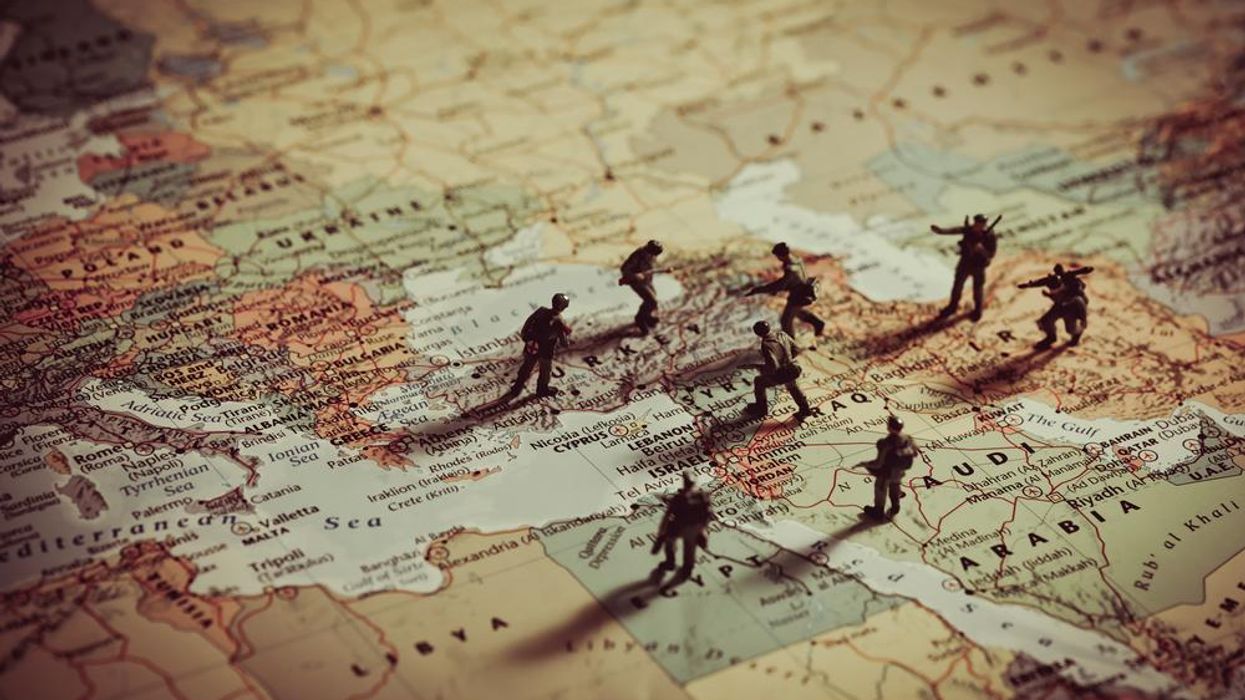
As Vice President Mike Pence, Secretary of State Mike Pompeo, National Security Advisor John Bolton, Israeli Prime Minister Benjamin Netanyahu, and Saudi crown prince and de facto ruler Mohammad bin Salman clamor for a war against Iran, they seem to have conveniently forgotten the destruction and mayhem wrought by the American invasion of Iraq 16 years ago.
These war drummers are underestimating the potential negative consequences of the war and overestimating the Iranian people's dislike of their theocratic regime. They, like the advocates of the Iraqi invasion in the winter of 2002 and early spring 2003, are confusing Iranians' dislike of the ayatollahs with their potential embrace of a foreign invader.
On the eve of the Iraq war, former President George W. Bush, Vice President Dick Cheney, Defense Secretary Donald Rumsfeld, National Security Advisor Condoleezza Rice, Deputy Secretary of Defense Paul Wolfowitz, the Vice President Chief of Staff and Assistant to the President David Addington all claimed that the Iraqi invasion aimed at liberating the country from the brutal regime of Saddam Hussein. Removing Saddam from power, they maintained, would eliminate the threat of weapons of mass destruction (WMD) and bring stability, security, and democracy to Iraq.
As developments unfolded over the past 16 years, the "liberation" claims proved to be bogus. The invasion and the decision to de-Ba'athify Iraq and dissolve the Iraqi military created an environment conducive to sectarianism, insurgency, and terrorism. The vacuum that followed the regime collapse, the incompetence of the American administration in the "Green Zone," and the pervasive corruption of the new Iraqi governing councils was quickly filled by pro-Iranian militias, al-Qaeda, and later the Islamic State. The promise of stability and security was replaced by chaos, bloodshed, and mayhem.
The massive destruction of Iraq and the horrendous human and material cost the American "liberation" caused for the country will be child's play compared to what could happen if Trump and his Israeli and Saudi allies decide to attack Iran. Unlike Iraq--which the British cobbled together after World War One out of the Shia, Sunnis, and Kurds under a minority Sunni rule-- Iran has been in existence for centuries with a vast territory and a huge population. If attacked, Iran has the capability to retaliate against its neighbors, especially Saudi Arabia. Its air and missile forces could quickly destroy the oil and gas facilities and the water and power grids on the Arab side of the Gulf. A war against Iran could easily spread to the Gulf and the Levant. The entire region could go up in flames.
Hubris and Ignorance
The Bush administration was not willing or interested in answering the "morning after" questions regarding the post-Saddam future of Iraq. Whenever I and others urged policy makers to consider the law of unintended consequences and what could go wrong in Iraq following the invasion, Vice President Cheney and Secretary of Defense Rumsfeld dismissed our concerns and arrogantly claimed that the U.S. military and civilian administration following the invasion would be able to control the situation in Iraq. Their hubris regarding America's power and ignorance of Iraqi realities on the ground led to a total breakdown of Iraqi society following the demise of the Saddam regime.
The Trump administration seems to be equally arrogant and ignorant about Iran. It has displayed a similar disregard for strategic thinking about the future of Iran beyond the clerical regime. The Iranophobes within the administration seem to be more obsessed with Iran than the Bush administration was ever with Iraq.
Instead of relying on calm, expert-based analysis, Secretary of State Pompeo has made a series of trips to the region that have involved bullying, threats, and hilarious, if not tragic, mischaracterizations.
Instead of relying on calm, expert-based analysis, Secretary of State Pompeo has made a series of trips to the region that have involved bullying, threats, and hilarious, if not tragic, mischaracterizations. In a recent conversation with Christian broadcasters in Jerusalem, Pompeo waxed eloquent about God's presumed divine plan designating Trump as a possible savior of the "Jewish people," Sunni Islam, Maronite Lebanon, Alawite Syria, and the rest of the world from the perceived modern-day Persian "Hamans."
The American foreign policy process is in serious trouble if Pompeo truly believes that Trump could be the twenty-first-century version of Queen Esther or Hadassah and that this religious vision could chart the path to a grand strategy in the Middle East. When warped religious interpretations are offered as a substitute for rationally debated policy, whether by a radical Wahhabi Salafist, an evangelical Christian, or an ultra-Orthodox Jew, democratic governments should fear for their future. Invoking the divine as an inspiration or a justification for violence against another country, much as Osama bin Laden did on the eve of 9/11, is a rejection of rational discourse and a return to the barbarism of previous epochs.
Pompeo's imagined "shuttle diplomacy" in the Middle East has been reduced to supporting Netanyahu's upcoming election bid, threatening Hezbollah in Lebanon, recognizing Israeli sovereignty over the Golan Heights, and lambasting any state that does business with Iran. His ambassador-designee to Saudi Arabia, John Abizaid, told Congress that the threat from Iran supersedes concerns for human rights in Arab autocracies.
Furthermore, Trump administration policy operatives, including John Bolton and Rudy Giuliani, have treated an Iranian group called the Mujahedin-e Khalq or MEK as a legitimate alternative to the clerical regime in Iran. The MEK, however, is a terrorist cult that has received funding from all sorts of dubious sources and is often used as a tool by outside groups, states, and organizations, including intelligence services of regional and international state actors, to further an anti-Iran agenda.
Similarly, the Bush administration viewed Ahmed Chalabi, the Iraqi emigre, and the organization he founded, the Iraqi National Congress, as the legitimate alternative to the Saddam regime in Iraq. Vice President Cheney and Secretary of Defense Rumsfeld fully bought into Chalabi's snake-oil sales. Chalabi was instrumental in instigating America's invasion of Iraq at the cost of trillions of dollars and thousands of American and Iraqi lives. Iraq has never recovered from that ill-fated, unnecessary war. Bolton and Giuliani are as susceptible to MEK's claims as Cheney and Rumsfeld were to Chalabi's.
For the sake of whipping up regional animus toward Iran and preparing the ground for a war against the "Persian menace," Pompeo in effect has told Arab autocrats that so long as they keep mouthing anti-Iran rhetoric, Washington will ignore their despicable human rights record and the continued repression of their people. The thousands of political prisoners in Egyptian, Saudi, and Bahraini jails will have to wait for another day.
Arab regimes have become masters in the art of communicating with their American benefactors. During the Cold War, they received American aid as long as they brandished anti-Communist slogans. After the collapse of the Soviet Union and with the rise of terrorism, these same strongmen were happy to adopt an anti-terrorism rhetoric in order to continue receiving American military and economic aid. Their current anti-Iran public posture is the latest phase in their communication with Washington and is as equally profitable as the previous two phases.
When some regional politicians demurred about getting tough with Iran, as happened during Pompeo's recent visit to Lebanon, he did not hesitate to threaten them with a panoply of economic sanctions. Vice President Mike Pence used similar language at the recent meeting in Warsaw to berate and even threaten America's European allies if they dared to take a conciliatory posture toward Iran. The European reaction to Pence's speech showed that his pathetic performance backfired. Pompeo's Warsaw meeting ended in utter failure.
Iran Nuclear Deal
Managing Iran's malign behavior through the Iran nuclear deal or the Joint Comprehensive Plan of Action (JCPOA) was a stroke of diplomatic genius, which former Secretary of State John Kerry and Secretary of Energy Ernest Moniz negotiated. The Obama administration placed Iran's objectionable behavior in two baskets--a nuclear basket, which they addressed through the Iran deal, and a non-nuclear one, which the Obama administration was to address once the nuclear inspection became operational and Iran fully compliant. That approach would have worked: most experts judged Iran to be in compliance with the conditions of the nuclear deal. Unfortunately, President Trump decided not to recertify the agreement.
Trump's decision contradicted the judgment of most nuclear and intelligence experts about Iran's compliance. The International Atomic Energy Agency (IAEA), for example, affirmed Iran's compliance in more than a dozen of its successive quarterly reports and as recently as earlier this month.
In his open testimony to Congress in January, the Director of National Intelligence Dan Coats stated that Iran continued to comply with the deal even after Trump announced his intention to scuttle it. Coats said, "We do not believe Iran is currently undertaking activities we judge necessary to produce a nuclear device." Iran was of course cheating in other areas, according to the DNI's testimony, but not on the nuclear agreement.
In a statement issued April 25 of last year, over two dozen Israeli senior military and intelligence officials judged that it was "in Israel's best interest that the United States maintains the nuclear agreement with Iran." The Israeli statement went on to say that "The current deal is better than no deal" and that "Iran's destructive regional policies and actions, its support for acts of terrorism, its presence in Syria, and its ballistic missiles program should be dealt with outside the framework of the agreement." This was precisely the position of the Obama administration when it negotiated the deal in the first place.
The Path Forward
Fifty-plus retired American generals and diplomats, in a statement published earlier this month, urged the Trump administration to rejoin the Iran nuclear deal and work on resolving outstanding concerns with Iran diplomatically. They advised against a war because they saw no good outcome. The statement did not seek to exonerate Iran's destabilizing behavior and its involvement in Yemen, Syria, Iraq, or Lebanon. Nor did the retired senior leaders ignore Iran's link to terrorism. The statement, however, pointed out, among other things, that the 2015 nuclear deal "put limitations on Iran's nuclear program that provided assurances that it would not be used to develop weapons, improved American intelligence about potential future development and significantly improved the security of the United States and our allies."
Additionally, the retired generals and diplomats emphasized that Iran is complying with the agreement and that, under the JCPOA, Iran is barred from engaging in nuclear weapons development program, which prevents it from producing a nuclear device. "Reentering the agreement and lifting the sanctions will greatly enhance United States' ability to negotiate improvements and enable us to address concerns with the existing agreement."
Coming from these military and policy realists, who are dedicated to the security of this country, Israel, and America's allies, this advice is grounded in sane strategic analysis, not in theological whimsy.
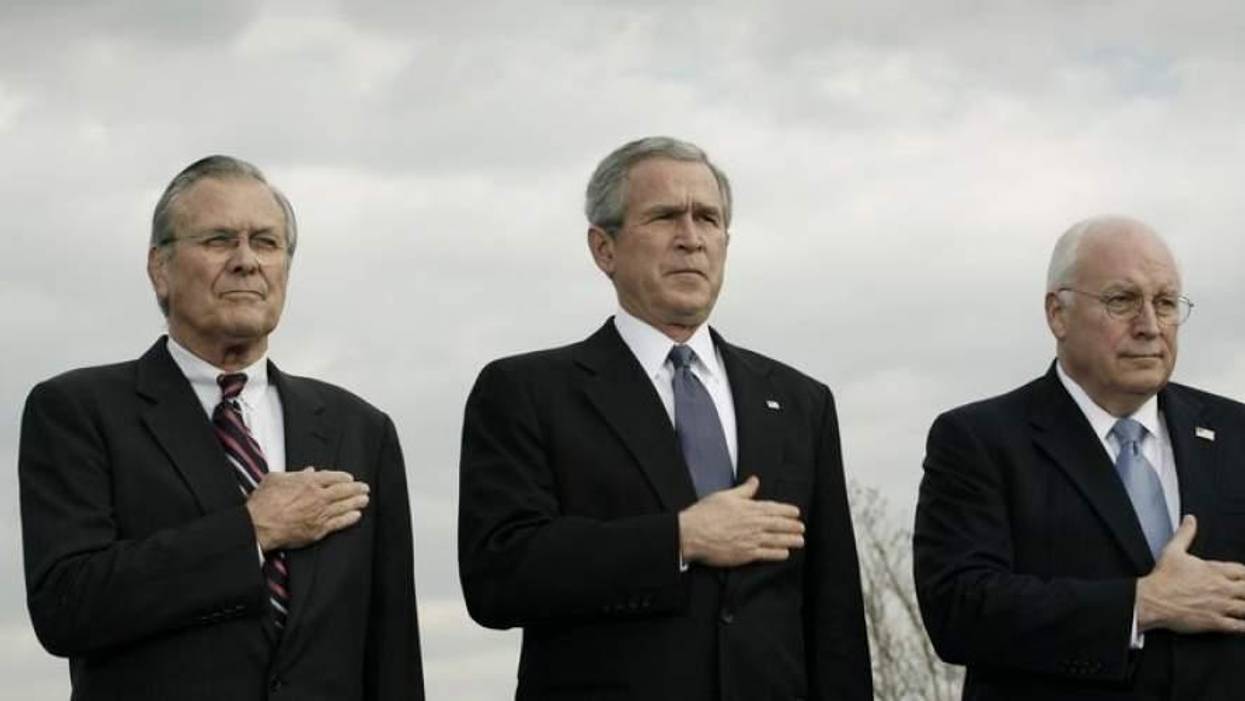
Sixteen years after the United States invaded Iraq and left a trail of destruction and chaos in the country and the region, one aspect of the war remains criminally underexamined: why was it fought in the first place? What did the Bush administration hope to get out of the war?
The official, and widely-accepted, story remains that Washington was motivated by Saddam Hussein's weapons of mass destruction (WMD) programme. His nuclear capabilities, especially, were deemed sufficiently alarming to incite the war. As then US Secretary of State Condoleezza Rice said, "We do not want the smoking gun to be a mushroom cloud."
Despite Saddam not having an active WMD programme, this explanation has found support among some International Relations scholars, who say that while the Bush administration was wrong about Saddam's WMD capabilities, it was sincerely wrong. Intelligence is a complicated, murky enterprise, the argument goes, and given the foreboding shadow of the 9/11 attacks, the US government reasonably, if tragically, misread the evidence on the dangers Saddam posed.
There is a major problem with this thesis: there is no evidence for it, beyond the words of the Bush officials themselves. And since we know the administration was engaged in a widespread campaign of deception and propaganda in the run-up to the Iraq war, there is little reason to believe them.
My investigation into the causes of the war finds that it had little to do with fear of WMDs - or other purported goals, such as a desire to "spread democracy" or satisfy the oil or Israel lobbies. Rather, the Bush administration invaded Iraq for its demonstration effect.
A quick and decisive victory in the heart of the Arab world would send a message to all countries, especially to recalcitrant regimes such as Syria, Libya, Iran, or North Korea, that American hegemony was here to stay. Put simply, the Iraq war was motivated by a desire to (re)establish American standing as the world's leading power.
Indeed, even before 9/11, then-Secretary of Defense Donald Rumsfeld saw Iraq through the prism of status and reputation, variously arguing in February and July 2001 that ousting Saddam would "enhance US credibility and influence throughout the region" and "demonstrate what US policy is all about".
"A quick and decisive victory in the heart of the Arab world would send a message to all countries, especially to recalcitrant regimes such as Syria, Libya, Iran, or North Korea, that American hegemony was here to stay. Put simply, the Iraq war was motivated by a desire to (re)establish American standing as the world's leading power."
These hypotheticals were catalysed into reality by September 11, when symbols of American military and economic dominance were destroyed. Driven by humiliation, the Bush administration felt that the US needed to reassert its position as an unchallengeable hegemon.
The only way to send a message so menacing was a swashbuckling victory in war. Crucially, however, Afghanistan was not enough: it was simply too weak a state. As prison bullies know, a fearsome reputation is not acquired by beating up the weakest in the yard. Or as Rumsfeld put it on the evening of 9/11, "We need to bomb something else to prove that we're, you know, big and strong and not going to be pushed around by these kinds of attacks."
Moreover, Afghanistan was a "fair" war, a tit-for-tat response to the Taliban's provision of sanctuary to al-Qaeda's leadership. Rumsfeld, Deputy Secretary of Defense Paul Wolfowitz, and Under Secretary of Defense for Policy Douglas Feith considered restricting retaliation to Afghanistan dangerously "limited", "meager", and "narrow". Doing so, they alleged, "may be perceived as a sign of weakness rather than strength" and prove to "embolden rather than discourage regimes" opposed to the US. They knew that sending a message of unbridled hegemony entailed a disproportionate response to 9/11, one that had to extend beyond Afghanistan.
Iraq fit the bill both because it was more powerful than Afghanistan and because it had been in neoconservative crosshairs since George HW Bush declined to press on to Baghdad in 1991. A regime remaining defiant despite a military defeat was barely tolerable before 9/11. Afterwards, however, it became untenable.
That Iraq was attacked for its demonstration effect is attested to by several sources, not least the principals themselves - in private. A senior administration official told a reporter, off the record, that "Iraq is not just about Iraq", rather "it was of a type", including Iran, Syria, and North Korea.
In a memo issued on September 30, 2001, Rumsfeld advised Bush that "the USG [US government] should envision a goal along these lines: New regimes in Afghanistan and another key State [or two] that supports terrorism [to strengthen political and military efforts to change policies elsewhere]".
Feith wrote to Rumsfeld in October 2001 that action against Iraq would make it easier to "confront - politically, militarily, or otherwise" Libya and Syria. As for then-Vice President Dick Cheney, one close adviser revealed that his thinking behind the war was to show: "We are able and willing to strike at someone. That sends a very powerful message."
In a 2002 column, Jonah Goldberg coined the "Ledeen Doctrine", named after neoconservative historian Michael Ledeen. The "doctrine" states: "Every ten years or so, the United States needs to pick up some small crappy little country and throw it against the wall, just to show the world we mean business."
It may be discomfiting to Americans to say nothing of millions of Iraqis that the Bush administration spent their blood and treasure for a war inspired by the Ledeen Doctrine. Did the US really start a war - one that cost trillions of dollars, killed hundreds of thousands of Iraqis, destabilised the region, and helped create the Islamic State of Iraq and the Levant (ISIL) - just to prove a point?
More uncomfortable still is that the Bush administration used WMDs as a cover, with equal parts fearmongering and strategic misrepresentation - lying - to exact the desired political effect. Indeed, some US economists consider the notion that the Bush administration deliberately misled the country and the globe into war in Iraq to be a "conspiracy theory", on par with beliefs that President Barack Obama was born outside the US or that the Holocaust did not occur.
But this, sadly, is no conspiracy theory. Even Bush officials have sometimes dropped their guard. Feith confessed in 2006 that "the rationale for the war didn't hinge on the details of this intelligence even though the details of the intelligence at times became elements of the public presentation".
That the administration used the fear of WMDs and terrorism to fight a war for hegemony should be acknowledged by an American political establishment eager to rehabilitate George W Bush amid the rule of Donald Trump, not least because John Bolton, Trump's national security adviser, seems eager to employ similar methods to similar ends in Iran.
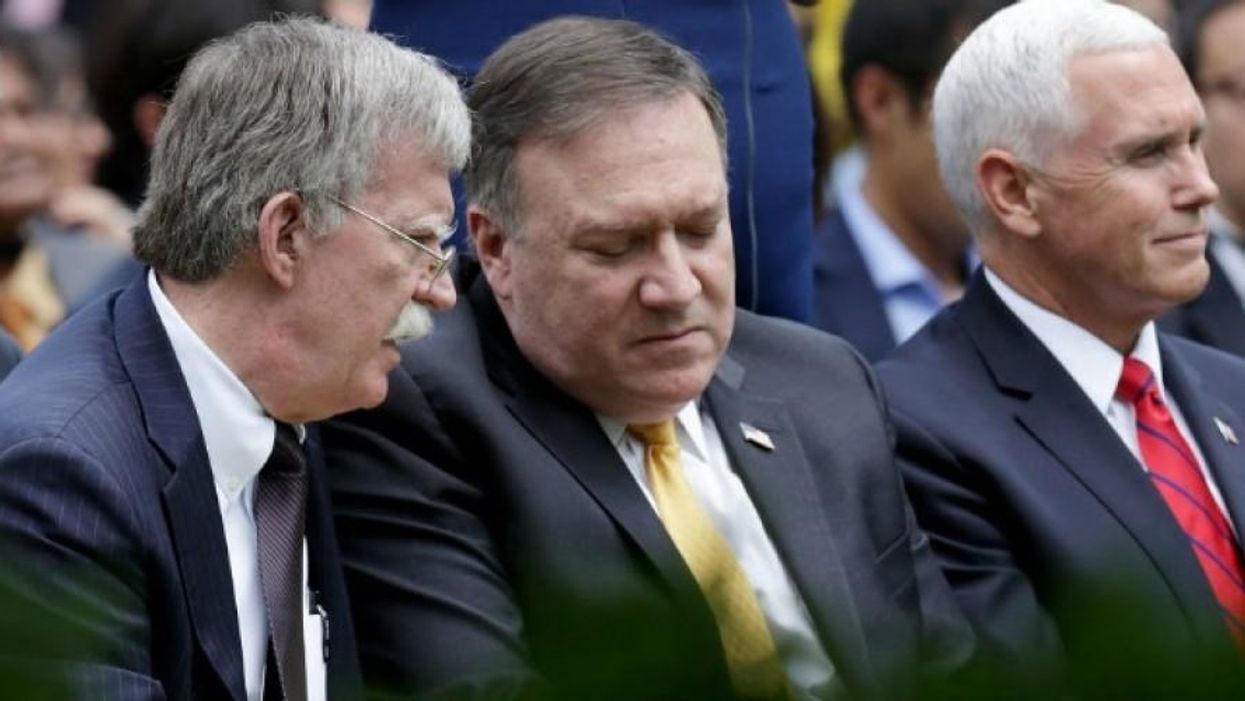
Here's the foreign policy question of questions in 2019: Are President Donald Trump, Israeli Prime Minister Benjamin Netanyahu, and Saudi Crown Prince Mohammed bin Salman, all severely weakened at home and with few allies abroad, reckless enough to set off a war with Iran? Could military actions designed to be limited -- say, a heightening of the Israeli bombing of Iranian forces inside Syria, or possible U.S. cross-border attacks from Iraq, or a clash between American and Iranian naval ships in the Persian Gulf -- trigger a wider war?
Worryingly, the answers are: yes and yes. Even though Western Europe has lined up in opposition to any future conflict with Iran, even though Russia and China would rail against it, even though most Washington foreign policy experts would be horrified by the outbreak of such a war, it could happen.
Despite growing Trump administration tensions with Venezuela and even with North Korea, Iran is the likeliest spot for Washington's next shooting war. Years of politically charged anti-Iranian vituperation might blow up in the faces of President Trump and his two most hawkish aides, Secretary of State Mike Pompeo and National Security Advisor John Bolton, setting off a conflict with potentially catastrophic implications.
Such a war could quickly spread across much of the Middle East, not just to Saudi Arabia and Israel, the region's two major anti-Iranian powers, but Iraq, Syria, Lebanon, Yemen, and the various Persian Gulf states. It might indeed be, as Iranian President Hassan Rouhani suggested last year (unconsciously echoing Iran's former enemy, Iraqi ruler Saddam Hussein) the "mother of all wars."
With Bolton and Pompeo, both well-known Iranophobes, in the driver's seat, few restraints remain on President Trump when it comes to that country. White House Chief of Staff John Kelly, National Security Advisor H.R. McMaster, and Secretary of Defense Jim Mattis, President Trump's former favorite generals who had urged caution, are no longer around. And though the Democratic National Committee passed a resolution last month calling for the United States to return to the nuclear agreement that President Obama signed, there are still a significant number of congressional Democrats who believe that Iran is a major threat to U.S. interests in the region.
During the Obama years, it was de rigueur for Democrats to support the president's conclusion that Iran was a prime state sponsor of terrorism and should be treated accordingly. And the congressional Democrats now leading the party on foreign policy -- Eliot Engel, who currently chairs the House Foreign Affairs Committee, and Bob Menendez and Ben Cardin, the two ranking Democrats on the Senate Foreign Relations Committee -- were opponents of the 2015 nuclear accord (though all three now claim to have changed their minds).
Deadly Flashpoints for a Future War
On the roller coaster ride that is Donald Trump's foreign policy, it's hard to discern what's real and what isn't, what's rhetoric and what's not. When it comes to Iran, it's reasonable to assume that Trump, Bolton, and Pompeo aren't planning an updated version of the unilateral invasion of Iraq that President George W. Bush launched in the spring of 2003.
Yet by openly calling for the toppling of the government in Tehran, by withdrawing from the Iran nuclear agreement and reimposing onerous sanctions to cripple that country's economy, by encouraging Iranians to rise up in revolt, by overtly supporting various exile groups (and perhaps covertly even terrorists), and by joining with Israel and Saudi Arabia in an informal anti-Iranian alliance, the three of them are clearly attempting to force the collapse of the Iranian regime, which just celebrated the 40th anniversary of the 1979 Islamic revolution.
There are three potential flashpoints where limited skirmishes, were they to break out, could quickly escalate into a major shooting war.
The first is in Syria and Lebanon. Iran is deeply involved in defending Syrian President Bashar al-Assad (who only recently returned from a visit to Tehran) and closely allied with Hezbollah, the Lebanese Shiite political party with a potent paramilitary arm. Weeks ago, Israeli Prime Minister Netanyahu openly boasted that his country's air force had successfully taken out Iranian targets in Syria. In fact, little noticed here, dozens of such strikes have taken place for more than a year, with mounting Iranian casualties.
Until now, the Iranian leadership has avoided a direct response that would heighten the confrontation with Israel, just as it has avoided unleashing Hezbollah, a well-armed, battle-tested proxy force. That could, however, change if the hardliners in Iran decided to retaliate. Should this simmering conflict explode, does anyone doubt that President Trump would soon join the fray on Israel's side or that congressional Democrats would quickly succumb to the administration's calls to back the Jewish state?
Next, consider Iraq as a possible flashpoint for conflict. In February, a blustery Trump told CBS's Face the Nation that he intends to keep U.S. forces in Iraq "because I want to be looking a little bit at Iran because Iran is the real problem." His comments did not exactly go over well with the Iraqi political class, since many of that country's parties and militias are backed by Iran.
Trump's declaration followed a Wall Street Journal report late last year that Bolton had asked the Pentagon -- over the opposition of various generals and then-Secretary of Defense Mattis -- to prepare options for "retaliatory strikes" against Iran. This roughly coincided with a couple of small rocket attacks against Baghdad's fortified Green Zone and the airport in Basra, Iraq's Persian Gulf port city, neither of which caused any casualties. Writing in Foreign Affairs, however, Pompeo blamed Iran for the attacks, which he called "life-threatening," adding, "Iran did not stop these attacks, which were carried out by proxies it has supported with funding, training, and weapons." No "retaliatory strikes" were launched, but plans do undoubtedly now exist for them and it's not hard to imagine Bolton and Pompeo persuading Trump to go ahead and use them -- with incalculable consequences.
Finally, there's the Persian Gulf itself. Ever since the George W. Bush years, the U.S. Navy has worried about possible clashes with Iran's naval forces in those waters and there have been a number of high-profile incidents. The Obama administration tried (but failed) to establish a hotline of sorts that would have linked U.S. and Iranian naval commanders and so made it easier to defuse any such incident, an initiative championed by then-Chairman of the Joint Chiefs Admiral Mike Mullen, a longtime opponent of war with Iran.
Under Trump, however, all bets are off. Last year, he requested that Mattis prepare plans to blow up Iran's "fast boats," small gunboats in the Gulf, reportedly asking, "Why don't we sink them?" He's already reinforced the U.S. naval presence there, getting Iran's attention. Not surprisingly, the Iranian leadership has responded in kind. Earlier this year, President Hassan Rouhani announced that his country had developed submarines capable of launching cruise missiles against naval targets. The Iranians also began a series of Persian Gulf war games and, in late February, test fired one of those sub-launched missiles.
Add in one more thing: in an eerie replay of a key argument George Bush and Dick Cheney used for going to war with Iraq in 2003, in mid-February the right-wing media outlet Washington Times ran an "exclusive" report with this headline: "Iran-Al Qaeda Alliance may provide legal rationale for U.S. military strikes."
Back in 2002, the Office of Special Plans at Secretary of Defense Donald Rumsfeld's Pentagon, under the supervision of neoconservatives Paul Wolfowitz and Douglas Feith, spent months trying to prove that al-Qaeda and Iraq were in league. The Washington Times piece, citing Trump administration sources, made a similar claim -- that Iran is now aiding and abetting al-Qaeda with a "clandestine sanctuary to funnel fighters, money, and weapons across the Middle East." It added that the administration is seeking to use this information to establish "a potential legal justification for military strikes against Iran or its proxies." Needless to say, few are the terrorism experts or Iran specialists who would agree that Iran has anything like an active relationship with al-Qaeda.
Will the Hardliners Triumph in Iran as in Washington?
The Trump administration is, in fact, experiencing increasing difficulty finding allies ready to join a new Coalition of the Willing to confront Iran. The only two charter members so far, Israel and Saudi Arabia, are, however, enthusiastic indeed. Last month, Prime Minister Netanyahu was heard remarking that Israel and its Arab allies want war with Iran.
At a less-than-successful mid-February summit meeting Washington organized in Warsaw, Poland, to recruit world leaders for a future crusade against Iran, Netanyahu was heard to say in Hebrew: "This is an open meeting with representatives of leading Arab countries that are sitting down together with Israel in order to advance the common interest of war with Iran." (He later insisted that the correct translation should have been "combating Iran," but the damage had already been done.)
That Warsaw summit was explicitly designed to build an anti-Iranian coalition, but many of America's allies, staunchly opposing Trump's decision to pull out of the Iran nuclear accord, would have nothing to do with it. In an effort to mollify the Europeans, in particular, the United States and Poland awkwardly renamed it: "The Ministerial to Promote a Future of Peace and Security in the Middle East."
The name change, however, fooled no one. As a result, Vice President Pence and Secretary of State Pompeo were embarrassed by a series of no-shows: the French, the Germans, and the European Union, among others, flatly declined to send ministerial-level representatives, letting their ambassadors in Warsaw stand in for them. The many Arab nations not in thrall to Saudi Arabia similarly sent only low-level delegations. Turkey and Russia boycotted altogether, convening a summit of their own in which Presidents Vladimir Putin and Recep Tayyip Erdogan met with Iran's Rouhani.
Never the smoothest diplomat, Pence condemned, insulted, and vilified the Europeans for refusing to go along with Washington's wrecking-ball approach. He began his speech to the conference by saying: "The time has come for our European partners to withdraw from the Iran nuclear deal." He then launched a direct attack on Europe's efforts to preserve that accord by seeking a way around the sanctions Washington had re-imposed: "Sadly, some of our leading European partners... have led the effort to create mechanisms to break up our sanctions. We call it an effort to break American sanctions against Iran's murderous revolutionary regime."
That blast at the European allies should certainly have brought to mind Secretary of Defense Rumsfeld's disparaging comments in early 2003 about Germany and France, in particular, being leaders of the "old Europe." Few allies then backed Washington's invasion plans, which, of course, didn't prevent war. Europe's reluctance now isn't likely to prove much of a deterrent either.
But Pence is right that the Europeans have taken steps to salvage the Iran nuclear deal, otherwise known as the Joint Comprehensive Plan of Action (JCPOA). In particular, they've created a "special purpose vehicle" known as INSTEX (Instrument for Supporting Trade Exchanges) designed "to support legitimate trade with Iran," according to a statement from the foreign ministers of Germany, France, and Great Britain. It's potentially a big deal and, as Pence noted, explicitly designed to circumvent the sanctions Washington imposed on Iran after Trump's break with the JCPOA.
INSTEX has a political purpose, too. The American withdrawal from the JCPOA was a body blow to President Rouhani, Foreign Minister Javad Zarif, and other centrists in Tehran who had taken credit for, and pride in, the deal between Iran and the six world powers (the United States, France, Germany, Britain, Russia, and China) that signed the agreement. That deal had been welcomed in Iran in part because it seemed to ensure that country's ability to expand its trade to the rest of the world, including its oil exports, free of sanctions.
Even before Trump abandoned the deal, however, Iran was already finding U.S. pressure overwhelming and, for the average Iranian, things hadn't improved in any significant way. Worse yet, in the past year the economy had taken a nosedive, the currency had plunged, inflation was running rampant, and strikes and street demonstrations had broken out, challenging the government and its clerical leadership. Chants of "Death to the Dictator!" -- not heard since the Green Movement's revolt against President Mahmoud Ahmadinejad's reelection in 2009 -- once again resounded in street demonstrations.
At the end of February, it seemed as if Trump, Bolton, and Pompeo had scored a dangerous victory when Zarif, Iran's well-known, Western-oriented foreign minister, announced his resignation. Moderates who supported the JCPOA, including Rouhani and Zarif, have been under attack from the country's hardliners since Trump's pullout. As a result, Zarif's decision was widely assumed to be a worrisome sign that those hardliners had claimed their first victim.
There was even unfounded speculation that, without Zarif, who had worked tirelessly with the Europeans to preserve what was left of the nuclear pact, Iran itself might abandon the accord and resume its nuclear program. And there's no question that the actions and statements of Bolton, Pompeo, and crew have undermined Iran's moderates, while emboldening its hardliners, who are making I-told-you-so arguments to Ayatollah Ali Khamenei, the country's supreme leader.
Despite the internal pressure on Zarif, however, his resignation proved short-lived indeed: Rouhani rejected it, and there was an upsurge of support for him in Iran's parliament. Even General Qassem Soleimani, a major figure in that country's Islamic Revolutionary Guard Corps (IRGC) and the commander of the Quds Force, backed him. As it happens, the Quds Force, an arm of the IRGC, is responsible for Iran's paramilitary and foreign intelligence operations throughout the region, but especially in Iraq and Syria. That role has allowed Soleimani to assume responsibility for much of Iran's foreign policy in the region, making him a formidable rival to Zarif -- a tension that undoubtedly contributed to his brief resignation and it isn't likely to dissipate anytime soon.
According to analysts and commentators, it appears to have been a ploy by Zarif (and perhaps Rouhani, too) to win a vote of political confidence and it appears to have strengthened their hand for the time being.
Still, the Zarif resignation crisis threw into stark relief the deep tensions within Iranian politics and raised a key question: As the Trump administration accelerates its efforts to seek a confrontation, will they find an echo among Iranian hardliners who'd like nothing more than a face-off with the United States?
Maybe that's exactly what Bolton and Pompeo want. If so, prepare yourself: another American war unlikely to work out the way anyone in Washington dreams is on the horizon.

What dreamers they were! They imagined a kind of global power that would leave even Rome at its Augustan height in the shade. They imagined a world made for one, a planet that could be swallowed by a single great power. No, not just great, but beyond anything ever seen before -- one that would build (as its National Security Strategy put it in 2002) a military "beyond challenge." Let's be clear on that: no future power, or even bloc of powers, would ever be allowed to challenge it again.
And, in retrospect, can you completely blame them? I mean, it seemed so obvious then that we -- the United States of America -- were the best and the last. We had, after all, outclassed and outlasted every imperial power since the beginning of time. Even that other menacing superpower of the Cold War era, the Soviet Union, the "Evil Empire" that refused to stand down for almost half a century, had gone up in a puff of smoke.
Imagine that moment so many years later and consider the crew of neoconservatives who, under the aegis of George W. Bush, the son of the man who had "won" the Cold War, came to power in January 2001. Not surprisingly, on viewing the planet, they could see nothing -- not a single damn thing -- in their way. There was a desperately weakened and impoverished Russia (still with its nuclear arsenal more or less intact) that, as far as they were concerned, had been mollycoddled by President Bill Clinton's administration. There was a Communist-gone-capitalist China focused on its own growth and little else. And there were a set of other potential enemies, "rogue powers" as they were dubbed, so pathetic that not one of them could, under any circumstances, be called "great."
In 2002, in fact, three of them -- Iraq, Iran, and North Korea -- had to be cobbled together into an "axis of evil" to create a faintly adequate enemy, a minimalist excuse for the Bush administration to act preemptively. It couldn't have been more obvious then that all three of them would go down before the unprecedented military and economic power of us (even if, as it happened, two of them didn't).
It was as clear as glass that the world -- the whole shebang -- was there for the taking. And it couldn't have been headier, even after a tiny Islamist terror outfit hijacked four American jets and took out New York's World Trade Center and part of the Pentagon on September 11, 2001. As President Bush would put it in an address at West Point in 2002, "America has, and intends to keep, military strengths beyond challenge, thereby making the destabilizing arms races of other eras pointless, and limiting rivalries to trade and other pursuits of peace." In other words, jihadists aside, it was all over. From now on, there would be an arms race of one and it was obvious who that one would be. The National Security Strategy of that year put the same thought this way: "Our forces will be strong enough to dissuade potential adversaries from pursuing a military build-up in hopes of surpassing, or equaling, the power of the United States." Again, anywhere on the planet ever.
Look at more or less any document from the period and you'll sense that they weren't shy about touting the unprecedented greatness of a future global Pax Americana. Take, for instance, columnist Charles Krauthammer who, in February 2001, six months before the terror attacks of September 11th, wrote a piece swooning over the new Bush administration's "unilateralism" to come and the "Bush Doctrine" which would go with it. In the process, he gave that administration a green light to put the pathetic Russians in their nuclear place and summed the situation up this way: "America is no mere international citizen. It is the dominant power in the world, more dominant than any since Rome. Accordingly, America is in a position to reshape norms, alter expectations, and create new realities. How? By unapologetic and implacable demonstrations of will."
"How Did USA's Oil Get Under Iraq's Sand?"
And soon enough after September 11th, those unapologetic, implacable demonstrations of will did, in fact, begin -- first in Afghanistan and then, a year and a half later, in Iraq. Goaded by Osama bin Laden, the new Rome went into action.
Of course, in 2019 we have the benefit of hindsight, which Charles Krauthammer, Vice President Dick Cheney, Secretary of Defense Donald Rumsfeld, Deputy Secretary of Defense Paul Wolfowitz, and the rest of that crew didn't have as they applied their Roman-style vision of an imperial America to the actual world. It should be added, however, that the millions of people who hit the streets globally to protest the coming invasion of Iraq in the winter of 2003 -- "How did USA's oil get under Iraq's sand?" said a typical protest sign (which Donald Trump would have understood in his own way) -- had a far better sense of the world than did their American rulers-to-be. Like the Soviets before them, in fact, they would grievously confuse military power with power on this planet.
More than 17 years later, the U.S. military remains stuck in Afghanistan, bedeviled in Iraq, and floundering across much of the Greater Middle East and Africa on a planet with a resurgent Russia, and an impressively rising China. One-third of the former axis of evil, Iran, is, remarkably enough, still in Washington's gunsights, while another third (North Korea) sits uncomfortably in a presidential bear hug. It's no exaggeration to say that none of the dreams of a new Rome were ever faintly fulfilled. In fact, if you want to think about what's been truly exceptional in these years, it might be this: never in history has such a great power, at its height, seemed quite so incapable of effectively applying force, military or otherwise, to achieve its imperial ends or bring its targets to heel.
And yet, wrong as they may have been on such subjects, don't sell Krauthammer and the rest of that neocon crew short. They were, in their own way, also prophets, at least domestically speaking. After all, Rome, like the United States, had been an imperial republic. That republic was replaced, as its empire grew, by autocratic rule, first by the self-anointed emperor Augustus and then by his successors. Arguably, 18 years after Krauthammer wrote that column, the American republic might be heading down the same path. After all, so many years later, the neocons, triumphantly risen yet again in Washington (both in the administration and as its critics), finally have their Caesar.
Hail, Donald J. Trump, we who are about to read your latest tweet salute you!
A Rogue State of One
Let's note some other passing parallels between the new Rome and the old one. As a start, it's certainly accurate to say that our new American Caesar has much gall (divided into at least three parts). Admittedly, he's no Augustus, the first of a line of emperors, but more likely a Nero, fiddling while, in his case, the world quite literally burns. Still, he could certainly say of campaign 2016 and what followed: Veni, Vidi, Tweeti (I came, I saw, I tweeted). And don't forget the classic line that might someday be applied to his presidency, "Et tu, Mueller?" -- or depending on who turns on him, you can fill in your name of choice.
One day, it might also be said that, in a country in which executive power has become ever more imperial (as has the power of the Senate's majority leader), blowback from imperial acts abroad has had a significant, if largely hidden, hand in crippling the American republic, as was once true of Rome. In fact, it seems clear enough that the first republican institution to go was the citizen's army. In the wake of the Vietnam War, the draft was thrown out and replaced by an "all-volunteer" force, one which would, as it came to fight on ever more distant battlefields, morph into a home-grown version of an imperial police force or foreign legion. With it went the staggering sums that, in this century, would be invested -- if that's even the word for it -- in what's still called "defense," as well as in a vast empire of bases abroad and the national security state, a rising locus of power at home. And then, of course, there were the never-ending wars across much of the Greater Middle East and parts of Africa that went with all of that. Meanwhile, so much else, domestically speaking, was put on the equivalent of austerity rations. And all of that, in turn, helped provoke the crisis that brought Donald Trump to power and might, in the end, even sink the American system as we've known it.
The Donald's victory in the 2016 election was always a sign of a deep disturbance at the heart of an increasingly unequal and unfair system of wealth and power. But it was those trillions of dollars -- The Donald claims seven trillion of them -- that the neocons began sinking into America's "infinite" wars, which cost Americans big time in ways they hardly tracked or noticed. Those trillions didn't go into shoring up American infrastructure or health care or education or job-training programs or anything else that might have mattered to most people here, even as untold tax dollars -- one estimate: $15,000 per middle-class family per year -- went into the pockets of the rich. And some of those dollars, in turn, poured back into the American political system (with a helping hand from the Supreme Court's 2010 Citizens United decision) and, in the end, helped put the first billionaire in the Oval Office. By the 2020 election campaign, we may achieve another all-American first: two or even three of the candidates could be billionaires.
All of this not only gave Americans a visibly unhinged president -- think of him, in axis-of-evil terms, as a rogue state of one -- but an increasingly unhinged country. You can feel so much of this in President Trump's confused and confusing attempts to both end American wars and ratchet them up, 17-and-a-half -- he always claims "almost 19" -- years after the invasion of Afghanistan. You can feel it in his gut-level urge to attack the "deep state" and yet fund it beyond its wildest dreams. You can feel it in his attempts to create a corps of "my generals" and then fire them all. You can feel the unhinged nature of events in a world in which, after so many years of war, America's enemies still seem to have the formula for staying afloat, no matter what Washington does. The Taliban in Afghanistan is on the rise; al-Shabaab in Somalia, is still going strong; the Houthis in Yemen remain functional in a sea of horror and starvation; ISIS, now without its caliphate, has from Syria to the Philippines, Africa to Afghanistan, become a distinctly global brand; al-Qaeda in the Arabian Peninsula thrives, while terror groups more generally continue to spread.
You can feel it in the president's confused and confusing explanations for his urges to withdraw American troops in days or four months or whenever from Syria and do the same or maybe not exactly in Afghanistan. (As he said in his State of the Union address, American troops would both withdraw and "focus" on "counterterrorism" in that country.) You can feel it in the way, after so many years of visible failure, the neocons are once again riding high in Washington, ascendant both in his administration and as critics of its global and military policies.
These days, who even remembers that classic early Cold War question -- who lost China? -- that rattled American domestic politics for years, or later, the similar one about Vietnam? Still, if Donald Trump ever truly does withdraw American forces from Afghanistan (undoubtedly leaving this country's allies in a Vietnam-style ditch), count on foreign policy establishmentarians in Washington and pundits around the country to ask an updated version of the same question: Did Donald Trump lose Afghanistan?
But no matter what happens, don't make the mistake of blaming him. It's true that he tweeted endlessly while the world burned, but he won't be the one who "lost" Afghanistan. It was "lost" in the grisly dreams of the neocons as the century began and it's never truly been found again.
Of course, we no more know what's going to happen in the years ahead than the neocons did in 2001. If history has taught us anything, it's that prediction is the diciest of human predilections. Still, think of this piece as an obituary of sorts. You know, the kind major newspapers write about those still living and then continually update until death finally occurs.
Think of it not as an obituary for a single loopy president, a man who, with his "great, great wall," has indeed been an opiate of the masses (for his famed base, at least) in the midst of an opioid crisis hitting them hard. Yes, Donald J. Trump, reality TV star and bankruptee, he of the golden letters, was elevated to a strange version of power by a troubled republic showing signs of wear and tear. It was a republic feeling the pressure of all that money flowing into only half-noticed distant wars and into the pockets of billionaires and corporate entities in a way that turned the very idea of democracy into a bad joke.
Someday, if people ask the obvious question -- not who lost Afghanistan, but who lost America? -- keep all those failed imperial wars and the national security state that went with them in mind when you try to answer. Cumulatively, they had a far more disruptive role than is now imagined in toppling the dominos that sent us all careening on a path to nowhere here at home. And keep in mind that, whatever Donald Trump does, the Caesarian die was cast early in this century as the neocons crossed their own Rubicon.
Hail, Caesar, we who are about to die salute you!
In a biting resignation letter published in full by CNN on Wednesday, longtime NBC News reporter, commentator, and military analyst William "Bill" Arkin blasted the corporate media network for embracing U.S. "national security leaders and generals" while "ignoring the empirical truth of what they have wrought: There is not one country in the Middle East that is safer today than it was 18 years ago. Indeed the world becomes ever more polarized and dangerous."
"I find it disheartening that we do not report the failures of the generals and national security leaders. I find it shocking that we essentially condone continued American bumbling in the Middle East and now Africa through our ho-hum reporting."
--William Arkin, former NBC News commentator
Reflecting on his past couple of decades working with the network--in addition to writing books and columns for major newspapers and serving as as military adviser to human rights and environmental groups--Arkin laments: "My expertise, though seeming to be all the more central to the challenges and dangers we face, also seems to be less valued at the moment. And I find myself completely out of [sync] with the network, being neither a day-to-day reporter nor interested in the Trump circus."
Noting in his 2,228-word memo that "the world and the state of journalism [are] in tandem crisis," Arkin delivers a scathing critique of how NBC has responded to the foreign policy of President Donald Trump--whom he calls "an ignorant and incompetent impostor"--asserting that "in many ways NBC just began emulating the national security state itself--busy and profitable. No wars won but the ball is kept in play."
However, Arkin also delivers a broader condemnation of the network's coverage of the so-called War on Terror in the nearly 18 years since 9/11, and how it has helped produce a scenario in which "perpetual war has become accepted as a given in our lives." He writes:
Seeking refuge in its political horse race roots, NBC (and others) meanwhile report the story of war as one of Rumsfeld vs. the Generals, as Wolfowitz vs. Shinseki, as the CIA vs. Cheney, as the bad torturers vs. the more refined, about numbers of troops and number of deaths, and even then Obama vs. the Congress, poor Obama who couldn't close Guantanamo or reduce nuclear weapons or stand up to Putin because it was just so difficult. We have contributed to turning the world national security into this sort of political story. I find it disheartening that we do not report the failures of the generals and national security leaders. I find it shocking that we essentially condone continued American bumbling in the Middle East and now Africa through our ho-hum reporting.
Characterizing himself as a "difficult guy" who spent much of his time at NBC challenging conventional narratives about war and nuclear weapons and arguing against hawkish U.S. foreign policy both on and off air, Arkin suggests the state of television news has worsened in the Trump era. He writes, "In our day-to-day whirlwind and hostage status as prisoners of Donald Trump, I think--like everyone else does--that we miss so much."
Summarizing his disagreements with the pro-war positions commonly bolstered by the network under the Trump administration, Arkin continues:
For me I realized how out of step I was when I looked at Trump's various bumbling intuitions: his desire to improve relations with Russia, to denuclearize North Korea, to get out of the Middle East, to question why we are fighting in Africa, even in his attacks on the intelligence community and the FBI. Of course he is an ignorant and incompetent impostor. And yet I'm alarmed at how quick NBC is to mechanically argue the contrary, to be in favor of policies that just spell more conflict and more war. Really? We shouldn't get out Syria? We shouldn't go for the bold move of denuclearizing the Korean peninsula? Even on Russia, though we should be concerned about the brittleness of our democracy that it is so vulnerable to manipulation, do we really yearn for the Cold War? And don't even get me started with the FBI: What? We now lionize this historically destructive institution?
Despite noting that "my time at NBC has been gratifying," and thanking a few former colleagues by name, Arkin concludes, "I'm ever so happy to return to writing and thinking without the officiousness of editorial tyrants or corporate standards." According to the memo, he is currently working on a novel about 9/11 and "a non-fiction book, an extended essay about national security and why we never seem to end our now perpetual state of war."
The letter was welcomed by many critics of corporate media and American militarism--including The Intercept's Glenn Greenwald, who praised Arkin's "scathing and unflinching" passages describing NBC and MSNBC "as pro-war propaganda outlets who exist to do little more than amplify and serve the security state agencies that are most devoted to opposing Trump, including their mindless opposition to Trump's attempts (with whatever motives) to roll back some of the excesses of imperialism, aggression, and U.S. involvement in Endless War, as well as to sacrifice all journalistic standards and skepticism about generals and the U.S. war machine if doing so interferes in their monomaniacal mission of denouncing Trump."
While pointing out that the pro-war posture of American corporate media network "has long been obvious, and deeply disturbing," Greenwald notes, "Still, that a network insider has blown the whistle on how all this works, and how MSNBC and NBC have become Ground Zero for these political pathologies of militarism and servitude to security state agencies, while not surprising, is nonetheless momentous given how detailed and emphatic he is in his condemnations."
Here is the full text of Arkin's resignation letter, as reported by CNN and confirmed by NBC:
January 4 is my last day at NBC News and I'd like to say goodbye to my friends, hopefully not for good. This isn't the first time I've left NBC, but this time the parting is more bittersweet, the world and the state of journalism in tandem crisis. My expertise, though seeming to be all the more central to the challenges and dangers we face, also seems to be less valued at the moment. And I find myself completely out of [sync] with the network, being neither a day-to-day reporter nor interested in the Trump circus.
I first started my association with NBC 30 years ago, feeding Cold War stories to Bob Windrem and Fred Francis at the Pentagon. I became an on-air analyst during the 1999 Kosovo War, continuing to work thereafter with Nightly News, delighting and oftentimes annoying in my peculiar position of being a mere civilian amongst THE GENERALS and former government officials. A scholar at heart, I also found myself an often lone voice that was anti-nuclear and even anti-military, anti-military for me meaning opinionated but also highly knowledgeable, somewhat akin to a movie critic, loving my subject but also not shy about making judgements regarding the flops and the losers.
When the attacks of 9/11 came, I was called back to NBC. I spent weeks on and off the air talking about al Qaeda and the various wars we were rushing into, arguing that airpower and drones would be the centerpiece not troops. In the new martial environment where only one war cry was sanctioned I was out of sync then as well. I retreated somewhat to writing a column for the Los Angeles Times, but even there I had to fight editors who couldn't believe that there would be a war in Iraq. And I spoke up about the absence of any sort of strategy for actually defeating terrorism, annoying the increasing gaggles of those who seemed to accept that a state of perpetual war was a necessity.
I thought then that there was great danger in the embrace of process and officialdom over values and public longing, and I wrote about the increasing power of the national security community. Long before Trump and "deep state" became an expression, I produced one ginormous investigation -- Top Secret America -- for the Washington Post and I wrote a nasty book -- American Coup -- about the creeping fascism of homeland security.
Looking back now they were both harbingers for what President Obama (and then Trump) faced in terms of largely failing to make enduring change.
Somewhere in all of that, and particularly as the social media wave began, it was clear that NBC (like the rest of the news media) could no longer keep up with the world. Added to that was the intellectual challenge of how to report our new kind of wars when there were no real fronts and no actual measures of success. To me there is also a larger problem: though they produce nothing that resembles actual safety and security, the national security leaders and generals we have are allowed to do their thing unmolested. Despite being at "war," no great wartime leaders or visionaries are emerging. There is not a soul in Washington who can say that they have won or stopped any conflict. And though there might be the beloved perfumed princes in the form of the Petraeus' and Wes Clarks', or the so-called warrior monks like Mattis and McMaster, we've had more than a generation of national security leaders who sadly and fraudulently have done little of consequence. And yet we (and others) embrace them, even the highly partisan formers who masquerade as "analysts". We do so ignoring the empirical truth of what they have wrought: There is not one country in the Middle East that is safer today than it was 18 years ago. Indeed the world becomes ever more polarized and dangerous.
As perpetual war has become accepted as a given in our lives, I'm proud to say that I've never deviated in my argument at NBC (or at my newspaper gigs) that terrorists will never be defeated until we better understand why they are driven to fighting. And I have maintained my central view that airpower (in its broadest sense including space and cyber) is not just the future but the enabler and the tool of war today.
Seeking refuge in its political horse race roots, NBC (and others) meanwhile report the story of war as one of Rumsfeld vs. the Generals, as Wolfowitz vs. Shinseki, as the CIA vs. Cheney, as the bad torturers vs. the more refined, about numbers of troops and number of deaths, and even then Obama vs. the Congress, poor Obama who couldn't close Guantanamo or reduce nuclear weapons or stand up to Putin because it was just so difficult. We have contributed to turning the world national security into this sort of political story. I find it disheartening that we do not report the failures of the generals and national security leaders. I find it shocking that we essentially condone continued American bumbling in the Middle East and now Africa through our ho-hum reporting.
I'm a difficult guy, not prone to either protocol or procedure and I give NBC credit that it tolerated me through my various incarnations. I hope people will say in the early days that I made Brokaw and company smarter about nuclear weapons, about airpower, and even about al Qaeda. And I'm proud to say that I also was one of the few to report that there weren't any WMD in Iraq and remember fondly presenting that conclusion to an incredulous NBC editorial board. I argued endlessly with MSNBC about all things national security for years, doing the daily blah, blah, blah in Secaucus, but also poking at the conventional wisdom of everyone from Matthews to Hockenberry. And yet I feel like I've failed to convey this larger truth about the hopelessness of our way of doing things, especially disheartened to watch NBC and much of the rest of the news media somehow become a defender of Washington and the system.
I'd argue that under Trump, the national security establishment not only hasn't missed a beat but indeed has gained dangerous strength. Now it is ever more autonomous and practically impervious to criticism. I'd also argue, ever so gingerly, that NBC has become somewhat lost in its own verve, proxies of boring moderation and conventional wisdom, defender of the government against Trump, cheerleader for open and subtle threat mongering, in love with procedure and protocol over all else (including results). I accept that there's a lot to report here, but I'm more worried about how much we are missing. Hence my desire to take a step back and think why so little changes with regard to America's wars.
I know it is characteristic of our overexcited moment to blast away at former employers and mainstream institutions, but all I can say is that despite many frustrations, my time at NBC has been gratifying. Working with Cynthia McFadden has been the experience of a lifetime. I've learned a ton about television from her and Kevin Monahan, the secret insider tricks of the trade and the very big picture of what makes for original stories (and how powerful they can be). The young reporters at NBC are also universally excellent. Thanks to Noah Oppenheim for his support of my contrarian and disruptive presence. And to Janelle Rodriguez, who supported deep expertise. The Nightly crew has also been a constant fan of my too long stories and a great team. I continue to marvel as Phil Griffin carries out his diabolical plan for the cable network to take over the world.
I'm proud of the work I've done with my team and know that there's more to do. But for now it's time to take a break. I'm ever so happy to return to writing and thinking without the officiousness of editorial tyrants or corporate standards. And of course I yearn to go back to my first love, which is writing boring reports about secret programs, grateful that the American government so graciously obliges in its constant supply. And I particularly feel like the world is moving so quickly that even in just the little national security world I inhabit, I need more time to sit back and think. And to replenish.
In our day-to-day whirlwind and hostage status as prisoners of Donald Trump, I think -- like everyone else does -- that we miss so much. People who don't understand the medium, or the pressures, loudly opine that it's corporate control or even worse, that it's partisan. Sometimes I quip in response to friends on the outside (and to government sources) that if they mean by the word partisan that it is New Yorkers and Washingtonians against the rest of the country then they are right.
For me I realized how out of step I was when I looked at Trump's various bumbling intuitions: his desire to improve relations with Russia, to denuclearize North Korea, to get out of the Middle East, to question why we are fighting in Africa, even in his attacks on the intelligence community and the FBI. Of course he is an ignorant and incompetent impostor. And yet I'm alarmed at how quick NBC is to mechanically argue the contrary, to be in favor of policies that just spell more conflict and more war. Really? We shouldn't get out Syria? We shouldn't go for the bold move of denuclearizing the Korean peninsula? Even on Russia, though we should be concerned about the brittleness of our democracy that it is so vulnerable to manipulation, do we really yearn for the Cold War? And don't even get me started with the FBI: What? We now lionize this historically destructive institution?
Even without Trump, our biggest challenge as we move forward is that we have become exhausted parents of our infant (and infantile) social media children. And because of the "cycle," we at NBC (and all others in the field of journalism) suffer from a really bad case of not being able to ever take a breath. We are a long way from resolving the rules of the road in this age, whether it be with regard to our personal conduct or anything related to hard news. I also don't think that we are on a straight line towards digital nirvana, that is, that all of this information will democratize and improve society. I sense that there is already smartphone and social media fatigue creeping across the land, and my guess is that nothing we currently see -- nothing that is snappy or chatty -- will solve our horrific challenges of information overload or the role (and nature) of journalism. And I am sure that once Trump leaves center stage, society will have a gigantic media hangover. Thus for NBC -- and for everyone else -- there is challenge and opportunity ahead. I'd particularly like to think and write more about that.
There's a saying about consultants, that organizations hire them to hear exactly what they want to hear. I'm proud to say that NBC didn't do that when it came to me. Similarly I can say that I'm proud that I'm not guilty of giving my employers what they wanted. Still, the things this and most organizations fear most -- variability, disturbance, difference -- those things that are also the primary drivers of creativity -- are not really the things that I see valued in the reporting ranks.
I'm happy to go back to writing and commentary. This winter, I'm proud to say that I've put the finishing touches on a 9/11 conspiracy novel that I've been toiling on for over a decade. It's a novel, but it meditates on the question of how to understand terrorists in a different way. And I'm undertaking two new book-writing projects, one fiction about a lone reporter and his magical source that hopes to delve into secrecy and the nature of television. And, if you read this far, I am writing a non-fiction book, an extended essay about national security and why we never seem to end our now perpetual state of war. There is lots of media critique out there, tons of analysis of leadership and the Presidency. But on the state of our national security? Not so much. Hopefully I will find myself thinking beyond the current fire and fury and actually suggest a viable alternative. Wish me luck.

"But for most of us, the movement was a life-giving force. To join a hundred thousand others in marches and rallies, to know that even if you felt helpless against the power of government you were not alone in your feelings--that people all over the country, of all ages, black and white, working people and middle-class people, were with you--was to be moved beyond words. ... to see Mohammed Ali defy the authorities even at the cost of his championship title, to hear Martin Luther King speak out against the war, to see little children marching with their parents, carrying signs--"Save the children of Vietnam"--was to feel the best of human beings were fighting your cause. ... millions of people protested the war not because their own lives were at stake, but because they truly cared about other people's lives, the lives of Vietnamese, of fellow Americans."
--Howard Zinn, You Can't Be Neutral On A Moving Train
When I was young and the war in Vietnam was raging, I rejected much of what I associated with a government and a society that could undertake the destruction of an entire people and still carry on as if there were nothing in the least bit abnormal about that state of affairs. In time, I saw that the way forward, at least for me, was to join those who understood just how evil the war was and how imperative it was for people to lift their voices, take to the streets, and risk their personal well being to protest the war.
In time, I saw that the way forward, at least for me, was to join those who understood just how evil the war was and how imperative it was for people to lift their voices, take to the streets, and risk their personal well being to protest the war.
Reading Zinn's account of the Vietnam antiwar movement (in his book You Can't Be Neutral On A Moving Train) and how it grew from isolated pockets of opposition into a massive, nation-wide wave of resistance, I felt re-united with feelings that have languished inside me for the past decade and a half. In the winter of 2003, as the US prepared to invade Iraq, I was on the streets with hundreds of thousands of others who truly cared about preventing the needless deaths of both Iraqis and fellow Americans. For a time, I believed we would prevail over the Pentagon, the defense contractors, and the Department of Defense--each of which had its own reasons for wanting to prosecute yet another act of criminal aggression against a relatively defenseless country. This time around, however, it was conceivable that our passionate commitment to peace and its expression through movement building, rallies, and demonstrations might actually stay the hand of our "Commander-in-Chief" and his war-mongering, neo-conservative ideologues: Dick Cheney, Condoleezza Rice, Donald Rumsfeld, Paul Wolfowitz, et al.
On a frigid, fingertip-freezing day in February 2003, close to a million of us hit the streets of New York to make our voices heard. Together with comparable numbers of our brethren in other countries, we declared our united opposition to a war against Iraq--a war that many in the peace movement judged would be both illegal and immoral, and unconscionably destructive.
That winter afternoon stands out in my memory as the last time I felt the degree of exhilaration Howard Zinn so beautifully evokes in his description of the camaraderie he experienced during the high watermark of the Vietnam antiwar movement. A month later, on March 20, 2003, the war we hoped to prevent officially began with the much ballyhooed "shock and awe" bombing of Iraq. As someone with deep, personal connections to people in Iraq and a long-term involvement with the anti-sanctions movement, I felt profoundly demoralized by our failure to stop Bush II from attacking yet another Muslim nation under the pretext of "defending the world from grave danger." But fellow activists reminded me that our surrender was not an option. However much defeated many of us felt, we had to keep up the struggle to bring some measure of sanity to a world in which the glorification of military power and the choice of violence over diplomacy nine times out of ten trumps international law and humanitarian considerations.
This year, on the eve of Thanksgiving, I turned to historian and activist Howard Zinn, author of A People's History of the United States, for a way to hold and live with the terrible knowledge that once again my country is putting the projection of power and the pursuit of hegemonic objectives (controlling global energy resources; maintaining ties with US-friendly regional allies, etc.) ahead of simple humanity. Instead of the Vietnamese, the latest target of the US government's malevolent, calculated indifference to massive human suffering are the people of Yemen. Progressive writers and activists have spoken out forcefully against the genocidal nature of Saudi Arabia's war on Yemen, and demanded a total suspension of arms sales to the Saudi regime and the cessation of all other forms of assistance, including mid-air refueling of Saudi war planes, targeting information, and diplomatic cover.
In this essay, I have no wish to repeat what has been said elsewhere about the conflict between the Kingdom of Saudi Arabia and the Houthi rebels of Yemen. Informed readers are aware of the Kingdom's bogus claim that the rebels are significantly supported by Iran, its greatest foe. Therefore, the war is, in effect, a battle with the Islamic Republic of Iran for dominance of the Middle East and the ultimate victory of extremist Sunni Islam over the Shia theocracy of Iran. By this line of specious reasoning, the US alliance with Riyadh is a necessary bulwark against Iran's growing regional influence and its purported role in fomenting terror and further destabilizing the Middle East.
I leave the delineation of such matters in far more competent hands. What matters most to me are the humanitarian consequences of this three-year-conflict, which shows no sign of stopping any time soon despite the recent US decision to stop re-fueling Saudi war planes and the growing, world-wide alarm that the Saudis are condemning an entire people to death from famine, sickness, and unrelenting airstrikes on civilian targets, like markets, hospitals, schools, and mosques. Consider the following figures from author Nicholas Davies, citing data from the Armed Conflict Location and Event Data Project (ACLED), a nongovernmental organization (NGO):
ACLED now estimates the true number of people killed in Yemen is probably between 70,000 and 80,000. ACLED's estimates do not include the thousands of Yemenis who have died from the war's indirect consequences, such as starvation and preventable diseases like diphtheria and cholera. UNICEF reported in December 2016 that a child was dying every 10 minutes in Yemen, and the humanitarian crisis has only worsened since then. At that rate the total of all deaths caused directly and indirectly by the war must by now be more than one hundred thousand.
At that rate the total of all deaths caused directly and indirectly by the war must by now be more than one hundred thousand.
An estimated one hundred thousand people killed directly or indirectly in a war that never should have begun in the first place. A war that has the blessings of Donald Trump in the form of billions of dollars of arms sales; a "bromance" with Mohammed bin Salman (MbS), the Crown Prince of Saudi Arabia; and a brazen refutation of the CIA's conclusion that the Crown Prince "personally ordered" the killing of Saudi journalist and self-imposed exile Jamal Khashoggi. Quoting Secretary of Defense Mike Pompeo, Trump told the world on Thanksgiving morning, "It's a mean and nasty place out there."
And thanks to people like Secretary of State Mike Pompeo, National Security Advisor John Bolton, President Donald Trump, and his bosom buddy the Little Prince of the world's leading autocracy and exporter of terrorist doctrine, it's getting a whole lot meaner and nastier. According to a recent report issued by the charity Save the Children, about 85,000 children under the age of 5 have starved to death as a consequence of the civil war in Yemen. How can anyone possibly grasp the significance of that number and the scale of human suffering implicit in the deaths of so many little children. One only has to look at photos of severely malnourished Yemeni children to realize the inhumanity of this war and that of the people who either prosecute or condone the violence. Working in Yemen since 1963, Save the Children states unequivocally that "13 million people face starvation--many of them children." Furthermore, "Over 22 million people--three out of every four--urgently need lifesaving assistance, including over 11 million children." The following statistics are from the above-mentioned report:
The US, first under Obama and now under Trump, does much more than condone the bombing of civilian, government, and military targets in Yemen. Not only do we provide the killers with bombs and guided missiles; we unashamedly support the economic war being conducted against the people of Yemen by Saudi Arabia and its coalition partners. Martha Mundy, Professor Emeritus of Anthropology at the London School of Economics, has done extensive fieldwork in Yemen and other Arab countries. In her recent report for the World Peace Foundation, Mundy notes the responsibility of the US, the UK, and France--the three major arms dealers--in the commission of war crimes in Yemen as a result of the bombing. But their support for the economic war being waged is generally ignored, she says, and it is this form of violence that is "the major cause of starvation" in Yemen.
According to Professor Mundy, the war has evolved in stages, from attacks on mainly military and government facilities to "civilian and economic targets, including water and transport infrastructure, food production and distribution, roads and transport, schools, cultural monuments, clinics and hospitals, and houses, fields and flocks." In August 2016, the Coalition launched a third stage: economic war with intermittent blockades of al-Hodeidah, Yemen's major port on the Red Sea; the closure of the airport in Sana'a to all commercial flights; and the transfer of the central bank of Yemen to the city of Aden. (Southern Yemen, where Aden is situated, is controlled by forces of the United Arab Emirates (UAE), which is aligned with Saudi Arabia in its war on the Houthi rebels, based in San'a' in the north.) On the basis of her research, Mundy concludes that the economic war is the leading cause of the tragedy that has befallen the people of Yemen:
Today Yemen is commonly described as the greatest humanitarian crisis in the world with 80% of the population requiring food assistance and with outbreaks of cholera that have affected more than a million people. The causes of that include not just the effects of the bombing campaign on the quality and quantity of food and water available ... but above all the impact of the deepening economic war from late 2016.
The good news is that this crisis is finally getting the attention it deserves. During the week of December 1, the US Senate is expected to vote on S. J. Resolution 54, the bipartisan War Powers Resolution on ending US support for the slaughter of innocents in Yemen. Voters are encouraged to contact their senators and urge them to support the bill, sponsored by Senators Bernie Sanders (I-VT), Mike Lee (R-UT) and Chris Murphy (D-CT).
In my home state of Massachusetts, a coalition of peace groups--including Mass Peace Action, Veterans for Peace, the American Friends Service Committee, and Friends Meeting at Cambridge (Quaker)--is undertaking a variety of actions to draw attention to the crisis and to get more people involved in working to end it. The centerpiece of our peace advocacy is an ongoing campaign to hold Raytheon accountable for its sale of deadly weapons to the Saudi-led coalition. To that end, we've held well-attended demonstrations in front of the company's Cambridge office and encouraged attendees to play an active role in the campaign. Some of the tactics we advocate include organizing educational events, writing opinion pieces for local papers, and using social media to inform people about the crisis in Yemen.
Because our government, along with US-based arms manufacturers, is just as responsible for the bloodshed in Yemen as the Saudis and their allies.
The movement against that war is growing. My hope is that it will soon reach a critical mass, and that once again, as they did during the Vietnam War and in the build up to the Iraq war, people from all walks of life, of every ethnicity and color under the sun will come together on the streets of their towns and cities, and with one indivisible voice, cry out in the wilderness, "Save the children of Yemen!"
Because the lives of those children matter every bit as much as the lives of our own children. Because our government, along with US-based arms manufacturers, is just as responsible for the bloodshed in Yemen as the Saudis and their allies. Because as members of a purportedly democratic society we are obliged to hold our leaders accountable and demand that they do everything in their power to protect and preserve the lives of the people of Yemen.
A CNN reporter once interviewed Denis Halliday about the sanctions regime imposed on Iraq by the UN but enforced by the US and the UK. A few years earlier, in 1998, Halliday resigned his post as the UN humanitarian coordinator of the Oil-for-Food program in Iraq to protest the sanctions and the devastation they caused. In response to the interviewer's question about Saddam Hussein's brutality and the need to keep the sanctions in place, Halliday said, "Nothing justifies the killing of children in Iraq. Nothing."
What was true then is no less true today: "Nothing justifies the killing of children in Yemen. Nothing."