SUBSCRIBE TO OUR FREE NEWSLETTER
Daily news & progressive opinion—funded by the people, not the corporations—delivered straight to your inbox.
5
#000000
#FFFFFF
To donate by check, phone, or other method, see our More Ways to Give page.
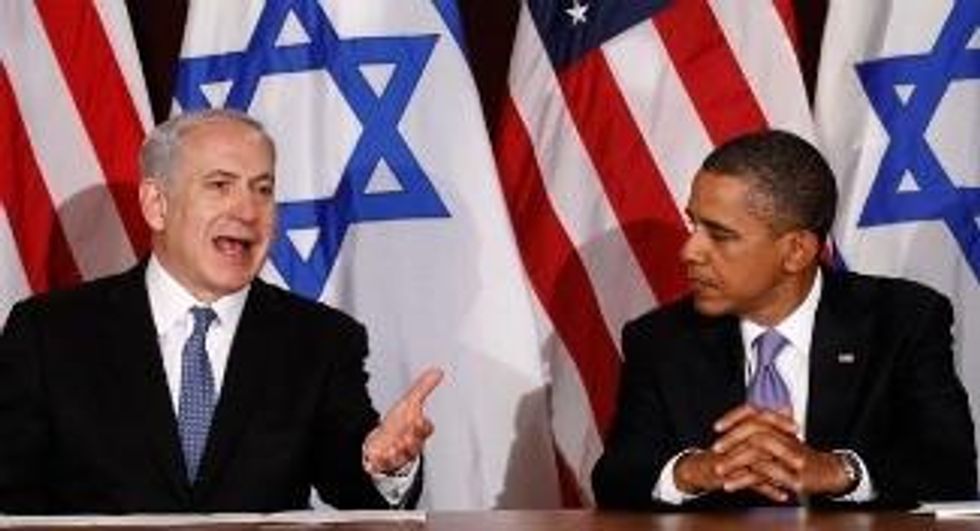
Speaking before students at Northern Virginia Community College on February 13, President Obama unveiled his 2013 budget request, in which he proposed "some difficult cuts that, frankly, I wouldn't normally make if they weren't absolutely necessary. But they are." These budget cuts are unavoidable, the President argued, because "the truth is we're going to have to make some tough choices in order to put this country back on a more sustainable fiscal path." In a sad commentary on the misplaced priorities of the Obama Administration, however, these "tough choices" will affect the delivery of basic services to U.S. citizens while the Israeli military hits the jackpot at taxpayer expense.
As part of its budget request, the White House released a 205-page document detailing the cuts, consolidations, and savings the Obama Administration is proposing. These proposed cuts include $5 million to the USDA to analyze food-borne pathogens, potentially making the U.S. food supply even less safe than it already is after 30 people died last year after eating listeria-infected cantaloupe; a $359 million cut to the EPA to provide grants to states for water infrastructure projects when an estimated 1.7 million Americans shockingly lack access to basic water and sanitation services according to the Water Infrastructure Network; and a whopping $360 billion cut over ten years in Medicare, Medicaid, and other health programs even though the World Health Organization rates the U.S. health system as only 37th globally in health care performance.
Given these "difficult cuts" to the budget, it is easy to agree with Israeli journalist Ran Dagoni, who wrote last year in the Israeli business newspaper Globes, that "The time has come to bid goodbye to the military aid that the US extends to Israel, that generous package..that enables the Israeli taxpayer to share the cost of procuring equipment for the IDF [Israel Defense Forces] with the US taxpayer." After all, Israel - the 28th wealthiest country in the world in 2011, with a per capita gross domestic product greater than Korea and Saudi Arabia according to the International Monetary Fund - hardly needs U.S. charity more than we need safe food, clean water, and health care.
Yet, instead of reducing or even just freezing levels of U.S. military aid to Israel, President Obama wants to provide Israel with $3.1 billion of U.S. taxpayer-funded weapons next year, an increase from $3.075 billion in 2012, making the State Department's claim that this budget request "maintains last year's record funding levels" for Israel both immodest and inaccurate. By comparison, of the nine other Near Eastern countries receiving U.S. military aid, the budget request for eight of them is unchanged from last year's budget while the request for Tunisia declined.
Were Israel using these weapons for legitimate purposes and to further U.S. foreign policy objectives, then perhaps a persuasive case could be constructed for why the United States does not need to make any budgetary "tough choices" when it comes to Israel. However, Israel misuses U.S. weapons, in violation of U.S. laws, to commit grave and systematic human rights abuses against Palestinians in furtherance of its 44-year military occupation of the Palestinian West Bank, East Jerusalem, and Gaza Strip and its illegal colonization of the West Bank and East Jerusalem. From 2000 to 2009, the United States provided Israel with more than $24 billion of military aid and delivered more than 670 million weapons, rounds of ammunition, and related military equipment. During that same period, according to the Israeli human rights organization B'Tselem, Israel killed at least 2,969 Palestinians "who did not take part in the hostilities and were killed by Israeli security forces (not including the objects of targeted killings)."
Israel often kills Palestinians with these same U.S. weapons provided at taxpayer expense. Such was likely the case last December when an Israeli soldier fired a high-velocity tear gas canister at 28-year-old Mustafa Tamimi, a resident of the West Bank village of Nabi Saleh, who was protesting against Israeli settlers seizing land on which his village's natural spring is located. The canister, fired from an Israeli armored vehicle, struck the activist in the face. He died the next day from his wounds. Strong evidence exists that the tear gas canister that killed Mustafa was made by Combined Systems, Inc. of Jamestown, Pennsylvania and likely could have been one of more than 595,000 tear gas canisters and other "riot control" equipment, valued at more than $20.5 million, which were funded by U.S. taxpayers and given to the Israeli military between 2000 and 2009.
Not only does U.S. military aid to Israel make U.S. taxpayers complicit in Israel's human rights abuses of Palestinians; it also acts as a disincentive for Israel to work in tandem with the Obama Administration to achieve stated U.S. foreign policy goals of freezing Israeli settlement expansion, ending Israeli military occupation, and establishing a Palestinian state and a just and lasting Israeli-Palestinian peace.
The United States cannot afford the moral and economic costs of providing ever-increasing amounts of U.S. taxpayer-funded weapons to Israel. In this era of "tough choices" for the budget, here is a clear-cut example of a subsidy that should be ended.
Speaking before students at Northern Virginia Community College on February 13, President Obama unveiled his 2013 budget request, in which he proposed "some difficult cuts that, frankly, I wouldn't normally make if they weren't absolutely necessary. But they are." These budget cuts are unavoidable, the President argued, because "the truth is we're going to have to make some tough choices in order to put this country back on a more sustainable fiscal path." In a sad commentary on the misplaced priorities of the Obama Administration, however, these "tough choices" will affect the delivery of basic services to U.S. citizens while the Israeli military hits the jackpot at taxpayer expense.
As part of its budget request, the White House released a 205-page document detailing the cuts, consolidations, and savings the Obama Administration is proposing. These proposed cuts include $5 million to the USDA to analyze food-borne pathogens, potentially making the U.S. food supply even less safe than it already is after 30 people died last year after eating listeria-infected cantaloupe; a $359 million cut to the EPA to provide grants to states for water infrastructure projects when an estimated 1.7 million Americans shockingly lack access to basic water and sanitation services according to the Water Infrastructure Network; and a whopping $360 billion cut over ten years in Medicare, Medicaid, and other health programs even though the World Health Organization rates the U.S. health system as only 37th globally in health care performance.
Given these "difficult cuts" to the budget, it is easy to agree with Israeli journalist Ran Dagoni, who wrote last year in the Israeli business newspaper Globes, that "The time has come to bid goodbye to the military aid that the US extends to Israel, that generous package..that enables the Israeli taxpayer to share the cost of procuring equipment for the IDF [Israel Defense Forces] with the US taxpayer." After all, Israel - the 28th wealthiest country in the world in 2011, with a per capita gross domestic product greater than Korea and Saudi Arabia according to the International Monetary Fund - hardly needs U.S. charity more than we need safe food, clean water, and health care.
Yet, instead of reducing or even just freezing levels of U.S. military aid to Israel, President Obama wants to provide Israel with $3.1 billion of U.S. taxpayer-funded weapons next year, an increase from $3.075 billion in 2012, making the State Department's claim that this budget request "maintains last year's record funding levels" for Israel both immodest and inaccurate. By comparison, of the nine other Near Eastern countries receiving U.S. military aid, the budget request for eight of them is unchanged from last year's budget while the request for Tunisia declined.
Were Israel using these weapons for legitimate purposes and to further U.S. foreign policy objectives, then perhaps a persuasive case could be constructed for why the United States does not need to make any budgetary "tough choices" when it comes to Israel. However, Israel misuses U.S. weapons, in violation of U.S. laws, to commit grave and systematic human rights abuses against Palestinians in furtherance of its 44-year military occupation of the Palestinian West Bank, East Jerusalem, and Gaza Strip and its illegal colonization of the West Bank and East Jerusalem. From 2000 to 2009, the United States provided Israel with more than $24 billion of military aid and delivered more than 670 million weapons, rounds of ammunition, and related military equipment. During that same period, according to the Israeli human rights organization B'Tselem, Israel killed at least 2,969 Palestinians "who did not take part in the hostilities and were killed by Israeli security forces (not including the objects of targeted killings)."
Israel often kills Palestinians with these same U.S. weapons provided at taxpayer expense. Such was likely the case last December when an Israeli soldier fired a high-velocity tear gas canister at 28-year-old Mustafa Tamimi, a resident of the West Bank village of Nabi Saleh, who was protesting against Israeli settlers seizing land on which his village's natural spring is located. The canister, fired from an Israeli armored vehicle, struck the activist in the face. He died the next day from his wounds. Strong evidence exists that the tear gas canister that killed Mustafa was made by Combined Systems, Inc. of Jamestown, Pennsylvania and likely could have been one of more than 595,000 tear gas canisters and other "riot control" equipment, valued at more than $20.5 million, which were funded by U.S. taxpayers and given to the Israeli military between 2000 and 2009.
Not only does U.S. military aid to Israel make U.S. taxpayers complicit in Israel's human rights abuses of Palestinians; it also acts as a disincentive for Israel to work in tandem with the Obama Administration to achieve stated U.S. foreign policy goals of freezing Israeli settlement expansion, ending Israeli military occupation, and establishing a Palestinian state and a just and lasting Israeli-Palestinian peace.
The United States cannot afford the moral and economic costs of providing ever-increasing amounts of U.S. taxpayer-funded weapons to Israel. In this era of "tough choices" for the budget, here is a clear-cut example of a subsidy that should be ended.
Speaking before students at Northern Virginia Community College on February 13, President Obama unveiled his 2013 budget request, in which he proposed "some difficult cuts that, frankly, I wouldn't normally make if they weren't absolutely necessary. But they are." These budget cuts are unavoidable, the President argued, because "the truth is we're going to have to make some tough choices in order to put this country back on a more sustainable fiscal path." In a sad commentary on the misplaced priorities of the Obama Administration, however, these "tough choices" will affect the delivery of basic services to U.S. citizens while the Israeli military hits the jackpot at taxpayer expense.
As part of its budget request, the White House released a 205-page document detailing the cuts, consolidations, and savings the Obama Administration is proposing. These proposed cuts include $5 million to the USDA to analyze food-borne pathogens, potentially making the U.S. food supply even less safe than it already is after 30 people died last year after eating listeria-infected cantaloupe; a $359 million cut to the EPA to provide grants to states for water infrastructure projects when an estimated 1.7 million Americans shockingly lack access to basic water and sanitation services according to the Water Infrastructure Network; and a whopping $360 billion cut over ten years in Medicare, Medicaid, and other health programs even though the World Health Organization rates the U.S. health system as only 37th globally in health care performance.
Given these "difficult cuts" to the budget, it is easy to agree with Israeli journalist Ran Dagoni, who wrote last year in the Israeli business newspaper Globes, that "The time has come to bid goodbye to the military aid that the US extends to Israel, that generous package..that enables the Israeli taxpayer to share the cost of procuring equipment for the IDF [Israel Defense Forces] with the US taxpayer." After all, Israel - the 28th wealthiest country in the world in 2011, with a per capita gross domestic product greater than Korea and Saudi Arabia according to the International Monetary Fund - hardly needs U.S. charity more than we need safe food, clean water, and health care.
Yet, instead of reducing or even just freezing levels of U.S. military aid to Israel, President Obama wants to provide Israel with $3.1 billion of U.S. taxpayer-funded weapons next year, an increase from $3.075 billion in 2012, making the State Department's claim that this budget request "maintains last year's record funding levels" for Israel both immodest and inaccurate. By comparison, of the nine other Near Eastern countries receiving U.S. military aid, the budget request for eight of them is unchanged from last year's budget while the request for Tunisia declined.
Were Israel using these weapons for legitimate purposes and to further U.S. foreign policy objectives, then perhaps a persuasive case could be constructed for why the United States does not need to make any budgetary "tough choices" when it comes to Israel. However, Israel misuses U.S. weapons, in violation of U.S. laws, to commit grave and systematic human rights abuses against Palestinians in furtherance of its 44-year military occupation of the Palestinian West Bank, East Jerusalem, and Gaza Strip and its illegal colonization of the West Bank and East Jerusalem. From 2000 to 2009, the United States provided Israel with more than $24 billion of military aid and delivered more than 670 million weapons, rounds of ammunition, and related military equipment. During that same period, according to the Israeli human rights organization B'Tselem, Israel killed at least 2,969 Palestinians "who did not take part in the hostilities and were killed by Israeli security forces (not including the objects of targeted killings)."
Israel often kills Palestinians with these same U.S. weapons provided at taxpayer expense. Such was likely the case last December when an Israeli soldier fired a high-velocity tear gas canister at 28-year-old Mustafa Tamimi, a resident of the West Bank village of Nabi Saleh, who was protesting against Israeli settlers seizing land on which his village's natural spring is located. The canister, fired from an Israeli armored vehicle, struck the activist in the face. He died the next day from his wounds. Strong evidence exists that the tear gas canister that killed Mustafa was made by Combined Systems, Inc. of Jamestown, Pennsylvania and likely could have been one of more than 595,000 tear gas canisters and other "riot control" equipment, valued at more than $20.5 million, which were funded by U.S. taxpayers and given to the Israeli military between 2000 and 2009.
Not only does U.S. military aid to Israel make U.S. taxpayers complicit in Israel's human rights abuses of Palestinians; it also acts as a disincentive for Israel to work in tandem with the Obama Administration to achieve stated U.S. foreign policy goals of freezing Israeli settlement expansion, ending Israeli military occupation, and establishing a Palestinian state and a just and lasting Israeli-Palestinian peace.
The United States cannot afford the moral and economic costs of providing ever-increasing amounts of U.S. taxpayer-funded weapons to Israel. In this era of "tough choices" for the budget, here is a clear-cut example of a subsidy that should be ended.